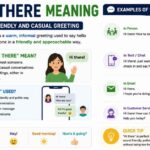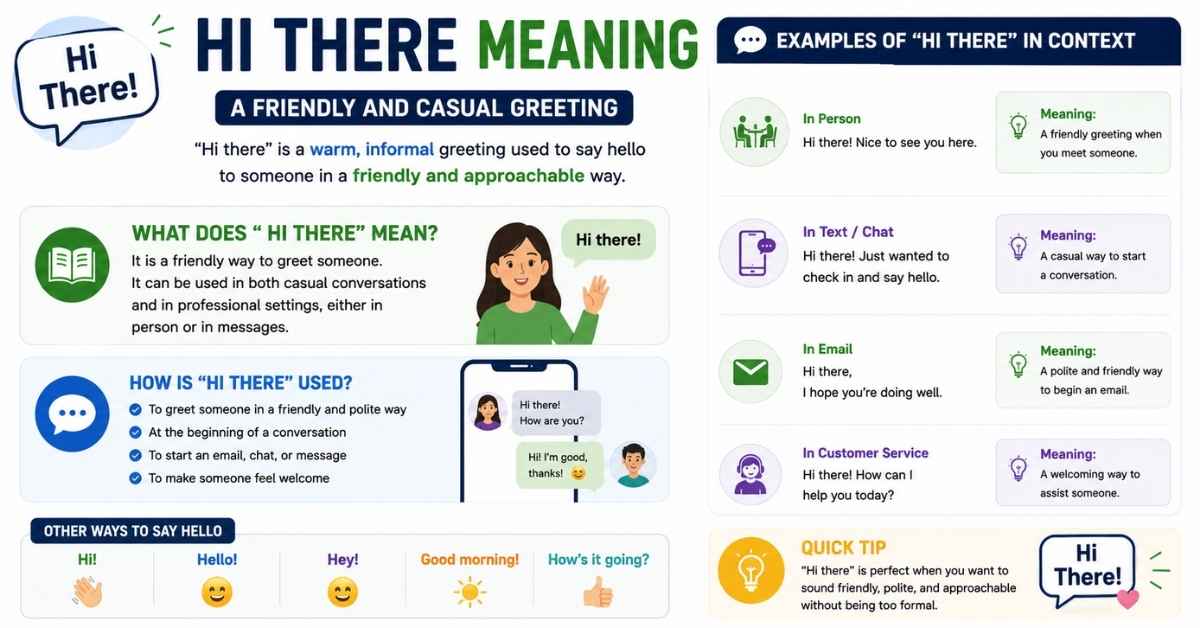
hi there is a friendly, informal greeting used in everyday English to say hello in a warm and approachable way. It is commonly used in conversations, messaging, emails, and customer service interactions where the speaker wants to sound polite, casual, and welcoming without being too formal.
At its core, “hi there” is a variation of a basic greeting Greeting that signals openness and friendliness. It does not carry deep literal meaning; instead, it functions as a social connector that helps start conversations smoothly and comfortably.
What “Hi There” Really Means in Communication
In modern communication, “hi there” belongs to the category of phatic expressions—words used not to transfer information, but to build social connection.
It is closely related to:
- “Hi”
- “Hello”
- “Hey there”
- “Hello there”
Unlike simple greetings, “hi there” adds a subtle emotional layer of warmth and friendliness, making it feel more personal.
In terms of communication science, it functions within interpersonal communication systems Interpersonal Communication where the goal is not information exchange, but relationship building.
Why People Say “Hi There” Instead of Just “Hi”
People naturally adjust greetings based on tone, relationship, and emotional intent.
1. To sound more welcoming
“Hi there” feels more open and friendly than “hi” alone.
2. To soften the conversation start
It reduces abruptness in digital communication like chats and emails.
3. To create emotional warmth
It signals friendliness and approachability.
In social interaction, greetings act as relationship signals that define distance and tone between speakers.
The Emotional Tone Behind “Hi There”
The emotional meaning of “hi there” depends heavily on context.
Friendly and approachable
It often signals positive intent and openness.
Casual but respectful
It sits between formal “hello” and informal “hey”.
Slightly personal
The word “there” adds a subtle sense of addressing the person directly, making it feel more engaging.
From a psychological perspective, greetings influence first impressions and help establish trust within seconds.
What Message “Hi There” Sends About You
When you use “hi there,” you are indirectly communicating:
In personal conversations
You are friendly and easy to talk to.
In professional settings
You are polite but not overly formal.
In customer service
You are approachable and supportive.
In digital communication
You are conversational and human-like.
In communication theory, this aligns with tone signaling, where small language choices shape perception more than actual content.
Is “Hi There” Professional?
The answer depends entirely on context and audience.
When it works professionally
- Customer support chats
- Internal team messages
- Friendly workplace emails
- Startup or casual environments
When it may not work
- Legal communication
- Government correspondence
- Formal business proposals
- Executive-level outreach
In professional communication systems Business Communication, tone must match hierarchy and formality expectations.
Can You Use “Hi There” in Emails?
Yes—but strategically.
First-time emails
✔ Works if tone is friendly or networking-focused ✘ Avoid in strict corporate or legal contexts
Client communication
✔ Good for long-term friendly relationships
Job applications
✘ Better to use “Dear” or “Hello”
Example usage
- “Hi there, I hope you’re doing well…”
- “Hi there, I wanted to follow up on…”
Email greetings are part of email etiquette systems Email Etiquette that shape credibility and tone perception.
“Hi There” in Text Messages and Social Media
Friends and acquaintances
Very natural and commonly used.
Group chats
Works as a soft attention grabber.
Social media DMs
Feels friendly without being too direct.
LinkedIn messages
Can work, but depends on industry tone.
Digital messaging is part of modern online communication behavior Digital Communication where tone substitutes body language.
Why Brands and Companies Use “Hi There”
Businesses use “hi there” strategically to:
Build instant trust
Friendly tone reduces friction.
Humanize automation
Makes chatbot responses feel less robotic.
Improve customer engagement
Warm greetings increase response rates.
This is common in customer service communication systems Customer Service Communication where emotional tone directly affects user satisfaction.
Why AI Assistants Use “Hi There”
AI systems often use “hi there” because:
- It feels neutral and friendly
- It reduces perceived formality
- It improves conversational flow
- It mimics human interaction patterns
In AI design, this is part of conversational UX principles Human Computer Interaction.
When You Should Avoid Saying “Hi There”
Avoid using it in:
Formal legal writing
Too casual
Academic papers
Not appropriate tone
Executive communication
May seem unprofessional
Sensitive conversations
Can feel dismissive
Real-Life Examples of “Hi There”
Workplace
“Hi there, can you review this report?”
Customer support
“Hi there! How can I help you today?”
Networking
“Hi there, I came across your profile…”
Social media
“Hi there 😊 thanks for connecting!”
Dating apps
“Hi there, how’s your day going?”
Each usage depends on relationship distance and emotional intent.
How Native Speakers Interpret “Hi There”
American English
Common in casual communication and customer service.
British English
Slightly less common but still understood.
Australian English
Very casual and friendly tone.
Canadian English
Widely used in both personal and professional casual contexts.
Native interpretation depends on social context rather than grammar rules.
Hi There vs Other Greetings
Hi vs Hi There
- Hi → neutral
- Hi there → warmer
Hello vs Hi There
- Hello → neutral/formal
- Hi there → friendly/casual
Hey There vs Hi There
- Hey there → more informal
- Hi there → balanced tone
Greetings vs Hi There
- Greetings → formal
- Hi there → conversational
Greeting Tone Scale
| Greeting | Warmth | Formality |
|---|---|---|
| Greetings | Low | High |
| Hello | Medium | Medium |
| Hi | Medium | Low |
| Hi There | High | Low |
| Hey There | Very High | Very Low |
The Psychology of “Hi There”
Greetings influence:
1. First impressions
People decide tone within seconds.
2. Trust formation
Friendly greetings increase perceived openness.
3. Social distance
Words signal how close or distant relationships are.
From a psychological perspective, this relates to social bonding mechanisms in communication behavior.
Common Mistakes With “Hi There”
Using it in overly formal contexts
Can reduce professionalism.
Misreading tone
It is friendly—not romantic by default.
Overusing it in business emails
Can feel repetitive.
Assuming universal interpretation
Cultural context matters.
Frequently Asked Questions
What does “hi there” mean?
It is a friendly, informal greeting used to start conversations.
Is “hi there” formal or informal?
It is informal to semi-formal.
Is “hi there” professional?
Yes, in casual professional environments, but not formal settings.
Is “hi there” rude?
No, it is generally polite and friendly.
Is “hi there” flirty?
Not inherently, but context can make it sound playful.
Can I use “hi there” in emails?
Yes, in informal or friendly communication.
Why do people say “hi there”?
To sound more warm, friendly, and approachable.
What is the difference between “hi” and “hi there”?
“Hi there” feels more personal and engaging.
Final Takeaway
“hi there” is more than a greeting—it is a social tone marker that shapes how people perceive friendliness, openness, and emotional intent in both digital and real-world communication.
It works best when you want to sound:
- Warm
- Approachable
- Human
- Non-intimidating
But it should be avoided when communication demands:
- High formality
- Legal precision
- Executive authority
In modern digital communication, mastering small greetings like “hi there” is not just language—it is psychological positioning and relationship engineering in real time.