Juneteenth colors meaning refers to the symbolism behind the red, white, and blue colors featured on the Juneteenth flag, a powerful symbol of freedom, emancipation, and African American heritage. These colors represent resilience, hope, unity, perseverance, and the ongoing journey toward equality. While many people recognize the colors, fewer understand the deeper historical significance connected to Juneteenth, the celebration commemorating the end of slavery in the United States.
As interest in Juneteenth celebrations, Juneteenth flag meaning, and African American history continues to grow, many people want to understand not only what the colors are but also why they matter. Whether you’re attending a community event, creating educational materials, decorating for a celebration, or simply learning more about the holiday, understanding the symbolism behind these colors helps connect the visual elements of Juneteenth to its powerful historical story.
Quick Answer: What Do the Juneteenth Colors Mean?
The official Juneteenth colors are:
- Red
- White
- Blue
These colors appear on the Juneteenth flag and symbolize:
| Color | Meaning |
|---|---|
| Red | Strength, sacrifice, resilience, and cultural remembrance |
| White | Freedom, hope, and new beginnings |
| Blue | Unity, perseverance, and inclusion in the American story |
Together, these colors represent the significance of freedom and the enduring contributions of African Americans to the United States.
Why the Meaning of Juneteenth Colors Matters
Many people search for what do Juneteenth colors mean because they want more than a simple definition. They want to understand the story behind the symbols.
Colors play an important role in cultural celebrations because they communicate ideas without words. In the case of Juneteenth, the colors help tell a story about emancipation, perseverance, freedom, and community identity.
For many families and communities, Juneteenth is not simply a holiday. It is a day of remembrance, reflection, education, and celebration. The colors serve as visual reminders of that history.
Understanding the symbolism also helps people participate respectfully in Juneteenth events rather than viewing the colors as simple decorations.
The Story Behind the Juneteenth Flag
To understand the meaning of Juneteenth colors, it’s important to first understand the Juneteenth flag itself.
The flag was created to represent the freedom of African Americans following emancipation and to provide a unifying symbol for Juneteenth celebrations across the country.
Unlike many historical flags, the Juneteenth flag was designed specifically to celebrate freedom and national inclusion.
Who Created the Juneteenth Flag?
The modern Juneteenth flag was created by Ben Haith, often known as the “Juneteenth Flag Father.”
Working alongside collaborators including Lisa Jeanne Graf, Haith sought to create a symbol that would represent freedom, resilience, and the national significance of Juneteenth.
The design has evolved over time, but its core symbolism remains unchanged.
How the Flag Became a National Symbol
As Juneteenth celebrations spread across the United States, the flag gained recognition as a visual representation of the holiday.
When Juneteenth became a federal holiday in 2021, public awareness of the flag and its symbolism increased dramatically.
Today, the flag appears at:
- Community celebrations
- Educational events
- Government buildings
- Museums
- Cultural festivals
- Family gatherings
What Each Juneteenth Color Represents
While the colors may appear simple at first glance, each carries multiple layers of symbolism connected to freedom, heritage, and American identity.
The Meaning of Red on the Juneteenth Flag
The color red is one of the most significant elements of Juneteenth celebrations.
It often symbolizes:
- Strength
- Resilience
- Sacrifice
- Cultural memory
Many historians and cultural educators also connect red to long-standing traditions within African American communities.
Red appears frequently in Juneteenth celebrations through:
- Red velvet cake
- Strawberry beverages
- Hibiscus drinks
- Watermelon dishes
- Fruit punches
These traditions serve as reminders of endurance, survival, and cultural continuity.
The Meaning of White on the Juneteenth Flag
The color white represents:
- Freedom
- Hope
- New beginnings
- Opportunity
Following emancipation, freedom represented more than a legal change. It symbolized the possibility of building a new future.
The white portions of the Juneteenth flag reflect optimism and the promise of progress for future generations.
The Meaning of Blue on the Juneteenth Flag
The color blue symbolizes:
- Unity
- Perseverance
- Citizenship
- Inclusion
Blue reinforces the idea that African Americans are an inseparable part of the American story.
It reflects the belief that freedom should extend to every citizen and that the journey toward equality continues.
The Hidden Meaning Behind the Flag’s Other Symbols
Many articles focus only on colors, but the flag contains several additional symbols that help explain its deeper message.
What the Star Represents
The white star at the center of the Juneteenth flag has multiple meanings.
First, it acknowledges Galveston, where news of emancipation finally reached enslaved African Americans on June 19, 1865.
Second, the star symbolizes freedom spreading across all fifty states.
The star serves as a reminder that Juneteenth is not only a Texas story but an American story.
What the Burst Represents
The starburst surrounding the central star symbolizes a new beginning.
It reflects:
- The arrival of freedom
- The end of slavery
- Expanding opportunities
Many interpret the burst as a visual representation of freedom radiating outward.
What the Arc Represents
The curved line running across the flag represents a horizon.
This horizon symbolizes:
- Progress
- Possibility
- A future beyond oppression
Together, the star, burst, and arc transform the flag into a narrative of hope and advancement.
Why the Juneteenth Flag Uses Red, White, and Blue
One of the most frequently asked questions is:
Why are Juneteenth colors red, white, and blue?
The answer surprises many people.
The colors were intentionally chosen because they mirror the colors of the American flag.
This design choice communicates a powerful message:
African Americans are not separate from the American story. They are an essential part of it.
The flag emphasizes that freedom and citizenship belong to all Americans.
Rather than creating distance, the color scheme highlights inclusion, equality, and shared national identity.
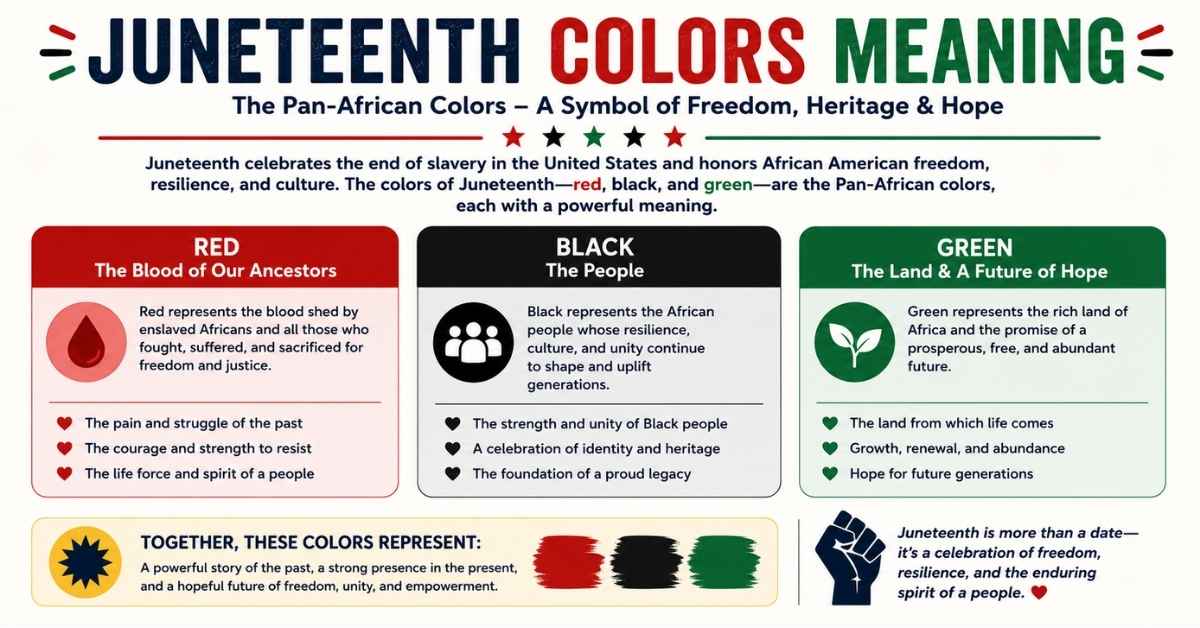
Juneteenth Colors vs. Pan-African Colors
Perhaps the biggest source of confusion surrounding Juneteenth symbolism involves the difference between Juneteenth colors and Pan-African colors.
Many people assume they are the same. They are not.
Understanding the Pan-African Flag
The Pan-African flag uses:
- Red
- Black
- Green
Created by the Marcus Garvey and the Universal Negro Improvement Association, the flag represents global African heritage and unity.
Key Differences Between the Two Color Systems
| Juneteenth Colors | Pan-African Colors |
|---|---|
| Red, White, Blue | Red, Black, Green |
| Focus on emancipation and freedom | Focus on African heritage and identity |
| Represents Juneteenth celebrations | Represents Pan-African unity |
| Connected to the Juneteenth flag | Connected to the Pan-African movement |
Can Both Be Used During Juneteenth Celebrations?
Yes.
Many communities incorporate both symbols into Juneteenth events.
The two color systems represent different but complementary aspects of African American history and cultural identity.
How Communities Use Juneteenth Colors Today
The meaning of Juneteenth colors extends far beyond the flag itself. Across the United States, communities use these colors to celebrate freedom, honor African American history, and educate future generations.
At modern Juneteenth events, you’ll often see red, white, and blue decorations, clothing, banners, educational displays, and cultural exhibits. These colors help create a shared visual identity that connects people to the holiday’s historical significance.
Public Celebrations and Festivals
Many Juneteenth festivals feature:
- Red, white, and blue stage decorations
- Community parades
- Cultural performances
- Educational exhibits
- Historical presentations
The colors serve as visual reminders of emancipation, freedom, and resilience.
Schools and Educational Programs
Teachers increasingly use Juneteenth colors to help students understand:
- The history of slavery
- The significance of emancipation
- African American contributions
- The meaning of freedom
Color symbolism provides an accessible way for students to connect with historical concepts.
Community Organizations
Nonprofits, museums, and cultural organizations often incorporate Juneteenth colors into:
- Awareness campaigns
- Educational workshops
- Heritage celebrations
- Community outreach programs
These visual symbols help reinforce the holiday’s educational mission.
What Colors Should You Wear on Juneteenth?
One of the most common questions people ask is:
“What colors should you wear on Juneteenth?”
While there is no strict dress code, many people choose clothing that reflects the holiday’s symbolism.
Traditional Choices
The most common options include:
- Red shirts
- White dresses
- Blue accessories
- Juneteenth-themed apparel
Wearing these colors is a way to show support, awareness, and appreciation for the holiday.
Pan-African Color Combinations
Some participants choose:
- Red
- Black
- Green
These colors represent Pan-African heritage and are frequently seen at Juneteenth events.
Community-Based Preferences
Different communities celebrate differently. Some emphasize the official Juneteenth flag colors, while others incorporate Pan-African symbolism.
Both approaches can be meaningful when used respectfully and with an understanding of their historical significance.
How Juneteenth Colors Appear in Decorations and Design
The symbolism of Juneteenth colors also plays an important role in event planning, graphic design, and community celebrations.
Event Decorations
Popular decoration ideas include:
- Banners
- Table settings
- Balloons
- Flags
- Posters
- Backdrops
These elements help create a visual connection to the holiday’s message.
Social Media Graphics
As Juneteenth awareness grows, many organizations create social media content using symbolic color palettes.
Effective designs often incorporate:
- The Juneteenth flag
- Freedom-themed imagery
- Historical references
- Educational messaging
The goal is not simply decoration but meaningful storytelling.
Educational Materials
Schools and museums frequently use color symbolism in:
- Infographics
- Classroom posters
- Historical timelines
- Interactive displays
Visual learning tools often help audiences understand complex historical topics more effectively.
The Connection Between Juneteenth Colors and Food Traditions
One of the most overlooked aspects of Juneteenth celebrations is the role of red foods.
While many people understand the meaning of the Juneteenth flag, fewer realize how food traditions connect to cultural symbolism.
Why Red Foods Are Important
In many African American communities, red foods symbolize:
- Strength
- Sacrifice
- Resilience
- Cultural continuity
The tradition has roots in West African culinary practices and has evolved over generations.
Common Juneteenth Foods
Popular Juneteenth foods include:
- Red velvet cake
- Strawberry soda
- Fruit punch
- Watermelon
- Strawberries
- Hibiscus tea
- Barbecue dishes
These foods have become recognizable symbols of Juneteenth celebrations.
The Cultural Meaning Behind Food Traditions
Food serves as more than nourishment during Juneteenth.
It helps preserve:
- Family traditions
- Community connections
- Historical memory
- Cultural identity
This is one reason red remains such a powerful color in Juneteenth observances.
What Juneteenth Colors Mean to Different Generations
The symbolism of Juneteenth continues to evolve.
While the core message remains freedom and remembrance, different generations may interpret the colors in unique ways.
Historical Perspective
Older generations often view the colors through the lens of:
- Civil rights struggles
- Community resilience
- Historical remembrance
For many families, Juneteenth celebrations have been passed down for decades.
Modern Perspective
Younger generations frequently engage with Juneteenth through:
- Social media
- Educational programs
- Community events
- Cultural awareness campaigns
The colors remain relevant because they connect historical lessons to contemporary discussions about equality and representation.
Why the Symbolism Continues to Matter
The continued use of Juneteenth colors demonstrates how symbols help preserve collective memory.
They provide a visual language that communicates freedom, hope, and perseverance across generations.
LEARN MORE: Meh Meaning in Text
Common Misunderstandings About Juneteenth Colors
Several myths continue to circulate online.
Understanding the facts helps prevent confusion.
Myth: Juneteenth Colors Are the Same as Black History Month Colors
Not exactly.
Many people associate Black History Month with the Pan-African colors:
- Red
- Black
- Green
The official Juneteenth flag uses:
- Red
- White
- Blue
The two systems have different origins and meanings.
Myth: The Juneteenth Flag Copies the American Flag
The similarity is intentional.
The colors were chosen to communicate inclusion and citizenship, not imitation.
The message is that African Americans are part of the American story.
Myth: The Colors Have No Historical Meaning
Every element of the Juneteenth flag was carefully chosen to represent freedom, progress, and national belonging.
Myth: Only One Color System Is Correct
Both Juneteenth colors and Pan-African colors hold significance within African American history.
They simply represent different traditions and historical perspectives.
Expert Insights: Why Symbols Matter in Freedom Celebrations
Throughout history, communities have used symbols to preserve stories, values, and shared experiences.
Juneteenth colors perform a similar function.
They help communicate ideas that may be difficult to express through words alone.
Colors Preserve Historical Memory
Visual symbols can often make history more accessible.
A person may not immediately recall specific dates or events, but they may remember the symbolism attached to colors and flags.
Symbols Create Community Identity
Shared symbols help unite people around common values.
For Juneteenth, those values include:
- Freedom
- Equality
- Resilience
- Progress
Symbols Encourage Education
Many people first learn about Juneteenth through its flag and colors.
These visual elements often spark deeper curiosity about African American history.
How to Explain Juneteenth Colors to Children
Teaching Juneteenth to children becomes easier when symbolism is simplified.
A Child-Friendly Explanation
You can explain the colors this way:
- Red reminds us to be strong and remember those who struggled for freedom.
- White reminds us of hope and new opportunities.
- Blue reminds us that everyone belongs and deserves equal freedom.
Using Stories and Visuals
Children often learn best through:
- Storytelling
- Flag illustrations
- Color activities
- Historical timelines
Interactive learning helps make the holiday more meaningful.
Family Discussion Guide
Questions parents can ask include:
- Why is freedom important?
- What does hope mean?
- Why do communities celebrate history?
- How can we learn from the past?
These conversations help children connect historical events to modern values.
Frequently Asked Questions
What Do Juneteenth Colors Mean?
The official Juneteenth colors are red, white, and blue. They symbolize resilience, freedom, hope, unity, and progress.
Why Are Juneteenth Colors Red, White, and Blue?
The colors were chosen to connect African American freedom with the broader American story and the ideals of citizenship.
What Does the Juneteenth Flag Symbolize?
The flag represents freedom, emancipation, new beginnings, and national inclusion.
Who Created the Juneteenth Flag?
The flag was created by Ben Haith with contributions from Lisa Jeanne Graf.
What Does the Juneteenth Star Mean?
The star represents Texas, where Juneteenth originated, and symbolizes freedom spreading across the nation.
Are Juneteenth Colors the Same as Pan-African Colors?
No. Juneteenth colors are red, white, and blue, while Pan-African colors are red, black, and green.
Why Is Red Important During Juneteenth?
Red symbolizes resilience, sacrifice, cultural memory, and long-standing food traditions.
What Colors Should You Wear on Juneteenth?
Many people wear red, white, and blue clothing or incorporate Pan-African colors depending on community traditions.
Why Does the Flag Look Similar to the American Flag?
The design intentionally emphasizes that African Americans are part of the American story and deserve equal freedom and citizenship.
What Does the Burst on the Flag Mean?
The burst represents a new beginning and the expanding reach of freedom.
What Does the Arc on the Flag Represent?
The arc symbolizes a new horizon and future possibilities.
Can Both Color Systems Be Used During Juneteenth?
Yes. Many communities respectfully incorporate both Juneteenth colors and Pan-African colors into celebrations.
Key Takeaways: Understanding the Meaning Behind Juneteenth Colors
The Juneteenth colors meaning goes far beyond aesthetics. The official colors—red, white, and blue—reflect the themes of freedom, resilience, hope, unity, and progress that define Juneteenth. Through the Juneteenth flag, these colors tell a powerful story about emancipation, citizenship, and the ongoing pursuit of equality.
Understanding the symbolism behind the colors helps deepen appreciation for Juneteenth celebrations, African American heritage, and the historical significance of June 19, 1865. Whether seen on flags, clothing, decorations, educational materials, or community events, these colors continue to serve as enduring reminders of freedom, perseverance, and the importance of remembering the past while building a better future.