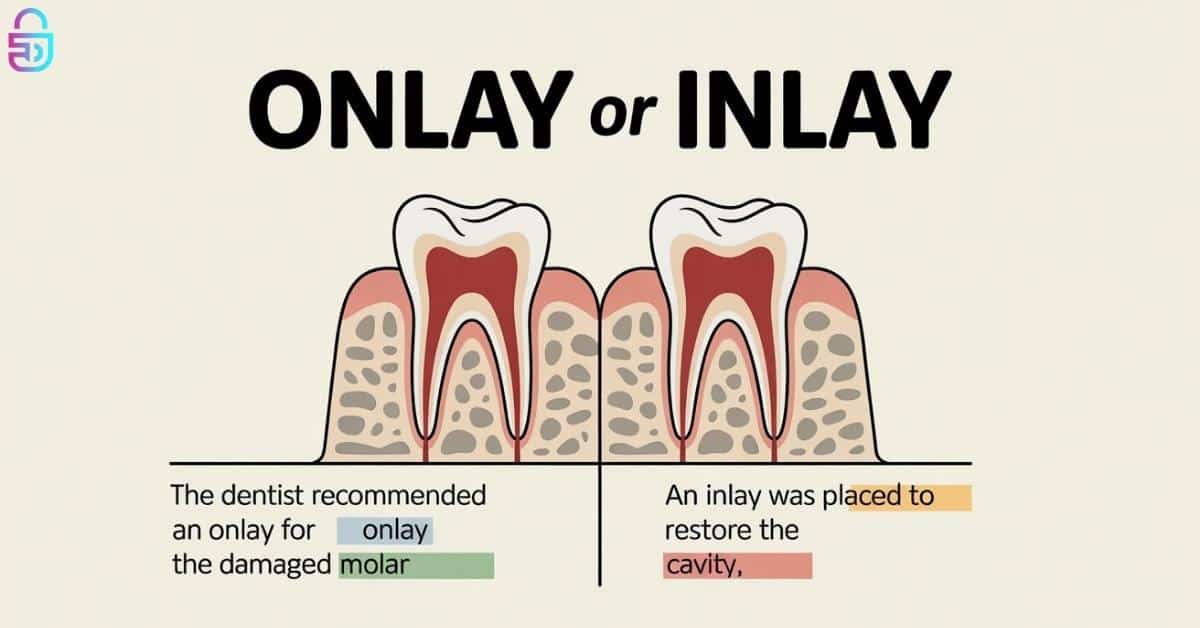
Onlay or inlay is a common dental comparison patients search when they are dealing with tooth decay or damage and want to understand the best restoration option. In simple terms, an inlay is used when damage is limited to the inner part of a tooth, while an onlay is recommended when the damage extends to one or more cusps of the tooth.
Both are indirect restorations used in restorative dentistry, designed to preserve more natural tooth structure compared to crowns. This guide explains the difference between inlay and onlay, including cost, procedure, durability, and which option is better depending on your dental condition.
If you are confused between onlay vs inlay, this article will give you a clear, decision-based understanding so you can confidently discuss treatment options with your dentist.
What is a Dental Inlay?
A dental inlay is a custom-made restoration used to repair a tooth that has mild to moderate decay or damage, typically inside the grooves of the tooth without affecting the outer cusps. Inlays are a part of indirect fillings, meaning they are fabricated in a dental lab and then bonded into place.
Inlays are commonly made from porcelain, composite resin, or gold, depending on strength and aesthetic needs. Among restorative dentistry options, inlays are considered more conservative because they preserve most of the natural tooth structure.
Dentists usually recommend inlays when:
- The cavity is too large for a regular filling
- The tooth cusps are still strong and intact
- You need a long-lasting alternative to dental fillings
In simple terms, an inlay is the middle ground between a filling and a crown.
What is a Dental Onlay?
A dental onlay is a more extensive restoration than an inlay. It covers not only the inner surface of the tooth but also extends over one or more cusps. This is why onlays are sometimes called a partial crown.
Onlays are designed for teeth that are more significantly damaged but still do not require a full crown. They provide strong structural support and are widely used in restorative dentistry treatments.
Onlays are commonly used when:
- A large portion of the tooth is damaged
- Cusps are weakened or fractured
- A crown is not yet necessary but reinforcement is needed
Like inlays, onlays are made from porcelain, ceramic, composite resin, or gold, depending on functional and cosmetic needs.
Onlay vs Inlay: Key Differences
The main confusion patients have is understanding the difference between inlay and onlay, as both look similar in purpose but differ in coverage and strength.
Here is a clear comparison:
| Feature | Inlay | Onlay |
| Coverage Area | Inside the tooth only | Covers one or more cusps |
| Tooth Removal | Minimal | Moderate |
| Strength | Moderate | High |
| Aesthetic Result | Excellent | Excellent |
| Durability | 10–15 years | 15–30 years |
| Use Case | Small to medium decay | Large decay or weak cusps |
The key takeaway is simple: 👉 Inlays preserve more tooth structure 👉 Onlays provide more strength and protection
Onlay or Inlay: Which One Should You Choose?
Choosing between onlay or inlay depends entirely on the condition of your tooth. Dentists evaluate several clinical factors before recommending treatment.
An inlay is preferred when:
- The decay is limited to the inner portion of the tooth
- Tooth cusps are still strong
- Minimal reinforcement is needed
An onlay is preferred when:
- The tooth has large cavities or cracks
- One or more cusps are damaged
- The tooth needs structural reinforcement
In modern dentistry, the decision is often based on tooth preservation and long-term durability, not just cost.
A simplified decision rule used by dentists is:
Small damage → Filling Moderate damage → Inlay Large damage → Onlay Severe damage → Crown
Inlay vs Onlay vs Filling
Understanding inlay vs filling vs onlay helps patients see why indirect restorations are often recommended.
A filling is applied directly into the cavity and is suitable for small decay. However, fillings are less durable under strong chewing pressure.
An inlay is stronger than a filling because it is lab-made and precisely fitted.
An onlay goes even further by protecting the tooth’s outer structure, making it one of the strongest conservative treatments before a crown.
In terms of strength hierarchy:
Filling < Inlay < Onlay < Crown
Inlay vs Onlay vs Crown
Many patients also compare inlay vs onlay vs crown, especially when tooth damage is significant.
A crown covers the entire tooth and is used when the tooth is heavily damaged or weakened.
Here’s the key difference:
- Inlay: Repairs inside the tooth only
- Onlay: Covers part of the tooth including cusps
- Crown: Covers the entire tooth
While crowns provide maximum protection, they require more removal of natural tooth structure. This is why dentists often prefer inlays or onlays as conservative dentistry treatments whenever possible.
Procedure: How Inlays and Onlays Are Done
The procedure for both inlays and onlays is similar and usually requires two visits.
Step 1: The dentist removes decayed or damaged tooth structure and prepares the tooth.
Step 2: A digital scan or impression is taken.
The Step 3: A temporary filling is placed to protect the tooth.
Step 4: The inlay or onlay is fabricated in a dental lab.
Step 5: The final restoration is bonded using dental cement.
This process ensures a precise fit and long-term durability.
Materials Used in Inlays and Onlays
Different materials affect strength, aesthetics, and cost.
- Porcelain: Best for natural appearance
- Composite resin: Affordable and aesthetic
- Gold: Extremely durable and long-lasting
- Ceramic: Strong and highly aesthetic
Porcelain and ceramic are most commonly used today due to their natural tooth-like appearance.
Cost of Onlay vs Inlay
The cost of inlays and onlays depends on material, dentist expertise, and location.
On average:
- Inlay cost: Lower due to smaller coverage
- Onlay cost: Higher due to complexity and size
Factors affecting cost:
- Material used (gold is most expensive)
- Tooth location (molars cost more)
- Dental lab quality
- Insurance coverage
In many cases, insurance partially covers indirect dental restorations, depending on the policy.
Lifespan & Durability
One of the biggest advantages of inlays and onlays is their durability.
- Inlays typically last 10–15 years
- Onlays can last 15–30 years
Factors affecting lifespan include:
- Oral hygiene
- Bite pressure
- Material type
- Dentist skill
Onlays are generally stronger because they reinforce the tooth structure.
Advantages of Inlays
Inlays offer several benefits:
- Preserve natural tooth structure
- Stronger than fillings
- Natural appearance
- Long-lasting solution for moderate decay
They are ideal for patients who want a conservative dental restoration.
Advantages of Onlays
Onlays provide even more protection:
- Reinforce weakened teeth
- Cover damaged cusps
- Prevent further fracture
- High durability and strength
They are especially useful for molars under heavy chewing force.
Pain Level & Recovery Time
A common concern is whether the procedure is painful.
In reality, both inlay and onlay procedures are performed under local anesthesia, so patients feel minimal discomfort.
After treatment:
- Mild sensitivity may occur for a few days
- Normal chewing resumes within a week
- Full adaptation happens quickly
Recovery is generally smooth and fast.
LEARN MORE: Taking vs Taken
Common Mistakes Patients Make
Many patients delay treatment or choose incorrect options.
Common mistakes include:
- Choosing fillings for large cavities
- Ignoring cracked molars
- Delaying restoration until crown is required
- Not understanding inlay vs onlay differences
Early treatment helps preserve natural teeth.
Alternatives to Inlay and Onlay
If damage is severe, alternatives include:
- Dental crowns
- Fillings
- Tooth extraction with implant
- Veneers (cosmetic cases only)
Dentists select based on tooth condition and long-term prognosis.
FAQs
Which is better, onlay or inlay?
It depends on damage level. Inlays are better for small cavities, while onlays are stronger for larger damage.
Is an onlay stronger than a filling?
Yes, onlays are significantly stronger and more durable than fillings.
How long do inlays last?
Typically 10–15 years depending on oral hygiene and material.
Is inlay better than crown?
No, crowns are stronger but more invasive. Inlays preserve more tooth structure.
Does insurance cover inlays and onlays?
Many dental insurance plans partially cover them, depending on policy.
Conclusion
Choosing between onlay or inlay depends on the extent of tooth damage, strength requirements, and long-term dental health goals. Inlays are ideal for smaller cavities where tooth preservation is key, while onlays are better for larger damage requiring reinforcement.
Both treatments are highly effective forms of restorative dentistry, offering a balance between durability, aesthetics, and tooth preservation. Consulting a dentist remains the best way to determine whether an inlay vs onlay is right for your specific case.
If you want, I can next:
- Turn this into a WordPress-ready SEO post (with schema + meta tags)
- Or optimize it further for Featured Snippets + Top 3 ranking push