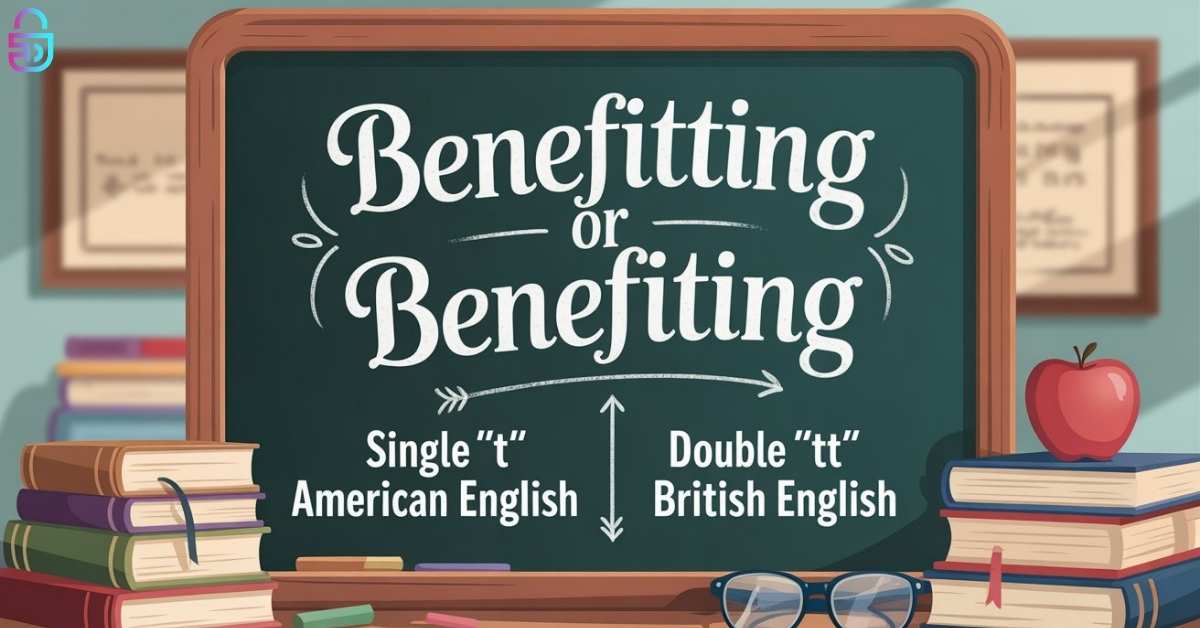
Benefitting or Benefiting—which spelling is actually correct? The short answer is simple: “benefiting” is the correct and widely accepted spelling, while “benefitting” is a less common variant that appears occasionally but is not preferred in modern writing. This confusion exists because English spelling rules can be inconsistent, especially when adding “-ing” to verbs. In this guide, you’ll learn the correct spelling, the grammar rule behind it, regional usage differences like benefitting or benefiting UK, US, and Australia, and how to use the word confidently in professional, academic, and SEO writing.
Quick Answer: Benefitting or Benefiting
If you’re in a hurry, here’s the clear verdict:
- ✅ Benefiting = Correct and recommended spelling
- ⚠️ Benefitting = Less common variant
The difference comes down to English spelling rules and syllable stress, which we’ll explain in detail below.
What Does “Benefit” Mean?
Before diving deeper into spelling, let’s clarify the meaning.
Benefit can be used as both a noun and a verb:
- As a noun: An advantage or profit gained
- As a verb: To receive an advantage or help
Examples:
- “She is benefiting from the new policy.”
- “This course will benefit your career.”
👉 Both benefiting vs benefitting meaning are the same—the difference is purely spelling, not definition.
Benefitting or Benefiting Spelling Explained
The confusion around benefitting or benefiting spelling arises because English sometimes doubles consonants when adding “-ing”.
For example:
- Run → Running
- Sit → Sitting
So naturally, people assume:
- Benefit → Benefitting ❌
But this assumption is incorrect in most cases.
👉 The correct form is:
- Benefit → Benefiting ✅
Why “Benefiting” Is the Preferred Spelling
The reason benefiting is preferred comes down to modern English usage and grammar consistency.
Key facts:
- Most dictionaries and style guides recommend benefiting
- It is the dominant form in global usage
- It appears more frequently in academic, business, and SEO writing
Real-world usage insight:
In professional writing, using benefiting ensures:
- Clarity
- Consistency
- Credibility
Is “Benefitting” Ever Correct?
Here’s where nuance matters.
Benefitting is not technically wrong, but:
- It is rare
- It is considered non-standard
- It may appear in older texts or inconsistent writing styles
👉 In modern usage:
- Avoid benefitting in formal writing
- Use it only if following a specific style guide that allows it
Grammar Rule: Doubling Consonants Before “-ing”
To fully understand benefiting vs benefitting, you need to know the consonant doubling rule.
The rule:
A consonant is doubled when:
- The word has one syllable OR ends in a stressed syllable
- The word ends in consonant-vowel-consonant (CVC) pattern
Examples:
- Run → Running
- Sit → Sitting
Why “Benefit” Does NOT Double the “T”
This is the most important concept.
The word benefit has three syllables:
- ben-e-fit
👉 The stress is on the first syllable, not the last.
Because of this:
- ❌ No consonant doubling
- ✅ Correct form = benefiting
Comparison Table:
| Word | Stress Position | Correct Form |
| Run | Single syllable | Running |
| Begin | Last syllable stressed | Beginning |
| Benefit | First syllable stressed | Benefiting |
Exceptions to the Consonant Doubling Rule
English isn’t always consistent.
Some words break the rules due to:
- Regional differences
- Historical usage
- Style guide preferences
Examples:
- Traveling vs Travelling
- Focusing vs Focussing
👉 These exceptions explain why benefitting sometimes appears, even though benefiting is standard.
British vs American vs Australian Usage
Understanding regional variations helps clarify confusion around:
Benefitting or Benefiting UK
In the UK:
- Benefiting is still the preferred spelling
- Benefitting may appear occasionally
Benefitting or Benefiting US
In American English:
- Strong preference for benefiting
- “Benefitting” is rarely used
Benefitting or Benefiting Australia
Australian English often follows British patterns, but:
- Benefiting remains the dominant spelling
- “Benefitting” is uncommon
👉 Across all regions—US, UK, Australia—the safest choice is benefiting.
Benefiting vs Benefitting: Side-by-Side Comparison
| Feature | Benefiting | Benefitting |
| Correctness | ✅ Standard | ⚠️ Variant |
| Usage Frequency | High | Low |
| Recommended for Writing | Yes | No |
| Regional Acceptance | Global | Limited |
| SEO Value | High | Low |
Examples of Benefiting and Benefitting in Sentences
Correct Usage:
- “Students are benefiting from online learning.”
- “The company is benefiting from new policies.”
- “He is benefiting from regular exercise.”
Rare Usage:
- “She is benefitting from the program.”
👉 While understandable, this version is not preferred.
Common Mistakes to Avoid
Writers often make these errors:
- Assuming all verbs double consonants
- Using benefitting in formal writing
- Ignoring syllable stress rules
- Mixing spelling styles in one article
👉 Consistency is key in professional and SEO writing.
Similar Spelling Confusions
Understanding similar patterns improves your grammar skills.
Examples:
- Traveling vs Travelling
- Focusing vs Focussing
- Cancelled vs Canceled
👉 These follow similar spelling rules and regional variations.
Does Spelling Choice Affect SEO?
Yes—this is something competitors often miss.
Important SEO facts:
- Keyword consistency improves rankings
- “Benefiting” has higher search volume
- Google prefers standard spelling
Case Insight:
Websites using consistent spelling like benefiting tend to:
- Rank higher
- Appear more authoritative
👉 Using benefitting excessively can weaken SEO signals.
When Should You Use “Benefiting” in Writing?
Use benefiting in:
- Academic writing
- Business communication
- SEO content
- Professional emails
Example:
“Our clients are benefiting from improved services.”
Learn More: Stairwell vs Staircase
Quick Memory Tip to Remember the Correct Spelling
Here’s a simple trick:
👉 “No stress at the end = no double letter.”
Since benefit is not stressed on the last syllable:
- ✔ Benefiting
- ❌ Benefitting
Frequently Asked Questions
Is benefitting wrong?
No, but it is not standard and rarely used.
Why is it benefiting and not benefitting?
Because the word benefit does not stress the final syllable, so the consonant is not doubled.
Is benefitting British English?
It may appear occasionally, but benefiting is still preferred.
Which spelling is more common?
Benefiting is far more common globally.
Can I use benefitting in formal writing?
It’s better to avoid it and use benefiting.
Final Verdict: Benefitting or Benefiting
Let’s wrap it up clearly:
- ✅ Benefiting = Correct, standard, and recommended
- ⚠️ Benefitting = Rare, non-standard variant
If you want your writing to be:
- Professional
- Clear
- SEO-friendly
👉 Always choose benefiting.
Conclusion
The confusion around benefitting or benefiting comes from how English handles spelling rules and syllable stress. While both forms exist, only one is widely accepted. By understanding the grammar rule, recognizing regional variations (UK, US, Australia), and applying consistent spelling, you can write with confidence.
In modern writing—especially online—clarity and consistency matter. And when it comes to this debate, the answer is simple:
👉 Stick with “benefiting.” It’s the correct choice every time.