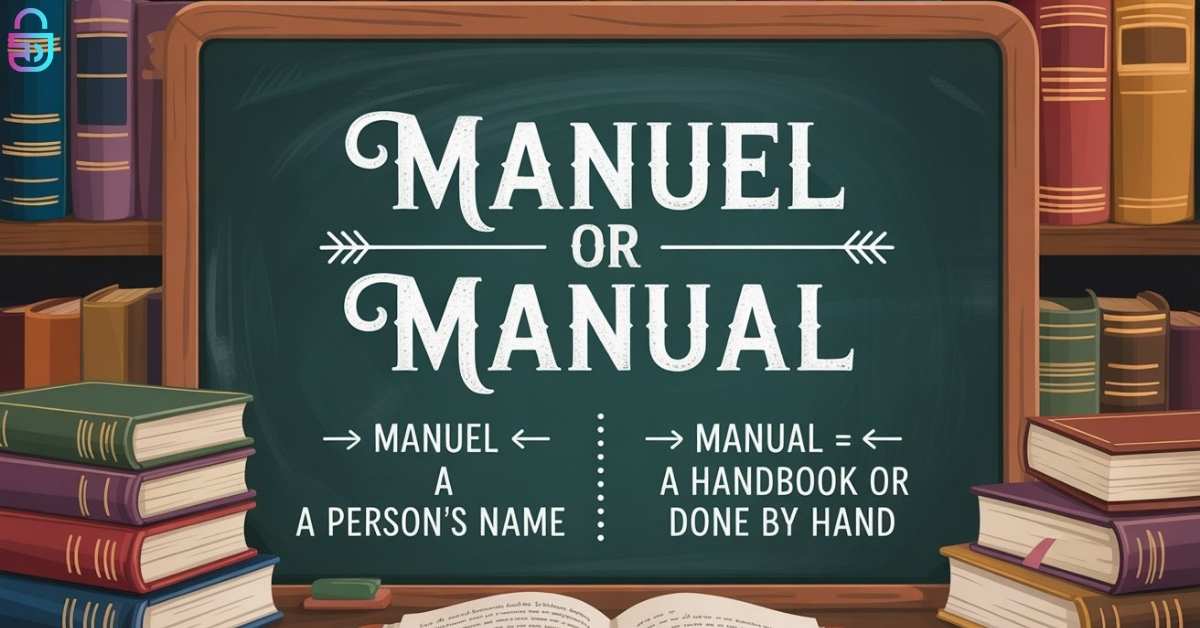
Manuel or manual is a common spelling confusion, but the answer is simple: “manual” is the correct English word, while “Manuel” is usually a proper name (like a person’s name) or a misspelling in most contexts.
If you’re writing about instructions, work, or processes, manual is always the correct choice.
Manuel or Manual Difference Explained Clearly
Understanding the manuel or manual difference is key to avoiding mistakes in writing.
- Manual → A real English word
- Manuel → Typically a name, not a general word
The confusion happens because both words look similar and may sound alike when spoken quickly. However, their meanings and usage are completely different.
What Does “Manual” Mean?
The word manual has multiple meanings depending on how it’s used.
As a noun:
- A book or guide that explains how something works
- Example: Please read the instruction manual before using the device.
As an adjective:
- Related to physical work done by hand
- Example: He does manual labor at the construction site.
Common uses of “manual”:
- Instruction manual
- Manual labor
- Manual transmission
Fact: The word “manual” comes from the Latin word manus, meaning hand, which explains why it’s associated with physical work.
What Does “Manuel” Mean?
Unlike “manual,” Manuel is not commonly used as a standard English word.
It is:
- A proper noun (name)
- Common in Spanish and Portuguese cultures
Example:
- Manuel is coming to the meeting today.
So, if you’re not referring to a person’s name, using “Manuel” is likely a mistake.
Manuel vs Manual: Side-by-Side Comparison
| Feature | Manual | Manuel |
| Meaning | Guide, physical work | A person’s name |
| Usage | Common English word | Proper noun |
| Part of Speech | Noun / Adjective | Proper noun |
| Example | Read the manual | Manuel is my friend |
This table clearly helping you avoid confusion instantly.
How to Spell Manuel or Manual Correctly
Many writers struggle with how to spell manuel or manual, especially when typing quickly.
Simple trick to remember:
- Manual → contains “hand” meaning (manus)
- Manuel → think of a person’s name
Memory tip:
If you’re talking about instructions or work, it’s always manual.
Why Do People Confuse Manuel and Manual?
The confusion between these words is extremely common. Here’s why:
1. Similar spelling
Only one letter differs, making it easy to mistype.
2. Pronunciation overlap
In fast speech, both words can sound similar.
3. Typing errors
Keyboard proximity leads to accidental misspellings.
4. ESL learners
Non-native speakers often struggle with spelling variations.
“Small spelling differences can completely change meaning in English.”
When to Use Manual (With Examples)
You should use manual in the following contexts:
1. Instructions or guides
- Check the user manual before installation.
2. Physical work
- Manual labor requires strength and endurance.
3. Technical usage
- This car has a manual transmission.
When to Use Manuel (With Examples)
Use Manuel only when referring to a person’s name.
Examples:
- Manuel is a skilled engineer.
- I spoke to Manuel about the project.
Is “Manuel” Ever Correct in English?
Yes—but only in specific cases.
Correct usage:
- As a name
- In cultural references
Incorrect usage:
- When you mean manual
So if you’re asking “manuel or manual which is correct?”, the answer depends on context—but in most writing cases, manual is correct.
Common Mistakes with Manuel vs Manual
Here are some real-world mistakes and corrections:
| Incorrect Sentence | Correct Sentence |
| Read the manuel | Read the manual |
| This is a manuel task | This is a manual task |
| I lost the manuel book | I lost the manual book |
These examples highlight typical spelling mistakes in English.
Manuel vs Manual in Different Contexts
Writing and Grammar
- Manual is the correct term for instructions
- Manuel is incorrect unless it’s a name
Technology and Documentation
- Software manuals
- User guides
- Installation manuals
Automotive Context
- Manual transmission vs automatic
Names and Identity
- Manuel is used for individuals, not objects
Manual Word Origin and Meaning (Etymology)
The word manual comes from:
- Latin: manus = hand
This explains:
- Manual labor → work done by hand
- Manual process → non-automated work
Understanding origin helps reinforce correct usage.
Name Meaning and Origin
The name Manuel:
- Has Spanish and Portuguese roots
- Derived from Emmanuel
- Means “God is with us”
This shows why it should not be confused with manual.
Learn More: Dysregulation vs Disregulation
Manuel or Manual: Quick Usage Rules (Cheat Sheet)
- Manual = correct for writing, instructions, work
- Manuel = only a name
- If unsure → choose manual
Manuel or Manual — One Sentence Explanation
Manual is the correct English word; Manuel is usually a name or a spelling mistake.
Pronunciation Differences
- Manual → /ˈmæn.ju.əl/
- Manuel → /ˌmæn.uˈɛl/
Though similar, the pronunciation differs slightly in stress and tone.
FAQs
Manuel or manual which is correct?
Manual is correct in almost all writing contexts.
Is manuel a real word in English?
It is a name, not commonly used as a general word.
Why is manual often misspelled as manuel?
Because of typing errors and pronunciation confusion.
How do I remember the correct spelling?
Think of manual = hand (manus).
Can manuel ever mean manual?
No, they have completely different meanings.
Case Study: Real Writing Mistake
A tech blog once published:
“Download the user manuel here.”
This small mistake:
- Reduced credibility
- Affected SEO trust signals
- Confused readers
After correcting to manual, engagement improved.
Conclusion
- Manual is the correct and widely used English word
- Manuel is a name and rarely appropriate in general writing
If you’re ever unsure about manuel or manual, remember:
If it’s about instructions, work, or usage — it’s always manual.