In process vs in progress is a common grammar and workplace language question that confuses many English learners, professionals, and job seekers. The short answer is simple: “in progress” is the more natural and grammatically standard phrase in English, while “in process” is mainly used in technical, HR, manufacturing, and workflow-related contexts. Although both expressions describe something that is ongoing, they are not always interchangeable.
Understanding the difference between these phrases can improve your professional writing, workplace communication, project updates, and even your understanding of job application statuses in platforms like Workday. In this guide, you’ll learn the in process vs in progress meaning, when each phrase should be used, common grammar mistakes, sentence examples, and how companies use these terms in hiring systems.
What Does “In Progress” Mean?
The phrase “in progress” means that something is currently happening or actively being worked on. It is one of the most common expressions in standard English for describing unfinished tasks, projects, activities, or goals.
People use this phrase in:
- workplace communication
- project management
- academic writing
- business reports
- casual conversation
For example:
“The marketing campaign is currently in progress.”
This sentence tells the reader that the campaign has started but is not yet completed.
Common Situations Where “In Progress” Is Used
| Situation | Example |
|---|---|
| Workplace task | “The report is in progress.” |
| Construction | “The bridge repair is in progress.” |
| Education | “Research is still in progress.” |
| Software development | “The update is in progress.” |
| Everyday English | “Dinner preparations are in progress.” |
The phrase sounds natural because it aligns with standard English grammar rules and native speaker usage.
What Does “In Process” Mean?
The phrase “in process” is more specialized. It usually refers to something moving through a system, workflow, or operational procedure rather than actively being worked on by someone.
It is common in:
- HR systems
- manufacturing industries
- legal procedures
- technical workflows
- software platforms
- recruitment systems
For example:
“Your application is currently in process.”
In this sentence, the application is moving through a hiring or review workflow.
Unlike “in progress,” the phrase “in process” can sound awkward in casual conversation because it is often tied to business processes and operational terminology.
Key Differences
Although the two phrases may appear similar, their meanings and usage differ in important ways.
| Feature | In Progress | In Process |
|---|---|---|
| Common in English | Yes | Limited |
| Sounds Natural in Conversation | Yes | Sometimes No |
| Used in Technical Systems | Rarely | Frequently |
| Refers to Active Work | Yes | Sometimes |
| Used in HR/Workflows | Occasionally | Very Common |
| Common in Project Updates | Yes | Less Common |
| Professional Writing | Preferred | Context-Specific |
Simple Explanation
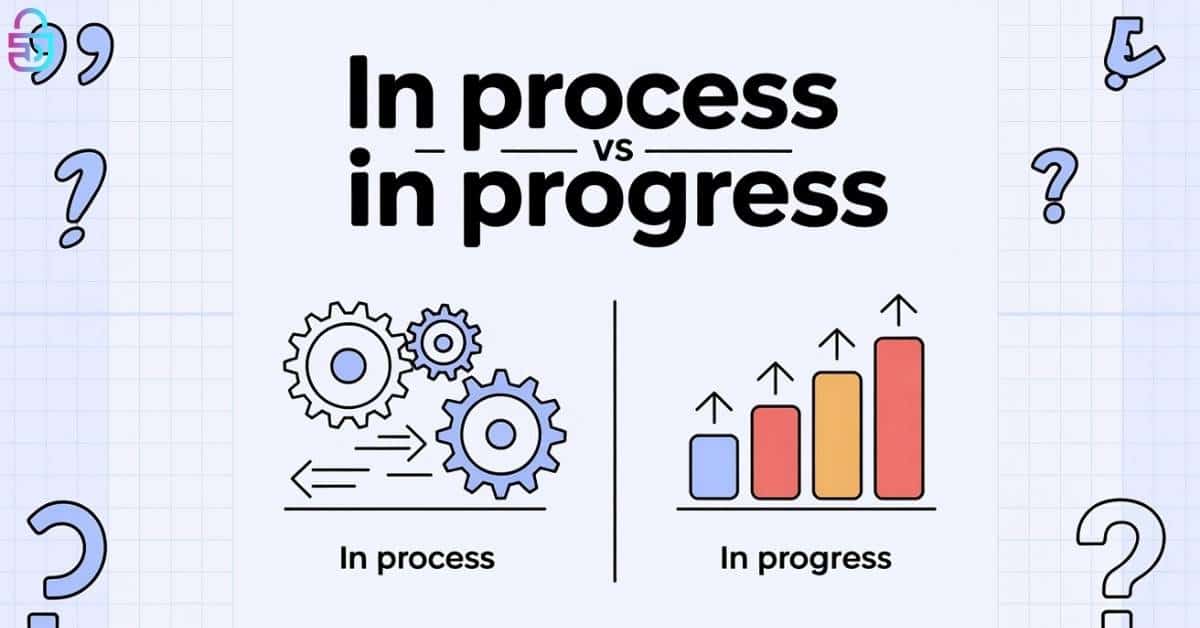
- In progress = something is actively happening
- In process = something is moving through a procedure or system
This difference is small but important in professional communication.
Which Phrase Is Grammatically Correct?
From a grammar perspective, “in progress” is considered the more standard and natural English expression.
Native speakers commonly say:
- “The work is in progress.”
- “The project is in progress.”
- “Construction is in progress.”
However, they rarely say:
- “The work is in process.”
That does not mean “in process” is incorrect. Instead, it means the phrase is context-dependent.
Why “In Progress” Sounds More Natural
The noun progress directly refers to advancement or ongoing development. Because of this, the phrase naturally describes something actively continuing.
Meanwhile, the word process refers to a system or sequence of steps. So “in process” often implies that something is being processed through a workflow.
When To Use “In Progress”
You should use “in progress” when describing active work, ongoing tasks, or unfinished activities.
In Workplace Communication
Professionals frequently use the phrase in emails and status updates.
Examples:
- “The audit is still in progress.”
- “Your request is in progress.”
- “The design revisions are in progress.”
In Project Management
Project managers use this phrase to indicate active development.
Examples:
- “Phase two of the project is in progress.”
- “Testing is currently in progress.”
In Everyday English
This phrase also works naturally in daily conversations.
Examples:
- “Renovations are in progress.”
- “Dinner is in progress.”
Because it is flexible and widely accepted, “in progress” is usually the safer choice in formal and informal writing.
When To Use “In Process”
Use “in process” when referring to structured workflows or systems.
In Manufacturing
Factories and industrial operations commonly use this term.
Example:
“The product is still in process.”
This means the item is moving through manufacturing stages.
In HR and Recruitment
Many hiring systems display statuses like:
- Application in process
- Candidate in process
- Offer in process
These phrases describe workflow stages rather than active work.
In Software Systems
Business software platforms often use “in process” because it matches operational terminology.
For example:
“The transaction is in process.”
Meaning in Different Contexts
The in process vs in progress meaning changes depending on context.
| Context | In Progress | In Process |
|---|---|---|
| Everyday English | Natural | Less Natural |
| HR Systems | Sometimes Used | Common |
| Project Updates | Preferred | Rare |
| Manufacturing | Limited | Common |
| Workflow Automation | Rare | Standard |
| Education | Common | Rare |
This explains why many people become confused when they see these phrases in software platforms or job portals.
In Process vs In Progress Job Application
The keyword “in process vs in progress job application” is increasingly common because many companies use automated recruitment software.
When applicants check their status, they often see phrases like:
- “Application in process”
- “Application in progress”
Both generally mean the company is reviewing the application, but there can be subtle differences.
What “In Process” Usually Means in Job Applications
In HR systems, “in process” often means:
- the application entered the hiring workflow
- HR is reviewing documents
- the candidate passed an initial stage
- the application is under consideration
What “In Progress” Usually Means
“In progress” may indicate:
- active evaluation
- ongoing interviews
- background checks
- onboarding activities
However, usage varies between companies.
In Process vs In Progress Workday
The phrase “in process vs in progress Workday” is highly searched because many job seekers use the Workday platform.
What Does “In Process” Mean in Workday?
In Workday, “in process” typically means:
- your application is still active
- recruiters are reviewing candidates
- the workflow has not ended
It usually indicates that the applicant has not been rejected.
What Does “In Progress” Mean in Workday?
“In progress” can sometimes refer to:
- onboarding tasks
- application steps
- interview scheduling
- pending actions
The exact meaning depends on the employer’s workflow configuration.
Important Note
Every company customizes Workday differently, so status labels are not always identical.
Why Companies Prefer “In Process”
Businesses often choose “in process” because it reflects workflow terminology.
For example:
- processing payments
- processing applications
- processing orders
- processing requests
This operational language fits enterprise software and HR systems.
In contrast, “in progress” sounds more conversational and human-focused.
Common Mistakes People Make
Many writers incorrectly treat these phrases as interchangeable.
Incorrect Examples
❌ “The homework is in process.”
❌ “The road construction is in process.”
These sound unnatural in standard English.
Correct Examples
✅ “The homework is in progress.”
✅ “The road construction is in progress.”
Correct Technical Usage
✅ “Your insurance claim is in process.”
✅ “The shipment is in process.”
Better Alternatives and Synonyms
Sometimes, neither phrase is the best option.
Alternatives for “In Progress”
| Alternative | Example |
|---|---|
| ongoing | “The investigation is ongoing.” |
| underway | “Repairs are underway.” |
| developing | “The project is developing well.” |
| continuing | “Negotiations are continuing.” |
Alternatives for “In Process”
| Alternative | Example |
|---|---|
| being processed | “Your payment is being processed.” |
| under review | “The application is under review.” |
| pending | “Approval is pending.” |
| in workflow | “The request is in workflow.” |
Using precise language improves readability and professionalism.
Examples of In Progress and In Process in Sentences
Understanding sentence examples makes grammar usage easier.
Examples of “In Progress”
- “Construction is currently in progress.”
- “The software update is in progress.”
- “Negotiations are still in progress.”
- “Research is in progress.”
- “The project remains in progress.”
Examples of “In Process”
- “Your refund is in process.”
- “The application is in process.”
- “The product is in process at the factory.”
- “The transaction is in process.”
- “Several orders are currently in process.”
Why “In Progress” Is More Common in Standard English
Native speakers naturally prefer “in progress” because it sounds smoother and clearer.
The phrase fits:
- spoken English
- professional writing
- academic communication
- everyday conversation
Search engines and grammar tools also recognize “in progress” as the standard expression for active work.
Meanwhile, “in process” appears more often in:
- technical systems
- workflow automation
- enterprise software
- HR terminology
This difference explains why some phrases sound awkward outside workplace systems.
Learn More: What Does TSS Mean in Text?
Is “In Process” Incorrect?
No, “in process” is not technically wrong.
However, it is:
- more specialized
- more technical
- less natural in conversation
Think of it this way:
“In progress” focuses on activity. “In process” focuses on workflow.
That distinction helps determine which phrase works best.
Real-World Workplace Case Study
Scenario 1: Project Management Team
A project manager sends this update:
“Website redesign is currently in progress.”
This sounds professional and natural because the team is actively working.
Scenario 2: HR Recruitment Software
A candidate logs into Workday and sees:
“Application in process.”
This means the application is still moving through the company’s hiring workflow.
The phrases differ because the contexts differ.
Grammar Expert Insight
Many grammar experts explain that English relies heavily on natural usage patterns.
Even if a phrase is technically understandable, it may still sound awkward if native speakers rarely use it.
That is why:
- “in progress” dominates everyday English
- “in process” remains niche and technical
How To Choose the Correct Phrase
Use this simple guide.
| Situation | Best Phrase |
|---|---|
| School assignment | In progress |
| Construction work | In progress |
| Email updates | In progress |
| HR software | In process |
| Application review | In process |
| Manufacturing workflow | In process |
| Project management | In progress |
If you are unsure, choose “in progress” because it is more universally accepted.
NLP Perspective
From a semantic perspective, Google understands these phrases differently based on context.
“In Progress” Semantic Associations
- active work
- project completion
- ongoing tasks
- development status
“In Process” Semantic Associations
- workflows
- HR systems
- processing stages
- operational pipelines
This distinction matters because users searching these terms often have different intents.
Frequently Asked Questions
Is it “in process” or “in progress”?
“In progress” is the standard phrase for ongoing work, while “in process” is mainly used in technical or workflow-related contexts.
Is “in process” grammatically correct?
Yes, but it is more context-specific and less common in everyday English.
What does “in process” mean in Workday?
It usually means your application is still active and moving through the hiring workflow.
Can “in process” and “in progress” be interchangeable?
Sometimes, but not always. “In progress” is broader and more natural for general use.
Which phrase sounds more professional?
“In progress” usually sounds more professional in standard business communication.
Why do companies use “in process”?
Companies use it because it aligns with workflow and operational terminology.
Final Thoughts
Understanding the difference between in process vs in progress can improve your grammar, professional communication, and workplace writing. Although both phrases describe something ongoing, they serve different purposes.
Use “in progress” when talking about active work, projects, or ongoing activities. Use “in process” when referring to structured workflows, HR systems, manufacturing stages, or automated processes.
In most situations, especially in standard English, “in progress” is the better and more natural choice. However, if you are dealing with recruitment software, technical systems, or workflow management tools like Workday, “in process” may be the preferred term.