“Unattentive or inattentive” looks like the kind of grammar question with a quick answer. Most articles stop there. They tell you one word is right, the other is wrong, then move on.
The confusion runs deeper than that.
People search this phrase because they want certainty. Maybe they saw “unattentive” in a draft and hesitated before sending an email. It’s maybe a teacher corrected it. Maybe spellcheck flagged it and created doubt. The question usually isn’t just about vocabulary. It’s about sounding natural, educated, and credible.
Here’s the short answer first:
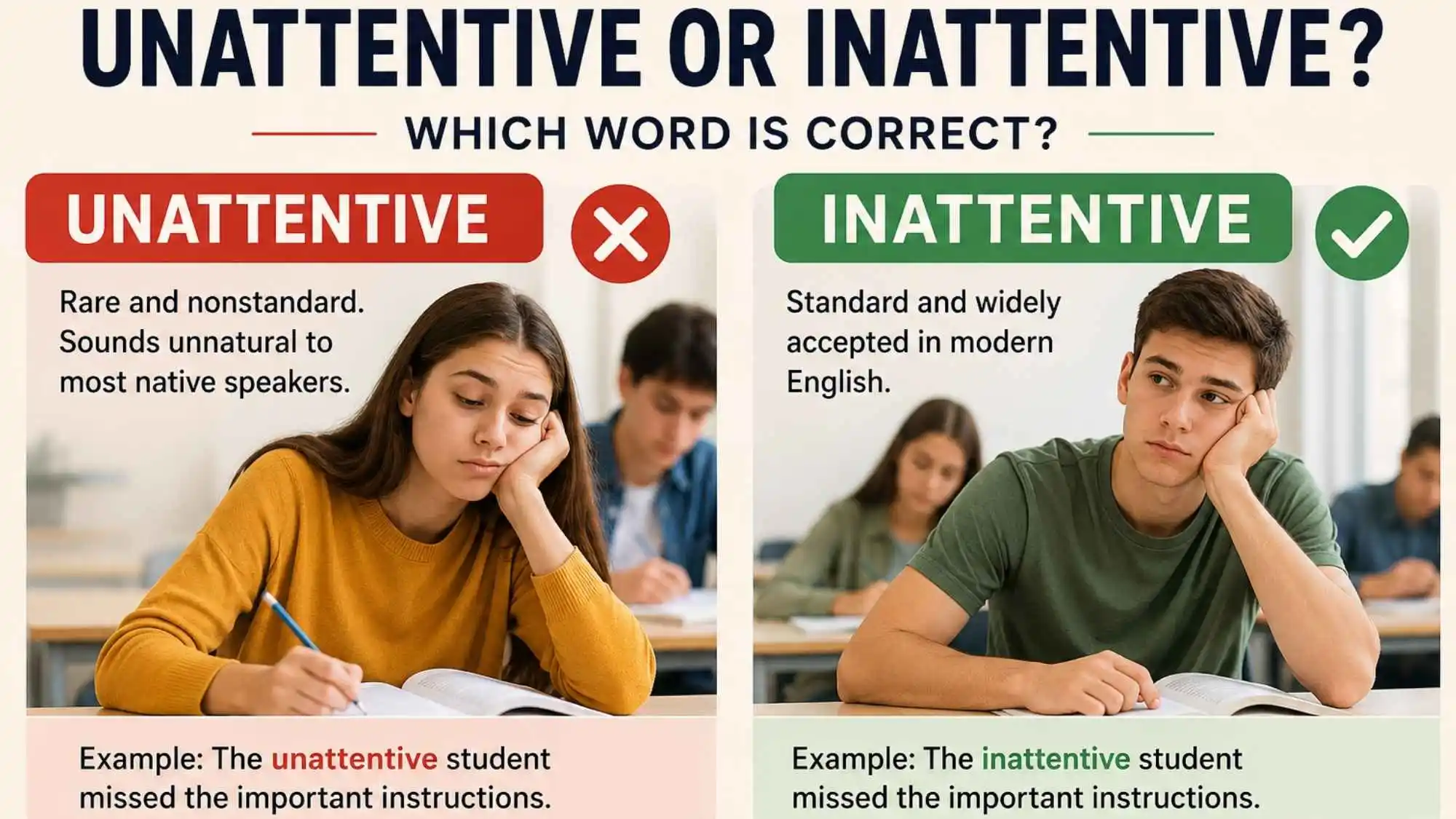
Inattentive is the standard and widely accepted English word. Unattentive exists in rare usage but sounds unnatural to most native speakers and is generally avoided in modern writing.
That single distinction answers most situations immediately. Still, the reason behind the confusion matters because once you understand why English favors “inattentive,” you stop second-guessing yourself every time similar words appear.
Quick Comparison: Unattentive vs Inattentive
| Word | Modern Usage | Sounds Natural? | Safe in Professional Writing? |
|---|---|---|---|
| inattentive | standard English | yes | yes |
| unattentive | rare/nonstandard | usually no | usually no |
If you are writing:
- an essay
- an article
- a business email
- academic content
- professional communication
use inattentive.
That is the version native speakers expect to read.
Why “Unattentive” Feels Like It Should Be Correct
The confusion makes sense. English trains people to think this way.
We naturally form opposites with the “un-” prefix:
- happy → unhappy
- clear → unclear
- comfortable → uncomfortable
So the brain assumes:
- attentive → unattentive
Logically, it fits the pattern.
The problem is that English does not always follow perfectly clean logic. Some words evolve through usage rather than consistency. Over time, speakers collectively settled on “inattentive” instead.
That happens more often in English than grammar books admit.
A similar pattern appears with words like:
- inaccurate instead of unaccurate
- incapable instead of uncapable
Nobody pauses when they hear “inaccurate,” even though “unaccurate” might seem structurally possible. Language eventually decides which forms feel natural and which ones fade into the background.
“Inattentive” won that battle a long time ago.
Is “Unattentive” Technically a Real Word?
This is where many grammar articles become misleading.
Some dictionaries and historical references acknowledge “unattentive.” You may even find older examples buried in archived books or obscure texts. That does not automatically make it standard modern English.
A word can technically exist and still sound wrong in real conversation.
Native speakers rarely use “unattentive” naturally. Most editors avoid it. Grammar tools often flag it because modern usage overwhelmingly favors “inattentive.”
That distinction matters more than dictionary technicalities.
Language is not only about what exists. It is also about what people actually say.
What Native Speakers Normally Use
This is the simplest test.
Read these aloud:
The teacher noticed several inattentive students during the lecture.
Now compare it with:
The teacher noticed several unattentive students during the lecture.
The second sentence is understandable, but it feels slightly off. Most fluent English speakers notice the awkwardness immediately even if they cannot explain the grammar rule behind it.
That reaction is important because natural writing depends heavily on reader instinct.
Professional editors think this way all the time. They often remove words not because they are impossible, but because they interrupt reading flow.
“Unattentive” creates that interruption.
Why Grammar Checkers Usually Reject “Unattentive”
People often assume grammar software acts like a dictionary. It does not.
Modern writing tools rely heavily on:
- usage frequency
- editorial standards
- language databases
- real-world writing patterns
If millions of published documents consistently prefer one version of a word, software treats that version as standard.
That is exactly what happened here.
“Inattentive” dominates:
- journalism
- academic writing
- books
- business communication
- mainstream publishing
“Unattentive” barely appears by comparison.
So when grammar tools flag it, they are responding to modern language behavior rather than inventing a rule out of nowhere.
LEARN MORE: What Does TSS Mean in Text?
The Difference Between Logical English and Natural English
This is where many English learners get frustrated.
A word can be logically understandable while still sounding unnatural.
For example, native speakers understand:
- “irregardless”
Yet many still avoid it because it carries a reputation for being nonstandard.
“Unattentive” falls into a softer version of that category. Readers understand it. They simply do not expect it.
That expectation shapes how polished your writing feels.
Someone reading quickly should never pause because a word feels unfamiliar in context. Even tiny interruptions affect perceived fluency.
Where Using “Unattentive” Can Create Problems
The risk is not misunderstanding. Most readers will still know what you mean.
The real risk is perception.
Academic Writing
Teachers and professors usually expect standard modern usage. “Unattentive” may look careless or outdated even if technically defensible.
Professional Communication
In business settings, unusual wording can distract from the actual message. Readers may focus on the vocabulary instead of your point.
Online Publishing
Readers move quickly online. If wording feels strange, trust weakens fast. Clean, familiar language performs better because it reduces friction.
That is one reason strong editors favor clarity over novelty unless there is a deliberate stylistic reason not to.
Can “Unattentive” Ever Be Acceptable?
Possibly, though rarely.
A novelist might use it intentionally for:
- historical tone
- character dialogue
- stylistic voice
- old-fashioned rhythm
Creative writing allows more flexibility because unusual wording can serve atmosphere or characterization.
Outside those contexts, “inattentive” remains the safer and more natural choice almost every time.
Why This Question Creates So Much Anxiety
Grammar questions often carry emotional weight people do not openly mention.
Someone searching “unattentive or inattentive” is often wondering:
- Will this make me sound uneducated?
- Is this a mistake native speakers notice instantly?
- Will my teacher mark this wrong?
- Does this sound awkward in professional writing?
That explains why short dictionary-style answers feel unsatisfying. Users want reassurance alongside correction.
The reassuring answer here is simple:
If you use “inattentive,” you will sound natural in both formal and everyday English.
Real Examples That Sound Natural
Context matters more than isolated definitions.
Here are examples native speakers would not think twice about.
Workplace
An inattentive review of the contract caused several costly errors.
Parenting
Parents sometimes mistake boredom for inattentive behavior.
Relationships
She felt he had become emotionally inattentive over time.
Education
The professor noticed a few inattentive students near the back of the classroom.
None of those sentences feel forced because “inattentive” already belongs naturally in those environments.
Common Words People Confuse With “Inattentive”
Part of the confusion comes from overlap with similar terms.
Distracted
Usually temporary. Someone loses focus for a moment.
Absent-Minded
Suggests forgetfulness or mental wandering.
Negligent
Stronger and more serious. Often connected to responsibility or carelessness.
Unfocused
More conversational and modern.
Careless
Emphasizes lack of caution rather than lack of attention itself.
These words share territory with “inattentive,” but they do not always carry the same emotional tone.
A Simple Way to Remember the Correct Version
Instead of memorizing grammar rules, notice the pattern shared by other common English adjectives:
- incapable
- inaccurate
- inappropriate
- inattentive
Many formal English words naturally prefer “in-” rather than “un-.”
Once you recognize that rhythm, “inattentive” starts sounding obvious.
What Professional Editors Would Recommend
Editors care deeply about readability because smooth writing keeps readers engaged.
If a word creates even a brief moment of hesitation, editors usually replace it with the more familiar alternative unless there is a strong stylistic reason to keep it.
For that reason, most professional editors would recommend:
- use “inattentive”
- avoid “unattentive”
especially in:
- articles
- essays
- resumes
- academic work
- public-facing content
- business communication
Not because readers cannot understand “unattentive,” but because polished writing should feel effortless to read.
The Shortest Correct Answer
If you only need the direct answer:
“Inattentive” is the accepted modern English word. “Unattentive” exists occasionally but sounds unnatural to most native speakers and is generally avoided in formal writing.
That resolves nearly every real-world situation.
Frequently Asked Questions About Unattentive or Inattentive
Is unattentive grammatically wrong?
Not completely, though it is rare and considered nonstandard in modern English usage.
Which word should I use in an essay?
Use “inattentive.”
Why does unattentive sound strange?
Modern English standardized around “inattentive,” so native speakers expect that version naturally.
Do native speakers say unattentive?
Very rarely.
Can teachers mark unattentive incorrect?
Yes, especially in formal academic writing.
Is inattentive formal or informal?
It works comfortably in both.
Can unattentive appear in literature?
Occasionally, particularly in older or stylistically unusual writing.
Final Thought About Unattentive or Inattentive
English is full of words that seem logical on paper but never became natural in everyday speech. “Unattentive” belongs in that category.
People will understand it. They just do not expect it.
“Inattentive,” meanwhile, feels immediate and familiar to native readers. It fits naturally in conversation, publishing, academic work, and professional communication without creating friction.
When clarity matters, the safer choice is also the more natural one: inattentive.