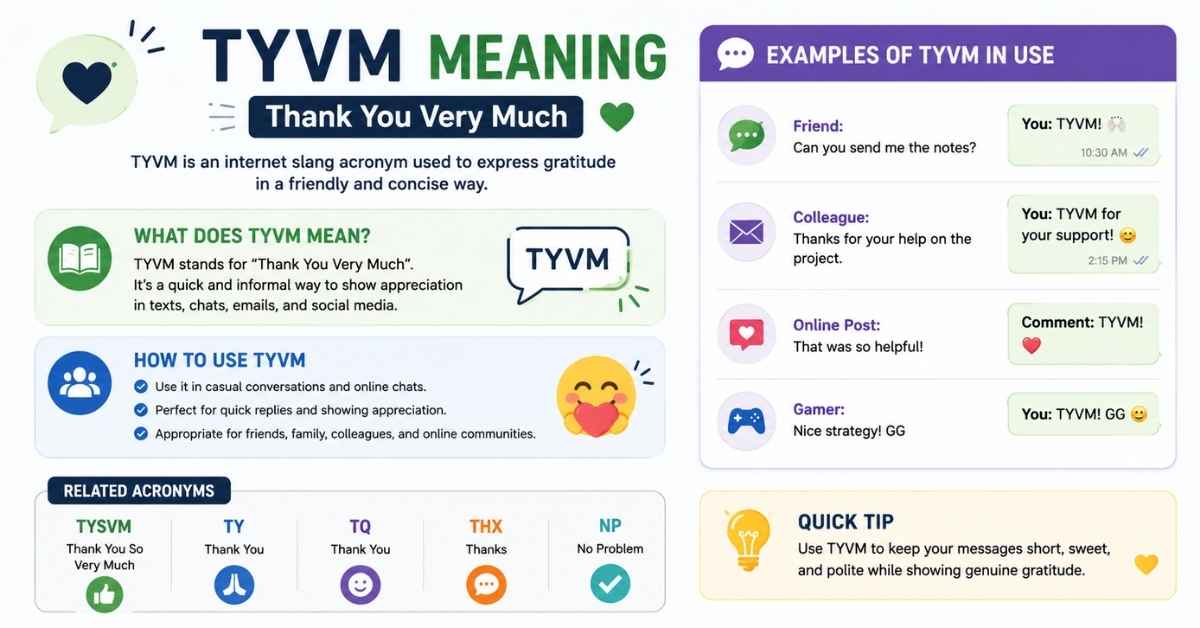
TYVM meaning “Thank You Very Much.” It is a popular texting abbreviation and internet slang used to express appreciation quickly in text messages, online chats, social media conversations, gaming communities, and messaging apps. Whether you’re chatting on WhatsApp, Snapchat, Instagram, Discord, Facebook Messenger, Slack, or SMS, TYVM is a friendly and informal way to thank someone.
Quick Facts
| Feature | Details |
|---|---|
| Full Form | Thank You Very Much |
| Meaning | A quick way to express gratitude |
| Type | Initialism (commonly called an acronym) |
| Common Use | Texting, social media, gaming, online chat |
| Tone | Friendly, appreciative, informal |
| Professional Use | Suitable for casual workplace chats, but avoid in formal emails |
TYVM Meaning
TYVM meaning is “Thank You Very Much.” It’s one of the most widely recognized texting abbreviations used to express gratitude and appreciation in digital conversations. Instead of typing the full phrase, people often shorten it to TYVM when sending a quick message, replying in a group chat, commenting on social media, or chatting during online games.
If you’ve recently received “TYVM” in a message and wondered what it means, don’t worry—it’s simply a polite and friendly way of saying “Thank you very much.” The abbreviation has become part of modern internet slang because it saves time while still sounding warm and appreciative.
Today, you’ll commonly see TYVM used across:
- Snapchat
- Facebook Messenger
- Discord
- TikTok comments
- SMS text messages
- Slack and Microsoft Teams
- Gaming chats
- Online communities
While the meaning is straightforward, understanding when to use TYVM, when to avoid it, and how its tone changes depending on the situation can help you communicate more naturally. That’s exactly what this guide will explain.
What Does TYVM Mean?
The answer is simple:
TYVM stands for “Thank You Very Much.”
It is an informal abbreviation people use to thank someone without typing the entire phrase. Since digital conversations are often fast-paced, abbreviations like TYVM have become common in online communication, instant messaging, and social media language.
Unlike a plain “Thanks,” TYVM usually conveys a little more enthusiasm and appreciation. It lets the other person know their help, kindness, or effort is genuinely valued while keeping the message short.
For example:
Friend: “I sent you the class notes.”
You: “TYVM! You saved me today.”
Here, TYVM feels natural because the conversation is friendly and informal.
Another example:
Coworker: “I’ve uploaded the presentation to the shared folder.”
Reply: “TYVM! I’ll review it before the meeting.”
In a casual workplace chat, this sounds polite and conversational.
TYVM Full Form
The TYVM full form is:
Thank You Very Much
Each letter represents one word:
- T = Thank
- Y = You
- V = Very
- M = Much
Although it’s made from the first letter of each word, most people simply refer to TYVM as a texting abbreviation or internet acronym, even though it is technically an initialism.
Is TYVM an Acronym or an Initialism?
This is a question many people don’t think about, but it’s an interesting part of modern digital communication.
Technically:
- An acronym forms a new word that’s pronounced as a word itself (for example, NASA or UNESCO).
- An initialism is pronounced by saying each individual letter (for example, FBI, USB, or BBC).
Since people usually say “T-Y-V-M” instead of pronouncing it as one word, TYVM is technically an initialism.
However, in everyday conversation, you’ll often see people use the terms acronym, abbreviation, and initialism interchangeably. For most readers, the important point is simply that TYVM is a shortened way of saying “Thank You Very Much.”
Why People Use TYVM Instead of Writing “Thank You Very Much”
If typing the full phrase isn’t difficult, why has TYVM become so popular?
The answer lies in how people communicate online today. Modern conversations are fast, informal, and often happen on mobile devices where speed matters.
Here are the main reasons people choose TYVM.
1. It Saves Time
Typing four letters is much faster than typing four complete words.
When you’re sending dozens of messages throughout the day, even small shortcuts become convenient.
Instead of writing:
“Thank you very much for your help!”
Many people simply type:
“TYVM!”
The meaning remains clear while reducing typing effort.
2. It Fits Natural Texting Habits
Text messaging has developed its own communication style.
Just as people write:
- LOL
- BRB
- IMO
- BTW
- IDK
they also use TYVM as part of everyday texting shorthand.
These abbreviations make conversations feel quick and natural.
3. It Sounds Friendly Without Being Too Formal
There’s a subtle difference between saying:
- Thank you
- Thanks
- TY
- TYVM
- TYSM
Each has a slightly different tone.
TYVM usually feels:
- appreciative
- warm
- friendly
- conversational
without sounding overly emotional.
4. It Works Across Multiple Platforms
Another reason for its popularity is flexibility.
People use TYVM almost everywhere online, including:
- WhatsApp chats
- Instagram DMs
- Facebook Messenger
- Snapchat conversations
- Discord servers
- Reddit replies
- Gaming communities
- Slack messages
- Microsoft Teams chats
- SMS texting
Because it’s widely recognized, most people immediately understand its meaning.
5. It Matches Modern Digital Communication
Online conversations prioritize speed while maintaining politeness.
Instead of lengthy messages, users often express gratitude with short phrases, emojis, or abbreviations.
Examples include:
- TYVM ❤️
- TYVM 😊
- TYVM!!
- TYSM
- Thanks!
- Appreciate it!
This reflects how digital etiquette has evolved—people value concise messages that still feel genuine.
Expert Insight: Using abbreviations like TYVM doesn’t make you less polite. In casual digital communication, they’re often seen as efficient and friendly. The key is matching your wording to the relationship and setting.
Where Is TYVM Commonly Used?
Although TYVM originated as a texting abbreviation, it’s now used across many online platforms. The context may change slightly, but the meaning remains the same.
TYVM Meaning in Text Messages
This is the most common place you’ll encounter TYVM.
Whether you’re thanking a friend, family member, or classmate, the abbreviation feels natural.
Example
Friend: “I picked up your package.”
You: “TYVM! I really appreciate it.”
Because texting is informal, abbreviations like TYVM fit perfectly.
TYVM Meaning on WhatsApp
Many users search for “TYVM meaning on WhatsApp.”
On WhatsApp, people often use TYVM when replying quickly in one-on-one conversations or group chats.
Examples include thanking someone for:
- sharing photos
- sending documents
- birthday wishes
- invitations
- helpful advice
The abbreviation keeps conversations flowing naturally without sacrificing politeness.
TYVM Meaning on Instagram and Facebook
Social media conversations tend to be brief, making abbreviations especially useful.
You might see TYVM in:
- Direct Messages
- Story replies
- Comment sections
- Community groups
Example:
“TYVM for the recommendation—I loved that restaurant!”
TYVM Meaning on Snapchat
Snapchat is built around quick, casual communication, so users frequently rely on shorthand.
Someone might reply:
“TYVM 😊”
after receiving:
- a Snap
- helpful information
- congratulations
- birthday wishes
The abbreviation feels natural because conversations are intentionally informal.
TYVM Meaning on Discord and Gaming Platforms
Gaming communities value speed during conversations.
Players often type:
- TY
- TYVM
- GG
- GLHF
- NP
instead of longer phrases.
For example:
Teammate: “I dropped extra health packs for you.”
Reply: “TYVM!”
In fast-paced games, abbreviations reduce typing time without interrupting gameplay.
TYVM in Workplace Messaging Apps
Can you use TYVM at work?
Sometimes, yes.
In casual conversations on Slack or Microsoft Teams, it may be perfectly acceptable to write:
“TYVM for updating the report.”
However, in formal emails to clients, executives, or external partners, it’s generally better to write:
“Thank you very much.”
Choosing the appropriate tone shows professionalism while respecting workplace communication norms.
TYVM in Online Communities
Forums, discussion boards, and community platforms such as Reddit often feature abbreviations because users value concise communication.
For instance:
“TYVM for explaining that—it makes much more sense now.”
This keeps conversations friendly and efficient while acknowledging another user’s contribution.
Real-Life Examples of TYVM in Conversations
Understanding the TYVM meaning is easy, but knowing how people actually use it makes a big difference. Context determines whether the abbreviation sounds warm, casual, playful, or even slightly sarcastic. The following examples show how TYVM fits naturally into different kinds of digital communication.
TYVM in Conversations Between Friends
Friends often use TYVM because their conversations are relaxed and informal.
Example 1
Emma: “I found the concert tickets you wanted.”
Liam: “TYVM! You’re the best!”
Why it works: The abbreviation feels genuine while keeping the conversation casual.
Example 2
Alex: “I’ll pick you up at 7.”
Chris: “TYVM! See you then.”
Again, the message sounds appreciative without being overly formal.
TYVM in Family Chats
Family group chats are another place where TYVM appears naturally.
Example
Mom: “I emailed you Grandma’s old photos.”
You: “TYVM ❤️ I can’t wait to see them.”
Adding an emoji makes the message feel even warmer and more personal.
TYVM in School or College
Students frequently use texting abbreviations when sharing notes, assignments, or reminders.
Example
Classmate: “Here’s today’s lecture notes.”
Reply: “TYVM! That really helped.”
This is a polite and efficient response that fits the conversational tone of student messaging.
TYVM in Workplace Chats
Many professionals communicate through Slack, Microsoft Teams, or other workplace messaging apps. In these settings, TYVM can work well—as long as the conversation is informal.
Example
Coworker: “I’ve uploaded the revised presentation.”
Reply: “TYVM! I’ll review it before the meeting.”
Example
Manager: “The schedule has been updated.”
Reply: “TYVM for letting me know.”
Expert Tip: Reserve TYVM for internal team chats. When writing to clients, executives, or external partners, it’s usually better to write “Thank you very much” in full.
TYVM in Customer Support Conversations
Although customer support teams generally use complete sentences, customers sometimes reply with abbreviations.
Example
Support Agent: “Your issue has now been resolved.”
Customer: “TYVM for the quick help!”
The response is concise but still expresses genuine appreciation.
TYVM on Social Media
You’ll often spot TYVM in comments, replies, and direct messages.
Example
“TYVM for your recommendation—I watched the movie last night and loved it!”
Example
“TYVM for all the birthday wishes everyone!”
These examples show how people use abbreviations while still sounding sincere.
TYVM in Group Chats
Whether it’s a family group, work group, or friends’ chat, TYVM is a quick way to acknowledge someone’s help.
Example
Group Member: “I’ve shared the travel itinerary.”
Reply: “TYVM! Everything looks great.”
Is TYVM Formal or Informal?
One of the most common questions after learning the TYVM full form is whether it’s appropriate in professional situations.
The answer depends on the context.
Informal Situations
TYVM works perfectly in:
- Text messages
- WhatsApp chats
- Snapchat conversations
- Instagram DMs
- Facebook Messenger
- Discord
- Gaming chats
- Conversations with friends
- Family messages
In these situations, it feels friendly and conversational.
Semi-Professional Situations
You can often use TYVM in:
- Slack
- Microsoft Teams
- Internal workplace chats
- Team collaboration tools
As long as your workplace has a casual communication style, the abbreviation usually sounds appropriate.
Formal Situations
Avoid using TYVM in:
- Job applications
- Cover letters
- Academic papers
- Business proposals
- Legal documents
- Client emails
- Professional networking introductions
Instead, write:
Thank you very much.
Using the complete phrase demonstrates professionalism and respect.
Quick Comparison
| Situation | Use TYVM? |
|---|---|
| Text message | ✅ Yes |
| ✅ Yes | |
| Instagram DM | ✅ Yes |
| Gaming chat | ✅ Yes |
| Discord | ✅ Yes |
| Slack team chat | ✅ Usually |
| Email to coworker | ⚠️ Depends on workplace culture |
| Email to client | ❌ No |
| Job application | ❌ No |
| Business proposal | ❌ No |
Can TYVM Sound Sarcastic?
Usually, TYVM expresses genuine gratitude.
However, like many phrases in online communication, the tone changes depending on context.
Genuine Appreciation
“TYVM for helping me move today!”
This clearly communicates sincere thanks.
Friendly Humor
“TYVM for reminding me…again 😂”
Here, the emoji signals playful teasing rather than criticism.
Possible Sarcasm
“Oh…TYVM for deleting my file.”
In this example, the surrounding words—not the abbreviation itself—create sarcasm.
This illustrates an important point:
TYVM is not inherently sarcastic. Context, punctuation, capitalization, and the relationship between the people involved determine how it’s interpreted.
How Punctuation Changes the Tone
Notice the subtle differences:
TYVM!
Warm and enthusiastic.
TYVM 😊
Friendly and appreciative.
TYVM…
May sound hesitant or disappointed depending on the conversation.
TYVM 🙄
Often suggests irony or frustration.
How Emojis Influence Meaning
Modern digital communication relies heavily on emojis.
Compare these:
- TYVM ❤️
- TYVM 😊
- TYVM 🙌
All feel warm and appreciative.
Now compare:
- TYVM 🙄
- TYVM 😒
These can suggest annoyance or sarcasm.
The abbreviation stays the same, but the emotional tone changes dramatically.
Learn More: WRU Meaning
Do People Still Use TYVM in 2026?
Yes. While internet slang evolves constantly, TYVM remains widely understood.
Some newer abbreviations become popular for a short time before disappearing, but expressions of gratitude tend to remain stable because they’re useful in everyday communication.
That said, different age groups may have different preferences.
Gen Z
Many younger users switch between:
- TY
- TYSM
- Thanks
- Appreciate it
- TYVM
Their choice often depends on the conversation rather than a strict preference.
Millennials
Millennials commonly recognize and use:
- TY
- TYVM
- TYSM
- THX
These abbreviations became popular during the rise of texting and instant messaging.
Older Adults
Many older users simply type:
- Thanks
- Thank you
- Thank you very much
However, those who regularly use messaging apps also understand TYVM.
Is TYVM Outdated?
No.
Although newer slang appears every year, TYVM is still recognized because it’s clear, polite, and easy to understand.
Unlike trend-based internet slang, expressions of gratitude rarely become obsolete.
TYVM vs. Other Popular Thank-You Abbreviations
Many users search for comparisons after learning the TYVM meaning.
Here’s how it compares with similar expressions.
| Abbreviation | Meaning | Tone | Best Used For |
|---|---|---|---|
| TY | Thank You | Casual | Everyday conversations |
| TYVM | Thank You Very Much | Friendly and appreciative | Texting, chats, gaming |
| TYSM | Thank You So Much | More enthusiastic | Emotional appreciation |
| THX | Thanks | Very casual | Quick replies |
| TQ | Thank You | Common in some regions | Casual messaging |
| Thanks | Complete word | Neutral | Most situations |
| Thank You | Complete phrase | Polite | Formal and informal communication |
TY vs. TYVM
TY is shorter and more neutral.
TYVM adds extra appreciation without becoming overly emotional.
Example:
TY = Thanks.
TYVM = Thanks—I really appreciate it.
TYVM vs. TYSM
These two abbreviations are often confused.
TYSM usually expresses stronger emotion.
Example:
“TYSM for supporting me during a difficult week.”
TYVM sounds appreciative but slightly more measured.
TYVM vs. THX
THX is one of the shortest ways to say thanks.
It’s ideal for:
- Quick confirmations
- Casual conversations
- Fast messaging
TYVM sounds a little warmer and more thoughtful.
TYVM vs. Writing “Thank You Very Much”
Sometimes the full phrase is the better choice.
For example:
- Formal email
- Business proposal
- Academic communication
- Client correspondence
In these situations, writing the complete phrase demonstrates professionalism and attention to detail.
When Should You Use TYVM?
Knowing the TYVM meaning is only part of the picture. The real skill is understanding when using TYVM feels natural and when another expression is a better choice.
As a general rule, TYVM works best in casual digital communication, where conversations are friendly, fast, and informal. It communicates appreciation without making the message feel overly formal.
Here are some situations where TYVM is an excellent choice.
1. Thanking Someone for a Favor
Whether a friend helped you move, shared useful information, or picked up something for you, TYVM is a quick way to show gratitude.
Example
Friend: “I brought your charger.”
You: “TYVM! You saved my day.”
2. Responding to Helpful Information
If someone answers your question online or explains something clearly, TYVM is an appropriate response.
Example
“TYVM for explaining that. I finally understand it now.”
3. Thanking Coworkers in Casual Team Chats
Many workplaces use Slack, Microsoft Teams, or similar messaging platforms for informal conversations.
Examples include:
- “TYVM for updating the spreadsheet.”
- “TYVM for covering today’s meeting.”
- “TYVM! I’ll finish the rest this afternoon.”
As long as your workplace encourages conversational communication, this abbreviation sounds perfectly natural.
4. Replying to Birthday Wishes
Group chats often fill with birthday messages.
Instead of replying individually, many people write:
“TYVM everyone for the birthday wishes! I really appreciate all the kind messages.”
5. Gaming Conversations
Online gaming communities frequently use abbreviations because players need to communicate quickly.
Examples:
“TYVM for the revive!”
“TYVM for the backup!”
6. Social Media Replies
Whether someone recommends a book, answers your question, or leaves a thoughtful comment, TYVM works well.
Example:
“TYVM for the recommendation—I’ll definitely check it out.”
7. Everyday Text Messages
Simple expressions of gratitude don’t always require complete sentences.
Examples:
- TYVM 😊
- TYVM!!
- TYVM ❤️
- TYVM for everything.
Short, friendly replies like these are common in text messages, WhatsApp chats, Snapchat, Instagram DMs, and Facebook Messenger.
When Should You Avoid TYVM?
Although TYVM is widely understood, there are situations where writing the complete phrase “Thank you very much” is more appropriate.
Formal Business Emails
If you’re emailing:
- Clients
- Customers
- Business partners
- Executives
avoid abbreviations.
Instead write:
Thank you very much for your time and consideration.
This creates a more professional impression.
Job Applications
When communicating with recruiters or hiring managers, complete words demonstrate professionalism.
Avoid:
“TYVM for reviewing my application.”
Instead write:
“Thank you very much for reviewing my application.”
Academic Writing
Professors, universities, and academic institutions generally expect standard written English.
Always use the complete phrase.
Legal or Official Communication
Formal documents should never include internet slang or texting abbreviations.
Messages Requiring Emotional Sensitivity
If someone has:
- supported you during a difficult time
- attended a funeral
- helped during an emergency
a complete thank-you message usually feels more sincere than an abbreviation.
How to Reply When Someone Says TYVM
If someone sends you TYVM, how should you respond?
Fortunately, there are many natural replies.
Friendly Replies
- You’re welcome!
- Anytime!
- Happy to help!
- No problem!
- Glad I could help.
- My pleasure.
Professional Replies
- You’re very welcome.
- It was my pleasure.
- Happy to assist.
- I’m glad I could help.
Casual Replies
- 😊 Anytime!
- No worries!
- Of course!
- You’ve got it!
- Always happy to help!
Example Conversation
Friend: “TYVM for picking me up.”
Reply: “You’re welcome! Happy to help anytime.”
Workplace Example
Coworker: “TYVM for fixing the report.”
Reply: “No problem. Glad everything worked out.”
Choosing a reply that matches the tone of the conversation keeps communication natural and friendly.
Common Mistakes People Make with TYVM
Even though TYVM is simple, people sometimes misuse it.
Using It in Formal Emails
This is the most common mistake.
Remember:
- Internal team chat → Usually acceptable.
- Client proposal → Avoid.
Assuming Everyone Knows the Abbreviation
Although TYVM is widely recognized, not everyone is familiar with internet slang.
If you’re communicating with someone who may not know texting abbreviations, writing “Thank you very much” in full is the safer choice.
Overusing Abbreviations
A message filled with abbreviations can become difficult to read.
For example:
TYVM, BTW, IMO, IDK…
Too many shortcuts may confuse readers or make the conversation feel less personal.
Balance convenience with clarity.
Ignoring Context
The same abbreviation can feel different depending on the situation.
Ask yourself:
- Is this casual?
- Is this professional?
- Will the other person understand it?
- Could the tone be misunderstood?
Thinking about context helps avoid awkward communication.
Misreading Sarcasm
As discussed earlier, TYVM itself is not sarcastic.
The surrounding words, punctuation, emojis, and relationship between the speakers determine the intended meaning.
Frequently Confused Questions About TYVM Meaning
Does TYVM Always Mean “Thank You Very Much”?
Yes. In modern texting, online chat, social media, and digital communication, TYVM almost always stands for “Thank You Very Much.”
Is TYVM Rude?
No.
It’s generally considered a polite way to express appreciation in informal conversations.
However, using it in very formal situations may appear too casual rather than rude.
Is TYVM Outdated?
No.
Although new slang appears every year, TYVM remains a familiar and widely understood abbreviation.
Its meaning is clear, making it useful across many platforms.
Is TYVM Professional?
It depends.
Suitable:
- Team chat
- Internal messaging
- Casual workplace conversation
Not suitable:
- Client communication
- Legal correspondence
- Job applications
- Formal business emails
Can TYVM Be Used in Emails?
Yes—but only in informal emails between colleagues who already have a relaxed communication style.
For formal emails, always write the complete phrase.
Is TYVM Used Worldwide?
Yes.
English speakers around the world recognize TYVM, especially people who frequently use:
- Discord
- SMS
- Online gaming
- Instant messaging
Although usage frequency varies by region, the meaning is generally understood wherever English internet slang is common.
Quick Decision Guide: Should You Use TYVM?
Use this simple guide whenever you’re unsure.
| Situation | Use TYVM? |
|---|---|
| Texting a friend | ✅ Yes |
| Family group chat | ✅ Yes |
| WhatsApp conversation | ✅ Yes |
| Snapchat message | ✅ Yes |
| Instagram DM | ✅ Yes |
| Discord server | ✅ Yes |
| Gaming chat | ✅ Yes |
| Slack team chat | ✅ Usually |
| Microsoft Teams chat | ✅ Usually |
| Internal coworker message | ✅ Usually |
| Email to your manager | ⚠️ Depends on company culture |
| Email to a client | ❌ No |
| Job application | ❌ No |
| Academic assignment | ❌ No |
| Business proposal | ❌ No |
| Legal document | ❌ No |
Frequently Asked Questions
What does TYVM stand for?
TYVM stands for “Thank You Very Much.”
What does TYVM mean in texting?
In texting, TYVM is a quick and friendly way to express gratitude without typing the full phrase.
Is TYVM an acronym?
Technically, it’s an initialism because each letter is pronounced individually, although many people casually refer to it as an acronym.
Can TYVM be sarcastic?
Only in certain contexts. The abbreviation itself is neutral, but surrounding words, punctuation, and emojis can make it sound sarcastic.
Is TYVM still popular?
Yes. It’s still commonly used across text messages, social media, gaming communities, and online chats because it’s simple, recognizable, and polite.
What’s the difference between TYVM and TYSM?
- TYVM = Thank You Very Much (friendly appreciation)
- TYSM = Thank You So Much (often more emotional or enthusiastic)
Both are correct, but they convey slightly different levels of enthusiasm.
Can I use TYVM on WhatsApp?
Absolutely. It’s one of the most common places where people use TYVM in casual conversations.
Should I use TYVM in professional communication?
For casual workplace chats, yes.
For formal business communication, writing “Thank you very much” in full is the better option.
Conclusion
TYVM meaning is simple: it stands for “Thank You Very Much.” While the abbreviation is short, it’s an effective way to express gratitude, appreciation, and politeness in today’s fast-paced digital communication.
Whether you’re chatting with friends, replying in a WhatsApp group, thanking a teammate on Discord, responding to a message on Instagram, or sending a quick note in Slack, TYVM helps you acknowledge someone’s kindness without slowing down the conversation.