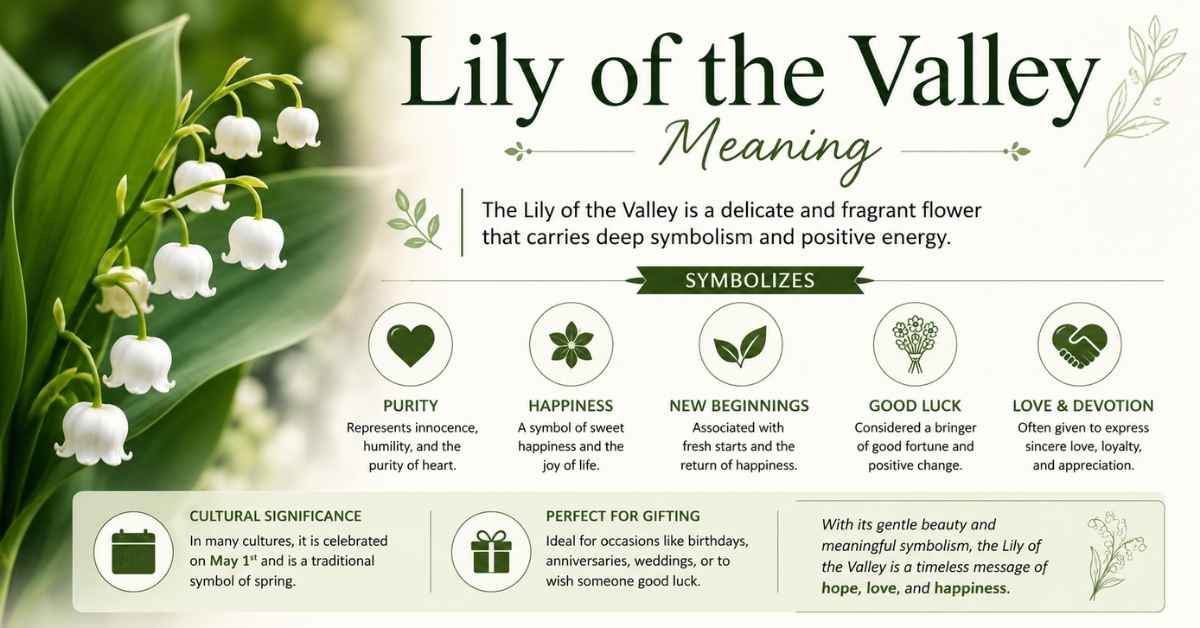
Lily of the valley meaning is most commonly associated with the return of happiness, purity, humility, hope, and new beginnings. Known for its delicate white bell-shaped flowers and sweet fragrance, Lily of the Valley (Convallaria majalis) has been treasured for centuries in cultures around the world. It symbolizes everything from everlasting love and faithful devotion to spiritual renewal and fresh starts, making it a popular choice for wedding bouquets, meaningful gifts, perfumes, and spring celebrations.
But its symbolism goes far beyond beauty. Throughout history, this charming flower has appeared in Christian traditions, Victorian flower language (floriography), royal weddings, literature, and folklore. Whether you’re wondering what Lily of the Valley symbolizes, looking for its spiritual meaning, choosing it for a special occasion, or simply curious about why it’s so admired, this guide explores every aspect of its significance in depth.
Lily of the Valley at a Glance
Before exploring its rich symbolism, here’s a quick overview of this iconic spring flower.
| Feature | Details |
|---|---|
| Botanical Name | Convallaria majalis |
| Common Names | May Lily, May Bells, Our Lady’s Tears |
| Plant Family | Asparagaceae |
| Native Regions | Europe, Asia, and parts of North America |
| Blooming Season | Spring (April to May) |
| Flower Color | White (with rare pink varieties) |
| Fragrance | Sweet, fresh, and delicate |
| Primary Symbolism | Return of happiness, purity, humility |
| Common Uses | Weddings, floral gifts, perfumes, gardens |
| Safety Note | All parts of the plant are poisonous if ingested. |
Quick Answer
If someone gives you Lily of the Valley, they’re often expressing one or more heartfelt messages:
- A wish for happiness and brighter days ahead
- Pure and sincere love
- Humility and kindness
- Faith, hope, and renewal
- Good luck for a new chapter in life
These timeless meanings explain why the flower remains one of the most beloved blooms in both personal celebrations and cultural traditions.
What Does Lily of the Valley Symbolize?
Flowers have always carried messages that words sometimes cannot express. In the language of flowers, few blooms communicate as many heartfelt emotions as Lily of the Valley.
Its symbolism has developed over centuries through religion, folklore, literature, and everyday traditions. Although different cultures interpret it in slightly different ways, several meanings appear consistently throughout history.
Purity and Innocence
One of the strongest associations with Lily of the Valley is purity.
Its tiny white bell-shaped blossoms naturally evoke feelings of cleanliness, honesty, and innocence. Throughout Europe, white flowers have long represented moral virtue, making Lily of the Valley a favorite in religious ceremonies, weddings, and christenings.
The flower’s graceful appearance reinforces this symbolism. Unlike bold or brightly colored blooms that demand attention, Lily of the Valley grows quietly beneath woodland trees, reflecting humility rather than extravagance.
Today, people often choose it to represent:
- Pure intentions
- Sincere affection
- Innocent love
- Honesty
- Gentle character
This symbolism makes it especially meaningful for bridal bouquets and milestone celebrations.
The Return of Happiness
Perhaps no meaning is more closely connected with Lily of the Valley than “the return of happiness.”
This phrase originated through Victorian floriography, also known as the language of flowers, where each bloom carried a specific emotional message.
The symbolism likely developed because Lily of the Valley blooms after the cold months of winter. Its appearance signals the arrival of spring, warmer days, and renewed life. For many people, it became a reminder that difficult seasons eventually give way to brighter moments.
That’s why the flower is often given to someone who is:
- Starting a new job
- Recovering from illness
- Celebrating a graduation
- Beginning married life
- Moving into a new home
- Overcoming personal challenges
In these situations, the flower gently communicates:
“Better days are ahead.”
That hopeful message continues to resonate today, making Lily of the Valley one of the most emotionally meaningful flowers in the world.
Humility and Quiet Strength
Unlike large, dramatic flowers that dominate a garden, Lily of the Valley grows close to the ground in shaded woodlands.
Its modest appearance has inspired another important symbolic meaning:
Humility.
Rather than seeking attention, it flourishes quietly while filling the air with an unforgettable fragrance. This combination of simplicity and strength has made it a symbol of:
- Quiet confidence
- Inner strength
- Modesty
- Grace under pressure
- Kindness without recognition
Many people relate this symbolism to the idea that true character doesn’t need to be loud to be noticed.
In today’s fast-paced world, that message feels especially relevant.
Hope and New Beginnings
Because Lily of the Valley blooms each spring, it naturally became associated with renewal.
Every blossom signals that winter has ended and new life has begun.
For this reason, the flower often represents:
- Fresh starts
- Personal growth
- Healing
- Second chances
- Optimism
- Positive change
People frequently include Lily of the Valley in celebrations marking life’s important transitions, including weddings, graduations, career changes, anniversaries, and new beginnings.
Its symbolism reminds us that every ending can become the start of something beautiful.
Everlasting Love and Devotion
Although roses are traditionally linked with romance, Lily of the Valley carries a quieter expression of love.
Instead of passionate romance alone, it symbolizes:
- Faithful commitment
- Enduring affection
- Loyalty
- Trust
- Lasting relationships
That’s one reason it appears so often in bridal bouquets.
Couples choosing this flower aren’t simply celebrating romance—they’re expressing hopes for a relationship built on trust, respect, and lifelong companionship.
Good Fortune and Positive Energy
In several European traditions, especially in France, Lily of the Valley is considered a symbol of good luck.
Receiving the flower is believed to bring:
- Prosperity
- Joy
- Success
- Blessings
- Positive energy
This belief has contributed to its popularity as a thoughtful gift during springtime celebrations and important life milestones.
Whether or not someone believes in luck, the flower’s optimistic symbolism makes it a meaningful gesture of encouragement.
The History Behind Lily of the Valley’s Meaning
Understanding the flower’s symbolism becomes even more fascinating when we explore its history. Many of today’s meanings didn’t appear overnight—they evolved through centuries of cultural traditions, religious beliefs, and social customs.
Ancient European Traditions
Long before the Victorian era gave flowers specific meanings, Lily of the Valley already held a special place in European folklore.
Its early spring blooms represented:
- The end of harsh winters
- Nature’s renewal
- Fertility
- Hope
- Prosperity
Communities celebrated the flower as one of the first signs that warmer, brighter days had arrived.
Because it appeared after long periods of cold weather, people naturally connected it with emotional renewal and fresh opportunities.
This seasonal cycle became the foundation for its enduring symbolism of hope and the return of happiness.
The Victorian Language of Flowers (Floriography)
During the 19th century, flowers became a subtle form of communication.
In an era when openly expressing emotions wasn’t always socially acceptable, people used bouquets to send carefully chosen messages.
Within this language of flowers, Lily of the Valley came to symbolize:
- Return of happiness
- Sweetness
- Purity
- Humility
- Trust
- Faithfulness
Victorian floral guides encouraged people to use the flower when welcoming loved ones back after a difficult period or wishing someone happiness in a new stage of life.
This meaning remains one of the strongest associations with Lily of the Valley today.
French May Day Tradition
One of the flower’s most cherished traditions comes from France.
Each year on May 1st, people exchange Lily of the Valley—known locally as Muguet—to wish friends and family good luck, happiness, and prosperity.
This custom dates back several centuries and has become an important cultural celebration.
Today, it’s common to see:
- Fresh bouquets
- Street flower vendors
- Handmade floral gifts
- Families exchanging small bunches as tokens of affection
The tradition reinforces the flower’s reputation as a symbol of hope and joyful beginnings.
Royal Wedding Traditions
Lily of the Valley has long been associated with elegance and timeless romance, making it a favorite flower among royal families.
Several famous royal brides have included it in their wedding bouquets because of its symbolism of:
- Faithful love
- Humility
- Purity
- Lasting happiness
- New beginnings
Its delicate appearance pairs beautifully with its emotional meaning, making it one of the most iconic wedding flowers in history.
The flower’s presence in high-profile ceremonies has also inspired countless couples around the world to include it in their own celebrations.
Rather than being chosen simply for its beauty, Lily of the Valley represents the hope that marriage will be built on trust, devotion, resilience, and enduring happiness.
Why Lily of the Valley Still Matters Today
Despite changing trends in gardening and floral design, Lily of the Valley has never lost its emotional appeal.
Its symbolism continues to resonate because it reflects experiences that nearly everyone understands:
- Starting over after difficult times
- Celebrating meaningful milestones
- Expressing sincere affection
- Honoring lasting relationships
- Finding hope in new beginnings
In a world where flowers often communicate emotions better than words, Lily of the Valley remains one of the most powerful symbols of quiet strength, enduring love, and the joyful promise that happiness can always return.
Spiritual and Biblical Meaning of Lily of the Valley
Beyond its graceful appearance and sweet fragrance, Lily of the Valley carries profound spiritual symbolism. Across Christian traditions, folklore, and personal reflection, it has become a symbol of faith, humility, hope, and God’s enduring love. While some meanings come from centuries-old traditions rather than direct biblical references, they continue to inspire people today.
Is Lily of the Valley Mentioned in the Bible?
One of the most common questions people ask is:
“Is Lily of the Valley mentioned in the Bible?”
The phrase “lily of the valleys” appears in Song of Solomon (Song of Songs) 2:1, where the speaker says:
“I am the rose of Sharon, and the lily of the valleys.”
However, biblical scholars generally agree that the original Hebrew text does not conclusively identify the plant as the modern Lily of the Valley (Convallaria majalis). The exact flower referenced remains uncertain, and it may have referred to a different wildflower native to the ancient Near East.
Even so, over time, Christian art, literature, and devotional traditions embraced Lily of the Valley as a symbol connected with this passage because of its delicate beauty and associations with purity.
Expert Insight: It’s important to distinguish between historical biblical interpretation and later Christian symbolism. While the flower isn’t definitively identified in Scripture, its symbolic meaning has become deeply rooted in Christian culture.
Learn More: What Is a Torta Girl
Christian Symbolism of Lily of the Valley
In Christianity, Lily of the Valley often represents qualities that believers strive to cultivate.
Purity
Its pristine white blossoms symbolize moral purity, innocence, and a heart devoted to God. This is one reason the flower is frequently used in religious celebrations and church floral arrangements.
Humility
The flower naturally bows downward, leading many to associate it with humility and modesty. Rather than standing tall above surrounding plants, it grows quietly in shaded woodlands, reminding believers that true greatness is often found in humility.
Hope and Resurrection
Because Lily of the Valley emerges every spring after winter, it symbolizes renewal, resurrection, and the promise of new life. This connection makes it especially meaningful during the Easter season, when themes of hope and spiritual rebirth are central.
Faith and Trust
Its reliable return each year serves as a reminder that difficult seasons eventually pass. For many Christians, the flower represents trust in God’s timing and confidence that brighter days will come.
Spiritual Lessons We Can Learn from Lily of the Valley
Regardless of religious beliefs, the flower offers meaningful life lessons.
Growth Happens Quietly
Lily of the Valley doesn’t bloom loudly or dramatically. Instead, it flourishes in peaceful woodland settings, teaching us that meaningful personal growth often happens quietly and consistently.
Beauty Can Exist Alongside Strength
Although its blossoms appear delicate, the plant is remarkably resilient. This reflects the idea that gentleness and strength are not opposites—they often exist together.
Every Season Has a Purpose
Just as spring follows winter, difficult chapters in life can lead to healing, wisdom, and new opportunities. The flower’s annual bloom serves as a hopeful reminder that new beginnings often emerge after periods of hardship.
Lily of the Valley Meaning in Love and Relationships
Flowers have long been used to express emotions that words cannot fully capture, and Lily of the Valley is no exception. Its symbolism focuses less on passionate romance and more on lasting affection, loyalty, trust, and heartfelt devotion.
A Symbol of Pure Love
Unlike red roses, which symbolize intense passion, Lily of the Valley represents gentle, sincere, and unconditional love.
Giving someone this flower can express:
- Deep admiration
- Respect
- Sincere affection
- Pure intentions
- Emotional honesty
It’s a thoughtful choice for relationships built on trust and mutual understanding.
Faithfulness and Lifelong Commitment
Because it symbolizes enduring happiness and unwavering devotion, Lily of the Valley has become closely associated with long-term relationships.
It conveys messages such as:
- “I’m committed to you.”
- “Our bond grows stronger with time.”
- “I value loyalty and trust.”
This makes it especially meaningful for engagements, anniversaries, and weddings.
Healing After Difficult Times
Another unique aspect of the flower is its connection to emotional healing. Since it represents the return of happiness, it’s often given after challenging periods to encourage hope and resilience.
Whether someone is recovering from loss, starting a new chapter, or overcoming personal struggles, the flower offers a gentle message:
“Brighter days are ahead.”
Why Lily of the Valley Is a Popular Wedding Flower
Few flowers are as closely linked with weddings as Lily of the Valley. Its elegant appearance, delicate fragrance, and uplifting symbolism make it a timeless choice for bridal bouquets and floral arrangements.
What It Represents in Marriage
For couples, Lily of the Valley symbolizes:
- Faithful love
- Trust
- Loyalty
- Humility
- Shared happiness
- A hopeful future together
Rather than emphasizing dramatic romance, it reflects the qualities that help relationships thrive over many years.
Why Royal Brides Choose It
Several royal brides have included Lily of the Valley in their wedding bouquets, helping cement its reputation as a flower of elegance and lasting love.
Its popularity stems from more than tradition. It beautifully represents the hope that marriage will be filled with:
- Joy
- Mutual respect
- Devotion
- New beginnings
- Enduring happiness
This symbolism has inspired countless couples around the world to include it in their own ceremonies.
Pairing Lily of the Valley with Other Wedding Flowers
Florists often combine Lily of the Valley with other blooms to create bouquets with layered meanings.
| Flower | Combined Symbolism |
|---|---|
| White Roses | Pure and everlasting love |
| Peonies | Prosperity and a joyful marriage |
| Ranunculus | Charm and admiration |
| Hydrangeas | Gratitude and understanding |
| Garden Roses | Romance and devotion |
These combinations allow couples to tell a meaningful story through their floral choices.
Lily of the Valley Meaning in Different Cultures
Although many symbolic meanings overlap, different cultures celebrate Lily of the Valley in unique ways.
| Culture or Tradition | Meaning |
|---|---|
| France | Good luck, happiness, and prosperity |
| Victorian England | Return of happiness |
| Christian Tradition | Purity, humility, faith, and hope |
| Modern Western Culture | New beginnings, love, and encouragement |
| Wedding Traditions | Devotion and lifelong commitment |
France: A Flower of Good Luck
In France, May 1st (La Fête du Muguet) is one of the flower’s most celebrated traditions. Friends and family exchange small bouquets of Muguet (Lily of the Valley) to wish one another good fortune, joy, and success.
This centuries-old custom reinforces the flower’s association with optimism and positive beginnings.
Victorian England: The Language of Flowers
During the Victorian era, flowers became a secret language of emotions.
Lily of the Valley conveyed a heartfelt wish for:
- Happiness
- Reconciliation
- Hope
- Faithfulness
- Gentle affection
Its message was especially meaningful when given to someone beginning a new chapter in life.
Modern Symbolism Around the World
Today, Lily of the Valley continues to symbolize:
- Personal growth
- Emotional healing
- Encouragement
- Kindness
- Renewal
- Lasting relationships
Its universal message of hope makes it meaningful across many cultures and generations.
Lily of the Valley Meaning in Tattoos
Floral tattoos often tell deeply personal stories, and Lily of the Valley is among the most symbolic flower designs.
A Fresh Start
Many people choose this flower after overcoming significant life challenges. It represents:
- Recovery
- Personal transformation
- New opportunities
- Hope after hardship
Remembering Loved Ones
Because it symbolizes enduring love and cherished memories, Lily of the Valley is also a meaningful memorial tattoo.
It can represent:
- Someone deeply missed
- Gratitude
- Family bonds
- Lasting influence
- Eternal love
Quiet Strength
Unlike bold floral designs, Lily of the Valley tattoos often reflect resilience through gentleness.
They remind the wearer that:
- Strength isn’t always loud.
- Healing takes time.
- Hope can bloom again.
Dream Meaning of Lily of the Valley
Dreams are highly personal, so interpretations vary. While there is no scientific evidence supporting universal dream meanings, many people find symbolic interpretations meaningful for personal reflection.
If Lily of the Valley appears in a dream, it is often associated with:
- Emotional healing
- A hopeful future
- Reconciliation
- Inner peace
- New beginnings
- Letting go of past pain
For some, it reflects optimism after a difficult season. For others, it may symbolize gratitude, spiritual growth, or renewed confidence.
Rather than predicting the future, these interpretations encourage self-reflection and emotional awareness.
Is Lily of the Valley a Good Gift?
Absolutely—when chosen thoughtfully, Lily of the Valley is one of the most meaningful flowers you can give.
Its symbolism makes it appropriate for many life events, especially those centered on hope, gratitude, and lasting relationships.
Best Occasions to Gift Lily of the Valley
| Occasion | Why It’s Meaningful |
|---|---|
| Wedding | Represents faithful love and a joyful future |
| Anniversary | Celebrates loyalty and lifelong commitment |
| Mother’s Day | Expresses gratitude and unconditional love |
| Graduation | Symbolizes fresh starts and exciting opportunities |
| Housewarming | Wishes happiness in a new home |
| Retirement | Marks the beginning of a rewarding new chapter |
| Recovery from Illness | Offers hope and encouragement |
| Sympathy | Conveys comfort, remembrance, and renewal |
When It May Not Be the Best Choice
Although beautiful, Lily of the Valley isn’t suitable for every situation.
Consider another flower if you want to express:
- Passionate romance (red roses may be more appropriate)
- Friendship alone (yellow flowers often communicate this more clearly)
- Bold celebration (sunflowers or gerbera daisies may better match the occasion)
Also remember that Lily of the Valley is poisonous if ingested, so extra care should be taken when gifting it to households with young children or curious pets.
Why This Flower Continues to Inspire
Whether featured in bridal bouquets, exchanged during French May Day celebrations, admired in woodland gardens, or chosen for a meaningful tattoo, Lily of the Valley remains a timeless symbol of hope, purity, humility, enduring love, and the joyful return of happiness.
Its quiet beauty reminds us that life’s most meaningful moments often come not through grand gestures, but through small acts of kindness, resilience, and unwavering faith that brighter days always lie ahead.
See More: Slang Words to Describe a Hot Guy
Hidden Meanings of Lily of the Valley Most Articles Don’t Explain
While most guides mention that Lily of the Valley symbolizes purity and the return of happiness, they often overlook why these meanings resonate so deeply. The flower’s symbolism isn’t based on tradition alone—it also reflects human psychology, seasonal change, and the emotions people naturally associate with nature.
Let’s explore the deeper layers behind its enduring appeal.
Its Fragrance Represents Lasting Memories
One of the most distinctive features of Lily of the Valley is its sweet, delicate fragrance.
Psychologists have long recognized that scent is closely connected to memory and emotion. A familiar floral fragrance can instantly remind people of childhood, family gatherings, weddings, or spring mornings.
That’s one reason Lily of the Valley is often associated with:
- Nostalgia
- Comfort
- Cherished memories
- Emotional healing
- Timeless love
Its fragrance has also inspired many luxury perfumes, reinforcing its image as a flower of elegance and refinement.
Why White Flowers Symbolize Purity
Across many cultures, white flowers represent honesty, peace, innocence, and new beginnings.
Lily of the Valley strengthens these associations because its tiny white bells appear fresh and untouched each spring.
Unlike brightly colored flowers that symbolize passion or celebration, Lily of the Valley communicates quieter emotions such as:
- Sincerity
- Humility
- Faith
- Grace
- Gentle encouragement
A Reminder That Hope Returns
The flower blooms after winter, making it a natural symbol of optimism.
Its annual appearance reminds us that:
- Difficult seasons don’t last forever.
- Growth often follows hardship.
- Every ending creates space for a new beginning.
This simple yet powerful message explains why Lily of the Valley remains meaningful during graduations, weddings, recoveries, retirements, and other major life transitions.
Common Misconceptions About Lily of the Valley
Despite its popularity, several myths surround this flower.
Myth 1: It’s a True Lily
Reality: Despite its name, Lily of the Valley is not a true lily.
Its botanical name is Convallaria majalis, and it belongs to the Asparagaceae family—not the Lilium genus.
Understanding this distinction helps avoid confusion with true lilies, which differ in appearance, growth habits, and symbolism.
Myth 2: It’s Safe Because It’s Beautiful
Many people assume delicate flowers are harmless.
In reality, every part of Lily of the Valley is poisonous if ingested. It contains naturally occurring compounds called cardiac glycosides, which can be dangerous to humans and pets.
Always:
- Keep it away from children and pets.
- Wash hands after handling large quantities.
- Never consume any part of the plant.
Its beauty should always be appreciated with proper care.
Myth 3: It Only Symbolizes Romance
While the flower is popular in weddings, its meaning extends far beyond romantic love.
It can also symbolize:
- Friendship
- Hope
- Healing
- Faith
- Gratitude
- Renewal
- Remembrance
- Encouragement
This versatility makes it suitable for many meaningful occasions.
Myth 4: Every Biblical Reference Refers to This Flower
As discussed earlier, scholars generally agree that the flower mentioned in Song of Solomon cannot be identified with certainty as modern Lily of the Valley.
The connection comes primarily from later Christian tradition, not definitive botanical evidence.
Understanding this distinction helps readers appreciate both the flower’s symbolism and historical context.
Beauty with Caution: Is Lily of the Valley Poisonous?
Yes. Lily of the Valley is a highly poisonous plant if ingested.
It contains cardiac glycosides, natural compounds that affect heart function. Even small amounts can be harmful to people, dogs, cats, and other animals.
Safety Tips
- Do not eat any part of the plant.
- Wear gloves if handling large quantities.
- Place arrangements out of reach of children and pets.
- Contact a medical professional or veterinarian immediately if ingestion is suspected.
Its toxicity does not diminish its symbolic beauty—it simply means it should be enjoyed responsibly.
Lily of the Valley Compared with Other Symbolic Flowers
Choosing the right flower depends on the message you want to send.
| Flower | Primary Meaning | Best For |
|---|---|---|
| Lily of the Valley | Return of happiness, purity, hope | Weddings, encouragement, new beginnings |
| White Lily | Purity, remembrance | Memorials, sympathy |
| Red Rose | Passionate love | Romance, Valentine’s Day |
| Peony | Prosperity, happy marriage | Weddings, anniversaries |
| Daisy | Innocence, optimism | Friendship, celebrations |
| Lavender | Calm, serenity | Wellness gifts, encouragement |
| Cherry Blossom | Renewal, life’s beauty | Personal growth, spring celebrations |
Expert Tip: If your goal is to express hope after a difficult time, Lily of the Valley is one of the most meaningful floral choices available.
How to Choose Lily of the Valley for Meaningful Occasions
Not every flower sends the same emotional message. Understanding when to choose Lily of the Valley can help you express your feelings more thoughtfully.
Choose Lily of the Valley If You Want to Express
- Hope after hardship
- New beginnings
- Pure affection
- Faithful love
- Humility
- Gratitude
- Encouragement
- Support during life transitions
It Works Especially Well For
- Weddings
- Engagements
- Anniversaries
- Graduations
- Mother’s Day
- Housewarming gifts
- Retirement celebrations
- Recovery from illness
- Sympathy arrangements
- Spring birthdays
Frequently Asked Questions
What does Lily of the Valley symbolize?
Lily of the Valley symbolizes purity, humility, hope, the return of happiness, new beginnings, faithful love, and lasting devotion.
Is Lily of the Valley lucky?
Yes. In several European traditions—especially in France—it is considered a good luck flower and is exchanged on May 1st to wish happiness and prosperity.
What is the spiritual meaning of Lily of the Valley?
Spiritually, the flower represents:
- Faith
- Hope
- Renewal
- Inner peace
- Humility
- Quiet strength
Many people also associate it with emotional healing and trusting that better days lie ahead.
What does Lily of the Valley mean in the Bible?
The phrase “lily of the valleys” appears in Song of Solomon, but scholars generally do not identify it with certainty as the modern Lily of the Valley. Its connection to Christian symbolism developed largely through tradition rather than definitive botanical evidence.
Why do brides carry Lily of the Valley?
Brides often choose it because it symbolizes:
- Pure love
- Humility
- Faithfulness
- A joyful marriage
- A hopeful future together
Its elegant appearance and timeless symbolism also make it a favorite in royal weddings.
Is Lily of the Valley poisonous?
Yes. All parts of the plant are poisonous if ingested. Keep it away from children and pets, and handle it responsibly.
What does a Lily of the Valley tattoo mean?
A Lily of the Valley tattoo commonly represents:
- Personal growth
- Emotional healing
- Hope
- Renewal
- Family bonds
- Lasting love
- Quiet resilience
Is Lily of the Valley a good gift?
Absolutely. It’s an excellent choice for weddings, anniversaries, graduations, Mother’s Day, housewarmings, and moments when you want to wish someone happiness, encouragement, or a fresh start.
Does Lily of the Valley symbolize love?
Yes, but it symbolizes gentle, faithful, and enduring love rather than passionate romance alone. It’s ideal for expressing trust, commitment, and lifelong devotion.
Is Lily of the Valley the same as a true lily?
No. Despite its common name, Lily of the Valley is not a true lily. It belongs to the Asparagaceae family and has different botanical characteristics from plants in the Lilium genus.
Final Thoughts:
Lily of the Valley is much more than a beautiful spring flower. For centuries, it has symbolized purity, humility, hope, the return of happiness, faithful love, and new beginnings. Its delicate white bell-shaped flowers, sweet fragrance, and rich cultural history have made it a cherished bloom in Christian traditions, Victorian floriography, French May Day celebrations, royal weddings, and meaningful gifts.
Whether you’re choosing it for a bridal bouquet, giving it to encourage someone through a new chapter, exploring its spiritual meaning, or simply appreciating its timeless beauty, Lily of the Valley reminds us that life’s most meaningful moments often begin quietly. Just as it blooms after the cold of winter, it encourages us to believe that healing follows hardship, hope follows uncertainty, and happiness has a way of returning.
Its story is one of resilience, grace, and quiet strength—qualities that continue to make Lily of the Valley one of the world’s most treasured symbolic flowers.