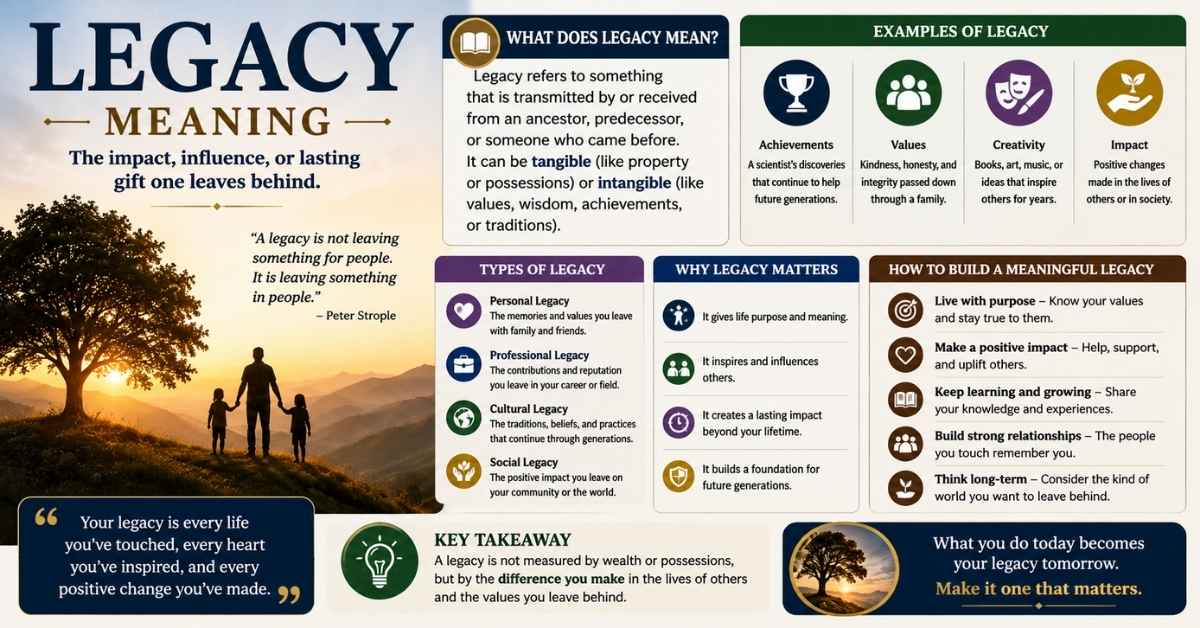
Legacy meaning refers to something valuable that is passed down from one person, generation, or organization to another. It can be a physical inheritance, such as money or property, or something intangible like values, achievements, traditions, reputation, knowledge, or influence. In modern usage, the word also describes legacy software, legacy systems, and other outdated technologies that continue to be used.
Understanding the legacy meaning in English helps you use the word correctly in conversations, writing, law, business, technology, and personal development. Whether someone talks about leaving a legacy, building a legacy, or maintaining a legacy system, the idea centers on something enduring that continues to have an impact over time.
| Quick Facts About Legacy | Details |
|---|---|
| Word Type | Noun |
| Pronunciation | LEG-uh-see |
| Plural | Legacies |
| Origin | Latin legatus / legare (“to send or appoint”) |
| Common Meanings | Inheritance, lasting impact, tradition, influence |
What Does Legacy Mean?
The simplest legacy definition is:
A legacy is something that remains or is passed on from the past, especially something that continues to influence future generations.
A legacy can be:
- Money or property left through a will.
- Personal achievements people remember.
- Family traditions passed down over generations.
- Business values established by founders.
- Technology that organizations continue to use despite being outdated.
For example:
- Her grandmother left a generous legacy to charity.
- His kindness became his greatest legacy.
- The company still relies on a legacy system.
Legacy Meaning in Simple Words
In simple terms, legacy means what you leave behind.
It doesn’t always refer to money. Often, people remember someone for their:
- Character
- Values
- Leadership
- Achievements
- Contributions
- Reputation
Someone who helps their community may leave a stronger legacy than someone who simply leaves wealth.
Legacy Meaning for Kids
For children, a simple explanation is:
A legacy is something good that people remember about you or something you pass on to others, such as kindness, knowledge, or traditions.
Example:
A teacher’s legacy is helping hundreds of students succeed.
Origin and History of the Word Legacy
The word legacy comes from the Latin word legare, meaning to appoint or leave something to another person.
Originally, it mainly referred to property given through a will. Over time, its meaning expanded to include ideas, traditions, influence, leadership, culture, and achievements.
Today, the word is widely used in everyday conversations, business, technology, history, and education.
Different Meanings of Legacy in Various Contexts
Legacy Meaning in Life
In everyday life, a legacy is the lasting impact your actions have on other people.
Examples include:
- Raising a loving family
- Helping your community
- Inspiring future generations
- Creating meaningful work
Legacy Meaning in the Bible
In the Bible, legacy is closely connected with faith, obedience, wisdom, and spiritual inheritance.
A biblical legacy isn’t only about material possessions. It also includes:
- Passing down faith
- Teaching God’s values
- Living a righteous life
- Leaving an example of love and service
Many biblical figures are remembered because of their spiritual legacy, not their wealth.
Legacy Meaning in Law
In legal terms, a legacy is money or personal property left to someone through a will.
Common legal terms include:
- Bequest
- Beneficiary
- Estate
- Executor
- Inheritance
- Probate
Legacy Meaning in Business
Businesses often discuss their legacy in terms of:
- Brand reputation
- Company values
- Customer trust
- Leadership
- Long-term impact
A founder’s legacy may continue to shape a company decades after retirement.
Legacy Meaning in Technology
Technology uses the word differently.
A legacy system is an older computer or information system that remains in use because replacing it is expensive or risky.
Examples include:
- Legacy software
- Legacy hardware
- Legacy applications
- Legacy databases
Although these systems are outdated, many organizations continue using them because they still support critical operations.
Leaving a Legacy Meaning
Leaving a legacy means creating something that continues to benefit others long after you’re gone.
A positive legacy can include:
- Helping people
- Sharing knowledge
- Supporting charitable causes
- Building successful businesses
- Inspiring others
Many people begin creating a legacy while they are still alive through their daily actions and decisions.
Building a Legacy Meaning
Building a legacy means intentionally creating a lasting impact.
You can build a meaningful legacy by:
- Living according to your values.
- Helping others grow.
- Sharing knowledge.
- Supporting your community.
- Leading with integrity.
- Creating something that benefits future generations.
Your legacy is shaped more by consistent actions than by a single achievement.
Lasting Legacy Meaning
A lasting legacy is something that continues to influence people for many years.
Examples include:
| Person or Organization | Lasting Legacy |
|---|---|
| Great teachers | Educated generations |
| Inventors | Life-changing innovations |
| Charities | Community support |
| Families | Traditions and values |
| Businesses | Trusted brands and culture |
A lasting legacy is often built through service, leadership, and positive influence.
Legacy vs. Heritage vs. Inheritance
| Term | Meaning |
|---|---|
| Legacy | Something lasting that is passed on, including influence, values, or property. |
| Heritage | Culture, traditions, and history inherited from previous generations. |
| Inheritance | Money, property, or possessions received after someone’s death. |
Although these words are related, they are not interchangeable in every situation.
Synonyms and Antonyms of Legacy
Common Synonyms
- Inheritance
- Bequest
- Heritage
- Tradition
- Contribution
- Influence
- Reputation
- Impact
- Gift
- Birthright
Common Antonyms
- Loss
- Neglect
- Forgetfulness
- Oblivion
- Insignificance
Legacy Meaning with Real-Life Examples
Understanding legacy becomes easier with examples:
- A parent leaves a legacy by teaching honesty and kindness.
- A scientist leaves a legacy through discoveries.
- A business founder creates a legacy by building a trusted company.
- A volunteer leaves a legacy through years of community service.
- A writer leaves a literary legacy that inspires readers for generations.
Common Phrases Using Legacy
You may come across these expressions:
- Leave a legacy
- Living legacy
- Family legacy
- Corporate legacy
- Legacy brand
- Legacy project
- Legacy software
- Legacy system
- Legacy code
- Cultural legacy
Each phrase reflects the idea of something that continues to have value or influence.
LEARN MORE: Adonai Meaning
Common Misconceptions About Legacy
Many people misunderstand the word.
Myth: Legacy only means inheritance.
Fact: Legacy also includes achievements, influence, values, traditions, and reputation.
Myth: Legacy only matters after death.
Fact: People build and strengthen their legacy throughout their lives.
Myth: Legacy is only personal.
Fact: Businesses, schools, governments, charities, and even software systems can have a legacy.
Frequently Asked Questions
What does legacy mean in simple words?
Legacy means something valuable you leave behind, such as money, traditions, knowledge, achievements, or a positive influence.
What is legacy meaning in English?
In English, legacy refers to something inherited from the past or something passed on to future generations, including property, values, reputation, or lasting influence.
What is legacy meaning in life?
In life, legacy is the lasting difference you make through your actions, character, and contributions.
What does leaving a legacy mean?
It means creating a positive impact that continues to benefit others long after your work is done.
What is building a legacy?
Building a legacy involves making intentional choices that leave future generations with something meaningful, whether through leadership, service, education, or innovation.
What is a legacy system?
A legacy system is an older computer or software system that remains in use because it still performs essential functions despite being outdated.
Is legacy the same as inheritance?
No. Inheritance usually refers to money or property, while legacy has a broader meaning that includes influence, achievements, traditions, and values.
Conclusion
Legacy meaning goes far beyond receiving money through a will. Today, the word represents lasting influence, personal achievements, family traditions, cultural heritage, business reputation, and even older technology systems that continue to serve a purpose. Whether you’re exploring legacy meaning in the Bible, legacy meaning in life, legacy meaning for kids, or legacy meaning in English, the central idea remains the same: a legacy is what continues to matter long after it is created.
By understanding the different contexts in which the word is used, you can apply it accurately in everyday conversations, professional settings, legal discussions, and personal growth. Ultimately, the most meaningful legacy is often not what we own—but the positive impact we leave on others.