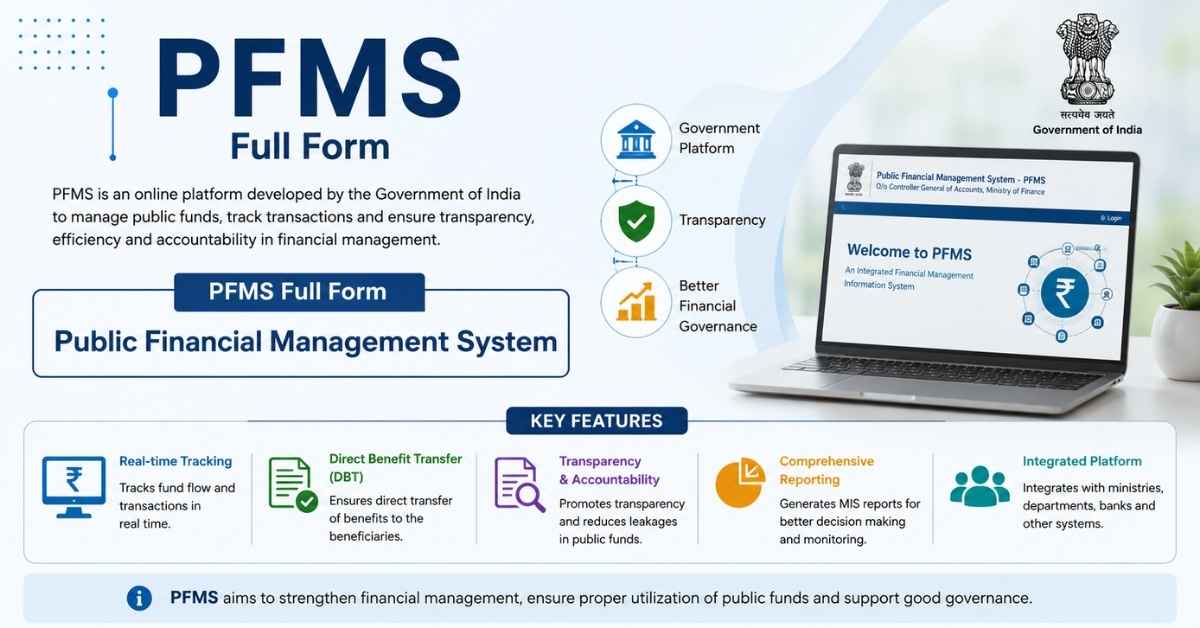
PFMS full form is Public Financial Management System. It is a Government of India initiative developed to manage, monitor, and track the flow of public funds efficiently. Whether it’s a scholarship payment, Direct Benefit Transfer (DBT), pension, government subsidy, or other welfare benefits, PFMS plays a crucial role in ensuring that funds reach the right beneficiary securely and transparently.
If you’ve recently seen PFMS on a scholarship portal, bank message, government website, or payment notification, you might be wondering what it means and why it’s important. The answer goes far beyond just the acronym. PFMS acts as the digital backbone of government financial management by helping departments release funds, validate beneficiary bank accounts, and monitor payments from allocation to final disbursement.
In this comprehensive guide, you’ll learn what PFMS is, how it works, who uses it, how it supports Direct Benefit Transfer (DBT), how to check PFMS payment status, and why it has become one of India’s most important digital governance systems. Along the way, we’ll simplify technical concepts into plain language and share practical examples that make the system easy to understand.
PFMS Full Form at a Glance
| Particular | Details |
|---|---|
| Full Form | Public Financial Management System |
| Developed By | Controller General of Accounts (CGA) |
| Under | Ministry of Finance, Government of India |
| Country | India |
| Purpose | Managing, tracking, and monitoring public funds |
| Previously Known As | Central Plan Scheme Monitoring System (CPSMS) |
| Common Uses | Scholarship payments, pensions, subsidies, welfare schemes, grants, and government payments |
| Primary Users | Government departments, implementing agencies, educational institutions, and beneficiaries |
| Related System | Direct Benefit Transfer (DBT) |
| Official Objective | Improve financial transparency, accountability, and efficient fund management |
Quick Fact: Millions of government transactions are processed or tracked through PFMS, making it one of India’s most significant public financial management platforms.
What Is PFMS? (Simple Explanation Anyone Can Understand)
Imagine the Government of India announces a scholarship for students across the country. Funds are allocated by the Ministry, transferred to the concerned department, verified, and finally deposited into eligible students’ bank accounts.
Without a centralized system, tracking every rupee would be extremely difficult.
This is where PFMS comes in.
Public Financial Management System (PFMS) is a centralized digital platform that helps government departments manage public money from the moment it is allocated until it reaches the final beneficiary. It acts as a transparent financial tracking system that reduces delays, minimizes errors, and strengthens accountability.
In simple terms, PFMS is like a digital control center that follows government funds throughout their entire journey.
Instead of manually monitoring thousands of payments, departments can use PFMS to:
- Track fund allocation
- Monitor expenditure
- Validate beneficiary bank accounts
- Process electronic payments
- Generate financial reports
- Improve transparency in government spending
For citizens, PFMS often becomes visible when they need to:
- Check a scholarship payment status
- Verify a government subsidy
- Track a pension payment
- Confirm a Direct Benefit Transfer (DBT)
- Monitor the status of a welfare scheme payment
Explaining PFMS with a Real-Life Example
Let’s say Riya, a university student, qualifies for a government scholarship.
Here’s what typically happens:
- The scholarship amount is approved by the concerned ministry.
- The payment details are processed through PFMS.
- Her bank account information is validated.
- The funds are transferred electronically.
- The payment status can be tracked through the PFMS system.
Without PFMS, this process could involve multiple disconnected systems, increasing the chances of delays and errors. With a centralized platform, the government can monitor every stage more effectively.
Why Was PFMS Created?
Before PFMS, government departments often relied on separate financial systems, making it difficult to track how funds moved between ministries, agencies, and beneficiaries.
Some common challenges included:
- Delayed fund releases
- Limited visibility into fund utilization
- Manual reconciliation
- Duplicate or incorrect beneficiary records
- Difficulty monitoring large government schemes
- Reduced financial transparency
To address these issues, the Government of India introduced a centralized platform that could streamline fund management while improving accountability.
The key objectives of PFMS include:
- Enhancing financial transparency
- Reducing payment delays
- Improving fund tracking
- Supporting Direct Benefit Transfer (DBT)
- Strengthening financial accountability
- Providing real-time financial information
- Improving public expenditure management
Today, PFMS supports numerous government programs by enabling efficient digital payments and better monitoring of public funds.
How PFMS Supports India’s Digital Governance
India has increasingly adopted digital platforms to improve public service delivery. PFMS is an important part of this transformation because it helps modernize how government funds are managed.
Instead of relying on paper-based workflows and fragmented financial systems, departments can use a unified platform to oversee payments, monitor budgets, and maintain accurate financial records.
PFMS contributes to broader governance goals by helping:
- Improve financial transparency
- Reduce administrative inefficiencies
- Support Digital India initiatives
- Strengthen accountability in public spending
- Enable faster digital payments
- Improve monitoring of government schemes
- Reduce leakages in fund distribution
For citizens, this often means quicker access to benefits and better visibility into payment processes.
How PFMS Works: Step-by-Step
Although PFMS operates behind the scenes, understanding its workflow helps explain why it is so important.
Step 1: Government Allocates Funds
Everything begins when a ministry or government department allocates money for a particular scheme or program.
Examples include:
- Scholarships
- Pension schemes
- Rural development programs
- Agricultural subsidies
- Social welfare initiatives
- Infrastructure projects
The allocated funds are recorded within the financial management process.
Step 2: Departments Authorize Payments
Once funding is approved, the responsible department verifies eligible beneficiaries and prepares payment instructions.
This stage may include:
- Beneficiary verification
- Scheme approval
- Budget confirmation
- Payment authorization
Accuracy at this stage helps reduce payment errors later.
Step 3: Beneficiary Details Are Verified
Before funds are released, beneficiary information is checked carefully.
Verification may include:
- Bank account details
- Beneficiary identification
- Scheme eligibility
- Required documentation
This step helps ensure that payments are directed to the intended recipients.
Step 4: Banking Systems Process the Payment
After verification, payment instructions move through the appropriate banking channels.
PFMS works with authorized banking infrastructure to facilitate electronic transfers while maintaining records for monitoring and reporting.
This integration helps improve payment efficiency and supports secure digital transactions.
Step 5: Funds Reach the Beneficiary
Once processing is complete, the funds are credited to the beneficiary’s registered bank account.
Depending on the scheme, beneficiaries may receive:
- Scholarship payments
- Pension installments
- Subsidy amounts
- Welfare benefits
- Grant-related payments
This digital process reduces reliance on manual disbursement methods and improves traceability.
Step 6: Payment Status Can Be Tracked
One of PFMS’s most valuable features is payment tracking.
Instead of waiting without information, beneficiaries can often verify whether a payment has been:
- Initiated
- Processed
- Successfully credited
- Returned
- Pending further action
This improves transparency and reduces uncertainty for users.
Who Uses PFMS?
Many people assume PFMS is only for government officials, but its impact extends to millions of citizens who receive government benefits.
Here are the primary groups that interact with or benefit from PFMS.
Students
Students are among the most frequent public users of PFMS because many scholarship programs rely on it for payment processing.
Typical use cases include:
- Central government scholarships
- Higher education financial assistance
- Fellowship payments
- Educational grants
Students often search for PFMS scholarship status or PFMS payment status to check whether their financial aid has been processed.
Farmers
Various agricultural support programs may use PFMS to facilitate eligible payments.
Examples include:
- Farming assistance
- Agricultural subsidies
- Rural development support
- Government welfare initiatives
A centralized financial management system helps improve transparency in these programs.
Pensioners
Many pension beneficiaries rely on government payment systems that integrate with PFMS.
For pensioners, timely and accurate disbursement is especially important, making reliable payment tracking a valuable feature.
Government Employees
Government departments use PFMS to:
- Monitor expenditures
- Track allocated budgets
- Authorize payments
- Generate financial reports
- Improve financial planning
- Ensure compliance with financial management procedures
For administrators, PFMS provides greater visibility into how public funds are utilized.
Educational Institutions
Universities, colleges, and educational organizations involved in government-funded programs may interact with PFMS for:
- Scholarship distribution
- Research grants
- Institutional funding
- Fellowship management
This helps ensure funds are distributed according to approved financial processes.
Government Departments and Implementing Agencies
The largest users of PFMS are government ministries, departments, autonomous bodies, and implementing agencies responsible for public expenditure.
They use the platform to:
- Monitor fund flow
- Track expenditures
- Manage budgets
- Process payments
- Generate reports
- Improve financial accountability
- Support efficient implementation of government schemes
For these organizations, PFMS serves as a comprehensive public financial management platform that strengthens transparency, efficiency, and oversight.
Learn More: Lily of the Valley Meaning
What Can You Do Using PFMS?
Although most people search for PFMS full form to learn what the acronym means, they soon discover that the platform offers much more than a definition. Public Financial Management System (PFMS) supports several financial processes that improve transparency, simplify payment tracking, and help government departments manage public funds efficiently.
Here are some of the most important functions of PFMS.
Track Government Payment Status
One of the most popular uses of PFMS is checking the status of government payments.
Depending on the scheme, beneficiaries may be able to verify whether their payment has been:
- Initiated
- Under processing
- Successfully credited
- Returned
- Pending further verification
This feature reduces uncertainty by allowing beneficiaries to understand where their payment stands.
Monitor Scholarship Payments
Students receiving financial assistance under government scholarship programs frequently use PFMS to track their scholarship disbursement.
Instead of repeatedly contacting their educational institution or department, students can often verify whether their scholarship has been processed and sent for payment.
Support Direct Benefit Transfer (DBT)
PFMS plays an important role in supporting Direct Benefit Transfer (DBT) by helping government departments process eligible payments electronically.
Through digital fund management and beneficiary verification, PFMS contributes to faster and more transparent transfers under many government welfare schemes.
Validate Beneficiary Information
Accurate beneficiary details are essential for successful fund transfers.
PFMS helps departments verify information such as:
- Bank account details
- Beneficiary records
- Scheme-related information
- Payment eligibility
This verification process reduces payment failures caused by incorrect or incomplete information.
Improve Financial Monitoring
Government departments also use PFMS to:
- Monitor allocated budgets
- Track public expenditure
- Review financial reports
- Analyze fund utilization
- Improve accountability across schemes
By centralizing financial information, PFMS makes it easier to oversee large-scale government programs.
Real-Life Examples of PFMS in Action
Government systems can sometimes feel difficult to understand because they are explained using technical language. Let’s look at how PFMS works in everyday situations.
Example 1: A Student Receiving a Scholarship
An engineering student qualifies for a government scholarship.
Here’s how PFMS supports the process:
- The scholarship is approved.
- The student’s bank details are verified.
- Payment instructions are processed.
- The scholarship amount is transferred electronically.
- The student can track the payment status through PFMS-supported services.
Instead of wondering when the scholarship will arrive, the student gains greater visibility into the payment process.
Example 2: A Farmer Receiving an Agricultural Subsidy
A farmer becomes eligible for a government subsidy under an agricultural support scheme.
Using PFMS:
- The department verifies eligibility.
- Payment information is processed.
- The subsidy is transferred to the registered bank account.
- Authorities can monitor the transaction for transparency and accountability.
Example 3: Monthly Pension Payment
A retired government employee receives a monthly pension.
PFMS helps departments:
- Process recurring payments.
- Maintain payment records.
- Improve financial tracking.
- Reduce delays caused by manual processing.
Example 4: Government Department Managing Public Funds
A ministry is responsible for distributing funds across multiple districts.
Using PFMS, officials can:
- Monitor fund allocation.
- Review expenditure.
- Track payment progress.
- Generate financial reports.
- Improve decision-making using centralized financial data.
This demonstrates that PFMS benefits both citizens and government administrators.
PFMS and Direct Benefit Transfer
Many people mistakenly believe that PFMS and DBT are the same. While they are closely connected, they perform different roles.
Understanding the distinction helps avoid confusion.
What Is Direct Benefit Transfer?
Direct Benefit Transfer (DBT) is a Government of India initiative that sends eligible financial benefits directly to beneficiaries instead of routing them through multiple intermediaries.
Examples include:
- Scholarships
- Subsidies
- Pension payments
- Welfare assistance
- Financial support under eligible government schemes
The objective is to make payments more efficient, transparent, and less prone to leakage.
How PFMS Supports DBT
PFMS provides the financial infrastructure that helps departments manage and monitor many DBT-related payments.
It assists with:
- Payment processing
- Beneficiary verification
- Financial reporting
- Fund monitoring
- Electronic payment workflows
In simple terms:
- DBT focuses on delivering benefits directly to eligible citizens.
- PFMS helps manage, process, and monitor many of those financial transactions.
Why This Partnership Matters
Together, PFMS and DBT help improve:
- Financial transparency
- Payment efficiency
- Reduced manual intervention
- Improved accountability
- Better fund tracking
- Faster beneficiary payments
For citizens, this means a more reliable and transparent payment ecosystem.
How to Check PFMS Payment Status
One of the most searched queries related to PFMS full form is “PFMS payment status check.”
While the exact interface may evolve over time, the overall process generally follows these steps.
Step 1
Visit the official PFMS portal.
Step 2
Navigate to the payment or beneficiary status section, if applicable to your scheme.
Step 3
Enter the required information, which may include details such as:
- Bank account number
- Scheme-specific reference number
- Beneficiary information
- Other identifiers requested by the portal
Step 4
Submit the information.
Step 5
Review the available payment status.
Possible outcomes may include:
- Payment Initiated
- Payment Under Process
- Payment Successful
- Payment Credited
- Payment Returned
- Pending Verification
Always use the official Government of India PFMS website to check payment-related information and avoid unofficial portals that may display inaccurate or outdated content.
Common Reasons PFMS Payments Are Delayed
A delayed payment does not necessarily mean the payment has failed.
Several factors can affect processing time.
Incorrect Bank Details
Even a small error in:
- Account number
- IFSC code
- Beneficiary information
can delay payment processing.
Bank Validation Issues
Banks may require additional verification before processing certain transactions.
This helps reduce the possibility of incorrect fund transfers.
Beneficiary Verification Pending
Some schemes require departments to complete verification before releasing payments.
Until verification is complete, the payment may remain pending.
Department Processing Time
Different schemes follow different approval workflows.
Some payments require multiple administrative approvals before funds are released.
Technical Processing Delays
Occasionally, scheduled maintenance, banking systems, or large payment batches may increase processing time.
These delays are generally temporary.
Public Holidays or Banking Schedules
Payments initiated near holidays or weekends may take additional time before appearing in the beneficiary’s account.
Quick Troubleshooting Checklist
Before raising a complaint, verify that:
- Your bank account details are correct.
- Your scheme application has been approved.
- Your beneficiary information matches official records.
- The payment has actually been released.
- Your bank account is active.
Many payment delays are resolved after routine verification or processing.
See More: What Is a Torta Girl
Benefits of PFMS
PFMS delivers value not only to government departments but also to millions of beneficiaries across India.
Benefits for Citizens
Citizens benefit from:
- Greater transparency
- Better payment tracking
- Reduced uncertainty
- Improved digital access
- Faster financial processing
- Improved accountability
Benefits for Students
Students receive:
- Better scholarship monitoring.
- Improved visibility into payment status.
- Reduced dependency on manual inquiries.
- Greater confidence in the payment process.
Benefits for Government Departments
Departments gain:
- Centralized financial management.
- Better expenditure tracking.
- Improved reporting.
- Faster payment workflows.
- More efficient fund utilization.
- Better compliance and accountability.
Benefits for Taxpayers
Efficient financial management also benefits taxpayers by encouraging:
- Better utilization of public funds.
- Greater transparency in government spending.
- Improved monitoring of welfare programs.
- Reduced duplication and financial leakages.
Benefits for India’s Digital Governance
PFMS supports broader national objectives by contributing to:
- Digital governance.
- Transparent financial systems.
- Better public expenditure management.
- Stronger accountability.
- Improved financial reporting.
Key Components of the PFMS Ecosystem
PFMS functions through the coordination of several important institutions.
| Entity | Role in PFMS |
|---|---|
| Controller General of Accounts (CGA) | Oversees the PFMS platform and public financial management framework. |
| Ministry of Finance | Provides policy direction and administrative oversight. |
| Government Departments | Allocate budgets, approve payments, and monitor expenditure. |
| Implementing Agencies | Execute schemes and submit payment requests. |
| Banks | Process eligible electronic fund transfers. |
| National Payments Corporation of India (NPCI) | Supports payment infrastructure and banking interoperability. |
| Beneficiaries | Receive eligible government payments through approved schemes. |
Every participant has a defined role, allowing public funds to move through a structured and accountable financial ecosystem.
PFMS vs. DBT vs. CPSMS
Many users confuse these three terms because they are closely related. The table below highlights the differences.
| Feature | PFMS | DBT | CPSMS |
|---|---|---|---|
| Full Form | Public Financial Management System | Direct Benefit Transfer | Central Plan Scheme Monitoring System |
| Purpose | Manage and monitor government funds | Deliver benefits directly to eligible beneficiaries | Earlier version of PFMS |
| Primary Role | Financial management and payment tracking | Benefit delivery mechanism | Scheme monitoring platform |
| Current Status | Active | Active | Renamed and evolved into PFMS |
| Main Users | Government departments, agencies, beneficiaries | Citizens receiving government benefits | Historical reference |
Key Takeaway
- PFMS is the financial management platform.
- DBT is the benefit delivery mechanism.
- CPSMS is the former name from which PFMS evolved.
Understanding these differences helps users interpret government communications more accurately.
Is PFMS Safe?
When people first come across PFMS (Public Financial Management System), one of their biggest concerns is whether it is genuine and safe to use. This is especially true for students waiting for scholarships, pensioners expecting monthly payments, or beneficiaries of government welfare schemes.
The reassuring answer is yes—PFMS is an official financial management platform of the Government of India. It is managed by the Controller General of Accounts (CGA) under the Ministry of Finance and is designed to improve transparency, accountability, and efficiency in public fund management.
However, it’s important to understand one thing:
PFMS is not a bank, nor is it a personal wallet. It is a platform that helps government departments manage, process, monitor, and track public funds and eligible payments.
How PFMS Improves Security
PFMS contributes to secure financial management by:
- Verifying beneficiary and bank information before eligible payments are processed.
- Recording digital payment trails, making it easier for departments to monitor transactions.
- Supporting transparency in the movement of public funds.
- Reducing manual paperwork, which helps minimize administrative errors.
- Working with authorized banking systems for electronic fund transfers.
Safety Tips for Citizens
To protect yourself:
- Always use the official PFMS portal for payment-related queries.
- Never share confidential banking credentials or OTPs with anyone claiming to represent PFMS.
- Be cautious of fake websites, unofficial apps, and phishing messages.
- Verify any payment-related communication through official government channels.
Common Myths About PFMS
Government platforms are often surrounded by misconceptions. Let’s separate fact from fiction.
| Myth | Reality |
|---|---|
| PFMS is a bank. | PFMS is a financial management platform, not a banking institution. |
| Everyone needs a PFMS account. | Many beneficiaries interact with PFMS indirectly through government schemes without creating a personal account. |
| PFMS only handles scholarships. | It supports various government payments, including scholarships, pensions, subsidies, grants, and welfare benefits. |
| PFMS directly approves schemes. | Government departments approve schemes. PFMS primarily manages and monitors the financial processes. |
| PFMS and DBT are identical. | DBT is the payment delivery initiative, while PFMS is the platform that supports financial management and payment tracking. |
| A delayed payment means it has failed. | Delays can occur because of verification, departmental approvals, banking processes, or scheduled payment cycles. |
Understanding these differences helps users interpret payment updates more accurately.
Common PFMS Terms Explained
Government finance often includes technical abbreviations. Here’s a simple glossary.
| Term | Meaning |
|---|---|
| PFMS | Public Financial Management System |
| CGA | Controller General of Accounts |
| DBT | Direct Benefit Transfer |
| CPSMS | Central Plan Scheme Monitoring System (former name of PFMS) |
| NPCI | National Payments Corporation of India |
| CBS | Core Banking System |
| Beneficiary | A person or organization eligible to receive government funds |
| Fund Flow | The movement of money from the government to implementing agencies and beneficiaries |
| Public Expenditure | Government spending on schemes, services, and development programs |
| Financial Accountability | Responsible monitoring and reporting of public money |
Knowing these terms makes it much easier to understand government notifications and financial documents.
Common Mistakes People Make When Using PFMS
Many payment-related issues are caused by avoidable mistakes rather than system failures.
1. Entering Incorrect Bank Details
Even a small mistake in an account number or IFSC code may delay payment processing.
2. Assuming Every Government Payment Appears Immediately
Different schemes follow different approval timelines. Processing time varies depending on the department and payment cycle.
3. Confusing PFMS with DBT
Many people assume PFMS sends money directly.
In reality:
- DBT is the benefit delivery initiative.
- PFMS helps manage and monitor many government payment processes.
4. Using Unofficial Websites
Always rely on official government sources when checking payment information.
Unofficial websites may contain outdated or incorrect details.
5. Ignoring Scheme Eligibility Requirements
Sometimes payments remain pending because eligibility verification or required documentation is incomplete.
Checking your application status with the concerned department can help resolve such issues.
Frequently Asked Questions
What is the full form of PFMS?
PFMS stands for Public Financial Management System, a Government of India platform used to manage, monitor, and track public funds and eligible government payments.
What is PFMS used for?
PFMS is used to improve financial management, fund tracking, payment processing, public expenditure monitoring, and financial transparency across government schemes.
Who manages PFMS?
PFMS is managed by the Controller General of Accounts (CGA) under the Ministry of Finance, Government of India.
Is PFMS a government website?
Yes. PFMS is an official Government of India platform developed to strengthen public financial management and payment transparency.
Can anyone use PFMS?
Government departments and implementing agencies actively use PFMS. Citizens generally interact with it while checking payment information or receiving benefits under eligible government schemes.
How can I check my PFMS payment status?
You can check your payment status through the official PFMS portal by providing the required payment or beneficiary details, depending on the scheme.
Why is my PFMS payment pending?
Common reasons include:
- Bank verification
- Beneficiary verification
- Departmental approval
- Processing timelines
- Technical or banking delays
Is PFMS connected with scholarships?
Yes. Many government scholarship programs use PFMS to process or monitor scholarship payments.
Is PFMS related to Direct Benefit Transfer?
Yes. PFMS supports the financial management and payment processes that help facilitate many DBT transactions under eligible government schemes.
What was PFMS called earlier?
Before becoming Public Financial Management System, it was known as Central Plan Scheme Monitoring System (CPSMS).
Does PFMS transfer money directly?
PFMS supports the processing and monitoring of eligible government payments. The actual transfer of funds occurs through authorized banking channels.
Is PFMS free to use?
Citizens checking payment information through official PFMS services generally do not pay a fee. However, eligibility and access depend on the specific government scheme.
Conclusion
Understanding the PFMS full form is only the first step toward appreciating how modern public finance works in India. Public Financial Management System (PFMS) is far more than an acronym—it is a critical digital platform that helps government departments manage public funds, improve transparency, monitor expenditure, and support timely payments under numerous government schemes.
Whether you’re a student waiting for a scholarship, a pensioner tracking monthly benefits, a beneficiary of a welfare scheme, or someone preparing for a competitive examination, knowing how PFMS functions can help you better understand the government’s payment ecosystem.
As India continues expanding its digital governance initiatives, platforms like PFMS will remain central to ensuring that public money is managed responsibly and reaches eligible beneficiaries with greater efficiency and accountability.
By understanding what PFMS is, how it works, and why it matters, you’re better equipped to interpret payment updates, government notifications, and financial processes with confidence.