Introduction
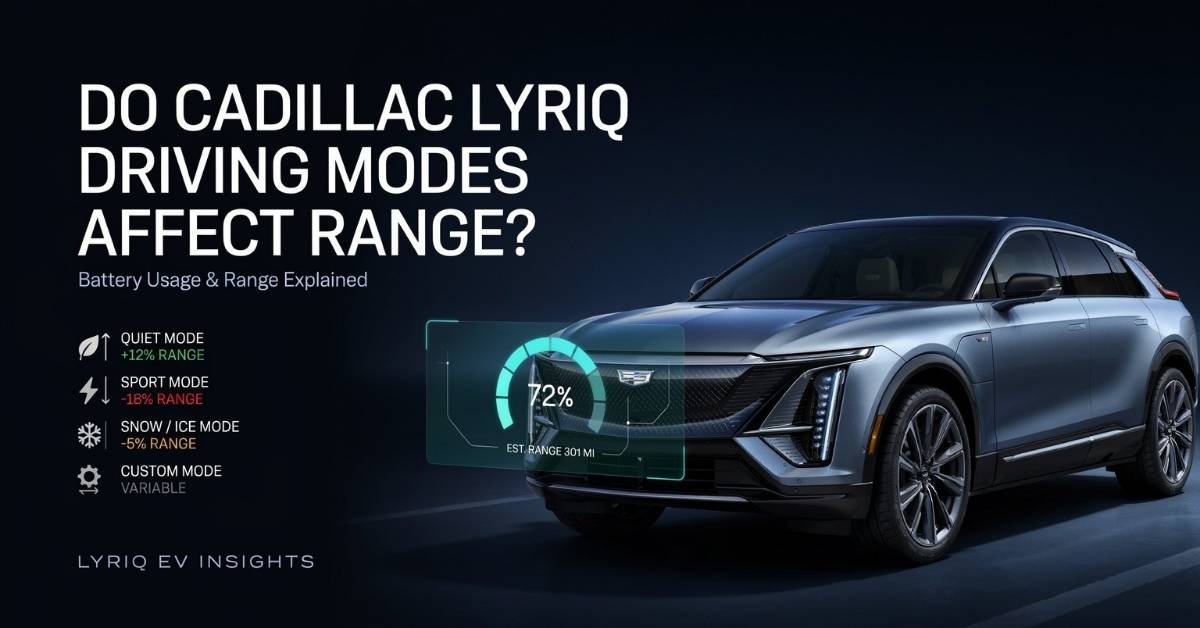
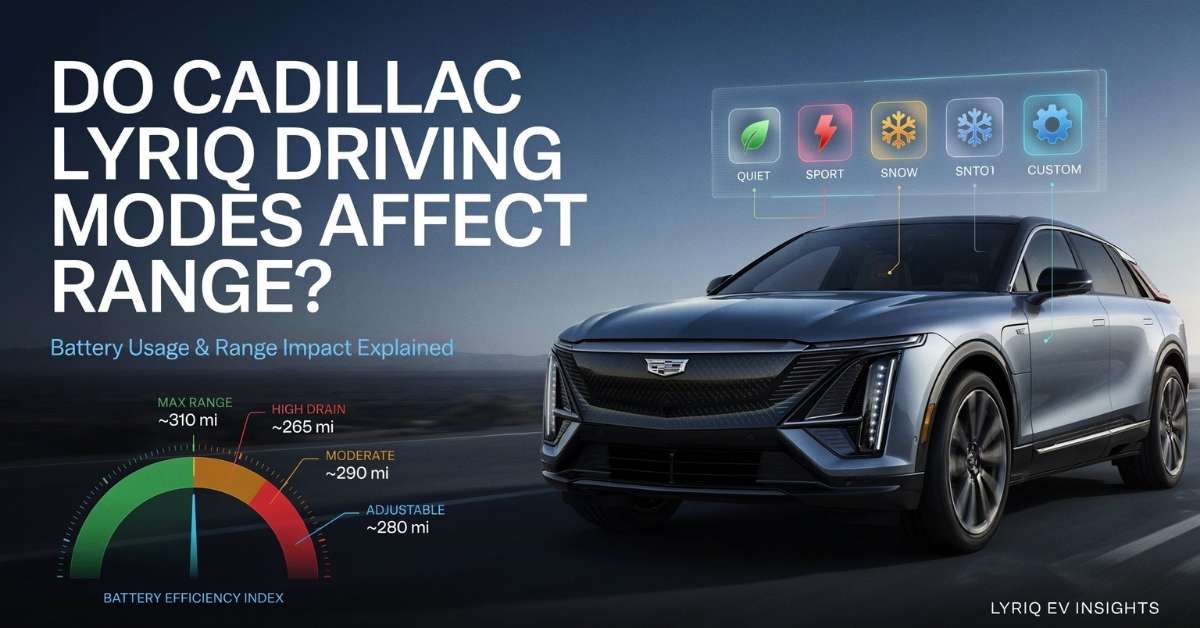
Do the driving modes in Cadillac LYRIQ offer different ranges or battery usages? The short answer is no—Cadillac LYRIQ driving modes do not change the battery’s capacity or unlock extra range on their own. However, they can indirectly affect energy consumption and real-world driving range by changing how the vehicle responds to your inputs. Features like throttle response, regenerative braking, traction control, and power delivery vary between modes, influencing how efficiently the electric motors use stored energy. In everyday driving, your driving style, speed, weather, road conditions, and climate control usage typically have a much greater impact on Cadillac LYRIQ battery usage than the selected driving mode itself.
This distinction is important because many EV owners confuse battery capacity with battery consumption. Your Cadillac LYRIQ’s Ultium battery stores the same amount of energy regardless of whether you’re driving in Tour Mode, Sport Mode, Snow/Ice Mode, or My Mode. What changes is how quickly that energy is used based on the vehicle’s software settings and, more importantly, how you drive.
If you’ve ever wondered whether Sport Mode drains the battery faster, whether Tour Mode provides the best range, or if One-Pedal Driving and regenerative braking actually help you travel farther, you’re not alone. These are some of the most common questions asked by current owners and prospective buyers researching the Cadillac LYRIQ range and battery efficiency.
In this guide, you’ll learn how each driving mode works, what really affects battery usage, how the Battery Management System (BMS) protects efficiency, and which mode makes the most sense for different driving situations. Rather than relying on marketing language, we’ll focus on the engineering principles and practical driving advice that help you get the most from your luxury electric SUV.
The Short Answer: Do Cadillac LYRIQ Driving Modes Change Battery Range?
If you’re looking for a simple answer before diving into the technical details, here it is:
No. Cadillac LYRIQ driving modes do not increase or decrease the battery’s total capacity. Instead, they modify vehicle behavior, which can indirectly influence energy consumption and the distance you can travel on a charge.
Think of the driving modes as different personalities for the same vehicle. The Ultium battery pack remains exactly the same, but the software changes how the vehicle responds to acceleration, braking, and road conditions.
Quick Comparison of do the driving modes in cadillac lyriq offer different ranges or battery usages?
| Driving Mode | Throttle Response | Power Delivery | Efficiency Impact | Best For |
|---|---|---|---|---|
| Tour Mode | Smooth and balanced | Progressive | Highest consistency for everyday driving | Daily commuting and highway trips |
| Sport Mode | Faster and more aggressive | Immediate torque | Depends on driving style | Performance-oriented driving |
| Snow/Ice Mode | Gentle and controlled | Reduced wheel slip | Optimized for traction rather than efficiency | Snow, ice, and slippery roads |
| My Mode | Customizable | User-defined | Varies based on settings | Personalized driving preferences |
Although many people assume Sport Mode automatically reduces range, that’s only partially true. The mode itself doesn’t consume additional electricity. Instead, it encourages quicker acceleration, and rapid acceleration naturally requires more power from the electric motors.
Likewise, Tour Mode doesn’t magically create extra miles. It simply offers smoother throttle calibration, making it easier for many drivers to maintain efficient driving habits.
What Actually Changes When You Switch Driving Modes?
Changing driving modes primarily adjusts how the vehicle’s software manages power delivery. These adjustments include:
- Throttle sensitivity
- Electric motor response
- Traction control calibration
- Torque delivery
- Steering feel (where applicable)
- Regenerative braking behavior in certain configurations
These changes affect the driving experience, not the amount of energy stored inside the battery.
For example, in Sport Mode, pressing the accelerator halfway may deliver significantly more torque than the same pedal position in Tour Mode. If you frequently accelerate aggressively, you’ll naturally use more electricity.
What Doesn’t Change Regardless of the Driving Mode?
Several key components remain exactly the same:
- Battery capacity
- Battery chemistry
- Charging capability
- Battery Management System (BMS) safety limits
- Motor efficiency characteristics
- Maximum usable battery energy
This means switching between modes cannot unlock hidden battery capacity or permanently reduce the battery’s health.
The Battery Management System (BMS) continuously protects the battery regardless of the selected mode by monitoring:
- Cell temperature
- Voltage balance
- State of charge
- Charging limits
- Thermal management
Whether you’re enjoying the instant acceleration of Sport Mode or the smooth refinement of Tour Mode, these protective systems remain active in the background.
Why Driver Behavior Matters More Than the Driving Mode
One of the biggest misconceptions about electric vehicles is believing that a software setting alone determines efficiency.
In reality, your right foot has a much greater influence on range than the selected driving mode.
For example:
Driver A
- Uses Sport Mode
- Accelerates smoothly
- Maintains consistent highway speeds
- Uses regenerative braking effectively
Driver B
- Uses Tour Mode
- Frequently accelerates aggressively
- Brakes hard at every stop
- Drives at high interstate speeds
Despite using the “more efficient” mode, Driver B may consume significantly more energy than Driver A.
This is because energy consumption in an EV depends primarily on the amount of power requested from the electric motors, not simply the software profile that’s selected.
Understanding this relationship helps eliminate unnecessary range anxiety and allows drivers to choose the mode that best fits their driving conditions rather than worrying about a dramatic loss of efficiency.
Understanding the Difference Between Battery Capacity and Battery Usage
Before discussing Cadillac LYRIQ battery usage, it’s essential to understand two terms that are often confused:
- Battery capacity
- Battery usage
Although they sound similar, they describe completely different aspects of how an electric vehicle operates.
Battery Capacity: How Much Energy the Battery Can Store
Battery capacity refers to the total amount of electrical energy stored inside the Cadillac LYRIQ’s Ultium battery pack.
It’s measured in kilowatt-hours (kWh).
Think of battery capacity as the size of a fuel tank in a gasoline vehicle. A larger tank can hold more fuel, while a larger battery can store more electrical energy.
No matter which driving mode you choose:
- Tour Mode
- Sport Mode
- Snow/Ice Mode
- My Mode
…the battery’s storage capacity remains unchanged.
Driving modes cannot create additional energy or reduce the physical amount of energy your battery can hold.
Battery Usage: How Quickly That Energy Is Consumed
Battery usage describes how fast stored electricity is used while driving.
This depends on many factors, including:
- Vehicle speed
- Acceleration
- Road gradient
- Outside temperature
- Tire pressure
- Passenger weight
- Cargo load
- Wind resistance
- Climate control usage
- Driving style
- Regenerative braking efficiency
Among these factors, driving mode is only one small part of the equation.
For example, driving at 75 mph on a cold winter day with the cabin heater running will generally consume far more energy than simply switching from Tour Mode to Sport Mode.
Why Many EV Owners Confuse These Two Concepts
The confusion usually comes from everyday language.
People often say:
“Sport Mode uses more battery.”
What they actually mean is:
Sport Mode may encourage driving behaviors that increase energy consumption.
That’s an important distinction.
The battery itself isn’t changing. Instead, the rate at which energy leaves the battery may change depending on how the vehicle is driven.
Understanding this difference makes it much easier to interpret Cadillac LYRIQ range estimates, compare battery efficiency, and develop driving habits that maximize real-world mileage.
Do the driving modes in cadillac lyriq offer different ranges or battery usages?
The Cadillac LYRIQ isn’t just changing dashboard graphics when you switch driving modes. Behind the scenes, the vehicle’s software adjusts how various systems respond to your inputs, creating noticeably different driving characteristics without altering the battery itself.
Each mode is designed with a specific purpose, whether that’s maximizing everyday comfort, delivering more responsive performance, improving traction on slippery roads, or letting you customize the driving experience to match your preferences.
Understanding what each mode changes—and what it doesn’t—helps you choose the right setting based on your driving environment rather than common misconceptions about battery usage.
Tour Mode: The Balanced Everyday Setting
For most drivers, Tour Mode will be the default choice because it’s designed to deliver a smooth, predictable, and comfortable driving experience.
In this mode, the accelerator pedal responds progressively, making it easier to maintain consistent speeds without sudden bursts of power. This smoother calibration often helps drivers develop more efficient driving habits, especially in city traffic and during longer highway journeys.
Key characteristics include:
- Balanced throttle response
- Predictable power delivery
- Comfort-focused driving feel
- Ideal for daily commuting
- Well-suited to maximizing consistent real-world efficiency
It’s important to remember that Tour Mode isn’t an “Eco Mode.” It doesn’t artificially limit the vehicle’s capabilities or reduce the battery’s power output. Instead, it provides a well-balanced driving experience that naturally supports efficient driving when paired with smooth acceleration and steady speeds.
Sport Mode: Performance Comes First
If Tour Mode is designed for balance, Sport Mode is all about making the Cadillac LYRIQ feel more responsive and engaging behind the wheel.
One of the biggest misconceptions is that Sport Mode automatically drains the battery faster. In reality, Sport Mode doesn’t consume extra electricity simply because it’s selected. Instead, it changes how the vehicle responds when you press the accelerator.
The software recalibrates several systems, including:
- Throttle response
- Torque delivery
- Acceleration sensitivity
- Steering feel (where equipped)
Because the electric motors respond more aggressively to pedal input, it’s easier to accelerate quickly. Those rapid bursts of acceleration require more power, which naturally increases battery usage if they’re used frequently.
When Sport Mode Makes Sense
Sport Mode is ideal for situations where you want:
- Faster acceleration onto highways
- More confident overtaking
- A more engaging driving experience
- Immediate motor response
If you continue driving smoothly—even in Sport Mode—your overall efficiency may remain surprisingly close to Tour Mode. However, repeated hard acceleration and spirited driving will increase energy consumption, reducing your real-world driving range.
Key Takeaway: Sport Mode doesn’t reduce range by itself—aggressive driving does.
Snow/Ice Mode: Built for Traction, Not Maximum Range
Driving on snow-covered roads or icy highways presents a completely different challenge than driving on dry pavement. In slippery conditions, maximizing efficiency becomes less important than maintaining control.
That’s exactly what Snow/Ice Mode is designed to do.
Instead of delivering instant torque, the software softens acceleration and carefully manages power sent to the wheels.
Changes include:
- Gentler throttle response
- Reduced wheel spin
- Enhanced traction control
- Improved stability on slippery surfaces
- Smoother power delivery
Some drivers assume Snow/Ice Mode lowers efficiency because acceleration feels slower. The reality is more nuanced.
The driving mode itself isn’t inherently inefficient. However, winter conditions usually involve:
- Cold battery temperatures
- Cabin heating
- Heated seats
- Defrosters
- Snow-covered roads
- Increased rolling resistance
These factors typically reduce range far more than Snow/Ice Mode itself.
Practical Example
Imagine two identical Cadillac LYRIQs:
- Vehicle A uses Tour Mode in freezing temperatures.
- Vehicle B uses Snow/Ice Mode on the same route.
Both vehicles will experience lower range because of the cold weather. The difference caused solely by the selected driving mode is likely to be minimal compared to the effects of temperature and road conditions.
My Mode: Personalized Driving Without Sacrificing Efficiency
My Mode allows owners to customize how the LYRIQ behaves instead of relying on predefined settings.
Depending on model year and configuration, drivers can personalize aspects such as:
- Steering feel
- Acceleration response
- Vehicle feedback
- Other available driving characteristics
This flexibility allows you to create a setup that balances comfort and responsiveness.
For example, you could choose:
- Smooth steering
- Moderate throttle response
- Comfortable everyday driving
Or:
- Sharper acceleration
- Sportier vehicle response
- Customized driving feel
Again, My Mode doesn’t alter battery capacity. Any change in efficiency comes from how the customized settings influence your driving behavior.
Do the driving modes in cadillac lyriq offer different ranges or battery usages?
This is where many online articles oversimplify the answer.
The technically correct explanation is:
Driving modes do not directly consume more battery. They influence how the vehicle responds, which can encourage driving habits that either increase or decrease energy consumption.
Understanding this difference helps eliminate one of the biggest misconceptions surrounding electric vehicles.
The Engineering Explanation
Electric vehicles continuously calculate how much power to deliver based on driver input.
When you press the accelerator, the vehicle’s control software determines:
- Requested torque
- Motor output
- Battery power demand
- Wheel traction
- Energy efficiency
Driving modes adjust these software calibrations.
For instance:
Tour Mode
- Progressive torque delivery
- Smoother acceleration
- Easier to drive efficiently
Sport Mode
- Higher torque available sooner
- Faster accelerator response
- Encourages stronger acceleration
Notice that the battery itself hasn’t changed.
Only the vehicle’s interpretation of your accelerator input has changed.
Why Software Doesn’t Change Battery Capacity
The Ultium battery pack has a fixed usable capacity.
Selecting another driving mode does not:
- Increase stored electricity
- Unlock hidden battery reserves
- Permanently reduce available energy
- Change battery chemistry
- Affect battery health
Instead, the Battery Management System carefully manages charging and discharging regardless of the selected mode.
This distinction is essential because many EV owners mistakenly believe software settings physically change the battery. They don’t.
Why Aggressive Acceleration Uses More Energy
One of the defining characteristics of electric motors is instant torque.
When rapid acceleration is requested:
- More electrical current flows from the battery.
- The inverter delivers additional power to the motors.
- Energy consumption rises significantly for that period.
If this happens repeatedly throughout a trip, overall efficiency decreases.
Conversely, gradual acceleration requires less peak power, helping preserve energy.
This explains why two drivers using the same driving mode can finish identical trips with noticeably different battery percentages.
Does Sport Mode Drain the Battery Faster?
Yes—but only under certain driving conditions.
Sport Mode itself doesn’t continuously consume extra electricity.
Instead, its sharper throttle response often encourages:
- Hard acceleration
- Faster corner exits
- Higher average speeds
- More spirited driving
These behaviors increase battery consumption.
However, if you cruise steadily on the highway using Sport Mode with smooth throttle inputs, the efficiency difference compared with Tour Mode is usually quite small.
Does Tour Mode Save Battery?
Tour Mode doesn’t actively save battery power.
Instead, its balanced calibration naturally promotes smoother driving.
Many drivers unconsciously:
- Accelerate more gently
- Maintain steadier speeds
- Avoid unnecessary bursts of power
As a result, they often achieve slightly better real-world efficiency.
Learn More: Propper or Proper
Is Snow/Ice Mode Less Efficient?
Not necessarily.
The purpose of Snow/Ice Mode is traction—not energy savings.
Most winter range loss comes from:
- Cold battery temperatures
- Cabin heating
- Reduced battery efficiency
- Snow-covered roads
- Tire resistance
The selected driving mode contributes only a small part of the overall picture.
How the Battery Management System (BMS) Influences Efficiency
Behind every Cadillac LYRIQ is an intelligent Battery Management System (BMS) that constantly monitors and protects the vehicle’s high-voltage battery.
Most drivers never notice it working, yet it plays one of the biggest roles in determining long-term efficiency and battery reliability.
What Is the Battery Management System?
The Battery Management System is essentially the battery’s control center.
It continuously monitors:
- Cell voltage
- Cell temperature
- Charging rate
- Discharging rate
- Battery balance
- State of Charge (SoC)
- Overall battery health
Its primary goal is to maximize both performance and battery longevity.
Thermal Management Matters More Than Driving Mode
Lithium-ion batteries perform best within a specific temperature range.
If the battery becomes:
- Too hot
- Too cold
…the BMS automatically adjusts operating conditions to protect it.
This thermal management system has a much greater influence on real-world efficiency than switching between Tour and Sport modes.
For example:
On a freezing winter morning, some battery energy is used to warm the pack before it reaches optimal operating temperature.
Similarly, during extremely hot weather, cooling systems help prevent overheating.
Both scenarios influence available driving range.do the driving modes in cadillac lyriq offer different ranges or battery usages?
Power Distribution and Energy Efficiency
The Battery Management System also determines:
- Safe power delivery
- Charging limits
- Regenerative braking availability
- Battery balancing
- Voltage management
It ensures the battery delivers power efficiently while protecting internal components.
No driving mode can override these safety protections.
Why Driving Modes Can’t Override Battery Protection
Whether you select:
- Tour
- Sport
- Snow/Ice
- My Mode
…the Battery Management System continues enforcing:
- Safe temperatures
- Maximum charging limits
- Safe discharge rates
- Battery protection algorithms
This is why changing driving modes cannot damage the battery or reduce its long-term lifespan under normal operation.
Regenerative Braking and One-Pedal Driving: Can They Increase Range?
One of the biggest advantages of driving an electric vehicle is the ability to recover energy that would otherwise be lost during braking.
The Cadillac LYRIQ uses regenerative braking, allowing the electric motors to function as generators when the vehicle slows down.
Instead of converting all kinetic energy into heat through traditional friction brakes, part of that energy is sent back to the battery.
How Regenerative Braking Works
When you lift off the accelerator or apply regenerative braking:
- The electric motor begins slowing the vehicle.
- The motor acts as a generator.
- Mechanical energy becomes electrical energy.
- Some of that electricity is returned to the battery.
Although regeneration doesn’t recover every unit of energy used during acceleration, it can improve efficiency—especially in stop-and-go traffic.
One-Pedal Driving Explained
One-Pedal Driving allows drivers to accelerate and slow down using mostly the accelerator pedal.
As you release the pedal, regenerative braking increases automatically, helping recover energy while reducing reliance on conventional brakes.
Benefits include:
- Smoother driving
- Reduced brake wear
- Better energy recovery
- Improved efficiency in urban traffic
When Regenerative Braking Helps the Most
Regenerative braking is most effective during:
- City driving
- Heavy traffic
- Frequent stoplights
- Moderate downhill grades
It offers less benefit during:
- Long highway cruising
- Constant-speed driving
- Situations requiring minimal braking
Common Myths About Do the driving modes in cadillac lyriq offer different ranges or battery usages?
Myth: Regenerative braking fully recharges the battery.
Reality: It only recovers a portion of energy that would otherwise be lost.
Myth: One-Pedal Driving always increases range dramatically.
Reality: It can improve efficiency, particularly in urban driving, but overall range still depends on speed, weather, terrain, and driving habits.
Myth: Driving modes completely change regenerative braking performance.
Reality: Regenerative braking behavior can vary slightly depending on vehicle configuration and settings, but the overall efficiency gains depend far more on traffic conditions and driver inputs than on the selected drive mode alone.
What Has the Biggest Impact on Cadillac LYRIQ Range?
Many owners spend time debating whether Tour Mode or Sport Mode offers better efficiency. In reality, driving mode is only one variable in a much larger equation.
Several external factors have a far greater influence on real-world range than simply switching between driving modes.
| Factor | Typical Impact on Range | Why It Matters |
|---|---|---|
| Vehicle Speed | Very High | Higher speeds increase aerodynamic drag, requiring substantially more energy. |
| Outside Temperature | Very High | Extreme heat or cold affects battery efficiency and thermal management. |
| HVAC Usage | High | Heating and air conditioning draw additional power from the battery. |
| Driving Style | High | Aggressive acceleration and hard braking increase energy consumption. |
| Road Elevation | Moderate to High | Climbing hills requires more power, while descents can recover energy through regenerative braking. |
| Tire Pressure | Moderate | Underinflated tires increase rolling resistance. |
| Passenger & Cargo Weight | Moderate | Extra weight requires more energy to move the vehicle. |
| Wheel Size & Tires | Moderate | Larger wheels and performance tires can reduce efficiency. |
| Driving Mode | Low to Moderate | Influences vehicle behavior, but usually has less impact than the factors above. |
The takeaway is simple: if your goal is to maximize Cadillac LYRIQ range, focusing on smooth driving habits, maintaining proper tire pressure, managing climate control wisely, and avoiding unnecessary high speeds will generally deliver far greater benefits than changing driving modes alone.do the driving modes in cadillac lyriq offer different ranges or battery usages?
See More: What Does Torta Mean
Which Driving Mode Should You Use? A Practical Decision Guide
After understanding how Cadillac LYRIQ driving modes work, the next logical question is:
“Which driving mode should I actually use?”
The truth is, there isn’t one “best” driving mode for every situation. Each mode is designed for a different driving environment, and choosing the right one depends on your priorities—whether that’s comfort, performance, traction, or efficiency.
For Daily City Driving: Tour Mode
If most of your driving involves:
- Traffic lights
- Stop-and-go traffic
- Short commutes
- Urban streets
Tour Mode is usually the best choice.
Its smoother throttle response makes it easier to accelerate gradually, while One-Pedal Driving and regenerative braking can recover energy during frequent stops. Together, these features help many drivers achieve consistent battery efficiency without sacrificing comfort.
Recommended For:
- Daily commuting
- School runs
- Shopping trips
- Urban driving
For Highway Driving: Tour Mode or My Mode
Highway efficiency depends far more on maintaining a steady speed than on the selected driving mode.
Whether you’re using Tour Mode or a personalized My Mode setup, smooth acceleration and consistent cruising will have the greatest impact on Cadillac LYRIQ range.
Helpful tips for highway efficiency include:
- Use gradual acceleration when merging.
- Maintain a consistent cruising speed whenever possible.
- Avoid unnecessary rapid lane changes or hard acceleration.
- Use regenerative braking naturally when slowing for traffic.
For Long Road Trips
When covering hundreds of miles in a day, comfort and efficiency become equally important.
Tour Mode remains the preferred option because it offers:
- Predictable throttle response
- Comfortable power delivery
- Relaxed driving feel
- Consistent efficiency
Planning charging stops, preconditioning the battery before departure, and monitoring tire pressure will generally have a much greater effect on total trip efficiency than switching driving modes.
For Winter Weather: Snow/Ice Mode
When roads become slippery, safety should always take priority over maximizing range.
Choose Snow/Ice Mode when driving in:
- Snow
- Ice
- Freezing rain
- Slush
- Wet roads with reduced traction
The softer throttle calibration reduces wheel spin and gives you more controlled acceleration, making it easier to maintain stability.
Although winter weather often reduces EV range, remember that cold temperatures and cabin heating—not Snow/Ice Mode itself—are the primary reasons for increased battery usage.
For Mountain Roads
Mountain driving combines steep climbs with long descents.
During uphill sections, the battery naturally works harder to overcome gravity. On downhill stretches, regenerative braking can recover part of that energy.
A balanced mode like Tour Mode is generally sufficient for most mountain routes, while drivers seeking quicker throttle response may prefer Sport Mode on dry, winding roads.
For Performance Driving: Sport Mode
If your goal is responsiveness rather than maximum efficiency, Sport Mode is the obvious choice.
You’ll notice:
- Sharper accelerator response
- Faster torque delivery
- More engaging driving dynamics
- Improved confidence during overtaking
Just remember that enthusiastic acceleration will naturally increase energy consumption, meaning you’ll likely recharge sooner than if you drove more conservatively.
Real-World Driving Scenarios and Expected Efficiency
One reason there’s so much confusion about Cadillac LYRIQ battery usage is that no two trips are identical. Real-world efficiency depends on a combination of weather, traffic, terrain, speed, and driving habits—not just the selected driving mode.do the driving modes in cadillac lyriq offer different ranges or battery usages?
Scenario 1: Urban Stop-and-Go Traffic
Best Mode: Tour Mode
Frequent stops allow regenerative braking to recover energy, making city driving one of the most efficient environments for many EVs.
Efficiency Tips
- Leave extra space ahead.
- Anticipate traffic.
- Brake smoothly.
- Use One-Pedal Driving where comfortable.
Scenario 2: Highway Cruising
Best Mode: Tour Mode or My Mode
At highway speeds, aerodynamic drag becomes the biggest consumer of energy.
Driving 75 mph instead of 65 mph can reduce range far more than switching between Tour and Sport modes.
Scenario 3: Cold Winter Morning
Best Mode: Snow/Ice Mode (when traction is limited)
Range reductions are primarily caused by:
- Battery warming
- Cabin heating
- Cold battery chemistry
- Increased rolling resistance
Using scheduled battery preconditioning before departure can improve both efficiency and charging performance.
Scenario 4: Hot Summer Afternoon
Best Mode: Tour Mode
Air conditioning uses battery power, but efficient climate management helps maintain passenger comfort without significantly compromising range.
Parking in the shade and pre-cooling the cabin while plugged in can reduce energy demand once you begin driving.
Scenario 5: Weekend Scenic Drive
Best Mode: Sport Mode
If your goal is to enjoy the LYRIQ’s instant torque and refined handling, Sport Mode enhances the driving experience. The slight increase in energy consumption is often a worthwhile trade-off for drivers who value performance over maximum efficiency.do the driving modes in cadillac lyriq offer different ranges or battery usages?
Common Myths About Cadillac LYRIQ Driving Modes
Let’s separate fact from fiction.
Myth 1: Sport Mode Cuts Your Range in Half
Reality: No.
Sport Mode changes throttle response, not battery capacity. Any reduction in range comes from more aggressive driving—not from the mode itself.
Myth 2: Tour Mode Is an Eco Mode
Reality: Not exactly.
Tour Mode is designed for balanced everyday driving. It doesn’t artificially limit power or create additional battery capacity.
Myth 3: Driving Modes Damage the Battery
Reality: False.
The Battery Management System (BMS) continuously protects the battery regardless of the selected driving mode.
Myth 4: One Driving Mode Is Always Best
Reality: Every mode serves a different purpose.
Choosing the right mode depends on:
- Road conditions
- Weather
- Traffic
- Personal preference
- Driving style
Myth 5: Regenerative Braking Fully Recharges the Battery
Reality: Regenerative braking improves efficiency by recovering some energy that would otherwise be lost, but it cannot replace charging or fully replenish the battery.
Cadillac LYRIQ vs. Other Luxury EVs: Do Driving Modes Work Differently?
Many premium electric SUVs offer multiple driving modes, but their underlying philosophy is remarkably similar.
| Vehicle | Driving Modes | Battery Capacity Changes? | Range Changes? |
|---|---|---|---|
| Cadillac LYRIQ | Tour, Sport, Snow/Ice, My Mode | No | Indirectly through driving behavior |
| Tesla Model Y | Chill, Standard | No | Depends on acceleration habits |
| BMW iX | Personal, Efficient, Sport | No | Driver-dependent |
| Mercedes-Benz EQE SUV | Eco, Comfort, Sport | No | Primarily influenced by driving style |
Across these vehicles, the pattern is the same: drive modes change how the vehicle behaves, not how much energy the battery can store.
Expert Tips to Maximize Cadillac LYRIQ Range Without Sacrificing Comfort
If your goal is to travel farther between charging stops, focus on habits that consistently improve efficiency.
Drive Smoothly
Avoid abrupt acceleration whenever possible. Smooth inputs reduce peak power demand and help maintain better miles per kWh.
Take Advantage of Regenerative Braking
Lift off the accelerator early when approaching traffic lights or slower vehicles to recover energy instead of relying solely on the friction brakes.
Maintain Proper Tire Pressure
Correct tire pressure reduces rolling resistance, improves efficiency, and promotes even tire wear.
Precondition the Battery
When the vehicle is plugged in, preconditioning can bring the battery to an optimal operating temperature before you leave, improving both efficiency and charging performance in extreme weather.
Use Climate Control Wisely
Instead of immediately setting the cabin to the highest heating or cooling level, use moderate temperature settings when practical. Features like heated seats and a heated steering wheel can often improve comfort with less energy demand than raising cabin temperature dramatically.
Reduce Unnecessary Weight
Extra cargo increases the energy required to move the vehicle. Remove heavy items you don’t need for everyday driving.
Keep Vehicle Software Updated
Software updates can improve system optimization, refine energy management, and enhance overall vehicle performance. Staying current helps ensure you’re benefiting from the latest efficiency improvements provided by the manufacturer.
Frequently Asked Questions about do the driving modes in cadillac lyriq offer different ranges or battery usages?
Does Sport Mode reduce Cadillac LYRIQ range?
Not directly. Sport Mode changes throttle response and encourages quicker acceleration. If you drive aggressively, you’ll use more energy and reduce your real-world range. If you drive smoothly, the difference compared with Tour Mode is usually modest.
Which Cadillac LYRIQ driving mode is the most efficient?
For most drivers, Tour Mode provides the most balanced combination of comfort, responsiveness, and consistent efficiency.
Does driving mode affect battery health?
No. The Battery Management System (BMS) protects the battery regardless of the selected driving mode, helping maintain long-term battery health.
Can driving modes change charging speed?
No. Charging speed depends on factors such as charger output, battery temperature, and the battery’s state of charge—not the selected driving mode.
Is there an Eco Mode in the Cadillac LYRIQ?
The Cadillac LYRIQ does not include a dedicated Eco Mode. Tour Mode is the closest equivalent for everyday efficient driving.
Does One-Pedal Driving improve efficiency?
Yes, especially in stop-and-go traffic. It increases opportunities to recover energy through regenerative braking, although the overall benefit depends on traffic conditions and driving habits.
Does My Mode affect battery usage?
Only indirectly. Any difference in energy consumption comes from the customized driving characteristics and how they influence your driving behavior.
Which driving mode is best for highway trips?
Tour Mode is generally the best choice for long highway drives because it offers predictable throttle response and comfortable cruising characteristics.
Which driving mode is best during winter?
Use Snow/Ice Mode whenever additional traction is needed. It prioritizes stability and controlled power delivery on slippery roads.
Can software updates change driving mode behavior?
Yes. Vehicle software updates may refine throttle calibration, regenerative braking behavior, or overall system optimization. However, they do not change the physical battery capacity.
Final Verdict: do the driving modes in cadillac lyriq offer different ranges or battery usages?
If you’ve been wondering whether the driving modes in Cadillac LYRIQ offer different ranges or battery usages, the answer is straightforward: they do not change the battery’s capacity or the amount of energy it can store. Instead, they adjust throttle response, power delivery, traction control, and other vehicle behaviors, which can indirectly influence how much energy you consume based on how you drive.
For most owners, Tour Mode delivers the best balance of comfort and efficiency for daily use, while Sport Mode offers a more engaging driving experience without inherently harming battery life. Snow/Ice Mode enhances safety in challenging conditions, and My Mode allows you to personalize the driving experience to suit your preferences.
Ultimately, the biggest factors affecting Cadillac LYRIQ range are vehicle speed, outside temperature, HVAC use, driving style, terrain, tire pressure, and traffic conditions. By focusing on smooth acceleration, making good use of regenerative braking and One-Pedal Driving, maintaining your vehicle, and planning for seasonal conditions, you can maximize efficiency without sacrificing the premium driving experience that makes the LYRIQ stand out.