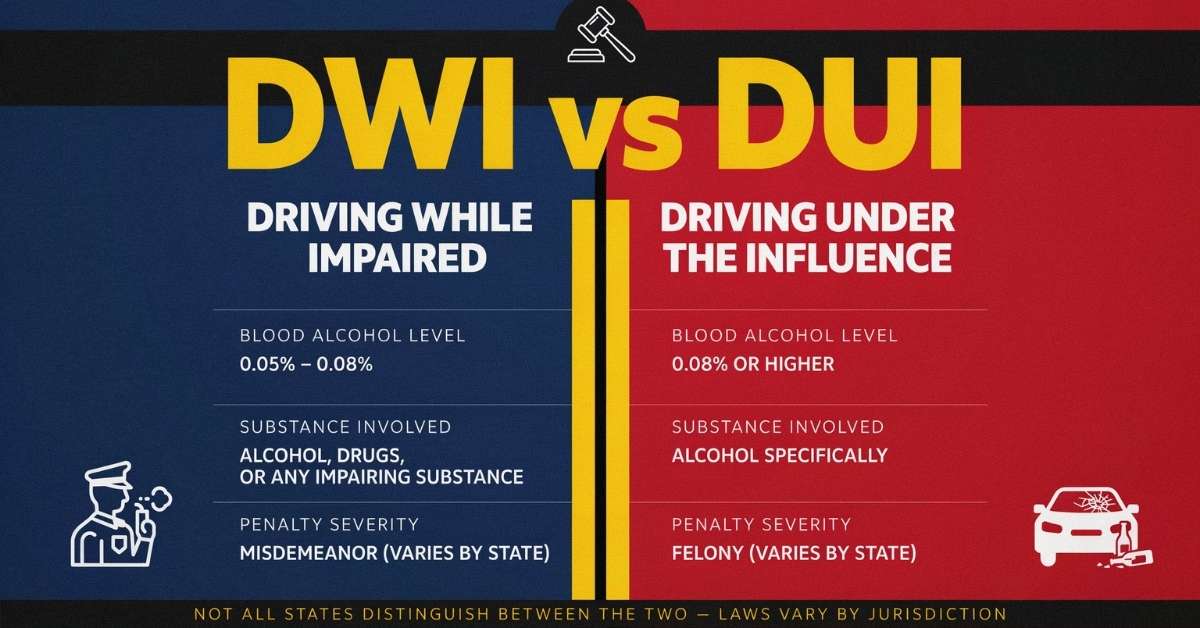
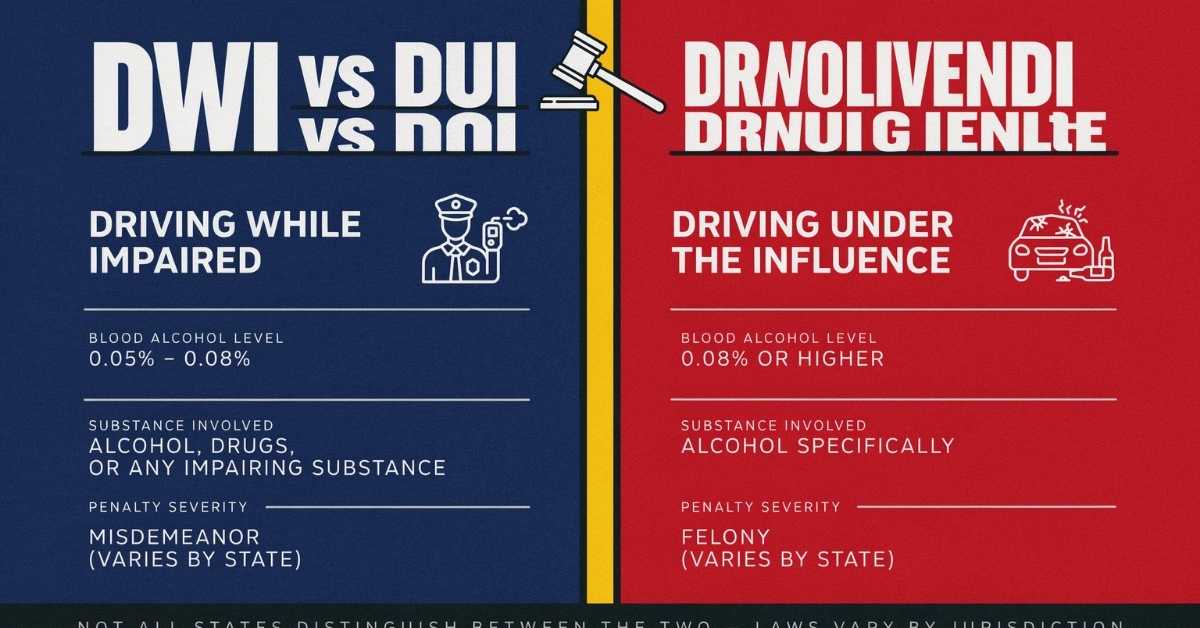
DWI vs DUI is one of the most commonly searched legal comparison terms, but the answer isn’t as simple as many people expect. The difference between a DWI (Driving While Intoxicated or Driving While Impaired) and a DUI (Driving Under the Influence) depends on the laws of the state where the offense occurs. Some states use only one of these terms, while others assign different meanings to each. As a result, neither DWI nor DUI is automatically more serious nationwide—the specific charge, penalties, and legal consequences vary by jurisdiction.
If you’ve recently been charged, know someone who has, or simply want to understand the law, you’ve probably encountered conflicting explanations online. That’s because every U.S. state has the authority to define impaired driving offenses differently. Some states use DUI as the primary offense, others use DWI, and a few recognize additional terms such as OWI (Operating While Intoxicated), OVI (Operating a Vehicle Impaired), or DWAI (Driving While Ability Impaired).
This comprehensive guide explains DWI vs DUI in plain English, compares the two side by side, explores how laws differ across states, discusses Blood Alcohol Concentration (BAC) limits, alcohol and drug-impaired driving, potential legal consequences, insurance implications, employment concerns, and the practical questions people often ask after an impaired driving charge.
DWI vs DUI at a Glance
Before diving deeper, here’s a quick comparison that highlights the most important differences.
| Feature | DUI (Driving Under the Influence) | DWI (Driving While Intoxicated/Impaired) |
|---|---|---|
| Meaning | Driving while impaired by alcohol, drugs, or both | Driving while intoxicated or impaired, depending on state law |
| Primary Focus | Alcohol, drugs, prescription medication, or any impairing substance | Usually alcohol intoxication or impairment, but definitions vary |
| Used By | Many U.S. states | Many U.S. states, often with different legal definitions |
| BAC Consideration | Often linked to legal BAC limits but not exclusively | Often linked to BAC or impairment, depending on jurisdiction |
| Drug-Impaired Driving | Commonly included | Included in many states |
| License Consequences | Possible suspension or revocation | Similar consequences depending on state law |
| Insurance Impact | Often increases premiums significantly | Similar insurance consequences |
| Criminal Record | May become part of your criminal record | May also result in a criminal record |
| Which Is Worse? | Depends entirely on state law | Depends entirely on state law |
Key Takeaway: The terms DUI and DWI are not interchangeable everywhere. Understanding your state’s legal definitions is essential before assuming one offense is more serious than the other.
What Do DUI and DWI Actually Mean?
Although people often use these terms interchangeably in everyday conversation, the law doesn’t always treat them the same way. Their meanings depend on the jurisdiction where the offense occurs, making it important to understand the legal context instead of relying on general assumptions.
What Is a DUI?
A DUI, or Driving Under the Influence, generally refers to operating a motor vehicle while impaired by alcohol, illegal drugs, prescription medications, or any substance that affects your ability to drive safely.
In many states, a driver may face a DUI charge when:
- Their Blood Alcohol Concentration (BAC) exceeds the legal limit.
- Police determine the driver is impaired through observation or standardized field sobriety tests.
- Chemical testing, such as a breathalyzer or blood test, supports evidence of impairment.
- Drugs—including marijuana or prescription medications—affect driving ability.
One of the biggest misconceptions is that DUI only applies to alcohol. In reality, many jurisdictions include impairment caused by controlled substances, prescription medications, and even combinations of alcohol and drugs under DUI laws.
Expert Insight
A person doesn’t necessarily have to appear obviously intoxicated to face a DUI charge. If law enforcement believes a driver’s physical or mental abilities are significantly impaired, legal consequences may still follow under the applicable state laws.
What Is a DWI?
DWI typically stands for Driving While Intoxicated or Driving While Impaired, although the exact wording varies by state.
Some jurisdictions use DWI to describe:
- Driving while legally intoxicated due to alcohol.
- Driving with a BAC above the state’s legal threshold.
- Driving while impaired by alcohol or drugs.
- A more serious offense than DUI in certain states.
However, other states treat DUI and DWI as the same offense, simply using different terminology in their legal codes.
Because of these differences, comparing DWI vs DUI without considering state law often leads to confusion.
Common Misconception
Many people believe:
“DWI is always worse than DUI.”
This isn’t universally true.
In some states:
- DWI represents the more serious charge.
In others:
- DUI is the only recognized impaired driving offense.
Elsewhere:
- Both terms refer to essentially the same violation.
Understanding how your state defines these offenses is far more important than assuming one label carries greater legal weight.
Why Do States Use Different Terms?
One of the biggest reasons people become confused about DWI vs DUI is that there is no single federal law defining impaired driving offenses. Instead, each state creates and enforces its own traffic and criminal laws.
Over time, legislatures adopted different terminology based on legal preferences, policy goals, and historical developments.
For example:
- Some states preferred Driving Under the Influence (DUI) because it covers a wide range of impairing substances.
- Others adopted Driving While Intoxicated (DWI) to emphasize alcohol intoxication.
- Several states later introduced terms such as OWI, OVI, or DWAI to better reflect local legal definitions.
As a result, two drivers in different states who engage in similar conduct could receive charges with different names, even if the underlying behavior is nearly identical.
Why This Matters
Suppose two drivers have identical BAC levels after consuming alcohol.
- Driver A is stopped in a state that primarily uses DUI.
- Driver B is stopped in a state that primarily uses DWI.
Although the offense names differ, the legal consequences may be similar—or they may vary significantly depending on that state’s statutes.
This illustrates why reading articles that ignore state-specific differences can create unnecessary confusion.
Is DWI Worse Than DUI?
This is arguably the most frequently asked question related to impaired driving laws.
The Short Answer
No—DWI is not automatically worse than DUI.
Whether one offense is considered more serious depends on:
- The state where the offense occurred
- How local law defines each term
- The driver’s Blood Alcohol Concentration (BAC)
- Whether drugs were involved
- Prior offenses
- Aggravating circumstances, such as accidents, injuries, or having a child passenger in the vehicle
Some states distinguish between DUI and DWI by assigning different legal thresholds or penalties. Others use only one term, making comparisons impossible.
Why People Assume DWI Is More Serious
Several states historically reserved DWI for higher levels of intoxication while using DUI for lesser impairment.
Because these state-specific rules became widely discussed online, many people mistakenly assume the distinction applies nationwide.
In reality, it does not.
Myth vs. Fact
| Myth | Fact |
|---|---|
| DWI is always worse than DUI. | False. The severity depends entirely on state law and the specific circumstances of the case. |
| DUI only applies to alcohol. | False. Many states include drugs and prescription medications. |
| If you’re below the legal BAC limit, you can’t be charged. | Not always. Impairment can sometimes be established through other evidence, depending on applicable laws. |
| Every state uses both DUI and DWI. | False. Many states recognize only one of these terms. |
Key Takeaway: Rather than asking “Which is worse?”, the better question is “How does my state define DUI and DWI?”
How States Define DUI and DWI
Understanding state terminology is one of the most important parts of comparing DUI vs DWI. While impaired driving laws share the common goal of improving road safety, the names, legal definitions, and enforcement approaches differ across the United States.
Some jurisdictions recognize only DUI, others use DWI, and a handful distinguish between multiple impaired driving offenses. These differences affect how charges are described, even though many of the underlying behaviors—such as driving while impaired by alcohol or drugs—are similar.
States That Primarily Use DUI
Many states use Driving Under the Influence (DUI) as the primary legal term for impaired driving offenses.
In these jurisdictions, DUI laws generally apply to impairment caused by:
- Alcohol
- Illegal drugs
- Prescription medications
- Controlled substances
- Combinations of impairing substances
The exact legal standards, BAC thresholds, and penalties vary by state, but the overall purpose is the same: preventing individuals from operating a vehicle when their ability to drive safely is impaired.
States That Primarily Use DWI
Other states primarily use Driving While Intoxicated (DWI) or Driving While Impaired.
Depending on local statutes, DWI may refer to:
- Alcohol intoxication above the legal BAC limit.
- General impairment caused by alcohol.
- Alcohol- or drug-related impairment.
- A distinct offense with its own legal criteria.
Because definitions differ, it’s essential to consult the laws of the state where the incident occurred rather than assuming the terminology has the same meaning everywhere.
States That Use Other Terms: OWI, OVI, and DWAI
One reason DWI vs DUI is confusing is that not every state uses these terms. Several states have adopted different legal terminology to describe impaired driving offenses. Although the names vary, the goal remains the same—preventing people from operating a vehicle while impaired by alcohol, illegal drugs, prescription medication, or other intoxicating substances.
OWI (Operating While Intoxicated)
Some states use OWI, which stands for Operating While Intoxicated. Unlike DUI or DWI, OWI emphasizes operating a vehicle rather than simply driving it. Depending on state law, this term may apply even if the vehicle is not moving but the individual is considered to be in control of it.
OVI (Operating a Vehicle Impaired)
OVI, or Operating a Vehicle Impaired, is another state-specific term. It generally covers impairment caused by:
- Alcohol
- Controlled substances
- Prescription medications
- Illegal drugs
- A combination of impairing substances
The focus is on whether the driver’s ability to safely operate the vehicle was impaired.
DWAI (Driving While Ability Impaired)
Some jurisdictions recognize DWAI, often as a separate offense with different legal standards than DUI or DWI. It may apply when a driver’s ability is impaired even if they do not meet a higher legal intoxication threshold.
Expert Insight: Although these acronyms differ, they all address the same public safety concern: impaired driving. Understanding the terminology used in your state helps you interpret legal information more accurately.
What Can Lead to a DUI or DWI Charge?
Many people believe a DUI or DWI only occurs after someone drinks too much alcohol. In reality, impaired driving laws are much broader.
A person may face charges if law enforcement determines they are unable to safely operate a vehicle because of alcohol, drugs, or another impairing substance.
Alcohol Impairment
Alcohol remains the most common cause of DUI and DWI arrests.
When officers suspect impairment, they typically consider:
- Driving behavior
- Physical appearance
- Speech patterns
- Coordination
- Standardized Field Sobriety Tests (SFSTs)
- Results from a Breathalyzer or other chemical tests
- Blood Alcohol Concentration (BAC)
Understanding BAC
Blood Alcohol Concentration (BAC) measures the percentage of alcohol in a person’s bloodstream.
In many states, 0.08% BAC is the legal limit for most adult drivers. However, this does not mean drivers below that level cannot face impaired driving charges.
If evidence suggests the driver’s judgment, coordination, or reaction time was significantly affected, impairment may still be considered under applicable state law.
Common Signs of Alcohol Impairment
- Delayed reactions
- Difficulty maintaining lanes
- Slurred speech
- Poor balance
- Confusion
- Bloodshot eyes
- Slow responses
- Reduced coordination
These observations often form part of an officer’s overall assessment.
Drug-Impaired Driving
Modern impaired driving laws extend far beyond alcohol.
Drivers may face a DUI or DWI if they are impaired by:
- Marijuana
- Prescription pain medication
- Sleep medications
- Anti-anxiety medication
- Illegal narcotics
- Stimulants
- Multiple substances used together
Unlike alcohol impairment, there is often no universal numeric threshold that automatically determines impairment for many drugs. Instead, investigators consider the totality of the circumstances, which may include driving behavior, physical observations, and available testing.
Prescription Medication Can Also Matter
Many people are surprised to learn that legally prescribed medication can contribute to an impaired driving charge if it affects the ability to drive safely.
Common examples include medications that may cause:
- Drowsiness
- Slowed reaction times
- Blurred vision
- Dizziness
- Impaired judgment
Taking medication exactly as prescribed does not necessarily eliminate the responsibility to drive safely.
Can You Be Charged Below the Legal BAC Limit?
One of the biggest misconceptions surrounding DWI vs DUI is that drivers are “safe” if their BAC is below 0.08%.
The reality is more nuanced.
While 0.08% is a common legal benchmark for many adult drivers, officers may still investigate impairment if a person’s driving ability appears significantly affected.
Factors that may be considered include:
- Erratic driving
- Physical signs of impairment
- Field sobriety performance
- Drug use
- Witness observations
- Other available evidence
Key Takeaway: A legal BAC threshold is important, but impairment—not just a number—can play a significant role depending on state law.
Learn More: SFM Compile
What Happens After a DUI or DWI Arrest?
For many people, the arrest process is unfamiliar and stressful. Understanding the typical sequence of events can reduce uncertainty.
Although procedures vary, a DUI or DWI case often follows a similar path.
Step 1: Traffic Stop
A law enforcement officer may stop a vehicle because of:
- Speeding
- Swerving
- Running a red light
- Equipment violations
- Suspicious driving behavior
Step 2: Initial Investigation
The officer may ask questions about:
- Alcohol consumption
- Drug use
- Destination
- Driving behavior
They also observe speech, coordination, and physical appearance.
Step 3: Field Sobriety Testing
If impairment is suspected, standardized Field Sobriety Tests may be requested.
These assessments evaluate:
- Balance
- Eye movement
- Divided attention
- Coordination
Step 4: Chemical Testing
Depending on state law, officers may request:
- Breath testing
- Blood testing
- Urine testing
These tests help determine alcohol or drug impairment.
Step 5: Arrest
If sufficient evidence exists, the individual may be arrested and taken into custody.
Step 6: Administrative License Action
In many jurisdictions, driving privileges may be affected through administrative procedures that are separate from the criminal case.
Step 7: Court Proceedings
The legal process may include:
- Initial appearance
- Hearings
- Motions
- Negotiations
- Trial (if applicable)
- Sentencing if convicted
Simplified Timeline
| Stage | Typical Event |
|---|---|
| Traffic Stop | Officer observes possible impairment |
| Investigation | Questions and observations |
| SFST | Field Sobriety Tests |
| Chemical Test | Breath, blood, or urine |
| Arrest | Booking and processing |
| License Review | Administrative action may begin |
| Court | Hearings and case resolution |
Potential Penalties: What You Can Generally Expect
The consequences of a DUI or DWI vary widely depending on:
- State law
- BAC level
- Prior convictions
- Whether an accident occurred
- Injuries or fatalities
- Presence of child passengers
- Commercial driver’s license status
While exact penalties differ, common consequences include:
| Possible Consequence | General Impact |
|---|---|
| Fines | Financial penalties that may increase for repeat offenses |
| License Suspension | Temporary loss of driving privileges |
| Probation | Court-supervised compliance |
| Community Service | Required hours of public service |
| Alcohol Education Programs | Mandatory educational courses |
| Ignition Interlock Device | Breath-testing device installed in a vehicle in some cases |
| Jail Time | Possible for certain offenses depending on the law |
Important: Penalties vary significantly from one state to another. Always refer to the laws of the jurisdiction where the offense occurred.
Beyond Court: Long-Term Consequences Many People Don’t Expect
A DUI or DWI can continue affecting someone’s life long after the court process ends.
Car Insurance Premiums
Insurance companies often view impaired driving convictions as indicators of increased risk.
Potential outcomes include:
- Higher premiums
- Limited policy options
- High-risk driver classification
- Additional insurance requirements, such as SR-22 filings where applicable
For many people, insurance costs become one of the longest-lasting financial consequences.
Employment Opportunities
Some employers conduct background checks during the hiring process.
Depending on the position, a DUI or DWI may influence:
- Hiring decisions
- Promotions
- Professional licensing
- Security clearances
- Commercial driving careers
Jobs involving transportation, childcare, public safety, or professional licenses may have stricter requirements.
Commercial Driver’s Licenses (CDLs)
Drivers who hold a Commercial Driver’s License (CDL) often face additional regulations.
Because commercial drivers operate larger vehicles and carry greater responsibility, impaired driving offenses may have more significant professional consequences.
International Travel
Certain countries may consider criminal convictions when evaluating entry requirements.
Travel implications vary widely by destination and individual circumstances.
Criminal Record
A conviction may become part of an individual’s criminal record.
Whether a record can later be sealed or expunged depends on the laws of the relevant jurisdiction and the facts of the case.
See More: Quartz vs Quartzite
Real-Life Scenarios That Cause Confusion
Understanding DWI vs DUI becomes easier when viewed through practical examples.
Scenario 1: One or Two Drinks at Dinner
A driver has a drink with dinner and feels capable of driving.
Even if their BAC is below a common legal threshold, observable impairment could still become a factor depending on applicable laws and the circumstances.
Scenario 2: Prescription Medication
Someone takes prescribed medication exactly as directed before driving home.
If the medication causes significant drowsiness or slowed reactions, it may still affect their ability to drive safely.
Scenario 3: Marijuana Impairment
A driver uses marijuana hours before driving and believes they are no longer impaired.
Depending on the circumstances and applicable law, officers may still investigate whether impairment exists.
Scenario 4: First Offense vs. Repeat Offense
Two individuals commit similar impaired driving offenses.
The person with prior convictions may face substantially different legal consequences than someone with no previous offenses.
Scenario 5: Commercial Driver
A CDL holder is stopped while operating a commercial vehicle.
Commercial drivers often face stricter standards because of the responsibilities associated with operating larger vehicles and transporting passengers or cargo.
DUI vs DWI: Common Myths Debunked
| Myth | Reality |
|---|---|
| DWI always means you’re more intoxicated than someone charged with DUI. | State law determines how these terms are defined. |
| DUI only involves alcohol. | Many jurisdictions include drug and prescription medication impairment. |
| You must fail a Breathalyzer to be arrested. | Officers may consider multiple forms of evidence during an investigation. |
| Below 0.08% BAC means you cannot be charged. | Impairment-based laws may apply in some situations. |
| A first offense has no lasting impact. | Even a first offense can affect insurance, employment, and driving privileges. |
If You’ve Been Charged, What Should You Do Next?
Receiving a DUI or DWI charge can feel overwhelming, but taking a thoughtful approach can help you navigate the situation more effectively.
Consider these practical steps:
- Read all legal paperwork carefully.
- Keep track of important court and administrative deadlines.
- Understand the driving laws that apply in your state.
- Maintain copies of documents related to your case.
- Review any license-related notices promptly.
- If appropriate, consider consulting a qualified attorney who practices in your jurisdiction.
Remember: This article provides general educational information. It is not legal advice, and laws differ by state.
DUI vs DWI vs OWI vs OVI vs DWAI: What’s the Difference?
By now, you understand that DWI vs DUI isn’t simply about which offense is “worse.” The terminology varies from one jurisdiction to another, and some states use additional terms that can make impaired driving laws seem even more confusing.
The comparison below provides a clear overview of the most common impaired driving acronyms you’ll encounter.
| Term | Full Form | General Meaning | Common Usage |
|---|---|---|---|
| DUI | Driving Under the Influence | Driving while impaired by alcohol, drugs, or another substance | Used by many states |
| DWI | Driving While Intoxicated or Driving While Impaired | Driving while intoxicated or impaired, depending on state law | Used by many states with varying definitions |
| OWI | Operating While Intoxicated | Focuses on operating a vehicle while impaired | Used in some states |
| OVI | Operating a Vehicle Impaired | Covers impairment caused by alcohol or drugs | Used in certain jurisdictions |
| DWAI | Driving While Ability Impaired | A separate offense recognized in some states | Often involves a lower level of impairment than other offenses |
Key Point: These terms all relate to impaired driving, but their legal definitions, penalties, and requirements depend entirely on the laws of the state where the incident occurs.
How to Understand Which Law Applies in Your State
Because impaired driving laws differ across the United States, the first step is identifying the jurisdiction where the incident occurred.
Ask yourself these questions:
- Which state did the traffic stop happen in?
- Does that state use DUI, DWI, or another legal term?
- Was alcohol involved, drugs, prescription medication, or a combination?
- Is it a first offense or a repeat offense?
- Were there aggravating factors such as an accident, injuries, or a child passenger?
Answering these questions helps you understand which laws may apply before reviewing state-specific information or seeking legal guidance.
Expert Tips to Avoid Impaired Driving Charges
While every driver’s situation is different, the safest approach is always to avoid driving whenever your ability may be impaired.
Practical tips include:
- Plan transportation before consuming alcohol.
- Use a rideshare service or designated driver when needed.
- Read warning labels on prescription medications.
- Never assume you are safe to drive simply because you “feel fine.”
- Understand that alcohol, marijuana, and certain medications can affect reaction time differently for each person.
- Give yourself adequate time before driving after consuming intoxicating substances.
Being proactive is far easier—and far less costly—than dealing with the legal, financial, and personal consequences of an impaired driving charge.
Frequently Asked Questions
Is DWI always worse than DUI?
No. Whether DWI is more serious than DUI depends entirely on state law. Some states distinguish between the two offenses, while others use only one term.
Are DUI and DWI the same thing?
Sometimes.
In many states, the terms are used interchangeably. In others, they describe different impaired driving offenses with different legal standards or penalties.
Can you get a DUI below the legal BAC limit?
Yes, in some situations.
Although 0.08% BAC is a common legal limit for adult drivers, impairment may still be evaluated based on driving behavior, observations, and other evidence depending on applicable laws.
Can prescription medication lead to a DUI or DWI?
Yes.
Certain prescription medications may impair your ability to operate a vehicle safely. If that impairment affects driving, legal consequences may be possible under state law.
Can marijuana result in a DUI?
Yes.
Many states prohibit driving while impaired by marijuana or other controlled substances, even though the methods used to evaluate impairment may differ from alcohol-related cases.
Will a DUI or DWI increase my insurance rates?
In many cases, yes.
Insurance companies often consider impaired driving convictions to be higher-risk events, which may lead to increased premiums or additional insurance requirements.
Does a DUI stay on your criminal record forever?
That depends on the jurisdiction.
Some states allow certain convictions to be sealed or expunged under specific conditions, while others maintain records for much longer periods.
Can a DUI affect employment?
Potentially.
Some employers review criminal background checks, especially for positions involving transportation, public safety, professional licensing, or commercial driving.
Can international travel be affected by a DUI?
Possibly.
Some countries consider criminal convictions when determining entry eligibility. Entry requirements vary by destination and individual circumstances.
Do all states use DUI and DWI?
No.
Some states use only DUI, others use DWI, and several use alternative terms such as OWI, OVI, or DWAI.
What’s the difference between DUI, DWI, OWI, OVI, and DWAI?
All of these terms relate to impaired driving, but they reflect different legal terminology adopted by individual states. Their exact meanings and legal consequences depend on state statutes.
What is Blood Alcohol Concentration (BAC)?
Blood Alcohol Concentration (BAC) measures the percentage of alcohol present in a person’s bloodstream. It is one factor law enforcement may use when evaluating alcohol-related impairment.
What is an Ignition Interlock Device?
An Ignition Interlock Device is a breath-testing device installed in a vehicle. In some cases, drivers must provide a breath sample before the vehicle can start, and additional tests may be required while driving.
What is SR-22 insurance?
An SR-22 is not a separate insurance policy. Instead, it is a certificate that some drivers may be required to file with their state to demonstrate they carry the minimum required auto insurance coverage.
Can first-time offenders avoid serious consequences?
A first offense is often treated differently from repeat offenses, but it can still result in significant legal, financial, and personal consequences depending on the circumstances and state law.
Conclusion
Understanding DWI vs DUI is about much more than learning two legal acronyms. These terms represent a complex area of impaired driving law that varies across the United States. While the names differ, the underlying goal is the same: protecting drivers, passengers, and everyone who shares the road.
If you’re researching this topic because of a recent traffic stop or legal concern, remember that general information can help you understand the basics, but the specific laws that apply depend on the jurisdiction where the incident occurred. Looking at the issue through the lens of your state’s statutes provides a far more accurate picture than relying on broad assumptions or online myths.
For everyone else, the takeaway is straightforward: understanding Blood Alcohol Concentration (BAC), recognizing how alcohol, marijuana, prescription medication, and other substances affect driving, and making responsible transportation choices can help prevent serious legal and personal consequences.
Whether your state uses DUI, DWI, OWI, OVI, or DWAI, the most important principle remains the same—never operate a vehicle if your ability to drive safely is impaired. Making informed decisions protects not only your future but also the safety of everyone on the road.