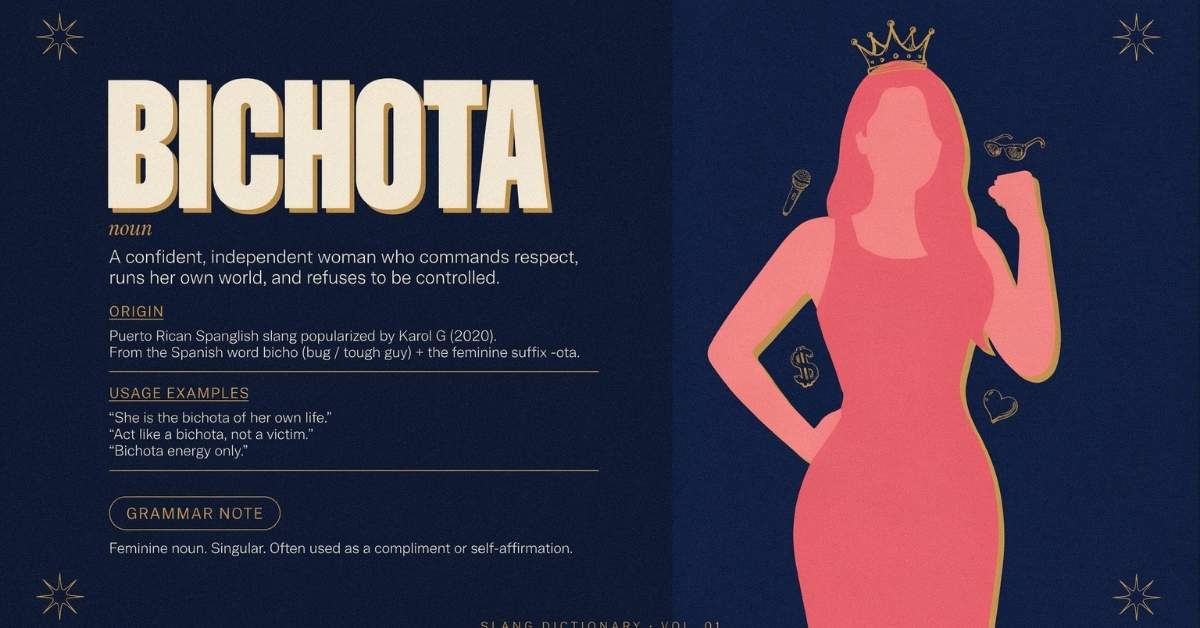
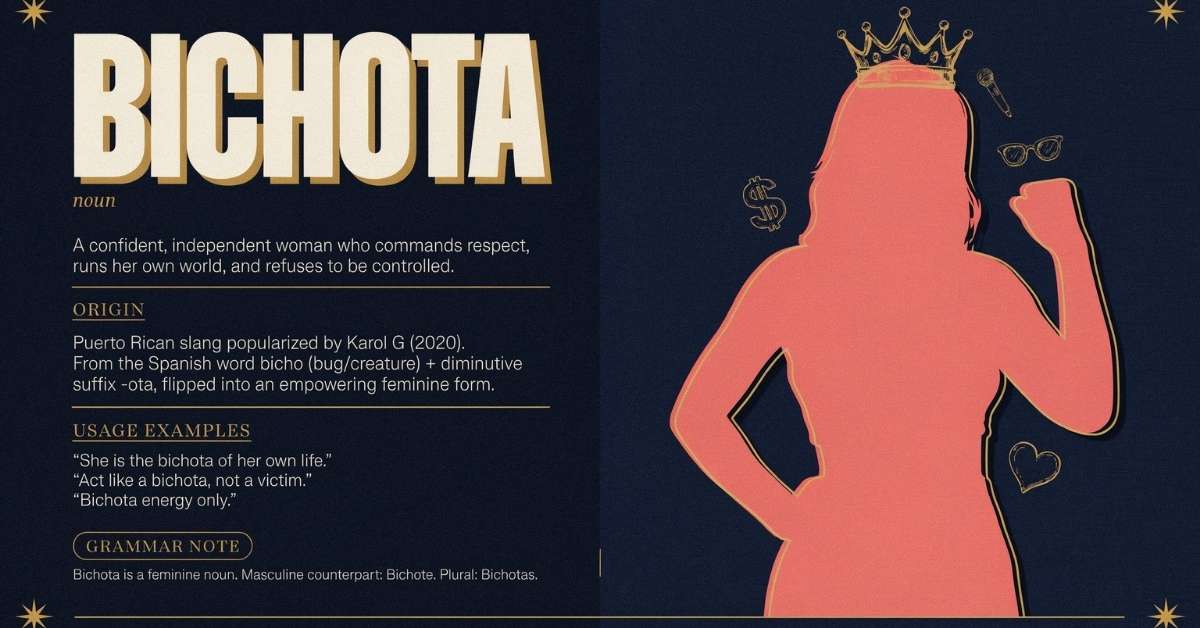
Bichota meaning refers to a confident, powerful, successful, and self-assured woman in modern Spanish slang. While the word originally evolved from Puerto Rican slang with a very different connotation, it gained a new identity after Karol G popularized it through her hit song “BICHOTA.” Today, many people use bichota to describe a woman who is fearless, independent, ambitious, and unapologetically authentic.
If you’ve come across the word on TikTok, Instagram, Spotify, or in conversations about Latin music and wondered, “What does bichota mean?”, you’re not alone. The term has become a global expression of female empowerment, but its journey is much more fascinating than a simple translation.
In this guide, you’ll learn the true meaning of bichota, its Spanish origin, how it evolved from Puerto Rican slang, why Karol G embraced it, how native speakers interpret it today, and when it’s appropriate—or inappropriate—to use the word.
What Does Bichota Mean?
The Short Definition
In today’s context, bichota is a Spanish slang term used to describe a woman who is:
- Confident
- Successful
- Independent
- Powerful
- Fearless
- Respected
- In control of her life
There isn’t a perfect one-word English translation, but depending on the situation, bichota can mean:
- Boss woman
- Boss lady
- Powerful woman
- Confident woman
- Independent woman
- Leader
- Queen
- A woman who knows her worth
Unlike a formal dictionary word, bichota carries emotional and cultural meaning that goes beyond a literal translation.
Example:
“She’s a total bichota—she built her own business and inspires everyone around her.”
Here, the word highlights strength, ambition, and confidence, not authority over others.
What Bichota Means Today
The modern bichota meaning has shifted far from its original roots.
Today, when people call someone a bichota, they usually mean she is:
- Self-confident
- Financially independent
- Emotionally strong
- Successful in her career
- Resilient
- Stylish
- Unapologetically herself
On TikTok, Instagram, and other social media platforms, the term is often used alongside photos or videos that celebrate achievements, confidence, or glamorous lifestyles.
For example:
“Feeling like a bichota today.”
This doesn’t imply arrogance. Instead, it reflects a mindset of believing in yourself and embracing your accomplishments.
Is Bichota a Positive or Negative Word?
The answer depends on where, how, and by whom it’s used.
In Modern Pop Culture
In today’s pop culture, bichota is overwhelmingly positive.
It symbolizes:
- Female empowerment
- Self-love
- Leadership
- Confidence
- Success
- Determination
Many women proudly refer to themselves as bichotas to express that they are confident, independent, and unafraid to pursue their goals.
In Traditional Contexts
Some older or native Puerto Rican Spanish speakers may associate the word with its earlier meaning, which had connections to criminal hierarchies and powerful figures in the drug trade.
Because of this historical background, interpretations can vary.
This difference is one reason you’ll sometimes find conflicting definitions online.
The modern meaning isn’t incorrect—it simply reflects how language naturally evolves over time, especially through music, culture, and social media.
Where Did the Word “Bichota” Come From?
Understanding the origin of bichota helps explain why the word has multiple meanings today.
Unlike many everyday Spanish words, bichota didn’t begin as a traditional dictionary term.
Instead, it evolved through language borrowing, street slang, and later popular culture.
The Connection to “Big Shot”
Many linguists and language resources trace the origin of bichote—the masculine form of bichota—to the English phrase “big shot.”
When English and Spanish speakers interacted over time, particularly in Puerto Rico, the pronunciation of “big shot” gradually transformed into bichote.
This is a fascinating example of linguistic borrowing, where words from one language are adapted into another.
The process wasn’t a direct translation. Instead, English pronunciation influenced a new slang word in Puerto Rican Spanish, which later developed its own unique meaning.
This type of language evolution is common in multilingual communities, where expressions often take on new lives shaped by local culture.
How Bichote Became Bichota
In Spanish, many nouns and adjectives have masculine and feminine forms.
The masculine form:
Bichote
became the feminine:
Bichota
Originally, this feminine form wasn’t widely used in everyday conversation.
Its popularity grew significantly after Karol G adopted it as the title of her 2020 hit song.
By doing so, she transformed bichota from a relatively uncommon slang variation into an internationally recognized symbol of female confidence and empowerment.
Today, millions of people recognize bichota before they ever hear the word bichote.
The Original Meaning Before Pop Culture
Before social media and international music made the word famous, bichote had a very different association in Puerto Rico.
Historically, it referred to a person with significant power or influence, and in some contexts it was associated with leaders within the illegal drug trade. Because of these origins, the term could carry a negative or intimidating tone.
It’s important to understand that this historical usage doesn’t define how most people use bichota today.
Language constantly changes.
Words often shift meaning because of:
- Music
- Movies
- Celebrities
- Internet culture
- Social media
- Generational change
Bichota is one of the clearest modern examples of this transformation.
Language Evolution in Action
The journey of bichota illustrates how slang can evolve:
| Stage | Meaning | Primary Context |
|---|---|---|
| Big Shot | Influential person | English expression |
| Bichote | Powerful figure; historically context-dependent in Puerto Rican slang | Puerto Rico |
| Bichota | Feminine adaptation | Limited early slang |
| Karol G’s “BICHOTA” | Empowered, confident woman | Latin music |
| Modern Social Media | Independent, successful, fearless woman | TikTok, Instagram, everyday slang |
This evolution explains why different websites sometimes provide different definitions—they’re describing different points in the word’s history rather than contradicting one another.
How Karol G Changed the Meaning of Bichota
Few songs have reshaped a slang word as dramatically as Karol G’s “BICHOTA.”
Before the song’s release, the term was largely unfamiliar outside certain Spanish-speaking communities.
Afterward, it became part of the global vocabulary of Latin music, TikTok, and Instagram, inspiring millions of people to embrace it as a symbol of confidence.
Why She Chose the Word
Karol G has explained in interviews that she wanted to reclaim the term and give it a new, empowering interpretation.
Rather than focusing on its earlier associations, she used bichota to represent a woman who:
- Believes in herself
- Works hard
- Leads with confidence
- Overcomes obstacles
- Doesn’t seek validation from others
Her intention wasn’t to celebrate power over people—it was to celebrate personal growth, self-worth, and ambition.
That message resonated with listeners across cultures, even among those who didn’t speak Spanish fluently.
How the Song Redefined the Term
The release of “BICHOTA” marked a turning point in how the public understood the word.
Instead of thinking about its historical slang meaning, fans began associating bichota with qualities like:
- Confidence
- Leadership
- Independence
- Success
- Self-respect
- Resilience
- Fearlessness
As the song gained popularity, creators on TikTok, Instagram Reels, and other social media platforms started using bichota in captions, hashtags, and videos celebrating personal achievements and self-confidence.
This cultural shift demonstrates how music can influence language, allowing a once niche slang term to become a widely recognized symbol of empowerment.
Why Millions Now Use It Differently
The widespread adoption of bichota reflects more than the success of a hit song. It shows how language evolves through culture and community.
Today, people use the term to describe someone who:
- Owns her success without apology
- Faces challenges with confidence
- Supports other women
- Takes pride in her achievements
- Lives authentically
For many fans, calling someone a bichota is a compliment that recognizes strength, determination, and self-belief rather than status or power alone.
This modern interpretation has helped transform bichota into one of the most recognizable pieces of Spanish slang in contemporary Latin pop culture, proving that words can take on entirely new meanings as societies, music, and online communities continue to shape the way we communicate.
What Does Bichota Mean on TikTok, Instagram, and Social Media?
While bichota has deep cultural and linguistic roots, its modern popularity is closely tied to social media. Platforms like TikTok, Instagram, YouTube Shorts, and X (formerly Twitter) have helped transform the word into a global expression of confidence, self-worth, and female empowerment.
Today, when someone uses bichota in a caption or comment, they’re usually celebrating a woman who is bold, ambitious, and proud of her accomplishments.
How People Use Bichota on TikTok
On TikTok, bichota often appears in videos that showcase:
- Personal achievements
- Career milestones
- Fashion transformations
- Fitness progress
- Luxury lifestyles
- Self-care routines
- Travel adventures
- Dance videos featuring Karol G’s music
Rather than referring to power over others, the word emphasizes owning your success and embracing your confidence.
Example captions:
- “Feeling like a bichota after getting my promotion.”
- “Every woman deserves to feel like a bichota.”
- “Today’s energy: confident, fearless, and unstoppable. #Bichota”
These examples reflect the modern interpretation of the word as a celebration of self-confidence rather than arrogance.
How Bichota Is Used on Instagram
On Instagram, bichota frequently appears in:
- Photo captions
- Fashion posts
- Travel content
- Business achievements
- Lifestyle blogs
- Women’s empowerment pages
Influencers and creators often use the term to express:
- Confidence
- Independence
- Leadership
- Personal growth
- Self-love
For many users, calling someone a bichota is similar to saying:
- “She’s a queen.”
- “She’s a boss.”
- “She knows her worth.”
What Does Bichota Mean in Text Messages?
In texting, the meaning is usually straightforward.
Someone might write:
“You’re such a bichota!”
This generally means:
- You’re amazing.
- You’re confident.
- You’re inspiring.
- You’re doing great.
- You look incredible.
The exact meaning depends on the conversation, but it is typically intended as a compliment.
Learn More: ICL Meaning Explained
How Native Spanish Speakers Understand Bichota
One mistake many articles make is assuming every Spanish speaker interprets bichota the same way.
In reality, Spanish slang changes significantly across countries. A word that carries one meaning in one region may have a different interpretation elsewhere.
Understanding these differences helps you use the term more naturally and respectfully.
Meaning in Puerto Rico
Puerto Rico is where the word’s story begins.
Historically, the masculine form bichote referred to someone with considerable influence or authority. In certain contexts, it became associated with individuals involved in organized crime, which gave the term a complex background.
Because of this history, some Puerto Ricans—especially older generations—may still associate bichota with those earlier meanings.
However, younger speakers and fans of Latin music increasingly recognize the modern, empowering interpretation popularized by Karol G.
This difference highlights how language evolves over time and why context is essential.
Meaning in Colombia
In Colombia, where Karol G was born, bichota is widely understood as a symbol of:
- Confidence
- Independence
- Success
- Personal empowerment
Many fans associate the word directly with Karol G rather than its historical origins.
As a result, the positive meaning is often the first one that comes to mind.
Meaning in Other Spanish-Speaking Countries
Across countries such as:
- Mexico
- Spain
- Argentina
- Chile
- Peru
- Dominican Republic
people generally recognize bichota because of its popularity in Latin music and social media.
However, familiarity varies depending on:
- Age
- Region
- Exposure to reggaeton
- Interest in pop culture
Some speakers use it regularly, while others rarely encounter it outside music.
Regional Differences at a Glance
| Country/Region | Common Interpretation |
|---|---|
| Puerto Rico | Original slang meaning plus modern interpretation |
| Colombia | Empowered, confident woman |
| Mexico | Popular social media slang |
| Spain | Mainly recognized through music |
| United States Latino Communities | Mix of traditional and modern meanings |
This variation is one reason why a simple dictionary definition doesn’t tell the whole story.
Is Bichota a Compliment or Can It Be Offensive?
This is one of the most frequently asked questions.
The short answer is:
Usually, it’s a compliment—but context matters.
When Bichota Is a Compliment
Today, calling someone a bichota often expresses admiration.
It suggests that the person is:
- Confident
- Independent
- Strong
- Successful
- Ambitious
- Fearless
For example:
“My sister is a real bichota. She started her own company and never gave up.”
Here, the word conveys respect and appreciation.
When It May Be Misunderstood
Some people, particularly those familiar with the term’s older Puerto Rican usage, may interpret it differently.
Because of its historical background, the word can occasionally cause confusion if:
- The audience is unfamiliar with Karol G’s modern interpretation.
- You’re speaking in a formal or professional setting.
- Cultural differences influence how the term is understood.
This doesn’t mean the word is inherently offensive—it simply means context matters.
A Practical Guide to Using Bichota
| Situation | Appropriate? | Why |
|---|---|---|
| Complimenting a confident friend | ✅ Yes | Positive modern meaning |
| Social media caption | ✅ Yes | Common and widely understood |
| Talking with Karol G fans | ✅ Yes | Fits the cultural context |
| Formal workplace meeting | ⚠️ Use caution | Informal slang may not suit the setting |
| Speaking with someone unfamiliar with the term | ⚠️ Depends | They may not understand the intended meaning |
Can Anyone Use the Word Bichota?
Because bichota has become internationally recognized, many people wonder whether it’s appropriate for everyone to use.
The answer depends on respect, context, and understanding the word’s cultural background.
Can Men Say Bichota?
Yes, men can say the word when referring to a woman in the modern, positive sense.
For example:
“She’s a bichota—she’s incredibly talented and confident.”
However, men generally wouldn’t describe themselves as bichota, since the term is grammatically feminine.
Can Women Call Themselves Bichota?
Absolutely.
Many women proudly use the word as a celebration of:
- Self-confidence
- Independence
- Leadership
- Achievement
- Personal growth
This is especially common on social media and within communities inspired by Karol G’s message.
Should Non-Spanish Speakers Use It?
Yes, but with awareness.
If you understand the word’s history and use it respectfully, most people will recognize the modern, positive meaning.
It’s best to avoid using bichota simply because it’s trendy without understanding its cultural significance.
Showing respect for the language and its origins is always appreciated.
When You Should Avoid Using It
You may want to avoid using the term:
- In formal business communication
- During academic presentations
- When speaking to audiences unfamiliar with the slang
- If you’re unsure how your audience interprets it
Choosing words that fit the situation demonstrates cultural awareness and effective communication.
How to Pronounce Bichota Correctly
Correct pronunciation helps you use the word confidently.
Phonetic Pronunciation
Bee-CHO-tah
IPA Pronunciation
/biˈtʃo.ta/
Syllable Breakdown
Bi • cho • ta
The stress falls on the second syllable:
bee-CHO-tah
Common Pronunciation Mistakes
Many English speakers mistakenly pronounce it as:
- “Bee-shot-ah”
- “Bitch-oh-ta”
- “Bee-co-ta”
These versions don’t reflect the standard Spanish pronunciation.
Remember:
The “ch” sounds exactly like the “ch” in the English word “chair.”
Bichota vs. Bichote vs. Jefa vs. Patrona
These words all relate to authority or confidence, but they aren’t interchangeable.
| Term | Meaning | Tone | Typical Usage |
|---|---|---|---|
| Bichota | Confident, empowered woman | Modern, positive | Social media, music, casual conversations |
| Bichote | Powerful figure; historically context-dependent in Puerto Rican slang | Depends on context | Regional slang |
| Jefa | Female boss or leader | Respectful | Workplace and everyday Spanish |
| Patrona | Female owner or person in charge | Formal or respectful | Business and leadership contexts |
Which Word Should You Use?
Choose:
- Bichota when celebrating confidence and empowerment.
- Jefa when referring to a professional female leader.
- Patrona when emphasizing ownership or authority.
- Bichote only when discussing its historical or regional meaning.
Knowing these distinctions helps you communicate naturally while respecting cultural context.
Real-Life Examples of Bichota in Everyday Conversations
Understanding a slang term becomes much easier when you see it in context.
Friends
Friend 1: “Did you hear Sarah launched her own fashion brand?”
Friend 2: “She’s such a bichota!”
Meaning: Sarah is admired for her confidence and entrepreneurial success.
Social Media Caption
“New goals, new mindset, same bichota energy.”
This highlights confidence and personal growth.
Text Message
A: “I finally got the promotion!”
B: “I knew you would! You’re a total bichota.”
Here, the word is used as a sincere compliment.
Music and Pop Culture
Fans often describe Karol G as:
“La Bichota.”
In this context, the nickname represents her confidence, influence, and success in the Latin music industry.
Everyday Spanish Conversation
“Ella es una bichota; siempre alcanza sus metas.”
English translation:
“She’s a confident and successful woman who always achieves her goals.”
This example reflects the modern, empowering interpretation that has become popular worldwide.
See More: Do Cadillac LYRIQ Driving Modes Affect Range or Battery Usage
Common Misunderstandings About the Word Bichota
Because bichota has evolved over time, it’s also one of the most misunderstood Spanish slang terms. Many websites oversimplify its meaning, while others focus only on its historical background. Understanding these misconceptions will help you use the word more accurately.
Myth 1: Bichota Always Refers to Crime
Reality: This is one of the biggest misconceptions.
Historically, the masculine form bichote could refer to a powerful figure in certain Puerto Rican contexts, including illegal activities. However, bichota is now commonly used in a very different way.
Today, thanks largely to Karol G, the word is widely understood as a symbol of:
- Confidence
- Success
- Leadership
- Female empowerment
- Self-belief
Most people using the word on social media are referring to this modern meaning—not its historical associations.
Myth 2: Bichota Only Means “Boss Lady”
While “boss lady” is a helpful translation, it doesn’t capture the full meaning.
A bichota is often seen as someone who:
- Believes in herself
- Achieves her goals
- Inspires others
- Doesn’t let setbacks define her
- Embraces her individuality
The word reflects an attitude and mindset, not just a job title.
Myth 3: Every Spanish Speaker Uses the Word
Not necessarily.
Some Spanish speakers use bichota frequently, while others rarely hear it outside Latin music or social media.
Its popularity depends on:
- Country
- Age
- Personal interests
- Exposure to reggaeton and pop culture
This is why regional context is so important.
Myth 4: Bichota Has One Universal Meaning
Like many slang expressions, bichota can mean slightly different things depending on:
- The speaker
- The audience
- The country
- The situation
Modern usage generally emphasizes empowerment, but understanding its history provides a more complete picture.
Why Bichota Became a Symbol of Female Empowerment
One reason bichota meaning attracts so much attention is that it goes beyond language—it represents a cultural shift.
Instead of defining power through fear or status, the modern interpretation celebrates women who create their own opportunities and live confidently.
For many people, being a bichota means:
- Owning your achievements
- Believing in your abilities
- Leading with confidence
- Supporting other women
- Refusing to let criticism stop your growth
This message resonates because confidence is something many people aspire to, regardless of their profession or background.
Why the Word Connects with So Many People
The popularity of bichota isn’t just about a catchy song.
It reflects values that many people admire:
- Self-confidence
- Independence
- Resilience
- Ambition
- Authenticity
- Personal growth
These themes have helped the word become part of everyday conversations, captions, and motivational content across the world.
The Evolution of Bichota: From Slang to Global Recognition
Understanding the timeline makes the word’s transformation much easier to appreciate.
| Time Period | How the Word Was Understood |
|---|---|
| English Influence | The phrase “big shot” becomes associated with someone important or influential. |
| Puerto Rican Slang | Bichote develops as a slang term with context-dependent meanings. |
| Feminine Form | Bichota emerges as the feminine adaptation but remains relatively uncommon. |
| 2020 | Karol G releases “BICHOTA,” introducing the word to a global audience. |
| Social Media Era | TikTok, Instagram, and other platforms popularize bichota as a symbol of confidence and empowerment. |
| Today | The word is widely recognized in Latin pop culture and often represents an ambitious, fearless, and self-assured woman. |
This timeline demonstrates how language evolves through music, culture, and everyday communication.
When Should You Use the Word Bichota?
Although bichota is generally positive today, it’s still important to use it appropriately.
Good Situations to Use It
The word fits naturally when:
- Complimenting a confident friend
- Celebrating someone’s achievement
- Writing an empowering social media caption
- Talking about Karol G or Latin music
- Discussing modern Spanish slang
Examples
✔ “She’s a true bichota—she built her business from scratch.”
✔ “Congratulations! You’re such a bichota.”
✔ “This playlist always brings out my bichota energy.”
Situations Where You Should Be Careful
Consider choosing another word if you’re:
- Writing formal business emails
- Giving academic presentations
- Speaking to people unfamiliar with the slang
- Communicating in professional settings
Words like jefa, líder, or empresaria may be more appropriate depending on the context.
Quick Facts About Bichota
| Question | Answer |
|---|---|
| Language | Spanish (Puerto Rican slang origin) |
| Literal Origin | Commonly linked to the English phrase “big shot” through Puerto Rican slang |
| Modern Meaning | A confident, empowered, and successful woman |
| Popularized By | Karol G |
| Used in Music? | Yes |
| Used on TikTok? | Yes |
| Used on Instagram? | Yes |
| Formal Spanish Word? | No, it’s informal slang |
| Positive Today? | Usually yes, depending on context |
| Best Translation | Boss woman, empowered woman, confident woman |
Frequently Asked Questions
What does bichota mean in English?
There isn’t an exact English equivalent, but bichota is commonly translated as boss woman, empowered woman, confident woman, or powerful woman. The best translation depends on the context.
Is bichota a compliment?
Yes. In modern usage, bichota is generally a compliment used to praise someone’s confidence, independence, ambition, or success.
Why is Karol G called La Bichota?
Karol G adopted the nickname after releasing her hit song “BICHOTA.” She redefined the word as a celebration of female empowerment, confidence, and self-belief, making La Bichota part of her artistic identity.
Is bichota offensive?
Usually not. Most people today understand it as a positive term. However, because of its historical background and regional differences, it’s still wise to consider your audience and the setting.
Can men use the word bichota?
Yes. Men can use bichota when referring to a woman in the modern empowering sense. Since it is the feminine form, men generally do not use it to describe themselves.
Is bichota Puerto Rican slang?
Yes. The term has roots in Puerto Rican Spanish, although its modern popularity comes largely from Karol G and the influence of Latin music.
What’s the difference between bichota and bichote?
Bichote is the masculine form and has historically carried different meanings depending on context. Bichota is the feminine adaptation and is now widely associated with confidence, independence, and empowerment.
How do you pronounce bichota?
The standard pronunciation is:
Bee-CHO-tah
IPA: /biˈtʃo.ta/
The emphasis is on the second syllable.
Is bichota a real Spanish word?
It is a recognized slang expression, not a traditional formal Spanish vocabulary word. Like many slang terms, its usage varies by region and cultural context.
What does bichota mean on TikTok?
On TikTok, bichota usually refers to someone who is confident, stylish, independent, and proud of her accomplishments. It often appears in captions celebrating success or self-confidence.
Can tourists or non-Spanish speakers use the word?
Yes, provided it’s used respectfully and with an understanding of its cultural background. Knowing the history behind the word helps you use it appropriately rather than simply following a trend.
Does bichota mean the same thing everywhere?
No. While the empowering meaning is widely recognized today, interpretations can still differ by country, generation, and personal experience.
Final Thoughts
Bichota meaning has evolved far beyond its original roots. What began as a Puerto Rican slang term has become an internationally recognized symbol of confidence, ambition, and female empowerment, thanks in large part to Karol G and the influence of Latin music and social media.
Like many slang expressions, bichota doesn’t have a single universal definition. Its meaning depends on culture, context, and how language evolves over time. For many people today, calling someone a bichota is a way of recognizing her determination, resilience, and willingness to embrace her authentic self.
Whether you discovered the word through a song, a TikTok video, or a conversation with friends, understanding its history, regional roots, and modern usage gives you a richer appreciation of why it has become one of the most recognizable expressions in contemporary Spanish slang.