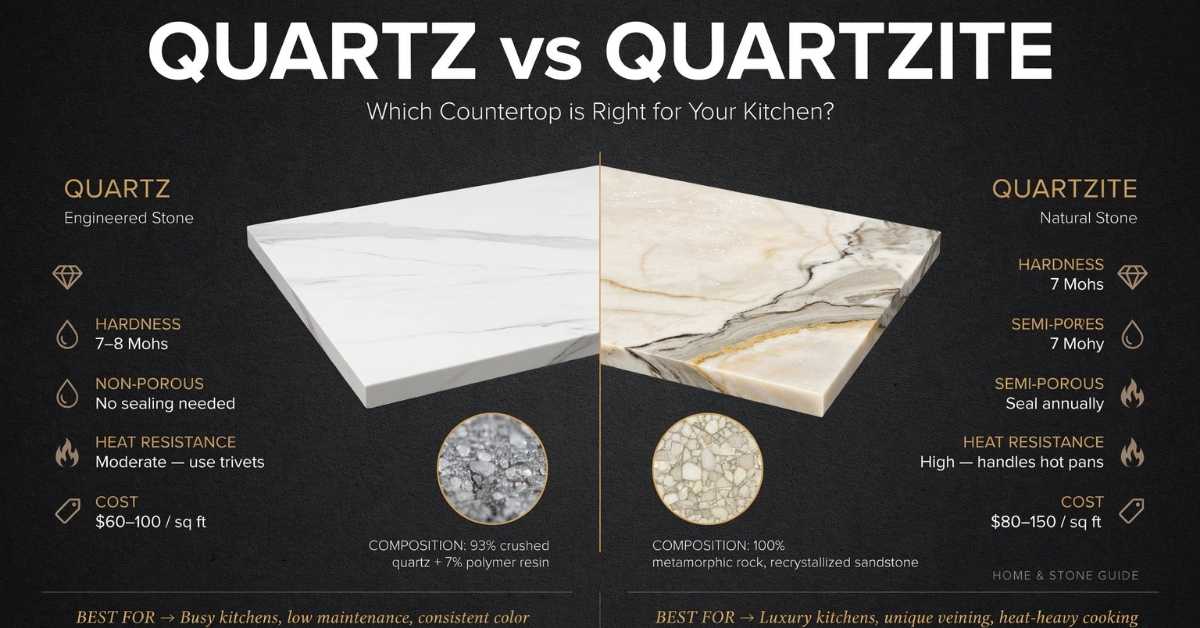
Quartz vs quartzite is one of the most common countertop comparisons homeowners make when planning a kitchen or bathroom renovation. The short answer is this: quartz is generally the better choice if you want a low-maintenance, stain-resistant, and consistent-looking countertop, while quartzite is ideal if you prefer the natural beauty of real stone, exceptional heat resistance, and one-of-a-kind veining. Neither material is universally “better”—the right option depends on your budget, lifestyle, cooking habits, design preferences, and willingness to perform routine maintenance.
At first glance, quartz countertops and quartzite countertops can look surprisingly similar. Both are durable, luxurious, and capable of transforming a kitchen into a stunning focal point. However, they differ significantly in composition, durability, maintenance requirements, heat resistance, porosity, installation, and long-term ownership costs.
Unfortunately, many online comparisons stop after explaining that quartz is engineered and quartzite is natural stone. While technically accurate, that information alone doesn’t help you decide which material fits your home.
This guide takes a different approach.
Instead of repeating generic comparisons, you’ll learn how each material performs in real-world kitchens, how they age over time, what professional fabricators wish every homeowner knew, and which option offers the best value for your specific needs. By the end, you’ll have the confidence to choose the countertop that matches your renovation goals without second-guessing your investment.
Quartz vs Quartzite at a Glance
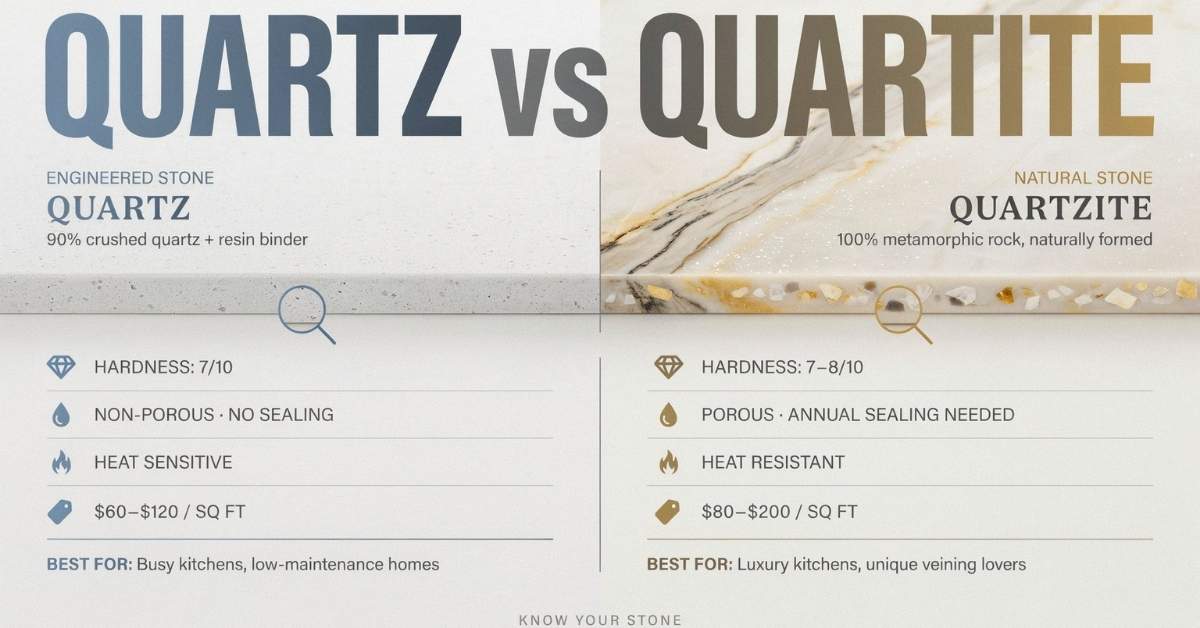
If you’re looking for a quick answer before diving into the details, this comparison table summarizes the most important differences.
| Feature | Quartz | Quartzite |
|---|---|---|
| Material Type | Engineered stone | Natural metamorphic stone |
| Appearance | Uniform and consistent | Unique natural veining |
| Heat Resistance | Good, but resin can be damaged by extreme heat | Excellent |
| Scratch Resistance | Very good | Outstanding |
| Stain Resistance | Excellent (non-porous) | Very good with proper sealing |
| Porosity | Non-porous | Naturally porous |
| Maintenance | Very low | Moderate |
| Sealing Required | No | Yes |
| UV Resistance | Limited for outdoor use | Excellent |
| Outdoor Applications | Not recommended in direct sunlight | Ideal |
| Lifespan | 20–30+ years | 50+ years with proper care |
| Repairability | Difficult if severely damaged | Can often be refinished |
| Color Options | Wide variety | Limited to natural colors |
| Installation | Easier consistency | Requires experienced stone fabricators |
| Cost | Moderate to premium | Premium to luxury |
| Best For | Busy families and low-maintenance homes | Luxury kitchens and natural stone enthusiasts |
Quick Recommendation
Choose quartz if you want:
- Minimal maintenance
- Consistent colors and patterns
- Excellent stain resistance
- Predictable pricing
- A family-friendly countertop
Choose quartzite if you want:
- Authentic natural stone
- Dramatic veining
- Superior heat resistance
- Outdoor durability
- Long-term luxury appeal
Understanding the Difference Starts With How They’re Made
One of the biggest reasons homeowners get confused is that the names quartz and quartzite sound almost identical. In reality, they’re created in completely different ways, and those differences directly affect how they perform in your home.
What Is Quartz?
Quartz countertops are engineered stone surfaces made by combining approximately 90–95% crushed natural quartz minerals with resins, polymers, and pigments. This mixture is compressed under high pressure and heat to create dense, durable slabs with consistent color and pattern.
Unlike natural stone, manufacturers can control nearly every aspect of the final product. That’s why brands such as Cambria, Caesarstone, Silestone, MSI, and LG Viatera offer hundreds of designs ranging from solid colors to realistic marble-inspired veining.
Why Homeowners Love Quartz
Because quartz is manufactured, it provides several practical advantages:
- Non-porous surface that resists stains from coffee, wine, and oil.
- No sealing required.
- Consistent patterns across multiple slabs.
- Wide range of colors and finishes.
- Easy daily cleaning with mild soap and water.
- Excellent durability for busy households.
These qualities make quartz one of the most popular choices for modern kitchens, especially for homeowners who want beautiful countertops without extensive maintenance.
The Engineering Advantage
The resin used during manufacturing fills microscopic gaps between quartz particles, creating a smooth, dense surface. This engineered structure explains why quartz performs exceptionally well against common household stains but also why excessive heat can damage the resin over time.
What Is Quartzite?
Quartzite is a natural metamorphic rock formed when sandstone rich in quartz is exposed to extreme heat and pressure deep within the Earth’s crust over millions of years.
During this transformation, individual quartz grains fuse together, creating an incredibly hard and durable stone. Unlike engineered quartz, every slab of quartzite is completely unique, with natural veining, mineral deposits, and color variations that cannot be replicated exactly.
Popular varieties include:
- Taj Mahal Quartzite
- Cristallo Quartzite
- Macaubas Quartzite
- Perla Venata Quartzite
Each slab tells its own geological story, making quartzite highly desirable for homeowners seeking a one-of-a-kind luxury kitchen.
Why Designers Love Quartzite
Interior designers often recommend quartzite because it combines the elegance of marble with significantly greater durability.
Benefits include:
- Natural beauty
- Exceptional heat resistance
- Unique veining
- High scratch resistance
- Long lifespan
- Outdoor suitability
However, because quartzite is naturally porous, it generally requires periodic sealing to help prevent staining.
Quartz vs Quartzite: Why They’re So Often Confused
Many homeowners assume quartz and quartzite are simply different versions of the same material because of their similar names. Even in showrooms, the polished surfaces can appear nearly identical at first glance.
The confusion usually comes down to three misconceptions:
Myth 1: Quartz Is Natural Stone
While quartz contains natural quartz minerals, the finished countertop is an engineered product, not a solid piece of natural stone.
Myth 2: Quartzite Is Completely Maintenance-Free
Although quartzite is incredibly durable, it still benefits from routine sealing because natural stone contains microscopic pores that can absorb liquids.
Myth 3: They Perform the Same
Both materials are strong, but they excel in different areas.
Quartz generally offers:
- Better stain resistance
- Easier maintenance
- More color consistency
Quartzite generally provides:
- Better heat resistance
- Greater natural uniqueness
- Superior UV stability
- Authentic stone character
Understanding these differences early helps narrow your decision before considering cost or design preferences.
Quartz vs Quartzite Feature-by-Feature Comparison
Rather than declaring one material universally superior, it’s more helpful to compare how each performs in the situations homeowners actually face every day.
Appearance and Natural Beauty
For many people, the countertop is the centerpiece of the kitchen. Appearance often becomes the deciding factor, especially in open-concept homes where the island serves as both a functional workspace and a design statement.
Quartz: Consistency and Design Flexibility
One of quartz’s biggest strengths is its consistency.
Since it’s manufactured, each slab can closely match another, making it easier to create:
- Large kitchen islands
- Waterfall edges
- Matching backsplashes
- Coordinated bathroom vanities
Manufacturers can also mimic the appearance of premium materials like marble and granite while offering patterns that don’t exist in nature.
This predictability is especially valuable for homeowners who prefer clean, modern, or minimalist interiors.
Ideal Design Styles
Quartz complements:
- Contemporary kitchens
- Scandinavian interiors
- Transitional homes
- Modern farmhouses
- Minimalist spaces
Quartzite: Nature’s Original Artwork
Quartzite offers something engineered materials simply cannot reproduce perfectly—true geological uniqueness.
Every slab features:
- Organic movement
- Natural veining
- Mineral crystals
- Subtle color variation
- Depth and texture
No two installations are ever exactly alike.
Premium varieties like Taj Mahal Quartzite have become favorites among luxury designers because they create elegant kitchens without sacrificing durability.
For homeowners who appreciate authentic natural materials, quartzite delivers unmatched visual character.
Which Looks More Luxurious?
Both materials can create beautiful kitchens, but they appeal to different tastes.
If you value:
- Perfect consistency
- Modern aesthetics
- Designer color options
Quartz may feel more refined.
If you value:
- Authentic natural stone
- One-of-a-kind patterns
- Organic elegance
Quartzite often creates a stronger impression of luxury.
Ultimately, the better-looking material is the one that complements your home’s architectural style and personal design vision.
Color Options and Design Flexibility
Color selection is another area where quartz and quartzite differ significantly.
Quartz Offers Nearly Unlimited Choices
Because manufacturers control pigments during production, quartz is available in an enormous range of colors and finishes.
You’ll find:
- Bright whites
- Warm creams
- Deep blacks
- Soft grays
- Bold statement colors
- Marble-look patterns
- Concrete-inspired finishes
This flexibility makes it easier to coordinate countertops with cabinets, flooring, wall colors, and backsplashes.
Quartzite Embraces Natural Variation
Quartzite’s palette is created by nature rather than pigments.
Common tones include:
- White
- Cream
- Gray
- Beige
- Gold
- Blue
- Green
- Soft pink
The exact colors depend on the minerals present during formation, giving every slab a distinctive appearance.
While options are more limited than engineered quartz, many homeowners consider this natural variation part of quartzite’s appeal.
Durability in Everyday Life
Durability isn’t just about laboratory testing—it also depends on how a countertop performs during years of cooking, entertaining, and family life.
Both materials are considered premium countertop options, but they excel in different situations.
We’ll compare scratch resistance, heat resistance, stain resistance, and daily wear in the next section to help you understand how each surface performs under real-world conditions.
Scratch Resistance
One of the most common questions homeowners ask is whether quartz or quartzite scratches more easily.
Both materials are highly durable, but quartzite generally has the advantage because it is an exceptionally hard natural stone that ranks high on the Mohs Hardness Scale. This makes it highly resistant to everyday scratches from utensils, cookware, and household use.
Quartz is also remarkably scratch-resistant thanks to its high quartz mineral content. However, the resin used in engineered quartz is slightly softer than natural quartzite, making it marginally more susceptible to surface damage under extreme conditions.
Practical Advice
Regardless of the material you choose:
- Use cutting boards instead of cutting directly on the countertop.
- Avoid dragging heavy cookware across the surface.
- Lift, rather than slide, rough-bottomed appliances.
Following these simple habits will help both quartz and quartzite countertops maintain their appearance for many years.
Heat Resistance: Which Countertop Handles Hot Pans Better?
Heat resistance is one of the biggest differences in the quartz vs quartzite debate, especially if you cook frequently.
Quartz: Heat Resistant, But Not Heatproof
Many homeowners assume quartz is completely heatproof because it contains natural quartz minerals. However, engineered quartz also contains resins and polymers that can become damaged when exposed to extreme temperatures.
Placing a hot pan directly from the stove or oven onto a quartz countertop can potentially cause:
- Resin discoloration
- Surface scorching
- Thermal shock
- Hairline cracks
- Permanent dull spots
While occasional brief contact with warm cookware may not cause immediate damage, countertop manufacturers—including brands like Cambria, Caesarstone, and Silestone—generally recommend using trivets or heat pads.
Quartzite: Exceptional Heat Resistance
Because quartzite is a natural metamorphic stone, it formed under immense heat and pressure deep within the Earth. As a result, it tolerates high temperatures far better than engineered quartz.
That doesn’t mean you should make a habit of placing extremely hot cookware directly on the surface, but quartzite offers a much larger safety margin.
Expert Insight
Professional fabricators often say:
Quartz usually fails because of heat. Quartzite usually fails because of poor maintenance.
That single observation highlights the biggest practical difference between the two materials.
Stain Resistance
Every kitchen experiences spills.
Coffee.
Red wine.
Olive oil.
Tomato sauce.
Turmeric.
Lemon juice.
How each countertop responds depends largely on porosity.
Quartz: One of the Most Stain-Resistant Countertops Available
Quartz is non-porous, meaning liquids cannot easily penetrate the surface.
This makes it highly resistant to common household stains, including:
- Coffee
- Wine
- Tea
- Juice
- Cooking oils
- Vinegar
- Food coloring
In most cases, a damp microfiber cloth and mild soap are enough to restore the surface.
This is one reason quartz has become a favorite among busy families and homeowners who don’t want to think about countertop maintenance.
Quartzite: Excellent With Proper Sealing
Quartzite naturally contains microscopic pores.
Without a quality sealant, liquids may gradually soak into the stone.
Potential staining substances include:
- Wine
- Coffee
- Oil
- Soy sauce
- Berries
- Curry
- Ink
Fortunately, sealing dramatically reduces this risk.
Modern penetrating sealers typically provide excellent protection when maintained according to the manufacturer’s recommendations.
Practical Tip
Instead of assuming every quartzite slab behaves the same, ask your fabricator:
“How porous is this specific slab?”
Different quartzite varieties absorb moisture at different rates.
Learn More: Bichota Meaning
Water Resistance
Water may seem harmless, but repeated exposure can affect certain countertop materials over time.
Quartz
Because quartz is engineered with resin, it resists:
- Water
- Soap
- Steam
- Humidity
This makes quartz an excellent choice for:
- Kitchens
- Bathrooms
- Laundry rooms
- Wet bars
Quartzite
Quartzite performs very well around water after proper sealing.
However, if sealant wears away, moisture can slowly penetrate the stone.
This doesn’t usually cause immediate damage, but long-term neglect increases the chance of discoloration or staining.
UV Resistance
Many homeowners overlook ultraviolet light until their kitchen receives years of direct sunshine.
Quartz
Standard engineered quartz isn’t designed for prolonged outdoor exposure.
Continuous UV exposure may eventually lead to:
- Yellowing
- Fading
- Resin discoloration
For this reason, most manufacturers recommend quartz for indoor applications.
Quartzite
Natural quartzite performs exceptionally well outdoors.
It maintains its color despite:
- Sunlight
- Rain
- Snow
- Temperature changes
This makes quartzite an outstanding option for:
- Outdoor kitchens
- Patio bars
- Poolside entertaining areas
If your project includes exterior living space, quartzite is usually the better investment.
Impact and Chip Resistance
Countertops don’t just experience scratches.
They also endure impacts from:
- Cast iron pans
- Heavy mixers
- Pressure cookers
- Falling dishes
Quartz
Quartz absorbs impact surprisingly well because resin provides slight flexibility.
Small accidental bumps rarely create major problems.
However, sharp impacts near edges can chip engineered quartz.
Quartzite
Quartzite is harder but also more rigid.
The surface itself resists damage extremely well, but edges may chip if struck with enough force.
Edge profile selection becomes important.
Rounded edges generally reduce visible chipping compared to square profiles.
Maintenance: What Living With Each Material Really Feels Like
Maintenance is where many homeowners either love or regret their countertop choice.
The daily experience matters far more than laboratory testing.
Daily Cleaning
Quartz
Routine care is refreshingly simple.
Usually all you need is:
- Warm water
- Mild dish soap
- Soft microfiber cloth
Avoid abrasive cleaners and harsh chemicals.
Quartzite
Daily cleaning looks almost identical.
The difference is long-term care.
Because quartzite is natural stone, homeowners should periodically inspect the surface for signs that resealing may be necessary.
Long-Term Maintenance
Quartz
Maintenance checklist:
- No sealing
- No polishing
- Easy cleanup
- Consistent appearance
This simplicity is one of quartz’s strongest selling points.
Quartzite
Maintenance typically includes:
- Periodic resealing
- Immediate cleanup of acidic spills
- Stone-safe cleaners
- Occasional professional maintenance
Many homeowners find these tasks manageable, but they do require commitment.
What Happens If Maintenance Is Ignored?
Quartz
Neglect usually results in:
- Surface buildup
- Reduced shine
- Minor discoloration
Fortunately, these issues are often cosmetic.
Quartzite
Ignoring maintenance can eventually cause:
- Staining
- Moisture absorption
- Etching from certain substances
- Reduced protective barrier
Routine sealing prevents most of these problems.
Maintenance Timeline
| Timeframe | Quartz | Quartzite |
|---|---|---|
| Daily | Wipe clean | Wipe clean |
| Weekly | Mild cleaner | Stone-safe cleaner |
| Monthly | Inspect for residue | Inspect sealant condition |
| Every 1–3 Years | Usually none | Reseal if recommended |
| Long-Term | Maintain finish | Maintain finish and reseal as needed |
Cost Breakdown Beyond the Price Tag
One of the biggest mistakes homeowners make is comparing only the purchase price.
The smarter comparison considers total ownership cost.
Material Cost
Prices vary by region, slab quality, thickness, edge profile, and brand.
Quartz
Typical installed price:
Approximately $60–$120 per square foot
Premium designer collections can exceed this range.
Quartzite
Typical installed price:
Approximately $80–$200+ per square foot
Rare exotic slabs may cost considerably more.
Fabrication Costs
Fabrication involves:
- Measuring
- Cutting
- Edge profiling
- Sink cutouts
- Cooktop openings
- Polishing
Quartzite generally costs more to fabricate because:
- It’s harder.
- It wears cutting tools faster.
- Installation requires greater expertise.
Installation Costs
Both materials require professional installation.
Quartzite often involves:
- Additional labor
- Specialized equipment
- Larger installation crews
This contributes to higher overall project costs.
Maintenance Costs Over Time
Quartz owners usually spend very little on maintenance beyond normal household cleaners.
Quartzite owners may occasionally purchase:
- Stone-safe cleaners
- Penetrating sealers
- Professional resealing services (if desired)
While these expenses aren’t overwhelming, they should be included when comparing long-term ownership.
Repair Costs
Neither material is immune to damage.
Quartz repairs can be challenging because engineered patterns are difficult to recreate seamlessly.
Quartzite may sometimes be professionally refinished or repaired depending on the location and severity of the damage.
Which Countertop Fits Your Lifestyle?
The “best” countertop depends on how you actually live.
Rather than asking which material is objectively superior, ask which one matches your daily routine.
Best for Busy Families
Recommended: Quartz
Why?
- Easy cleanup after meals.
- Excellent stain resistance.
- No sealing schedule.
- Consistent performance.
Parents often appreciate the reduced maintenance.
Best for Home Chefs
If you regularly cook with heavy cookware and frequently move hot pans, quartzite offers greater peace of mind thanks to its outstanding heat resistance.
Best for Luxury Homes
Homeowners seeking dramatic natural veining and one-of-a-kind slabs often prefer quartzite.
Premium varieties such as Taj Mahal Quartzite remain highly desirable in upscale kitchens because no two installations look exactly alike.
Best for Rental Properties
Rental homes benefit from materials requiring minimal upkeep.
Quartz usually provides:
- Predictable maintenance
- Easy cleaning
- Reliable durability
- Broad buyer appeal
Best for Airbnb Hosts
Vacation rentals experience frequent turnover and varying levels of care.
Quartz’s stain resistance and low-maintenance nature generally make it the safer long-term investment.
Best for Outdoor Kitchens
This category has a clear winner.
Quartzite performs far better outdoors because it tolerates:
- UV exposure
- Rain
- Heat
- Seasonal temperature fluctuations
Standard engineered quartz is generally not recommended for prolonged outdoor installations.
Best for Low-Maintenance Homeowners
If your priority is spending less time maintaining your countertops and more time enjoying your kitchen, quartz remains one of the easiest premium surfaces to own.
Best for Design Enthusiasts
If your dream kitchen centers around dramatic natural stone with distinctive veining and organic character, quartzite delivers an unmatched visual experience.
Expert Recommendation
Think beyond today’s renovation budget.
Ask yourself:
- How much maintenance am I realistically willing to perform?
- Will this kitchen receive heavy daily use?
- Do I prioritize unique natural beauty or long-term convenience?
Your answers often reveal the right countertop more clearly than any specification sheet.
Real-World Performance After Years of Use
A countertop isn’t just a design feature—it’s one of the hardest-working surfaces in your home. While both quartz and quartzite countertops are premium choices, their long-term performance depends on how they’re used and maintained.
What to Expect After 5 Years
Quartz
- Maintains its color and finish with minimal care.
- Rarely develops stains due to its non-porous surface.
- May show minor wear in high-traffic kitchens.
- Continues to look nearly new when protected from excessive heat.
Quartzite
- Retains its natural beauty exceptionally well.
- May require one or more resealing applications depending on use.
- Continues to resist scratches and heat extremely well.
- Develops a natural patina that many homeowners appreciate.
What to Expect After 10–20 Years
A properly maintained countertop of either material can still look excellent after a decade or more.
Quartz often remains visually consistent, while quartzite continues to showcase the timeless character of natural stone. The biggest difference is maintenance—quartzite owners who follow a sealing schedule usually enjoy decades of reliable performance.
Common Myths That Lead to Expensive Mistakes
Myth #1: Quartz Is Natural Stone
Reality: Quartz countertops are engineered stone, combining natural quartz minerals with resin and pigments.
Myth #2: Quartzite Never Needs Maintenance
Reality: Quartzite is durable but should be sealed periodically to help prevent staining.
Myth #3: You Can Always Put Hot Pans on Quartz
Reality: Excessive heat can damage the resin in engineered quartz. Always use trivets or heat pads.
Myth #4: Quartzite Is Impossible to Damage
Reality: While highly durable, quartzite can still chip along edges if subjected to strong impacts.
Myth #5: More Expensive Always Means Better
Reality: The best countertop is the one that matches your lifestyle, not simply the highest price tag.
Mistakes Homeowners Make Before Buying
Avoid these common—and costly—mistakes:
- Choosing based only on appearance.
- Ignoring long-term maintenance requirements.
- Comparing only material prices instead of total ownership costs.
- Hiring inexperienced fabricators.
- Not inspecting the actual slab before purchase.
- Assuming every quartzite slab performs the same.
- Forgetting to ask about warranties.
- Choosing a countertop that doesn’t fit their cooking habits.
Pro Tip: Spend as much time choosing your installer as you spend choosing your countertop. Even premium materials can underperform if fabricated or installed poorly.
How to Inspect a Slab Before You Buy
Whether you’re choosing Cambria, Caesarstone, Silestone, or a natural Taj Mahal Quartzite slab, inspect it carefully before approving fabrication.
Slab Inspection Checklist
- Examine the entire slab under good lighting.
- Check for cracks or excessive fissures.
- Review the veining pattern from multiple angles.
- Confirm slab thickness.
- Inspect polished, honed, or leathered finishes.
- Ask whether the slab has been factory treated or sealed.
- Discuss seam placement before fabrication.
- Verify edge profile options.
- Ask about matching additional slabs if your project requires them.
Taking time to inspect the slab can prevent expensive surprises after installation.
Questions to Ask Your Fabricator
Before signing a contract, ask:
- Is this genuine quartzite or another natural stone?
- Who performs the installation?
- What warranty covers fabrication and installation?
- How often do you recommend resealing this material?
- Which cleaner is safest?
- Can damaged sections be repaired?
- How will seams be positioned?
- What edge profile do you recommend?
- Have you installed this specific material before?
Experienced fabricators appreciate informed customers because it leads to better project outcomes.
Quartz vs Quartzite in Different Rooms
| Room | Best Choice | Why |
|---|---|---|
| Kitchen | Depends on lifestyle | Quartz for low maintenance; quartzite for natural beauty and heat resistance |
| Bathroom | Quartz | Moisture-resistant and easy to clean |
| Laundry Room | Quartz | Excellent resistance to water and household cleaners |
| Home Bar | Quartzite | Elegant appearance and good durability |
| Outdoor Kitchen | Quartzite | Superior UV and weather resistance |
| Commercial Spaces | Quartz | Low maintenance and consistent performance |
Quartz vs Quartzite vs Other Countertop Materials
Choosing between quartz and quartzite becomes easier when compared with other premium surfaces.
| Material | Key Advantage | Consideration |
|---|---|---|
| Quartz | Low maintenance | Less heat resistant than natural stone |
| Quartzite | Natural beauty and heat resistance | Requires sealing |
| Granite | Durable natural stone | Needs periodic sealing |
| Marble | Classic luxury | More prone to scratching and staining |
| Porcelain | Heat and UV resistant | Edge fabrication can be more specialized |
| Soapstone | Natural aging and heat resistance | Softer surface may scratch more easily |
| Dolomite | Marble-like appearance with added durability | Can still etch under acidic substances |
| Dekton / Sintered Stone | Excellent UV and heat resistance | Premium pricing in many markets |
Sustainability and Indoor Air Quality
Many homeowners now consider environmental impact alongside performance.
Quartz
- Manufactured using natural quartz minerals and resins.
- Material sourcing and production vary by manufacturer.
- Some brands emphasize lower-emission manufacturing and recycled content.
Quartzite
- A naturally occurring stone.
- Quarrying and transportation contribute to environmental impact.
- Longevity can reduce replacement frequency over time.
When evaluating sustainability, ask suppliers about responsible sourcing, manufacturing practices, and applicable environmental certifications.
Countertop Design Trends for 2026
Interior designers continue to favor timeless materials over short-lived trends.
Popular countertop trends include:
- Waterfall kitchen islands
- Thick edge profiles
- Warm white and cream surfaces
- Dramatic natural veining
- Honed and leathered finishes
- Minimalist kitchens
- Mixed-material designs
- Integrated backsplashes
- Large-format islands
- Organic textures paired with wood cabinetry
Quartz remains popular for contemporary interiors, while quartzite continues to dominate luxury custom homes.
Expert Recommendations by Buyer Type
| Buyer | Best Choice | Reason |
|---|---|---|
| First-time homeowner | Quartz | Affordable maintenance and predictable performance |
| Busy family | Quartz | Excellent stain resistance and easy cleaning |
| Home chef | Quartzite | Superior heat tolerance |
| Luxury homeowner | Quartzite | Unique natural veining |
| Rental property owner | Quartz | Lower maintenance requirements |
| Outdoor entertainer | Quartzite | UV and weather resistance |
| Design enthusiast | Quartzite | One-of-a-kind natural stone aesthetics |
| Budget-conscious remodeler | Quartz | Strong balance of value and performance |
Decision Matrix: Which Countertop Should You Choose?
| If Your Priority Is… | Choose |
|---|---|
| Lowest maintenance | ✅ Quartz |
| Authentic natural stone | ✅ Quartzite |
| Heat resistance | ✅ Quartzite |
| Stain resistance | ✅ Quartz |
| Outdoor installation | ✅ Quartzite |
| Consistent appearance | ✅ Quartz |
| Luxury visual impact | ✅ Quartzite |
| Easy cleaning | ✅ Quartz |
| Family-friendly kitchen | ✅ Quartz |
| Long-term natural elegance | ✅ Quartzite |
Pros and Cons
Quartz
Pros
- Non-porous
- No sealing required
- Excellent stain resistance
- Wide color selection
- Consistent appearance
- Easy daily maintenance
- Family-friendly
Cons
- Less resistant to extreme heat
- Not ideal for prolonged outdoor exposure
- Repairs can be difficult if significantly damaged
Quartzite
Pros
- Authentic natural stone
- Exceptional heat resistance
- Outstanding scratch resistance
- UV resistant
- Unique veining
- Long lifespan
Cons
- Requires periodic sealing
- Higher installation costs
- Natural variation between slabs
- Typically more expensive than quartz
Frequently Asked Questions
Is quartz better than quartzite?
Neither is universally better. Quartz is ideal for homeowners seeking low maintenance, while quartzite excels in natural beauty, heat resistance, and outdoor durability.
Which countertop lasts longer?
With proper care, both materials can last for decades. Quartzite’s natural stone composition gives it exceptional longevity, while quartz offers excellent durability with minimal maintenance.
Which scratches more easily?
Quartzite generally has the advantage because of its natural hardness, although both materials resist everyday scratching extremely well.
Can I place hot pans on quartz?
It’s best not to. Use trivets or heat pads to avoid damaging the resin within engineered quartz.
Does quartzite need sealing?
Yes. Periodic sealing helps maintain stain resistance and protects the stone from moisture absorption.
Which countertop costs more?
Quartzite often costs more because the material is quarried naturally and typically requires more complex fabrication and installation.
Which adds more resale value?
Both are considered premium countertop materials. The value they add depends on the overall quality of the renovation, buyer preferences, and local real estate trends.
Is quartzite worth the extra money?
If you value authentic natural stone, dramatic veining, and exceptional heat resistance, many homeowners find quartzite worth the investment.
Can quartz countertops crack?
Although uncommon, quartz can crack due to improper installation, structural movement, or severe impact.
Can quartzite stain?
Yes, if left unsealed or if spills remain on the surface for extended periods. Proper sealing greatly reduces this risk.
Which is easier to repair?
Minor repairs are possible for both materials, but seamless repairs can be challenging. The repair method depends on the location and extent of the damage.
Which is better for outdoor kitchens?
Quartzite is generally the better choice because it withstands sunlight, heat, and changing weather conditions more effectively than standard engineered quartz.
Final Verdict:
Choosing between quartz vs quartzite isn’t about finding a universal winner—it’s about selecting the countertop that fits your home, lifestyle, and long-term expectations.
Choose quartz if you want:
- Minimal maintenance
- Outstanding stain resistance
- A wide selection of colors and patterns
- Consistent appearance across large installations
- A practical, family-friendly surface
Choose quartzite if you want:
- The timeless beauty of natural stone
- Exceptional heat and UV resistance
- Unique veining that can’t be replicated
- A luxurious, high-end aesthetic
- A countertop built to perform for decades with proper care
If convenience, predictable maintenance, and everyday practicality are your priorities, quartz is likely the smarter investment. If you appreciate the individuality of natural materials and don’t mind periodic sealing, quartzite delivers a level of character and durability that many homeowners consider unmatched.
Ultimately, the best countertop is the one that complements your design vision, fits your maintenance preferences, and supports the way you live every day.