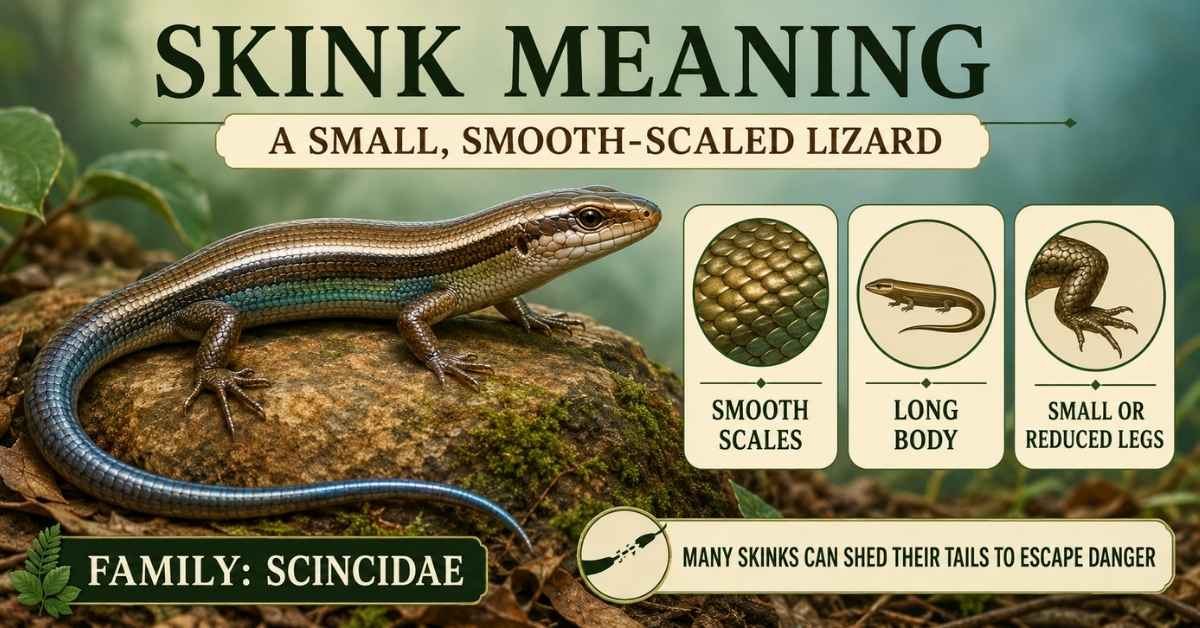
Skink meaning refers primarily to a type of lizard belonging to the family Scincidae. Skinks commonly have smooth, shiny scales, elongated bodies, and relatively short legs, although their appearance varies considerably between species. The word can also have rare historical meanings, while Cullen skink refers to a Scottish fish soup—not a reptile dish.
You may have encountered this unfamiliar word in a nature book, garden, game, crossword, text message, or restaurant menu. Its intended meaning becomes clear once you examine the surrounding context.
Skink Meaning at a Glance
| Detail | Quick answer |
|---|---|
| Primary meaning | A type of lizard |
| Scientific family | Scincidae |
| Pronunciation | /skɪŋk/, similar to “skin-k” |
| Word type | Noun; historically also a verb |
| Plural | Skinks |
| Common features | Smooth scales, long body, and often short legs |
| Historical meaning | To pour or serve a drink |
| Cullen skink | A traditional Scottish fish soup |
| Slang status | No universally accepted modern slang meaning |
A simple skink definition and example would be: “A skink is a smooth-scaled lizard.” For instance, “A small skink disappeared beneath the garden stones.”
What Does Skink Mean in Modern English?
The standard skink meaning in English is a lizard classified within the family Scincidae and the reptile order Squamata. A skink is therefore a lizard and a reptile, not a snake, amphibian, or mammal.
There are more than 1,500 described skink species, making Scincidae one of the most diverse lizard families. They inhabit forests, deserts, grasslands, gardens, rocky areas, and underground environments across much of the world. Zoological overview
How to Pronounce Skink
If you are wondering how to pronounce skink, say it as /skɪŋk/. It sounds approximately like “skin” with a hard k added at the end.
The pronunciation is essentially the same in American and British English. The plural form is skinks.
Is Skink a Noun or a Verb?
In normal modern English, skink is a noun:
“The blue-tailed skink moved quickly across the path.”
Historically, to skink could mean to pour, draw, or serve a drink. Its verb forms are skinked and skinking, but this usage is now rare or dialectal. The animal name developed separately through Latin scincus and Greek skinkos. Merriam-Webster
What Does a Skink Look Like?
Most people searching for skink lizard meaning also want to identify an animal they have seen. Skinks do not all look identical, but many share several recognizable features:
- Smooth, polished-looking scales
- A long or cylindrical body
- Short or reduced legs
- Fast, low-to-the-ground movement
- A long, tapering tail in many species
- A neck that may be less noticeable than that of other lizards
- Stripes, blue tails, blue tongues, or other markings in certain species
Some skinks have clearly developed legs, while others have tiny limbs or no visible limbs. This variation explains why people sometimes mistake them for snakes.
Why Some Skinks Look Like Snakes
Limb reduction can help burrowing species move through soil, sand, grass, or narrow spaces. A long body and small legs create a slithering movement, but a skink remains biologically classified as a lizard.
Color alone is not a dependable identification method. A bright blue tail, for example, appears in juveniles of several species and does not identify one specific skink.
| Feature | How it varies |
|---|---|
| Size | From very small to comparatively large |
| Legs | Well-developed, reduced, or absent |
| Tail | Long, short, detachable, or non-detachable |
| Color | Brown, bronze, striped, blue-tailed, or brightly marked |
| Habitat | Gardens, forests, deserts, rocks, trees, or underground |
| Diet | Insectivorous, omnivorous, or occasionally plant-focused |
Learn More: Cantab Meaning
Are Skinks Poisonous or Dangerous?
Commonly encountered skinks are not treated as dangerous venomous reptiles. They are usually shy and attempt to escape rather than confront people. However, an unidentified wild animal should not be handled unnecessarily.
It also helps to understand the terminology:
- Venomous animals inject toxins through a bite or sting.
- Poisonous animals cause harm when touched or eaten.
Regional myths sometimes describe brightly colored skinks as poisonous or venomous. For example, official wildlife guidance identifies five-lined skinks as harmless, although a large animal may deliver a defensive pinch when handled. North Carolina Wildlife Resources Commission
Do Skinks Bite?
A frightened, cornered, or restrained skink may bite in self-defense. The likely effect depends on the animal’s species and size, but most skinks prefer to run and hide.
Children should observe wild skinks rather than catch them. Dogs and cats should also be kept from chasing them because the pet may injure the lizard or provoke a defensive bite. Seek professional advice if a person is bitten or a pet eats an unidentified reptile.
What to Do If You Find a Skink in Your House
Finding a skink in the house can be startling, especially when its fast movement resembles that of a small snake. It may have entered through a gap while searching for shelter, warmth, moisture, or insects.
A humane response is usually straightforward:
- Keep children and pets away.
- Close doors leading farther into the building.
- Open a safe exit to the outdoors.
- Give the animal space and time to leave.
- Avoid glue traps, poison, or rough handling.
- Contact local wildlife assistance if you cannot identify or safely remove it.
Skinks around gardens may consume insects, spiders, snails, and other small invertebrates. Their presence does not automatically mean that a property has a serious infestation.
Skink vs. Snake, Gecko, Salamander, and Skunk
These animals may be confused because of their names, movement, or appearance.
| Animal | Main distinction |
|---|---|
| Skink | A smooth-scaled lizard, often with a long body and short legs |
| Snake | A legless reptile with a different body and skull structure |
| Gecko | A lizard that often has a more distinct head and specialized toe pads |
| Salamander | An amphibian with moist skin rather than scales |
| Skunk | A fur-covered mammal known for its defensive scent spray |
A photograph, geographic location, visible scales, and body structure are more useful for identification than color alone.
Skink, Skank, Skunk, or Sink?
These similar-looking words have completely different meanings.
- Skink is a neutral scientific and everyday word for a lizard.
- Skank can be a disparaging slang term. It can also describe a dance associated with ska and reggae.
- Skunk is a black-and-white mammal.
- Sink is a basin or a verb meaning to descend.
The difference between skink vs. skank is especially important. Calling an animal a skink is correct and neutral, while using “skank” about a person can be offensive.
A useful memory trick is to connect skink with the animal’s smooth, skin-like appearance: skin + k = skink.
Other Meanings of Skink
Although the lizard definition is dominant, the surrounding words can point to a different meaning.
What Does Skink Mean in Cullen Skink?
Cullen skink is a traditional Scottish soup commonly prepared with smoked haddock, potatoes, onions, and milk or cream. Cullen is a town in northeastern Scotland, while “skink” has a historical association with broth or soup.
Despite the unusual name, Cullen skink does not contain lizard. Cullen skink overview
Skink Meaning in Slang or Text Messages
There is no single, widely recognized skink slang meaning. In a text, chat, or social media post, it might be:
- A nickname or username
- An inside joke
- A reference to a reptile
- A misspelling of skank
- A gaming or fictional reference
If someone uses “skink” as an insult, its meaning depends on that speaker or community. It should not be presented as a universally established insult.
Skink Meaning in Games and Fantasy
Some games and fictional worlds use skinks as reptilian characters, scouts, warriors, or magical creatures. This is a fictional extension of the animal name rather than a separate standard dictionary definition.
Look for nearby words such as “unit,” “warrior,” “character,” “race,” or “game” to identify this context.
Skink Spiritual Meaning
Some modern spiritual interpretations connect skinks with adaptability, renewal, awareness, survival, or regeneration. These associations may be inspired by their ability to escape predators and, in some species, regrow part of a lost tail.
However, a skink spiritual meaning is symbolic and personal. It is not a scientific fact or the standard English definition of the word.
See More: Martyr Meaning
How Skink Is Used in Real Situations
| Example | Intended meaning |
|---|---|
| “A skink ran beneath the log.” | The lizard |
| “Skinks belong to the family Scincidae.” | Scientific classification |
| “The host skinked ale into each cup.” | Historical verb |
| “We ordered Cullen skink for lunch.” | Scottish soup |
| “The game added several skink units.” | Fictional or gaming use |
| “Skink is his online nickname.” | Context-specific informal use |
When the meaning is unclear, use a simple context check:
- Look at the surrounding words.
- Identify whether the subject is nature, food, history, gaming, or conversation.
- Apply the lizard definition unless the context clearly indicates otherwise.
- Verify unfamiliar slang instead of assuming it has a standard meaning.
Why Skinks Matter in Nature
Many skinks feed on insects and other small invertebrates, helping connect different levels of a local food web. Skinks are also prey for birds, snakes, mammals, and larger reptiles.
Diet varies considerably. Many species are mainly insectivorous, while others are omnivorous and may eat fruit, vegetation, snails, small animals, or carrion. This variation is another reason not to make universal claims about all skinks.
Tail Loss and Regeneration
Many skinks can detach their tails when seized by a predator, a process called autotomy. The moving tail distracts the attacker while the skink escapes.
A replacement may grow over time, but it is not an exact copy of the original. Some species cannot shed or regenerate their tails, so tail loss should never be deliberately triggered.
Eggs and Live Birth
Skink reproduction is unusually diverse. Some species lay eggs, while others give birth to live young. This biological diversity, together with differences in legs, habitat, diet, and body shape, makes Scincidae an especially varied lizard family.
Common Types of Skinks
Several names appear frequently in wildlife guides and pet discussions:
- Five-lined skink: Juveniles often have stripes and a bright blue tail.
- Blue-tongued skink: A comparatively large skink known for displaying its blue tongue.
- Ground skink: A small species frequently found in leaf litter.
- Sand skink: A streamlined burrower adapted to moving through sand.
- Water skink: A name used for species associated with moist or waterside habitats.
- Garden skink: A general common name for small skinks found around vegetation and homes.
In the United States, readers may encounter five-lined, broadhead, ground, western, or sand skinks. Australia is well known for garden, water, and blue-tongued skinks. In South Asia, elongated skinks may be confused with snakes and given different regional folklore names.
Frequently Asked Questions
Is a skink a lizard or a snake?
A skink is a lizard belonging to the family Scincidae. Some species resemble snakes because they have elongated bodies and very small limbs.
What is the plural of skink?
The plural is skinks.
What do skinks eat?
Many skinks eat insects, spiders, snails, worms, and other small invertebrates. Some species also consume vegetation, fruit, or small animals.
Can a skink regrow its tail?
Many species can regenerate part of a lost tail, but the replacement differs from the original. Some skinks cannot shed their tails at all.
Is skink an offensive word?
No. The standard meaning of skink is a neutral animal name. It may be confused with “skank,” which can be offensive.
Does Cullen skink contain a skink?
No. Cullen skink is a Scottish soup traditionally made with smoked haddock, potatoes, and onions.
What is the simplest skink meaning?
In simple English, a skink is a smooth-scaled lizard that often has a long body and short legs.
The Meaning to Remember
Skink most commonly means a lizard from the family Scincidae. You can often recognize one by its smooth scales, elongated body, quick movement, and relatively short legs. Historical, culinary, gaming, slang, and spiritual interpretations are less common and depend on context.
When choosing between skink, skank, and skunk, remember: a skink is the lizard.