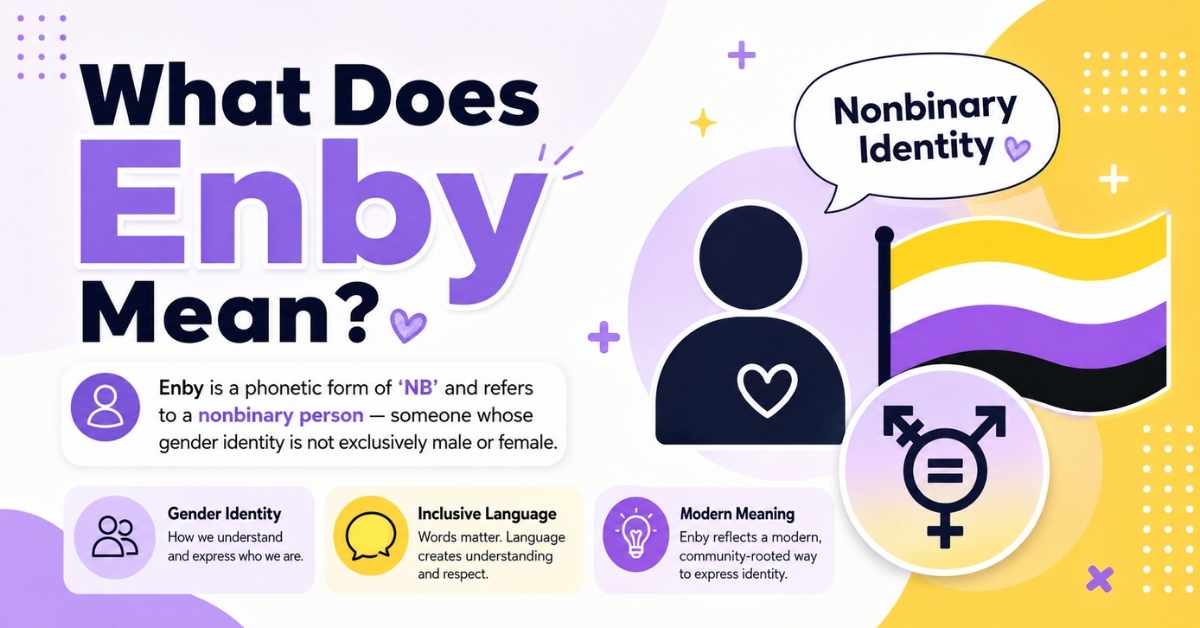
What does enby mean? Enby is an informal term for a nonbinary person or something associated with a nonbinary identity. It comes from saying the letters NB aloud and is pronounced “EN-bee.” Some nonbinary people proudly use enby for themselves, while others prefer nonbinary or another identity label because enby can sound too casual or youthful.
The most respectful approach is simple: use the language a person uses for themselves. Being enby does not automatically reveal someone’s pronouns, appearance, sexual orientation, or transition choices.
Enby Meaning at a Glance
| Question | Quick answer |
|---|---|
| What does enby mean? | An informal term for a nonbinary person |
| How is enby pronounced? | “EN-bee” |
| What does enby stand for? | It comes from the spoken pronunciation of NB, meaning nonbinary |
| Is enby the same as nonbinary? | The meanings strongly overlap, but tone and personal preference can differ |
| Is enby offensive? | Not inherently, but some people dislike being called it |
| What pronouns do enby people use? | Any pronouns, depending on the individual |
| Is enby formal language? | Usually informal |
| What is the plural of enby? | Both enbies and enbys are used |
The safest general rule is:
Call someone enby when they use or accept the term for themselves.
What Does the Word Enby Actually Mean?
The basic enby definition is straightforward: an enby is a person whose gender identity is nonbinary.
Nonbinary describes people whose gender is not exclusively male or exclusively female. A nonbinary person might experience gender as:
- A combination of genders
- Somewhere between male and female
- Outside male and female categories
- Changing over time
- Neutral or absent
- Difficult to describe using traditional labels
Nonbinary is an umbrella term. It may include identities such as agender, genderfluid, bigender, demigender, pangender, and genderqueer, although personal labels vary.
Enby as a Noun
Enby is often used as a noun referring to a person.
For example:
“Jordan describes themself as an enby.”
In this sentence, enby functions similarly to a person-label. However, not every nonbinary person feels comfortable being described this way.
Some people like the word because it feels friendly and community-based. Others find it too cute, informal, or infantilizing.
Enby as an Adjective
Enby can also appear before another noun:
“The organization created a support group for enby students.”
This usage is common in casual community conversations. In formal or professional writing, nonbinary students may be clearer and more widely understood.
Enby as an Identity Label
For some people, enby is more than shorthand. It may be a meaningful personal identity label that reflects how they understand themselves and connect with a wider community.
Other people identify as nonbinary but do not use enby at all.
Neither choice is more valid. Identity language is personal.
How Do You Pronounce Enby?
Enby is pronounced “EN-bee.”
It sounds like saying the letters:
- N — “en”
- B — “bee”
The spelling represents the sound of the initialism NB, which is short for nonbinary.
It is generally not pronounced “en-bye.”
Why Is It Spelled Enby Instead of NB?
The word enby is a pronunciation spelling. Rather than writing the initials N and B, people wrote out how those letters sound when spoken.
The progression looks like this:
Nonbinary → NB → “EN-bee” → Enby
Calling enby a conventional acronym is not completely accurate. An acronym is usually pronounced as a word, while NB is an initialism pronounced one letter at a time. Enby developed by writing that pronunciation phonetically.
Another reason some writers avoid NB is that those initials can also mean non-Black, particularly in conversations involving race and social justice. Writing enby or nonbinary can prevent ambiguity.
Where Did the Term Enby Come From?
The term enby developed in online LGBTQIA+ communities during the early 2010s.
A widely cited use appeared on Tumblr in 2013, where a user proposed enby as a gender-neutral person-label. The idea was to create a word that could sometimes serve a similar grammatical role to terms such as boy or girl without placing someone within the male–female binary.
How the Word Spread
The word gradually became more visible through:
- Tumblr
- LGBTQIA+ forums
- Social-media profiles
- Online support communities
- Personal blogs
- Queer media
- Everyday conversations
- Fiction and journalism
As more people adopted it, its meaning expanded beyond simple shorthand.
For some, enby became:
- A personal identity label
- A community term
- A casual noun
- A way to express belonging
- A warmer alternative to formal terminology
For others, the word’s association with terms such as boy and girl made it sound too youthful.
This difference explains why enby can feel affirming to one person and uncomfortable to another.
Enby vs Nonbinary: Are They the Same?
Enby and nonbinary usually refer to the same broad gender category, but they are not always interchangeable in tone or personal use.
Nonbinary is the broader and more formal term. Enby comes from the spoken pronunciation of NB and is usually more conversational.
| Enby | Nonbinary |
|---|---|
| Usually informal | Works in formal and informal settings |
| Often used as a noun | Commonly used as an adjective |
| May feel friendly or community-based | Often feels neutral and descriptive |
| Some adults find it youthful | More widely accepted in professional contexts |
| Best used according to personal preference | Usually safer when preference is unknown |
How the Terms Overlap
Both words may refer to someone whose gender is not exclusively male or female.
A person might say:
“I am nonbinary.”
They might also say:
“I’m an enby.”
In many contexts, those statements communicate closely related information.
Can Someone Be Nonbinary but Not an Enby?
Yes.
A nonbinary person may:
- Use enby and nonbinary
- Prefer only nonbinary
- Use enby only in casual settings
- Prefer a more specific identity label
- Avoid identity labels altogether
A dictionary can explain the general meaning of a word, but it cannot decide which label feels right for an individual.
Can Someone Identify Specifically as Enby?
Yes.
Some people use enby as a personal identity rather than treating it merely as an abbreviation. It may feel more comfortable, accessible, or connected to community language.
The important point is that self-identification matters more than an outsider’s preferred terminology.
Is Enby an Offensive or Disrespectful Word?
Enby is not inherently an offensive word or slur. Many people use it positively and comfortably.
However, it can become disrespectful when someone applies it to every nonbinary person without considering individual preference.
Why Some People Like the Term
Enby may feel:
- Friendly
- Informal
- Gender-neutral
- Community-created
- Easy to use as a noun
- Affirming
- Less clinical
- Connected to queer culture
For someone who has struggled to find words describing their identity, discovering enby may provide a sense of recognition or belonging.
Why Some People Dislike It
Other people find enby:
- Childish
- Too cute
- Infantilizing
- Overly casual
- Unsuitable for professional settings
- Uncomfortable when used by strangers
An adult may prefer nonbinary person because it sounds more neutral and does not carry the same youthful associations.
The Safest Usage Rule
Use enby when:
- The person uses it for themselves
- The person has said they accept it
- It is normal within the specific community
- You are using it in an appropriate informal context
Use nonbinary person when:
- You do not know someone’s preference
- You are writing professionally
- You are discussing a group with varied preferences
- Clarity matters
- The context is legal, medical, academic, or formal
How to Ask Whether Someone Uses the Term Enby
Many articles say “ask respectfully” without explaining what respectful wording sounds like.
You can ask:
“Do you use enby for yourself, or do you prefer nonbinary?”
Another option is:
“What language would you like me to use when describing your gender?”
Keep the question brief and relevant. The goal is not to ask someone to defend or explain their identity.
When You Do Not Need to Ask
Someone’s gender may not be relevant to the conversation.
You do not need to ask about a person’s identity merely because you are curious. If you can communicate respectfully without knowing, there may be no reason to raise the subject.
Questions to Avoid
Avoid asking about:
- Anatomy
- Medical procedures
- Hormone use
- Sex assigned at birth
- Previous names
- Whether the identity is permanent
- Whether someone is “really” male or female
- How they have sex
- Whether their family approves
These questions are personal and are rarely necessary for ordinary respectful communication.
What Pronouns Do Enby People Use?
Enby people can use any pronouns. Being nonbinary does not automatically mean that someone uses they/them.
Possible pronoun sets include:
- They/them
- He/him
- She/her
- He/they
- She/they
- Multiple pronoun sets
- Neopronouns
- A person’s name in place of pronouns in some situations
Identity and Pronouns Are Not the Same
Gender identity describes how someone understands their gender.
Pronouns are words used when referring to a person.
The two can be related, but one does not automatically determine the other.
A nonbinary person may use he/him pronouns without becoming a man. Another may use she/her without identifying as a woman. Pronouns are part of personal language, not a test that proves or disproves identity.
How to Ask About Pronouns
A direct and respectful question is:
“What pronouns do you use?”
You can also introduce your own pronouns first:
“I’m Sara, and I use she/her pronouns. What pronouns do you use?”
This makes the exchange feel more mutual.
Pronoun sharing should not be forced, especially in public settings where someone may not feel safe disclosing personal information.
What Enby Does Not Tell You About a Person
Knowing that someone is enby does not automatically reveal:
- Their pronouns
- Their name
- Their appearance
- Their clothing style
- Their body
- Their sex assigned at birth
- Their sexual orientation
- Whether they are transgender
- Whether they experience gender dysphoria
- Whether they want medical treatment
- Whether they want legal document changes
- Whether they use gender-neutral relationship terms
- Whether they like being called enby
Why Assumptions Cause Problems
Gender identity cannot be reliably determined from:
- Clothing
- Hairstyle
- Voice
- Body shape
- Interests
- Behaviour
- Relationship history
An enby person may look masculine, feminine, androgynous, or none of those things. Their presentation may also change over time.
There is no required appearance for being nonbinary.
Gender Identity, Expression, Pronouns, and Orientation
These concepts are related, but they do not mean the same thing.
| Concept | What it describes | Examples |
|---|---|---|
| Gender identity | A person’s internal understanding of gender | Nonbinary, woman, man, agender |
| Gender expression | How someone presents themselves | Clothing, voice, hairstyle |
| Pronouns | Words used to refer to someone | They, he, she |
| Sexual orientation | Romantic or sexual attraction | Gay, straight, bisexual, asexual |
| Sex characteristics | Physical or biological traits | Hormones, chromosomes, anatomy |
Enby Is About Gender Identity
Enby refers to gender identity, not sexual orientation.
A person’s gender does not tell you who they are attracted to.
Enby People Can Have Any Sexual Orientation
An enby person may identify as:
- Gay
- Lesbian
- Straight
- Bisexual
- Pansexual
- Asexual
- Queer
- Another orientation
- Unlabelled
Different people use orientation labels differently because many traditional labels were created around binary gender categories.
Appearance Does Not Define Identity
An enby person may present as:
- Masculine
- Feminine
- Androgynous
- Neutral
- Different at different times
Gender expression is personal. It does not make someone more or less genuinely nonbinary.
Is Enby the Same as Transgender?
Nonbinary identities are often included under the broader transgender umbrella, but not every enby or nonbinary person personally identifies as transgender.
Transgender generally describes someone whose gender identity differs from the sex they were assigned at birth.
Since nonbinary people do not identify exclusively with the gender traditionally associated with their assigned sex, many consider themselves transgender.
Others do not use that label.
Why Someone May Not Use the Transgender Label
Reasons may include:
- Personal preference
- Cultural background
- Community connection
- A different understanding of transgender identity
- Preference for a more specific term
- Discomfort with umbrella labels
The respectful approach is not to assign the transgender label automatically. Follow the person’s own language.
Learn More: What Does Yearning Mean
Enby Compared With Related Gender Terms
It is connected with several gender terms, but these words should not be treated as exact synonyms.
Enby vs Genderfluid
Genderfluid describes a gender experience that changes over time, situation, or personal feeling.
A genderfluid person may feel:
- More masculine at one time
- More feminine at another
- Neutral or outside those categories at other times
Some genderfluid people also identify as nonbinary or enby. Others primarily use genderfluid.
Enby vs Agender
Agender may describe someone who:
- Does not experience gender
- Feels little connection to gender
- Experiences gender as neutral
- Rejects gender categories
Agender is often placed under the nonbinary umbrella, but not every agender person uses enby.
Enby vs Genderqueer
Genderqueer is an identity that may involve challenging, mixing, or rejecting traditional gender categories.
Genderqueer and nonbinary overlap significantly. A person may use:
- Genderqueer
- Nonbinary
- Enby
- More than one of these
- None of them
Enby vs Bigender
Bigender usually refers to identifying with two genders. These genders may be experienced at the same time or at different times.
A bigender person may also identify as nonbinary because their gender does not fit exclusively into one binary category.
Enby vs Intersex
Enby relates to gender identity. Intersex relates to sex characteristics.
Intersex people are born with sex characteristics that do not fit typical definitions of exclusively male or female bodies.
An intersex person may identify as:
- A woman
- A man
- Nonbinary
- Enby
- Another gender
The two terms are not interchangeable.
Enby vs Gender Nonconforming
Gender nonconforming usually describes a person whose appearance or behaviour does not match social expectations associated with their gender.
A gender-nonconforming person may still identify as a man or woman. Expression alone does not establish a nonbinary identity.
How to Use Enby Correctly in a Sentence
The word can appear as a noun or adjective, but context and personal preference matter.
Using Enby as a Noun
“Sam identifies as an enby.”
This is appropriate when Sam uses enby for themself.
Avoid using it for someone who has not accepted the term.
Using Enby as an Adjective
“The programme supports enby and transgender students.”
This construction appears in informal community writing. In a professional document, this may be clearer:
“The programme supports nonbinary and transgender students.”
Informal Community Example
“The event welcomes trans and enby creators.”
This may feel natural when the organizers and audience already use the terminology.
Professional Example
“The survey included women, men, and nonbinary participants.”
Nonbinary is often preferable in formal research, workplace, policy, and media contexts.
Media and Journalism Example
When discussing a specific person, use their publicly stated language:
“The actor describes themself as nonbinary.”
Do not replace someone’s chosen term merely to avoid repeating a word.
What Is the Plural of Enby?
You may encounter both:
- Enbies
- Enbys
Both forms appear in dictionaries and real-world usage. Enbies is common because words ending in a consonant plus “y” often change to “ies” in English plurals.
However, some people prefer enbys because enby is a newer community-created term.
When referring to individuals, clarity and preference matter more than enforcing one plural as universally correct.
When to Use Enby and When to Use Nonbinary Person
| Situation | Safer wording |
|---|---|
| The person describes themself as enby | Enby |
| The person prefers nonbinary | Nonbinary person |
| Their preference is unknown | Nonbinary person |
| Casual community conversation | Enby may be appropriate |
| Professional report | Nonbinary person |
| Healthcare or legal document | Follow the person’s stated terminology and required form |
| Journalism | Use the person’s publicly stated language |
| General marketing copy | Avoid assuming every nonbinary person accepts enby |
Why Formality Matters
A word can be respectful in one setting and unsuitable in another.
Enby may feel warm and natural among friends or within an online community. The same word may feel too casual in:
- A legal document
- A medical record
- Academic research
- Workplace policy
- News reporting
- Official correspondence
Why Personal Preference Comes First
Style guides provide general rules, but they cannot override self-identification.
When discussing a particular person, use the term that person chooses whenever it is relevant and safe to do so.
How to Respond When Someone Tells You They Are Enby
A supportive first response can be simple:
“Thank you for telling me.”
When practical details are needed, ask:
“What name and pronouns would you like me to use?”
You do not need to deliver a speech or prove how supportive you are. Listen and follow their lead.
What Not to Say
Avoid responses such as:
- “Are you sure?”
- “You don’t look nonbinary.”
- “Is this just a phase?”
- “Which gender are you really?”
- “What were you before?”
- “Have you had surgery?”
- “Your life will be too difficult.”
- “I’ll never understand this.”
These responses turn a personal disclosure into a debate or interrogation.
Respect Their Privacy
Do not tell other people about someone’s identity unless they have clearly given permission.
A person may be comfortable being open with friends but not:
- At work
- At school
- With relatives
- In public
- In a particular community
Coming out in one situation does not mean someone has consented to being out everywhere.
See More: What Does Caleb Mean
What to Do If You Use the Wrong Term or Pronoun
Mistakes happen. The best response is usually brief and practical.
1. Correct Yourself
“He—sorry, they—sent the report yesterday.”
2. Continue the Conversation
Do not stop everything for a long apology.
A dramatic reaction can make the other person feel responsible for comforting you.
3. Practice Privately
Use the person’s name and pronouns in practice sentences:
- “They will attend the meeting.”
- “I sent the document to them.”
- “Their presentation begins at noon.”
Repeated practice makes the correct language feel natural.
If someone corrects you, a simple response works:
“Thanks for correcting me.”
Then continue using the correct term.
Can Adults Identify as Enby?
Yes. People of any age can identify as enby.
The word does not officially mean “nonbinary child.” Adults may use enby because it feels:
- Comfortable
- Friendly
- Gender-neutral
- Community-based
- Personally meaningful
Other adults avoid it because it sounds youthful or infantilizing.
Both responses are valid. Disliking the term enby does not make someone less nonbinary, and using it does not make someone immature.
Is Enby a Formal Dictionary Word or Internet Slang?
Enby began as a community-created online term, but it is now documented in major English dictionaries.
It can be described as:
- Informal
- A pronunciation spelling
- A noun
- An adjective
- A nonbinary identity label
- Community language
- Established modern vocabulary
Can Informal Language Be Legitimate?
Yes.
Informal does not mean incorrect or meaningless. It simply means the word may not be appropriate for every setting.
Words often begin within specific communities before becoming widely recognized. Dictionary inclusion records established usage, but it does not mean everyone must adopt the term.
Capitalization and Spelling
Enby is normally written in lowercase:
- enby
It is capitalized at the beginning of a sentence.
In US English, nonbinary is commonly written as one word. Non-binary with a hyphen remains common in British English and some publications.
How to Know Whether Enby Describes You
There is no test that can determine whether someone is enby.
Gender identity is personal, and people understand it in different ways.
Questions You Might Reflect On
You might consider:
- Do male or female categories fully describe me?
- Does nonbinary language feel more accurate or comfortable?
- How do I feel when people use different pronouns for me?
- Do I want a broad label or a more specific one?
- Does the word enby feel affirming, uncomfortable, or neutral?
- Would I prefer no label at all?
These questions are tools for reflection, not diagnostic criteria.
You Do Not Need to Decide Immediately
You are not required to:
- Choose a permanent label
- Come out
- Change your name
- Change your pronouns
- Dress androgynously
- Take hormones
- Have surgery
- Update legal documents
- Explain your identity to everyone
Labels can change as people learn more about themselves.
Someone can identify as nonbinary without using enby. Someone can also explore the term privately before deciding whether it fits.
When Support May Help
A trusted friend, supportive community, or qualified affirming professional may help when identity questions create distress or isolation.
Questioning gender is not itself a mental-health problem. Support should help someone explore safely rather than pressure them toward a particular conclusion.
The RESPECT Framework for Using Enby Appropriately
Use the RESPECT framework when you encounter the word enby.
R — Read the Context
Determine where the term appears:
- Personal introduction
- Social-media bio
- Workplace document
- News article
- Community conversation
- School setting
Context affects whether informal language is appropriate.
E — Explain the Basic Meaning
Enby is an informal word derived from saying NB, meaning nonbinary.
S — Separate Related Concepts
Do not confuse:
- Identity
- Pronouns
- Gender expression
- Sexual orientation
- Sex characteristics
P — Prioritize Personal Preference
Use the person’s own language.
Do not assume that every nonbinary person accepts enby.
E — Employ Respectful Examples
Ask clear, brief questions such as:
“Do you use enby, or do you prefer nonbinary?”
C — Correct Mistakes Briefly
Correct yourself, continue the conversation, and practise the right language later.
T — Trust Reliable Information
Use:
- Dictionaries for pronunciation and grammar
- Professional style guidance for public writing
- Community perspectives for personal experiences
- The individual’s own words for their identity
Common Misunderstandings About Enby
“Every Nonbinary Person Is an Enby”
Not necessarily. Some nonbinary people use enby, while others avoid it.
“All Enby People Use They/Them”
No. An enby person may use any pronouns.
“Enby Is a Sexual Orientation”
No. Enby relates to gender identity, not attraction.
“Enby People Must Look Androgynous”
There is no required appearance for being enby.
“Enby Means Intersex”
No. Enby concerns gender identity. Intersex concerns sex characteristics.
“Being Enby Requires Medical Transition”
No treatment, surgery, hormone use, or legal change is required.
“Enby Is Only for Teenagers”
Adults can use the term. Some enjoy it, while others find it too youthful.
“Enby and Nonbinary Are Completely Different”
Their meanings strongly overlap. The main differences involve tone, grammatical use, formality, and personal preference.
Frequently Asked Questions
What does enby mean in simple terms?
Enby is an informal term for a nonbinary person. It comes from saying the letters NB aloud as “EN-bee.” Some nonbinary people use it proudly, while others prefer nonbinary or another identity label.
What does enby stand for?
Enby comes from NB, an initialism for nonbinary. The spelling enby represents how the letters N and B sound when spoken.
How do you pronounce enby?
Enby is pronounced “EN-bee.” It sounds like saying the letters N and B aloud.
Is enby the same as nonbinary?
The terms strongly overlap, but their use can differ. Nonbinary is broader and more formal, while enby is usually informal and community-based. Not every nonbinary person likes being called enby.
Is enby offensive?
Enby is not inherently offensive. However, some people find it childish or infantilizing. Use it for a specific person when they use or accept the term.
Why do some people dislike the term enby?
Some adults feel that enby sounds cute, youthful, or similar to words such as boy and girl. Others appreciate that same friendly, community-oriented tone.
Can adults identify as enby?
Yes. Enby can be used by people of any age. Whether someone likes the term depends on personal preference, not age rules.
What pronouns do enby people use?
Enby people can use they/them, he/him, she/her, mixed pronouns, neopronouns, or other forms. Ask the person rather than assuming.
Can an enby person use he/him or she/her?
Yes. Pronouns do not automatically determine gender identity. An enby person may use he/him, she/her, they/them, or more than one set.
Is enby a noun or an adjective?
It can function as both. Someone may say “I am an enby,” or a writer may refer to “enby students.” Nonbinary is often clearer as an adjective in formal writing.
What is the plural of enby?
Both enbies and enbys are used. Enbies is common in general writing, but preferences and style choices vary.
Can someone be enby and transgender?
Yes. Many nonbinary people identify as transgender, but some do not personally use the transgender label.
Can someone be enby and straight?
Yes. Enby describes gender identity, not sexual orientation. An enby person may identify as straight, gay, bisexual, asexual, queer, or another orientation.
Is enby the same as genderfluid?
No. Enby is a broad informal term related to nonbinary identity. Genderfluid specifically describes a gender experience that changes over time or context. A person can identify as both.
Can cisgender people say enby?
Cisgender people can use the word respectfully when discussing its meaning or referring to someone who accepts the label. They should not impose it on every nonbinary person.
How should I ask whether someone uses the word enby?
You can ask:
“Do you use enby for yourself, or do you prefer nonbinary?”
Keep the question brief and accept the person’s answer.
What should I do if I use the wrong pronoun?
Correct yourself briefly, use the right pronoun, and continue. Avoid a lengthy apology that makes the other person responsible for reassuring you.
Final Answer: What Enby Means and How to Use It
Enby means a nonbinary person and comes from the spoken pronunciation of NB. It is usually pronounced “EN-bee” and is commonly used as an informal noun, adjective, or personal identity label.
Some people find enby warm, affirming, and community-based. Others consider it too casual or infantilizing and prefer nonbinary person.
The word does not automatically reveal someone’s pronouns, appearance, sexual orientation, body, or transition choices. When referring to a specific person, use the language they use for themselves. When you are uncertain, ask briefly and respectfully instead of making assumptions.