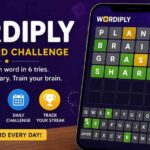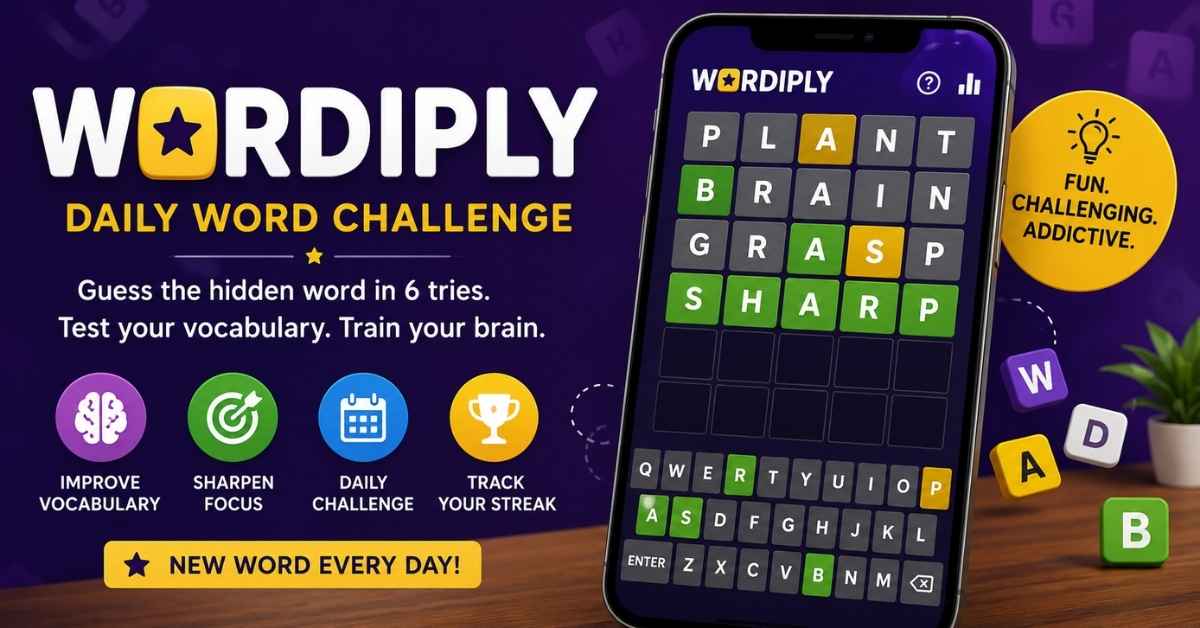
Wordiply is The Guardian’s daily word-building game where players get five attempts to create the longest possible words containing a given starter sequence. Instead of guessing one hidden answer like Wordle, you search your vocabulary for increasingly longer valid words while trying to improve both your Length Score and Letter Score.
The basic idea sounds simple, but getting consistently good results takes more than knowing long words. You need to recognize hidden letter patterns, explore word families, use prefixes and suffixes intelligently, and sometimes stop thinking about what the starter means and focus only on where those letters can appear.
If you have searched for Wordiply Guardian, Wordiply The Guardian, or simply want to understand how the game works before playing, this guide covers the rules, scoring system, strategies, common problems, app confusion, and advanced techniques that can help you find longer words.
What Is Wordiply?
Wordiply is a daily vocabulary and word-construction puzzle published as part of The Guardian’s word-game ecosystem.
Each game gives you a short starter word or letter sequence. Your job is to think of longer valid words that contain that sequence while keeping its letters together and in the correct order.
You receive five attempts.
Your performance is then evaluated using two measurements:
- Length Score – how close your longest submitted word is to the longest available word.
- Letter Score – the combined number of letters across the words you submitted.
This makes Wordiply different from conventional guessing games. There may be many valid answers, so the challenge is not simply finding the word. It is finding the best words you can think of.
What Makes Wordiply Different From Other Word Games?
Wordle rewards deduction.
Crosswords reward definitions and general knowledge.
Scrabble rewards board positioning and letter values.
Wordiply rewards lexical recall and word expansion.
You may immediately think of a seven-letter answer, feel pleased with it, and then realize there is a 12-, 15-, or even longer word containing the same starter.
That moment—when a much bigger word suddenly comes to mind—is a major part of Wordiply’s appeal.
Where Can You Play Wordiply?
The authentic Wordiply Guardian game is associated with The Guardian’s puzzle offering and can be played online through a compatible browser.
You can play on:
- desktop computers
- laptops
- smartphones
- tablets
For most players, nothing complicated is required. You open the daily game, read the starter sequence, and begin submitting words.
Can You Play Wordiply in the United States?
Yes. Although searches such as wordiply guardian uk are common because The Guardian is a British publication, Wordiply is not useful only to UK readers.
Players in the United States can access the browser-based game as well.
The British background does create one practical consideration: some players may wonder whether American and British spelling variants are treated differently. Accepted words ultimately depend on the game’s underlying word list, so you should not assume that every regional variation will automatically be accepted.
Is Wordiply Free?
Wordiply has been offered as part of The Guardian’s free puzzle experience.
However, access conditions, app features, account requirements, and puzzle availability can change over time. If the game ever prompts you to sign in or use a Guardian product, follow the current instructions shown by the official service rather than relying on old third-party guides.
How to Play Wordiply in 5 Simple Steps
You can understand the basic game in a minute.
Step 1: Read the Starter Sequence
Every daily game begins with a starter word or sequence of letters.
That starter must appear inside each valid submission.
Do not immediately think only about words that begin with the starter. It may appear:
- at the beginning
- in the middle
- near the end
That small change in mindset can dramatically expand your options.
Step 2: Think of Longer Words Containing It
Start with obvious extensions, but do not stop there.
Suppose your starter is:
ERA
You might move from a short word to increasingly larger words containing era.
The important point is that the sequence remains intact.
Step 3: Submit a Valid Word
Enter your first answer.
A good opening answer does not necessarily need to be the longest word you know. It can simply give you a solid starting point while you continue searching mentally for stronger alternatives.
Step 4: Expand Your Remaining Attempts
Use the remaining attempts strategically.
Look for:
- prefixes
- suffixes
- plurals
- compound words
- longer grammatical forms
- scientific or technical vocabulary
The best answer often appears after you stop chasing the obvious construction.
Step 5: Check Your Scores
Once your attempts are finished, Wordiply shows how effectively you performed.
Pay attention to both:
Length Score and Letter Score.
They reward different aspects of play.
The Most Important Wordiply Rule: Keep the Starter Sequence Together
This rule is worth emphasizing because some third-party Wordiply explanations get it wrong.
The starter letters should appear as the required continuous sequence, not scattered across different positions in the word.
Wordiply is therefore not an anagram puzzle where you can rearrange or separate the starter letters freely.
For example, if the starter were:
bid
A qualifying longer word needs to contain bid in that exact sequence.
The important principle is:
letters can appear before or after the starter, but the starter itself remains intact.
Can the Starter Appear in the Middle of a Word?
Yes.
In fact, learning to search for the starter inside the middle of larger words is one of the easiest ways to improve.
Beginners frequently think like this:
starter + ending
Experienced players also think:
beginning + starter + ending
That creates far more possibilities.
Does the Starter Need to Sound the Same?
No. You should primarily look at the letters, not the pronunciation.
Sometimes the sequence crosses a syllable boundary or appears inside a longer word where it sounds different from the original starter.
That creates an important advanced strategy:
search visually before searching semantically.
Wordiply Rules Beginners Often Misunderstand
Wordiply becomes easier once you understand what the game is actually testing.
You Have Five Attempts
You normally get five opportunities to submit qualifying words.
That means wasting an attempt on a weak answer can affect your final Letter Score.
Longer Words Usually Matter More
Your longest word affects your Length Score, while the total length of all submitted words affects your Letter Score.
Ideally, you want both:
- one extremely strong word
- several other long submissions
Can You Use Plurals?
Plural forms can be useful when they are accepted as valid words.
A simple -s or -es can sometimes increase a word’s length, but do not blindly add endings. The resulting word still needs to be accepted by the game.
Can You Add Prefixes and Suffixes?
Yes, when they form genuine words.
For example, a word family may expand through:
root → derived form → longer derived form
This is where basic knowledge of morphology becomes surprisingly useful.
Common additions may include:
- re-
- un-
- pre-
- -ed
- -ing
- -ness
- -tion
- -able
- -ity
Not every combination is a valid English word, so use these as brainstorming tools rather than formulas.
Can You Use Proper Nouns?
Do not assume names, places, brands, or other proper nouns will count.
Wordiply relies on an accepted word list, and a word that appears perfectly legitimate in everyday language may still fall outside that list.
How Wordiply Scoring Actually Works
The scoring system becomes much easier once you separate its two goals.
What Is the Length Score?
Your Length Score measures how close your longest submitted word is to the maximum-length word available for that day’s starter.
Imagine:
- Your longest word = 12 letters
- Maximum possible word = 15 letters
Your Length Score would effectively represent how close 12 is to 15.
If you find a word equal to the maximum available length, you can achieve a 100% Length Score.
What Is the Letter Score?
The Letter Score focuses on all your successful submissions rather than only your best one.
Suppose your five words contain:
| Attempt | Letters |
|---|---|
| Word 1 | 9 |
| Word 2 | 10 |
| Word 3 | 11 |
| Word 4 | 14 |
| Word 5 | 16 |
| Total | 60 |
Your Letter Score reflects that combined output.
This means one enormous word does not necessarily produce an exceptional overall result if your other submissions are short.
Length Score vs Letter Score
| Score | What It Rewards | Best Strategy |
|---|---|---|
| Length Score | Your single longest word | Find the maximum or near-maximum answer |
| Letter Score | Total letters across your attempts | Submit several consistently long words |
Strong players try to improve both at the same time.
What Is a Good Wordiply Score?
There is no universal number that automatically makes someone a good Wordiply player.
Difficulty changes with the starter.
Some days produce obvious extensions. Other starters demand obscure vocabulary, technical terminology, or unusual letter combinations.
For most players, the most useful benchmark is personal improvement.
Ask:
- Am I finding longer words than I used to?
- Am I wasting fewer attempts?
- Is my Letter Score becoming more consistent?
- Am I reaching higher Length Score percentages?
Community players sometimes compare raw scores, but those comparisons should not be confused with official performance standards.
Should You Focus on Length Score or Letter Score?
For casual play, focus on whichever makes the puzzle enjoyable.
For competitive improvement, use both.
A practical approach is:
- Secure a respectable word.
- Search aggressively for one maximum-length candidate.
- Use remaining attempts on other long alternatives.
That protects your Letter Score while still chasing a high Length Score.
A Better Way to Find Long Wordiply Words
Many players get stuck because they search too narrowly.
They see the starter and immediately attach the first ending that comes to mind.
A stronger approach is to explore the entire lexical neighborhood around the sequence.
Start With Word Families
Think about different forms of the same base concept:
- noun
- verb
- adjective
- adverb
- plural
- derived noun
- derived adjective
One word can lead to another.
For example:
prepare → prepared → preparedness
The exact words you can use depend on the starter, but the reasoning is what matters.
Search Before and After the Starter
Do not only think:
starter + suffix
Try:
prefix + starter
and:
prefix + starter + suffix
A starter that looks difficult near the beginning of a word may appear naturally inside a much longer one.
Think in Prefixes and Suffixes
English produces long words through derivation.
Ask:
- Can I add re-?
- Can I add un-?
- Is there a form ending in -tion?
- Can the word become -able?
- Is there a noun ending in -ness?
- Is there an adjective or plural form?
These questions push your memory beyond the most obvious answer.
Use Compound Words
Compound words are another overlooked source of length.
A familiar short word may sit inside a much larger compound.
Train yourself to ask:
“What longer word contains this sequence somewhere inside it?”
instead of:
“What word starts with this?”
Think Beyond Everyday Vocabulary
Technical vocabulary often contains unusually long constructions.
Explore words from:
- medicine
- biology
- chemistry
- technology
- law
- academia
- engineering
You do not need to memorize a dictionary. You simply need to stop rejecting a word because it sounds specialized.
The W-I-D-E Method for Better Wordiply Results
A repeatable framework makes the game easier when your mind goes blank.
W — Wrap the Starter
Try adding letters to both sides of the starter.
Do not mentally lock it at the beginning.
I — Insert It Inside a Larger Word
Ask yourself where the exact sequence appears inside longer vocabulary.
This is often where the strongest answers hide.
D — Derive Longer Forms
Explore grammatical and morphological variations.
A word might expand through:
- suffixation
- prefixation
- pluralization
- nominalization
- adjective formation
E — Extend One More Time
Once you find a strong word, ask:
Can this become even longer?
Check for:
- plural forms
- another suffix
- an additional prefix
- a compound form
- a different grammatical version
That final check can turn a good answer into your best answer.
Common Wordiply Mistakes That Cost You Points
Stopping at the First Obvious Word
The first valid answer is rarely guaranteed to be your best.
Better approach: treat it as a starting point and continue expanding.
Only Adding Letters at the End
This severely limits your vocabulary search.
Better approach: search before, after, and around the sequence.
Thinking About Meaning Instead of Letters
If the starter is a recognizable word, your brain naturally looks for related concepts.
That can trap you.
Better approach: treat the starter as a visual string of letters.
Forgetting Plurals and Derived Forms
A valid longer grammatical form may be sitting one suffix away.
Better approach: scan the whole word family before submitting.
Ignoring Specialist Vocabulary
Long scientific and technical words can be extremely valuable.
Better approach: mentally search fields beyond everyday conversation.
Using All Five Attempts Too Quickly
You may discover your best word only after the game is nearly finished.
Better approach: spend a moment exploring alternatives before using every attempt.
Why Won’t Wordiply Accept My Word?
Few things are more frustrating than finding what appears to be a perfect answer and having the game reject it.
Several factors may be responsible.
The Word May Not Be in the Accepted List
No word-game database contains every term used everywhere.
Very rare, specialist, archaic, regional, or newly coined words may not be recognized.
It May Be a Proper Noun
Names and branded terms may look valid but fall outside the accepted vocabulary.
The Starter May Not Actually Be Continuous
Check carefully.
You may see the required letters in the word while overlooking an extra character between them.
The Spelling May Be a Different Variant
Regional spelling differences can matter.
Does Wordiply Accept American Spellings?
Because Wordiply The Guardian comes from a British publication, U.S. users naturally wonder about American English.
The safest rule is simple:
accepted spelling depends on the game’s word list rather than your location.
Do not assume that every American or British variation will automatically work.
If one spelling is rejected, consider whether another standard variant exists.
Does Wordiply Use a Dictionary?
The creation of Wordiply involved substantial work around valid word lists and identifying maximum-length answers, with Collins connected to the game’s longest-word data.
That explains why the game can sometimes reject something that feels legitimate to a player: dictionary and game word lists are structured datasets, not perfect representations of every word anyone might use.
Wordiply Today: How the Daily Puzzle Works
Searches for wordiply today usually come from players who want one of four things:
- today’s starter
- a hint
- the longest possible word
- the current answer discussion
Wordiply follows a daily puzzle format, so the challenge changes regularly.
That daily reset gives the game much of its appeal. Everyone faces the same kind of fresh vocabulary problem and gets another chance to improve.
Should You Look Up Wordiply Today Hints?
That depends on how you enjoy word games.
If you mainly care about learning vocabulary, hints can be useful.
If the satisfaction comes from finding the long word yourself, consider using progressive hints rather than immediately checking the answer.
A good sequence is:
- Try independently.
- Look for a structural hint.
- Ask for a prefix or suffix clue.
- Reveal the maximum word only after finishing.
That preserves more of the challenge.
What If You Want the Longest Word Today?
There is nothing wrong with checking the longest answer after you have finished.
In fact, this can be a useful learning method.
Compare the winning word with your own thinking and ask:
What pattern did I miss?
Over time, that analysis makes you better at recognizing similar structures.
Is There a Wordiply Archive?
Players often want to revisit old challenges, especially after discovering the game late.
The important distinction is between:
- an official archive
- third-party historical lists
- puzzle trackers
- solvers
- unofficial replay tools
Do not assume that a site using the Wordiply name is officially connected with The Guardian.
If historical games matter to you, verify whether the archive is actually part of the official Guardian experience before entering account details or installing anything.
Can You Play Yesterday’s Wordiply?
Availability of previous puzzles depends on what the official game currently exposes.
Unofficial sites may record older starters or solutions, but viewing an old answer is different from replaying the original interactive puzzle.
Is There a Wordiply App?
This question deserves attention because searching an app store for Wordiply can produce confusing results.
The Guardian offers its own mobile ecosystem and puzzle experience, but there are also other products using the Wordiply name.
They may have completely different mechanics.
Guardian Wordiply vs Other Apps Called Wordiply
| Feature | The Guardian Wordiply | Other Wordiply-Branded Apps |
|---|---|---|
| Publisher | The Guardian | Other developers |
| Main challenge | Find long words containing a starter | Varies by app |
| Daily puzzle | Core format | May differ |
| Scoring | Length Score + Letter Score | Product-specific |
| Guardian connection | Yes | Usually no |
This distinction is especially important for U.S. users who search Google Play and assume the first matching title must be the Wordiply Guardian game.
Wordiply vs Wordle: What’s the Difference?
Wordiply and Wordle are both daily word games, but their underlying challenges are very different.
| Feature | Wordiply | Wordle |
|---|---|---|
| Main goal | Build long words containing a starter | Guess one hidden word |
| Core skill | Vocabulary and word construction | Deduction and letter-position logic |
| Possible answers | Many valid words | One intended solution |
| Attempts | Five Wordiply submissions | Six Wordle guesses |
| Scoring | Length and total letters | Guess efficiency/share grid |
| Thinking style | Expansion | Elimination |
Which Game Is Harder?
Neither is universally harder.
If you have a large vocabulary but dislike deduction, Wordiply may feel easier.
If you are excellent at pattern elimination but struggle to recall long words, Wordle may feel more natural.
Wordiply particularly rewards people who enjoy language structure, not just word recognition.
Who Created Wordiply?
Wordiply emerged from The Guardian’s efforts to develop an engaging daily word game during the wider growth of browser-based puzzles.
The game is associated with:
- David Shariatmadari
- Daniel Shariatmadari
- developer Freddie Preece
- designer Ana Pradas
- The Guardian
- Collins word data
The development process involved testing different ideas, refining the scoring system, and dealing with one of the hardest problems in any word game: deciding which words should count.
That history matters because it explains why Wordiply feels simple on the surface while relying on substantial word-list and scoring logic underneath.
Why Wordiply Is So Easy to Return To
The game creates several small psychological rewards.
Curiosity
There is always the question:
“Is there a much longer word I haven’t thought of?”
Competence
Finding an unusually long answer makes you feel genuinely clever.
Improvement
Scores give you something measurable to beat.
Daily Scarcity
A changing daily challenge encourages routine without requiring a long gaming session.
Social Comparison
Players naturally want to know how their result compares with friends or other puzzle fans.
That combination makes Wordiply more than a vocabulary test. It becomes a short daily challenge built around discovery and achievement.
LEARN MORE: mcdfoodforthoughts com
Is Wordiply Worth Playing?
If you enjoy:
- Wordle
- crosswords
- vocabulary challenges
- language puzzles
- long words
- pattern recognition
then Wordiply is easy to recommend trying.
It is particularly satisfying for people who enjoy the moment when an ordinary-looking sequence turns out to be hidden inside an enormous word.
For the best experience, do not obsess over finding the perfect answer immediately.
Start with something valid, explore the word family, then use the W-I-D-E method before your final attempt.
Frequently Asked Questions About Wordiply
What is Wordiply?
Wordiply is The Guardian’s daily word game where you try to create long valid words containing a given starter sequence across five attempts.
Is Wordiply Owned by The Guardian?
The commonly searched Wordiply The Guardian game is published within The Guardian’s puzzle ecosystem.
Is Wordiply Available in the United States?
Yes. U.S. users can access the browser-based game even though searches such as wordiply guardian uk reflect its British publishing background.
Is Wordiply Free to Play?
Wordiply has been available through The Guardian’s free puzzle offering, although current access conditions should always be checked on the official service.
How Many Attempts Do You Get in Wordiply?
Players normally receive five attempts to submit words containing the starter sequence.
Do the Starter Letters Have to Stay Together?
Yes. Treat the starter as a continuous sequence rather than scattering its letters throughout the word.
What Does Length Score Mean in Wordiply?
Your Length Score shows how close your longest submitted word is to the maximum-length word available for that day’s starter.
What Does Letter Score Mean?
Your Letter Score reflects the combined number of letters across your submitted words.
What Is a Good Wordiply Score?
There is no single official benchmark that works for every puzzle. A better goal is improving your Length Score and total letters over time.
Does Wordiply Accept American Spelling?
Accepted words depend on the game’s word list. Some U.S. and UK spelling variations may behave differently, so do not assume every regional spelling is supported.
Is There a Wordiply Archive?
Historical Wordiply information exists online, but users should distinguish between official Guardian functionality and third-party archives or solver sites.
Is Wordiply the Same as Wordle?
No. Wordle asks you to identify one hidden word. Wordiply asks you to construct multiple long words containing a given starter sequence.
Where Can I Find Wordiply Today?
Search for the official daily Guardian Wordiply game if you want the current puzzle. Third-party pages offering Wordiply today hints or answers may be useful after playing, but they should not be confused with the official game.
Final Takeaway
Wordiply looks simple until you realize how many different ways a tiny letter sequence can hide inside a much longer English word. The strongest players do more than attach obvious endings—they explore word families, prefixes, suffixes, compounds, morphology, technical vocabulary, and internal letter patterns.
If you want better scores, remember one rule above all: do not treat the starter as a standalone word. Treat it as a sequence that can appear anywhere inside something much larger.
Use all five attempts carefully, apply the W-I-D-E method, and you will start spotting possibilities that are easy to miss when you first play the Guardian Wordiply challenge.