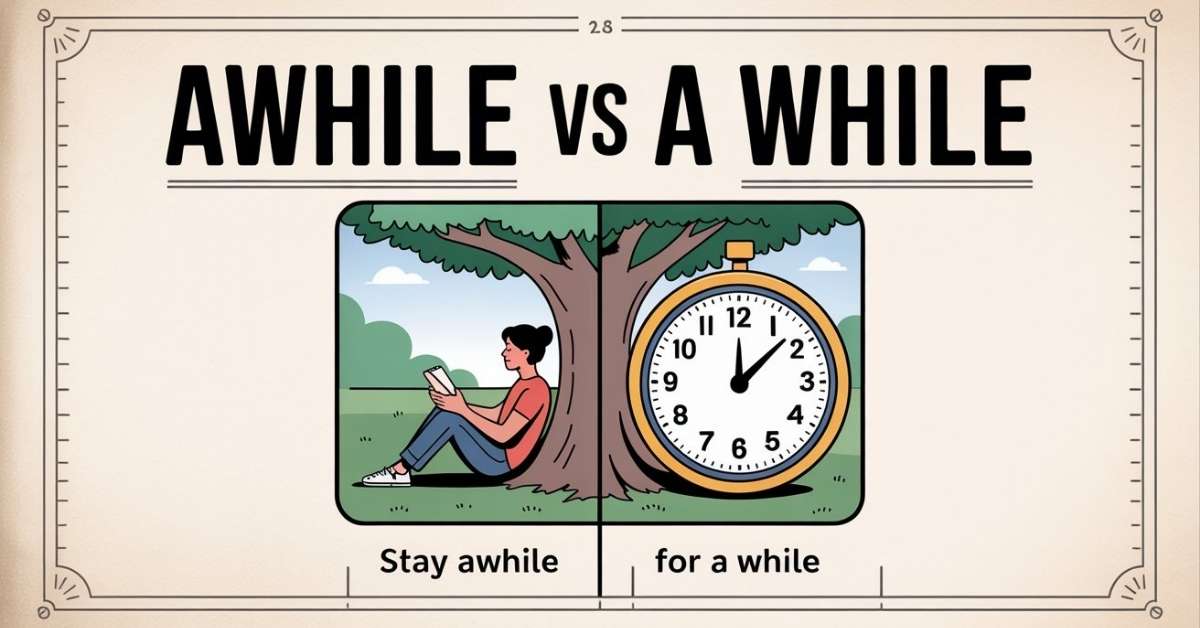
Awhile vs a while is one of the most common grammar questions in English writing. Many people use these terms interchangeably, but they do not always mean the same thing. The short answer is simple: “awhile” is an adverb, while “a while” is a noun phrase. Knowing this small grammar distinction can instantly improve your writing clarity and help you avoid common English grammar mistakes.
Writers, students, bloggers, ESL learners, and even native English speakers often confuse these two expressions because they sound identical in conversation. However, the awhile vs a while grammar difference becomes important in formal writing, academic work, proofreading, and professional communication.
For example:
- Correct: Stay awhile.
- Incorrect: We stayed for awhile.
Understanding the correct usage of awhile and a while can make your writing sound more polished and natural. In this guide, you will learn:
- the meaning of each phrase
- grammar rules
- sentence examples
- common mistakes
- formal vs informal usage
- memory tricks
- real-world writing tips
By the end, you will confidently know when to use awhile and when to use a while.
What Does “Awhile” Mean?
The word “awhile” is an adverb that means:
“For a short time.”
It modifies a verb directly and does not usually require a preposition before it.
Definition of “Awhile”
In English grammar, an adverb describes or modifies a verb. Since “awhile” works as an adverb, it explains how long an action happens.
Examples:
- Sit awhile.
- Stay awhile.
- Wait awhile.
- Rest awhile.
In all these examples, awhile directly modifies the action verb.
How to Use “Awhile” Correctly
The easiest grammar rule is this:
Use awhile when no preposition comes before it.
Correct Usage
| Sentence | Correct? |
|---|---|
| Stay awhile. | ✅ |
| Rest awhile. | ✅ |
| Talk awhile. | ✅ |
Incorrect Usage
| Sentence | Correct? |
|---|---|
| Stay for awhile. | ❌ |
| Wait in awhile. | ❌ |
Awhile vs A While Examples
Here are some easy awhile vs a while examples to understand the difference clearly.
| Awhile | A While |
|---|---|
| Sit awhile. | Sit for a while. |
| Stay awhile. | Stay for a while. |
| Rest awhile. | Rest for a while. |
Notice how:
- awhile works alone
- a while follows a preposition
Common Mistakes With “Awhile”
Many writers incorrectly use “awhile” after a preposition.
Incorrect:
We talked for awhile.
Correct:
We talked for a while.
Why? Because the preposition for needs a noun phrase, and a while acts as the noun phrase.
What Does “A While” Mean?
The phrase “a while” is a noun phrase that means:
“A period of time.”
Unlike “awhile,” this version includes:
- the article a
- the noun while
Definition of “A While”
Because “a while” is a noun phrase, it often follows:
- prepositions
- articles
- time expressions
Examples:
- for a while
- after a while
- quite a while
- a while ago
How to Use “A While” Correctly
Use a while whenever the sentence needs a noun phrase.
Correct Examples
- I waited for a while.
- We talked for a while.
- It has been a while.
- She stayed after a while.
These examples show how “a while” functions as a time-related noun phrase in sentence structure.
Why “A While” Is Two Words
Many people ask:
Why is “a while” written as two words?
The answer is grammatical structure.
- a = article
- while = noun
Awhile vs A While Grammar Difference
The awhile vs a while grammar difference becomes easy once you understand their parts of speech.
| Word/Phrase | Part of Speech | Meaning |
|---|---|---|
| Awhile | Adverb | For a short time |
| A while | Noun phrase | A period of time |
The Simplest Rule to Remember
Here is the easiest memory trick:
If the sentence contains a preposition like for, use a while.
Examples
- for a while
- after a while
- in a while
Without a preposition:
- Stay awhile.
- Wait awhile.
Quick Memory Trick
Remember this simple sentence:
Preposition = a while
If you see:
- for
- after
- in
- quite
Then use a while.
Awhile vs A While Examples
Learning through examples is one of the best ways to improve English grammar and writing clarity.
Correct Examples of “Awhile”
- Stay awhile.
- Sit awhile and relax.
- Rest awhile before leaving.
- Talk awhile with your friends.
- Wait awhile before responding.
Correct Examples of “A While”
- We stayed for a while.
- I have not seen you in a while.
- It has been a while.
- She waited for a while.
- We talked for a while after dinner.
Incorrect Examples and Corrections
| Incorrect Sentence | Correct Sentence |
|---|---|
| We waited for awhile. | We waited for a while. |
| It’s been awhile. | It’s been a while. |
| Stay for awhile. | Stay for a while. |
These examples show how proper grammar improves sentence structure and readability.
It’s Been Awhile vs A While
One of the most searched grammar questions online is:
it’s been awhile vs a while
This confusion appears frequently in texting, blogging, social media posts, and casual conversations.
Which Version Is Correct?
Grammatically Correct:
It’s been a while.
Common but Less Formal:
It’s been awhile.
Why?
Because the sentence actually means:
“It has been a period of time.”
The phrase needs a noun phrase, not an adverb.
Therefore:
- a while = grammatically standard
- awhile = commonly used informally
Why People Confuse These Phrases
The confusion happens because:
- both phrases sound identical
- spoken English blurs grammar distinctions
- informal writing often ignores grammar rules
In casual conversation, many native speakers write:
“It’s been awhile.”
Even though style guides and grammar experts usually recommend:
“It’s been a while.”
Formal vs Informal Writing Usage
Formal Writing
Use:
It has been a while.
Informal Writing
You may sometimes see:
It’s been awhile.
Which One Is Grammatically Correct?
Correct:
for a while
Incorrect:
for awhile
Because the preposition for requires a noun phrase.
Why “For Awhile” Sounds Natural
Many people write “for awhile” because conversational English often simplifies grammar patterns.
In speech, both versions sound identical.
However, formal grammar rules still prefer:
for a while
Correct Sentence Examples
- We stayed for a while.
- I waited for a while.
- She slept for a while.
- They talked for a while.
Awhile Ago vs A While Ago
Another major grammar confusion is:
awhile ago vs a while ago
Which Phrase Is Correct?
Correct:
a while ago
Incorrect:
awhile ago
The phrase requires a noun phrase after the implied preposition.
Why “Awhile Ago” Is Incorrect
“Awhile” functions as an adverb, while “a while” works as a noun phrase describing time.
That is why:
- a while ago ✅
- awhile ago ❌
Sentence Examples
Correct
- We met a while ago.
- I saw her a while ago.
Incorrect
- We met awhile ago.
- I saw her awhile ago.
Common Grammar Mistakes With Awhile and A While
Even advanced writers sometimes confuse these expressions.
Using “Awhile” After Prepositions
Incorrect:
- for awhile
- after awhile
- in awhile
Correct:
- for a while
- after a while
- in a while
This is the biggest grammar mistake associated with these words.
Combining Both Forms Incorrectly
Some writers mistakenly combine grammar structures.
Incorrect:
We rested for awhile before leaving.
Correct:
We rested for a while before leaving.
Informal Writing Errors
Social media, texting, and casual blogging often ignore strict grammar rules.
That is why phrases like:
- it’s been awhile
- for awhile
However, academic writing, and professional communication should follow standard grammar conventions.
When to Use Awhile vs A While
The easiest way to remember the difference is to focus on sentence structure.
Use “Awhile” When…
Use awhile when:
- it modifies a verb directly
- no preposition appears before it
Examples
- Stay awhile.
- Wait awhile.
- Rest awhile.
Use “A While” When…
Use a while when:
- a preposition comes before it
- the sentence needs a noun phrase
Examples
- for a while
- after a while
- in a while
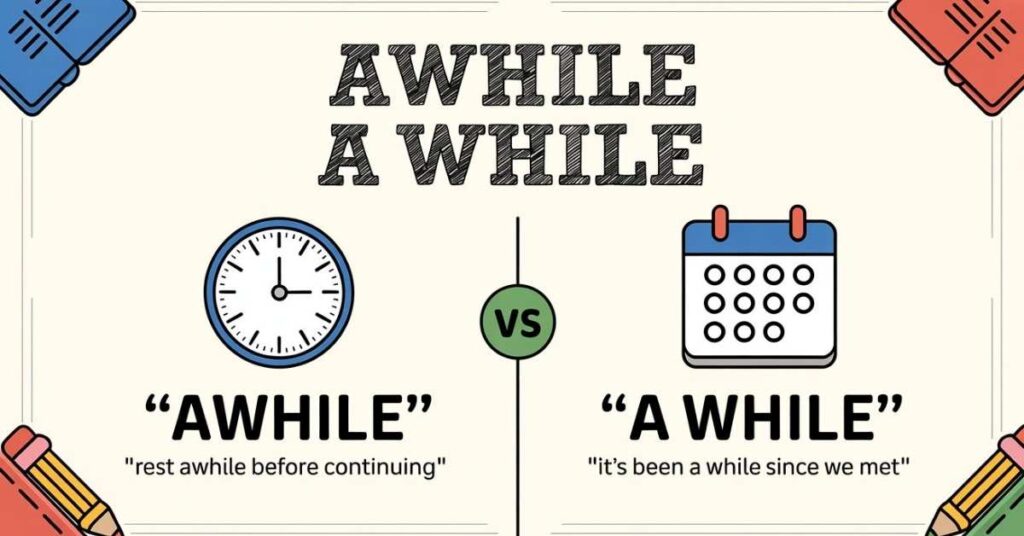
Quick Decision Guide
| Situation | Correct Choice |
|---|---|
| After a verb | awhile |
| After a preposition | a while |
| Time expression | a while |
| Adverb usage | awhile |
Is “Awhile” Formal or Informal?
Many readers wonder whether “awhile” sounds formal or conversational.
The answer depends on context.
Usage in Academic Writing
In academic and professional writing:
- grammar precision matters more
- editors prefer standard structures
That is why phrases like:
for a while
are strongly preferred.
Usage in Casual Writing
In texting and informal communication, people often ignore grammar distinctions.
Examples:
- It’s been awhile!
- Stay awhile!
These may appear acceptable conversationally, but not always grammatically.
Style Guide Recommendations
Grammar experts and style guides such as:
- AP Stylebook
- Chicago Manual of Style
- professional proofreading standards
typically recommend:
- “a while” after prepositions
- “awhile” as a standalone adverb
Learn More: Many or Meny
Why English Learners Confuse Awhile and A While
This grammar topic can be difficult for ESL learners and beginner writers.
Similar Pronunciation
Both phrases sound exactly the same in spoken English.
Spoken vs Written English
Spoken English often simplifies grammar naturally.
Written English, however, requires:
- correct syntax
- proper sentence structure
- grammatical accuracy
Tips for Remembering the Difference
Here is a simple memory shortcut:
If you see a preposition, use “a while.”
Examples:
- for a while
- after a while
- in a while
No preposition? Use:
- awhile
Quick Cheat Sheet for Awhile vs A While
| Awhile | A While |
|---|---|
| Adverb | Noun phrase |
| One word | Two words |
| Means “for a short time” | Means “a period of time” |
| Used after verbs | Used after prepositions |
Fast Grammar Rules
- Stay awhile. ✅
- Stay for a while. ✅
- Stay for awhile. ❌
Most Common Correct Phrases
Correct
- It’s been a while.
- For a while.
- A while ago.
- Stay awhile.
Incorrect
- It’s been awhile.
- For awhile.
- Awhile ago.
Frequently Asked Questions
Is it awhile or a while?
Both are correct, but they are used differently. “Awhile” is an adverb, while “a while” is a noun phrase.
What is the difference between awhile and a while?
The main difference is grammar structure:
- awhile = adverb
- a while = noun phrase
Can you say “for awhile”?
In formal grammar, “for a while” is preferred because the preposition “for” requires a noun phrase.
Is “awhile ago” correct?
No. The grammatically correct phrase is:
a while ago
Is “it’s been awhile” grammatically correct?
“It’s been a while” is the grammatically standard version, although “it’s been awhile” appears frequently in casual writing.
Is awhile one word?
Yes. “Awhile” is written as one word when used as an adverb.
Why is a while two words?
Because it contains:
- the article “a”
- the noun “while”
Together they form a noun phrase.
Conclusion
Understanding the difference between awhile vs a while is easier once you know the grammar rule behind each phrase. Although they sound identical in conversation, they serve different grammatical functions in English writing.
Remember:
- awhile is an adverb used directly after verbs
- a while is a noun phrase used after prepositions
If you can remember one simple rule, make it this:
Preposition = a while
That small grammar tip can instantly improve your writing clarity, proofreading accuracy, and overall English grammar skills.
Whether you are a student, blogger, ESL learner, editor, or professional writer, mastering this grammar distinction will help your sentences sound more natural, polished, and correct.