Protesters or protestors is a commonly searched grammar question in English, and the simple answer is: both spellings exist, but “protesters” is the correct and most widely accepted spelling in modern English. The word “protesters” refers to people who take part in a protest, demonstration, or public movement to express disagreement or demand change.
While “protestors” is sometimes seen in informal writing, news comments, or older usage, it is not the preferred spelling in dictionaries, journalism, or academic writing. So when asking is it protesters or protestors, the correct and professional answer is that “protesters” is the standard spelling used in American English, British English, and global formal writing.
In this article, we will deeply explore protesters or protestors spelling, usage differences, grammar rules, UK vs US usage, and why confusion exists in modern English.
What Does “Protester” Mean?
A protester is a person who publicly expresses disagreement, objection, or opposition to something, often as part of a group demonstration or movement.
In simple terms, protesters are individuals who take part in public protests, rallies, or movements to bring attention to social, political, or environmental issues.
Dictionary Meaning
According to major dictionaries like Cambridge and Merriam-Webster, a protester is:
“A person who publicly demonstrates opposition to something.”
This definition highlights that protest is an act of activism, expression, and public participation.
Common Contexts Where the Word Is Used
- Political demonstrations
- Civil rights movements
- Environmental activism
- Labor strikes
- Social justice campaigns
Examples in Sentences
- The protesters gathered outside the parliament building.
- Police controlled the crowd of peaceful protesters.
- Thousands of protesters marched through the city streets.
Is “Protestor” Also a Correct Word?
The spelling “protestor” does exist, but it is considered a less preferred variant of “protester.”
Origin of “Protestor”
The word comes from the root “protest,” and the suffix “-or” is sometimes used in English to form agent nouns (like “actor” or “doctor”).
Because of this pattern, some writers naturally formed “protestor,” but over time, English usage standardized toward “protester.”
Is “Protestor” Accepted?
Yes, but with limitations:
- Some dictionaries list it as a variant spelling
- It is less commonly used in professional writing
- It is rarely used in journalism or academic publications
So while it is not completely wrong, it is not the preferred spelling in modern English usage.
What Is the Main Difference?
The main difference between protesters vs protestors is purely spelling-based, not meaning-based.
Both words refer to the same thing:
People who protest.
Key Difference Explained
- Protesters → Standard, widely accepted spelling
- Protestors → Alternative, less common spelling
Grammar Insight
English often allows multiple spellings for agent nouns, but language evolution tends to favor one standardized form. In this case, “protester” became dominant due to dictionary preference and media usage.
Is It Protesters or Protestors in Modern English?
When people search is it protesters or protestors, they are usually looking for the correct modern usage.
The answer is clear:
“Protesters” is the correct and preferred spelling in modern English.
Dictionary Preference
Major dictionaries such as:
- Cambridge Dictionary
- Oxford English Dictionary
- Merriam-Webster
All primarily use “protester” as the main entry.
Media Usage
News organizations almost always use:
- Protesters marched…
- Protesters gathered…
The word “protestors” appears very rarely in professional journalism.
Protesters or Protestors UK: Which Spelling Is Used?
When it comes to protesters or protestors UK usage, both British and American English strongly prefer “protesters.”
British English Usage
In the UK:
- Newspapers like BBC, The Guardian, and The Times use “protesters”
- Academic writing also follows the same standard
American English Usage
In the US:
- AP Style Guide prefers “protester”
- Major news outlets like CNN and The New York Times use “protester”
Conclusion for UK vs US
There is no major difference between UK and US usage in this case. Both prefer:
Protesters
Why “Protester” Is the Preferred Spelling Today
There are several reasons why “protester” became the dominant form in English.
1. Dictionary Standardization
Lexicographers prefer “-er” endings for clarity and consistency.
2. Journalism Style Guides
Most editorial guides recommend:
- Simpler spelling
- More commonly used forms
3. Language Evolution
English naturally simplifies over time, and “protester” became the standardized form across global English.
4. Usage Frequency
Corpus data and online usage show:
- “Protester” appears significantly more often than “protestor”
Protesters or Protestors Spelling: Which One Should You Use?
When deciding protesters or protestors spelling, always choose based on context.
Recommended Usage
- Academic writing → Protester
- Blogging → Protester
- Journalism → Protester
- Formal communication → Protester
When “Protestor” Appears
- Informal writing
- User-generated content
- Older publications
- Spelling variations in comments
Examples of Protesters and Protestors in Sentences
Using “Protester”
- The protester held a sign demanding justice.
- Police negotiated with peaceful protesters.
- The government responded to the concerns of protesters.
Using “Protestor”
- A protestor was seen speaking to the media.
- Several protestors gathered near the building.
Incorrect or Unrecommended Usage
- Mixing both spellings in one article without consistency
- Using “protestor” in formal academic writing
Common Grammar Mistakes Related to Protesters or Protestors
Many learners confuse these words due to English spelling patterns.
Common Issues
- Confusing suffixes like “-er” and “-or”
- Assuming both are equally correct
- Overusing less common variants
Other Similar Confusing Words
- advisor vs adviser
- counselor vs counsellor
- behavior vs behaviour
- traveler vs traveller
These patterns show how English spelling often varies but still has a preferred standard form.
Why Search Intent Matters for “Protesters or Protestors”
The keyword “protesters or protestors” is not about political protests.
It is about:
- Grammar clarification
- Spelling correctness
- Writing guidance
What Users Actually Want
- Quick answer
- Simple explanation
- Correct spelling confirmation
This is why Google favors pages that:
- Give immediate answers
- Avoid unnecessary political context
- Focus on language usage
Tips for Using “Protester” Correctly
If you are a content writer or blogger, here are key tips:
Best Practices
- Always use “protester” as the primary keyword
- Maintain consistency throughout content
- Avoid mixing spellings unnecessarily
- Focus on readability and clarity
Tip
Search engines prefer:
Clear, consistent, and commonly used spelling forms
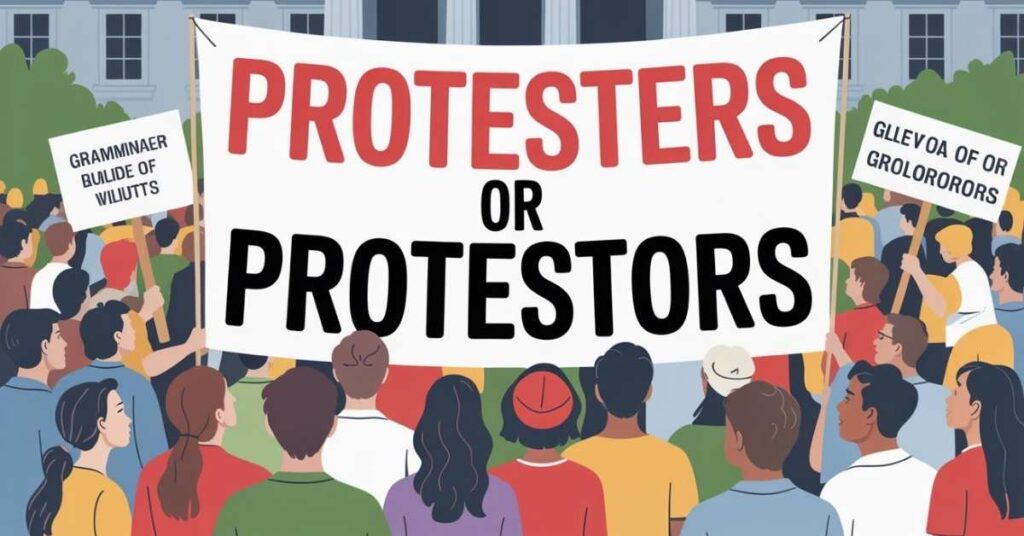
Comparison Table: Protesters vs Protestors
| Feature | Protesters | Protestors |
|---|---|---|
| Correctness | ✔ Standard | ⚠ Variant |
| Dictionary Use | ✔ Preferred | Limited |
| Journalism Use | ✔ Common | Rare |
| SEO Performance | ✔ Strong | Weak |
| Academic Writing | ✔ Accepted | Not preferred |
Frequently Asked Questions
Is protestor a real word?
Yes, but it is a less common variant of “protester.”
Why is protester more common?
Because dictionaries, journalism, and modern English usage prefer it.
Is it protesters or protestors in formal writing?
The correct choice is protesters.
Which spelling should students use?
Students should always use protesters in academic writing.
Do dictionaries accept both spellings?
Yes, but they prioritize protester as the main form.
Conclusion
To conclude, protesters or protestors spelling confusion is common, but the answer is simple. Both exist, but “protesters” is the correct, preferred, and widely accepted spelling in modern English.
Whether you are writing for SEO, academic work, journalism, or professional communication, the safest and most accurate choice is always protester/protesters.
So, if you ever wonder is it protesters or protestors, remember:
Use “protesters” for correct, modern, and professional English writing.