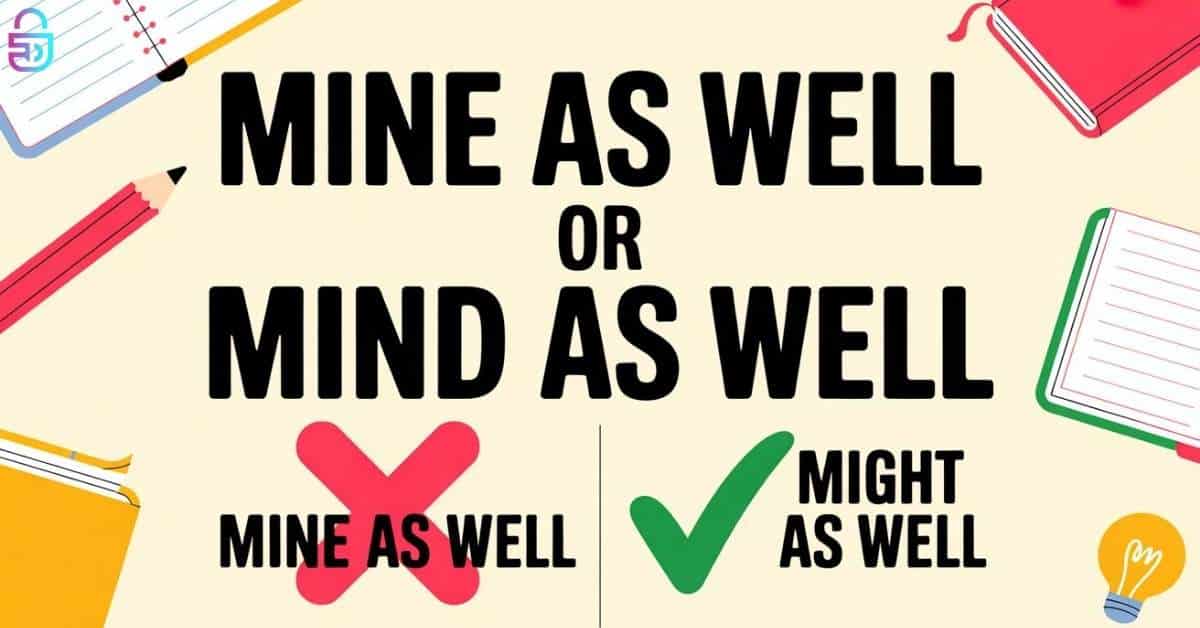
Mine as well or mind as well — if you’ve ever typed or said this phrase, you’re not alone. The quick, clear answer is this: both “mine as well” and “mind as well” are incorrect. The correct phrase is “might as well.”
This confusion happens because of how the phrase sounds in fast, spoken English, which leads many people to mishear and misspell it. In this guide, we’ll break everything down in a simple, practical way so you not only understand the difference—but also use it confidently in real life.
Is It “Mine As Well” or “Mind As Well”?
Let’s address the exact question: 👉 Is it mine as well or mind as well?
The answer is straightforward:
- ❌ Mine as well → Incorrect
- ❌ Mind as well → Incorrect
- ✅ Might as well → Correct
Even though “mine as well or mind as well or might as well” might all sound similar, only one of them is grammatically and contextually correct.
What Is the Correct Phrase — “Might As Well”?
The correct expression is:
“Might as well”
It’s a common idiomatic expression in English used when:
- There is no better option
- A decision feels neutral or obvious
- You’re doing something simply because there’s nothing to lose
Simple Definition:
“Might as well” means you may do something because it’s the best or only reasonable option.
What Does “Might As Well” Mean?
To fully understand why people confuse this phrase, you need to understand its meaning in everyday use.
Meaning in Plain English:
- “Since there’s no better choice…”
- “It doesn’t make much difference, so let’s do it”
- “We have nothing to lose”
Real-Life Examples:
| Situation | Sentence |
| No better plan | We’re already here, so we might as well stay. |
| Killing time | The meeting is late, we might as well grab coffee. |
| Casual decision | You’ve started the movie, you might as well finish it. |
👉 Notice how natural and conversational it feels.
Mine As Well vs Mind As Well vs Might As Well
Let’s break this down clearly:
| Phrase | Correct? | Why |
| Mine as well | ❌ No | “Mine” is a possessive pronoun and doesn’t fit |
| Mind as well | ❌ No | “Mind” doesn’t make sense in this context |
| Might as well | ✅ Yes | Correct idiomatic expression |
👉 This is one of the most common English grammar mistakes caused by pronunciation confusion.
Why Do People Say “Mine As Well” or “Mind As Well”?
This is where most competitors stop—but this is actually the key to ranking higher.
1. Connected Speech (Fast Pronunciation)
When spoken quickly:
“might as well” → sounds like → “mine as well”
This is called connected speech, where words blend together.
2. Phonetic Similarity
- “might” and “mine” sound very similar in casual speech
- The “t” sound often disappears
3. Misheard Phrases (Eggcorns)
This type of mistake is known as an eggcorn:
A word or phrase that is mistakenly used because it sounds similar to the correct one.
Examples:
- mine as well (instead of might as well)
- for all intensive purposes (instead of for all intents and purposes)
4. Spoken vs Written English Gap
People often:
- Learn phrases by hearing them
- Write them incorrectly later
👉 This is a classic spoken English vs written English issue.
Is “Mine As Well” Ever Grammatically Correct?
Short answer: No.
Here’s why:
- “Mine” is a possessive pronoun (like “my” or “yours”)
- It does not function as a modal verb
- It makes no grammatical sense in this structure
Example: ❌ I mine as well go → Incorrect ✅ I might as well go → Correct
How to Use “Might As Well” Correctly
Basic Structure:
Subject + might as well + base verb
Examples:
- I might as well call him now.
- We might as well leave early.
- They might as well try again.
Usage Tips:
- Use in casual conversation
- Avoid in formal writing
- Best for neutral or low-stakes decisions
Examples of “Might As Well” in Daily Conversation
To make your content more natural (and SEO-friendly), here are practical examples:
Everyday Scenarios:
- It’s raining, we might as well stay inside.
- You’ve already paid, you might as well use it.
- Nobody’s answering, we might as well leave.
Mini Case Study (Real Usage)
Imagine this situation:
You’re waiting for a delayed flight.
You might say:
- We’re stuck here for 2 hours—we might as well grab lunch.
👉 This shows how the phrase reflects real-life decision-making.
Common Mistakes Similar to “Mine As Well”
This is a powerful SEO section because it builds topical authority.
Frequently Confused Phrases:
| Incorrect | Correct |
| could of | could have |
| would of | would have |
| mine as well | might as well |
| for all intensive purposes | for all intents and purposes |
Why These Happen:
- Mishearing spoken English
- Lack of grammar awareness
- Phonetic similarity
👉 These are all examples of common English mistakes.
Learn More: Invision or Envision
Why Understanding This Matters
You might think:
“It’s just a small phrase—why does it matter?”
Here’s why:
1. Professional Communication
Using the wrong phrase can:
- Make writing look careless
- Reduce credibility
2. SEO & Content Writing
If you’re a writer:
- You must target both correct and incorrect variations
- But clearly explain the correct form
3. Language Clarity
Correct usage improves:
- Confidence
- Fluency
- Understanding
Quick Summary (Featured Snippet Ready)
- ✅ The correct phrase is “might as well”
- ❌ “Mine as well” and “mind as well” are incorrect
- 📌 The confusion comes from pronunciation and misheard speech
- 💡 “Might as well” means doing something because there’s no better option
FAQs
Is it mine as well or mind as well?
Neither is correct. The proper phrase is “might as well.”
What does “mine as well” mean?
It doesn’t have a real meaning. It’s a mistaken version of “might as well.”
Why do people say “mine as well”?
Because of fast speech and phonetic confusion, where “might” sounds like “mine.”
Is “mind as well” ever correct?
No, it’s also incorrect and not used in proper English.
How do you use “might as well” in a sentence?
Example:
We’re already late, so we might as well go tomorrow.
Final Thoughts
The confusion between mine as well or mind as well or might as well is incredibly common—but now you know the truth:
👉 Only “might as well” is correct.
What sets strong writers apart isn’t just knowing the right phrase—it’s understanding why mistakes happen and how to avoid them naturally.
If you remember one thing from this article, let it be this:
When in doubt, always go with “might as well.”
If you want to expand this into a full grammar content cluster or rank for similar keywords, I can help you build that next.