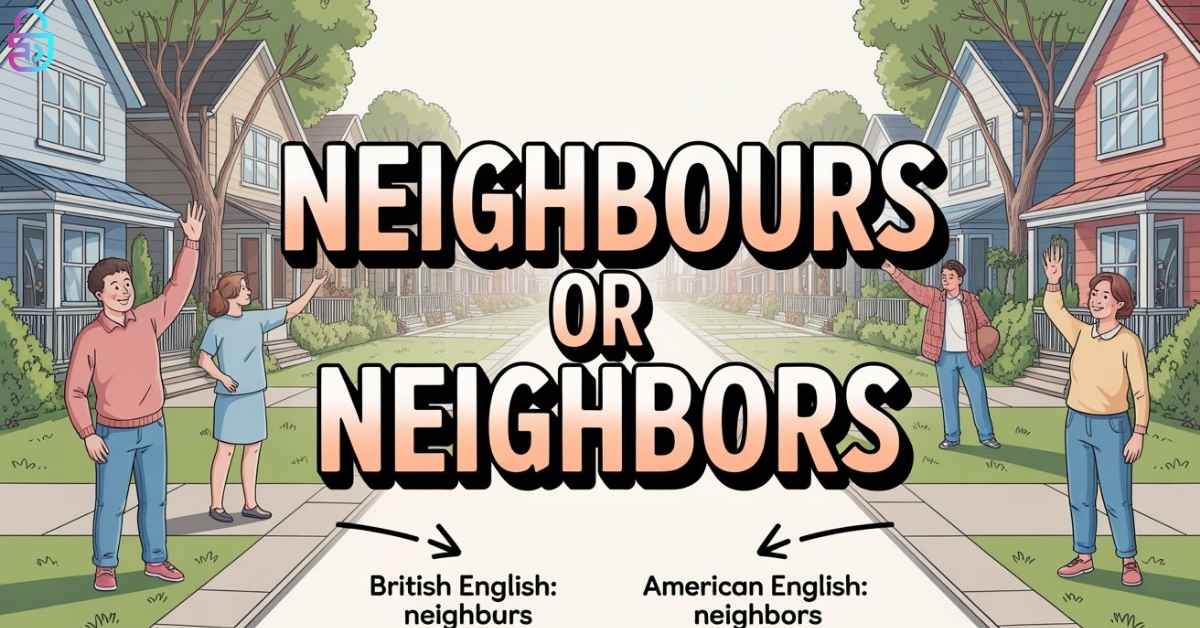
Neighbours or neighbors are both correct spellings of the same word. The difference comes down to British English vs American English spelling conventions. “Neighbours” is used in countries that follow British English, such as the UK, Australia, and New Zealand, while “neighbors” is the preferred spelling in the United States. If you are wondering, “is it neighbours or neighbors?”, the answer depends entirely on your target audience and regional language style.
Many English learners, writers, bloggers, and even native speakers become confused by these spelling differences because both words have the same meaning, pronunciation, and usage. The only distinction is the regional spelling preference. This article explains the difference between neighbours and neighbors, where each spelling is used, why the spellings vary, and which version you should use in writing, education, and professional communication.
What Does “Neighbour” or “Neighbor” Mean?
The words neighbour and neighbor refer to a person who lives near another person. It can describe someone living next door, across the street, or within the same community.
According to the Oxford Dictionary, a neighbour is:
“A person living near or next to another.”
Meanwhile, Merriam-Webster defines neighbor similarly in American English.
The meaning has remained consistent across both British English and American English. Only the spelling changed over time due to differences in language localization, spelling reforms, and regional writing conventions.
Common Examples
British English
- “Our neighbours invited us to dinner.”
- “The new neighbours moved in yesterday.”
American English
- “My neighbors are very friendly.”
- “The neighbors complained about the noise.”
In both cases, the pronunciation remains nearly identical.
Neighbours vs Neighbors: The Main Difference
The primary difference between neighbours vs neighbors is the inclusion of the letter “u” in British spelling.
| British English | American English |
|---|---|
| neighbour | neighbor |
| neighbours | neighbors |
| colour | color |
| favourite | favorite |
| humour | humor |
The spelling “neighbour” follows traditional British spelling conventions influenced by French and Latin. The American spelling “neighbor” was simplified during spelling reforms promoted by Noah Webster in the United States.
Why Did American English Remove the “U”?
In the early 1800s, American lexicographer Noah Webster aimed to simplify English spelling in the United States. He believed words should reflect pronunciation more directly.
As a result:
- colour → color
- labour → labor
- neighbour → neighbor
These spelling changes became standard in American English spelling and are still used today.
Is It Neighbours or Neighbors?
If you are asking, “is it neighbours or neighbors?”, both spellings are correct.
The correct version depends on:
- Your country
- Your audience
- Your writing style
- Your localization preferences
Use “Neighbours” If You Write For:
- United Kingdom
- Australia
- New Zealand
- Ireland
- South Africa
Use “Neighbors” If You Write For:
- United States
- American audiences
- US-based publications
For international audiences, consistency matters more than choosing one over the other.
Neighbours or Neighbors Canada: Which Spelling Is Used?
One of the most searched questions online is “neighbours or neighbors Canada.”
Canada follows a unique blend of British English and American English. However, Canadian English traditionally leans closer to British spelling conventions.
That means:
- Neighbour is generally preferred in Canada.
- “Neighbors” may still appear because of American media influence.
Canadian English Examples
| Preferred Canadian Spellings |
|---|
| neighbour |
| colour |
| favourite |
| centre |
Canadian schools, government institutions, and newspapers often use British-style spellings with “ou.”
However, exposure to American websites, TV, and social media has made American spellings increasingly common online.
So in Canada:
- “Neighbours” is technically more correct.
- “Neighbors” is widely understood and accepted.
Which Countries Use “Neighbours”?
The spelling “neighbours” is common in countries influenced by British English.
| Country | Preferred Spelling |
|---|---|
| United Kingdom | neighbours |
| Australia | neighbours |
| New Zealand | neighbours |
| Ireland | neighbours |
| South Africa | neighbours |
| Canada | mostly neighbours |
These countries also use spellings like:
- colour
- favourite
- organise
- centre
This spelling system is known as Commonwealth English.
Which Countries Use “Neighbors”?
The spelling “neighbors” dominates in:
- United States
- American publications
- US educational systems
- Most American websites
American English tends to simplify spellings by removing unnecessary letters.
Examples include:
- color
- favorite
- labor
- neighbor
Because the US dominates much of the internet, many global users also encounter American spellings frequently online.
Why Does British English Use “OU” Spellings?
Many English learners wonder why British words include “ou.”
The answer lies in linguistic history.
After the Norman conquest of England, French heavily influenced English spelling. Words like:
- colour
- honour
- neighbour
retained their French-inspired forms in Britain.
Later, American English simplified these spellings for efficiency and consistency.
Common British vs American Spelling Differences
| British English | American English |
|---|---|
| neighbour | neighbor |
| colour | color |
| favourite | favorite |
| humour | humor |
| labour | labor |
| organise | organize |
| centre | center |
| defence | defense |
These differences are examples of regional English, language variation, and spelling conventions.
Examples of “Neighbours” and “Neighbors” in Sentences
Understanding real-world usage helps avoid confusion.
British English Examples
- “Our neighbours hosted a barbecue last weekend.”
- “The neighbours reported suspicious activity.”
- “Friendly neighbours improve community life.”
American English Examples
- “The neighbors called the police about the noise.”
- “Our neighbors just bought a new car.”
- “Good neighbors support each other.”
Formal Writing Examples
- “Local neighbours participated in the community meeting.”
- “The neighbors association discussed property concerns.”
Bad Neighbours or Neighbors: Which Spelling Should You Use?
Another popular search phrase is “bad neighbours or neighbors.”
The correct spelling again depends on region:
- Bad neighbours → British English
- Bad neighbors → American English
This keyword often appears in:
- News headlines
- Real estate blogs
- Legal content
- Community discussions
Example Headlines
British English
- “How to Deal With Bad Neighbours”
American English
- “Signs You Have Bad Neighbors”
This search intent is slightly different because users are often looking for:
- dispute advice
- noise complaint solutions
- property line issues
- neighborhood conflict management
Neighbour vs Neighbor Pronunciation
Interestingly, the pronunciation is almost identical in both regions.
UK Pronunciation
Neighbour → /ˈneɪ.bər/
US Pronunciation
Neighbor → /ˈneɪ.bɚ/
Most people cannot distinguish the regional spelling from pronunciation alone.
This is why confusion around neighbor vs neighbour mostly happens in writing rather than speech.
Is “Neighbour” or “Neighbor” Grammatically Correct?
Both spellings are grammatically correct.
The important thing is consistency.
If you are writing in:
- British English → use “neighbour”
- American English → use “neighbor”
Mixing both spellings in one article can appear unprofessional unless you intentionally discuss spelling differences.
In Academic Writing
Universities usually require consistent localization:
- UK universities prefer British spelling
- US universities prefer American spelling
In Content Writing
Choosing the right spelling matters for:
- search intent
- regional
- keyword targeting
- audience trust
For example:
- “neighbours or neighbors canada” targets Canadian users
- “neighbor vs neighbour” targets informational search intent
- “is it neighbours or neighbors” targets FAQ-style searches
Neighbours vs Neighbors in Content Writing
For professionals and bloggers, localization matters significantly.
Which Version Should You Target?
Use:
- “neighbors” for US traffic
- “neighbours” for UK/Commonwealth traffic
If targeting international audiences, include both naturally throughout the article.
This strategy improves:
- semantic
- NLP relevance
- regional keyword matching
- long-tail keyword coverage
Why Google Understands Both
Google’s NLP systems recognize:
- spelling variations
- English dialects
- language localization
- semantic equivalence
However, localized SERPs still prioritize region-specific spellings.
Common Mistakes People Make
Many writers accidentally mix spelling systems.
Common Errors
- Using “neighbour” and “color” together
- Switching between UK and US English randomly
- Ignoring audience localization
- Copying content from mixed sources
Best Practice
Choose one style and remain consistent.
Synonyms of Neighbour and Neighbor
Using synonyms naturally improves readability and semantic optimization.
Common Synonyms
- nearby resident
- community member
- local resident
- next-door resident
- inhabitant
These words help diversify content without keyword stuffing.
Learn More: WFY Meaning
Neighbour vs Neighbor in Media and Pop Culture
The spelling also appears differently in books, television, and online media.
British Media
British newspapers and publishers prefer:
- neighbour
- neighbours
Popular British publications maintain traditional spelling conventions.
American Media
US websites overwhelmingly use:
- neighbor
- neighbors
This includes:
- newspapers
- blogs
- educational resources
- government publications
How Spellcheck Tools Handle “Neighbours” and “Neighbors”
Modern writing tools detect localization automatically.
| Tool | Supports British English | Supports American English |
|---|---|---|
| Grammarly | Yes | Yes |
| Microsoft Word | Yes | Yes |
| Google Docs | Yes | Yes |
Users can change language settings to:
- English (UK)
- English (US)
- English (Canada)
- English (Australia)
This affects spelling suggestions.
Why This Topic Matters in Modern English
The debate around neighbours or neighbors highlights how English evolved differently across regions.
It also demonstrates:
- linguistic variation
- global English adaptation
- localization importance
- cultural influence on language
As international communication grows online, understanding these differences becomes increasingly valuable.
Frequently Asked Questions
Is it neighbours or neighbors?
Both are correct. “Neighbours” is British English, while “neighbors” is American English.
Is neighbour British or American?
“Neighbour” is the British English spelling.
What is the American spelling of neighbour?
The American spelling is “neighbor.”
Which spelling does Canada use?
Canada usually prefers “neighbour,” although “neighbor” is also understood.
Why do British spell neighbour with a “u”?
British spelling retained French-influenced forms, while American English simplified many words.
Are neighbor and neighbour pronounced differently?
No. The pronunciation is nearly identical.
Which spelling should I use?
Use the spelling that matches your target audience’s region.
Final Verdict:
The debate between neighbours or neighbors is ultimately about British English vs American English spelling conventions.
Here is the simple rule:
- Use “neighbours” for British and Commonwealth audiences.
- Use “neighbors” for American audiences.
Both spellings are correct, widely recognized, and grammatically acceptable.
If you are creating content for blogging, education, or professional writing, your best approach is:
- understand your audience
- maintain consistency
- optimize for regional search intent
- use semantic variations naturally
Whether you write neighbour or neighbor, the meaning remains exactly the same: a person living nearby within your local community.