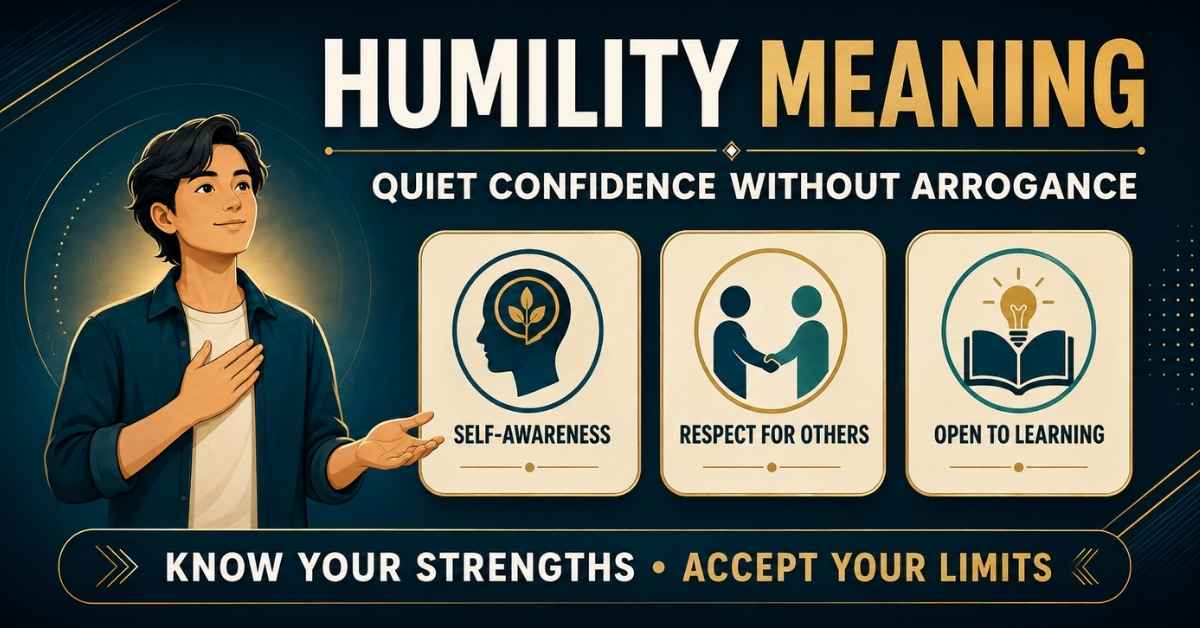
Humility meaning refers to having an accurate, grounded view of yourself without believing you are more important than other people. A humble person recognizes both strengths and limitations, stays open to learning, and treats others with respect. Humility is not weakness, low self-esteem, or hiding your abilities. You can be confident, ambitious, and proud of honest work while remaining humble.
What Does Humility Mean in Simple Words?
In simple words, humility means knowing your value without exaggerating it and recognizing that other people have value too. It is the noun form of humble and is pronounced hyoo-MIL-uh-tee.
Simple definition: Humility is an honest understanding of your strengths and limitations, combined with openness, respect, and freedom from arrogance.
An example of humility in a sentence is: “She accepted the award with humility and thanked everyone who helped her.”
The English word comes through Latin terms associated with being low or grounded. Older definitions often focused on lowliness. Modern psychological explanations are more balanced: humility involves accurate self-assessment, not thinking badly of yourself.
Humility means admitting mistakes, accepting correction, sharing credit, and keeping success in perspective. It does not mean denying achievements, tolerating disrespect, or pretending to be less capable than you are.
What Humility Looks Like in Real Life
Humility becomes clearer when you see it in behaviour rather than inspirational quotations.
| Situation | Humble response | What humility is not |
|---|---|---|
| You do not understand | Ask for an explanation | Pretend to know everything |
| You make an error | Admit it and repair the damage | Call yourself useless |
| Your team succeeds | Recognize your effort and share credit | Take all the praise |
| Someone corrects you | Consider whether the feedback is valid | Attack the person immediately |
| You receive a compliment | Say thank you | Deny all ability to attract reassurance |
| Someone crosses a boundary | Respond respectfully and firmly | Accept mistreatment to appear selfless |
When A humble student can ask for help. A humble leader can take responsibility after failure. A humble expert can say, “I don’t know.” The humble parent can apologize to a child after reacting unfairly.
The common thread is truthfulness. Arrogance distorts the truth upward; self-deprecation distorts it downward. Humility tries to see the situation accurately.
Humility, Confidence, Pride and Low Self-Esteem
People frequently confuse humility with insecurity. The difference lies in how accurately someone sees personal worth and ability.
| Trait | View of strengths | View of limitations | Treatment of others |
|---|---|---|---|
| Humility | Accurate | Honest | Equal respect |
| Confidence | Positive and realistic | Accepts room for growth | Respectful |
| Arrogance | Inflated | Ignored or denied | Others undervalued |
| Low self-esteem | Minimized | Exaggerated | Self undervalued |
| False humility | Hidden strategically | Performed | Often approval-seeking |
Can You Be Confident and Humble?
Yes, confidence and humility can exist together. Confidence says, “I can do this.” Humility adds, “I can do this, but I still have something to learn.”
You do not become arrogant simply by acknowledging a skill or achievement. Arrogance begins when confidence turns into superiority, entitlement, or an unwillingness to recognize other people’s abilities.
Is Humility the Opposite of Pride?
Humility is the opposite of excessive pride, arrogance, or hubris, but not every form of pride. Healthy pride is reasonable satisfaction in your work, identity, or progress. You can feel proud of an achievement without believing it makes you better than everyone else.
Humility meaning vs Modesty, Meekness and Humiliation
These related words are not interchangeable.
| Term | Meaning |
|---|---|
| Humility | An accurate, grounded view of yourself |
| Modesty | Restraint in displaying abilities or achievements |
| Meekness | Gentleness and reluctance to act aggressively |
| Submission | Yielding to another person’s authority or decision |
| Humiliation | Being made to feel ashamed or degraded |
| Self-deprecation | Speaking critically or dismissively about yourself |
A person may behave modestly without being genuinely humble. Likewise, a humble person can be assertive, visible, and ambitious. Humiliation lowers someone painfully; humility is normally a chosen attitude based on honest self-understanding.
Learn More: Platonic Meaning
How a Humble Person Responds
Humility is easiest to practice when you know what it sounds like.
When Someone Compliments You
“Thank you. I worked hard on it, and I appreciate you noticing.”
Accepting praise does not make you boastful. A simple thank-you respects both your effort and the person offering the compliment.
When You Make a Mistake
“I was wrong. I understand the effect it had, and here is how I will correct it.”
Accountability focuses on repair. Calling yourself terrible shifts attention back to you and may force others to provide reassurance.
When You Disagree or Feel Uncertain
“This is my current understanding, but I may be missing something. What evidence led you there?”
This is intellectual humility: recognizing that your knowledge and beliefs may be incomplete. It does not require treating every opinion as equally supported.
False Humility and Humblebragging
False humility is modesty performed to gain praise, approval, status, or moral superiority. It may include:
- Minimizing an achievement so people will praise it more
- Pretending not to know something
- Hiding a boast inside a complaint
- Rejecting every compliment to receive reassurance
- Acting modestly in public while demanding recognition privately
Genuine humility accepts accurate praise, gives credit without denying personal effort, and admits limitations without performing insecurity. However, discomfort with compliments is not automatically manipulative. Shyness, social anxiety, cultural habits, and low confidence may produce similar behaviour for different reasons.
When “Be Humble” Becomes Harmful
Sometimes “be humble” is good advice. At other times, it is used to demand silence, obedience, or invisibility.
Humility does not require you to accept abuse, ignore unfair treatment, hide success, or agree with authority automatically. This matters in families, workplaces, relationships, and religious communities where power is unequal.
People with greater power carry a particular responsibility to show humility by listening, sharing credit, and admitting errors. People with less power should not be told that self-advocacy is arrogance.
A respectful boundary might sound like:
“I respect your perspective, but being humble does not mean ignoring my needs or accepting disrespect.”
Humility without boundaries can become self-erasure.
Different Types of Humility
Intellectual Humility
You recognize that your beliefs may be incomplete and revise them when better evidence appears. Saying “I may be wrong” reflects intellectual honesty, not weakness.
Relational Humility
You listen to another person’s needs, admit harm, and apologize without becoming defensive. Relational humility supports trust without requiring self-neglect.
Cultural Humility
You examine assumptions about cultures and identities different from your own. Cultural humility is an ongoing willingness to learn rather than a claim that you have mastered someone else’s experience.
Leadership Humility
A humble leader requests feedback, develops other people, shares success, and owns failure. Humility does not remove authority; it changes how authority is used.
Spiritual Humility
Many religious traditions connect humility with recognizing human limitations, serving others, and placing life within a larger moral or divine order. In the Bible, humility is commonly associated with dependence on God, freedom from selfish ambition, and concern for others.
Personality research also uses honesty-humility for qualities such as fairness, sincerity, modesty, and lack of entitlement.
See More: Skink Meaning
Humility meaning Across Cultures and Workplaces
Humble behaviour can look different across cultures. Open self-promotion may be expected in one workplace but viewed as boastful in another. Some families value direct confidence; others emphasize collective achievement and respect for elders.
Age, gender, status, and religious expectations can also influence who is encouraged to speak and who is told to remain modest. These differences should be considered without stereotyping entire communities.
Across contexts, healthy humility retains four qualities: accuracy, openness, respect, and equal human worth.
How to Practice Humility Without Making Yourself Smaller
Use this five-part Grounded Humility Check:
- Accuracy: Am I recognizing both my strengths and limitations?
- Openness: Can I accept that I may be mistaken?
- Equality: Am I treating other people as equally worthy?
- Accountability: Can I admit and repair an error?
- Boundaries: Am I remaining respectful without erasing myself?
You can practice these qualities in small ways. Ask a sincere question before giving advice. Credit the person whose idea improved your work. Replace an excuse with a clear acknowledgment. Accept a compliment with “thank you.” Seek feedback from someone honest, and state uncertainty when the evidence is incomplete.
Humility is not a performance you perfect in a day. It develops through repeated choices to prefer truth over ego and learning over defensiveness.
A Quick Humility meaning Self-Assessment
Ask yourself:
- Can I admit that I do not know something?
- Can I accept correction without attacking the person?
- Do I recognize my strengths without exaggerating them?
- Can I celebrate another person’s success?
- Do I share credit and apologize without excuses?
- Can I change my opinion when the evidence changes?
- Can I set a respectful boundary?
This is a reflection tool, not a psychological diagnosis. A “no” answer identifies an area to examine rather than proving you are arrogant.
Frequently Asked Questions about Humility meaning
What Is Humility in One Sentence?
Humility is an accurate understanding of your strengths and limitations, combined with openness to learning and respect for other people’s equal worth.
What Is a Simple Example of Humility meaning?
An employee notices an error, admits it without making excuses, corrects the problem, and explains how they will prevent it from happening again.
Is Humility a Sign of Weakness?
No. Admitting mistakes, requesting feedback, and changing your mind often require confidence and courage. Humility becomes unhealthy only when it is confused with fear or self-erasure.
Does Humility Mean Putting Others Before Yourself?
It means considering other people rather than acting as though only your needs matter. It does not require constant self-sacrifice, poor boundaries, or neglecting your well-being.
Can Someone Be Too Humble?
Healthy humility is accurate. Excessive self-minimization, refusal of deserved credit, and fear of speaking up may indicate insecurity or learned submission rather than genuine humility.
What Is the Biblical Meaning of Humility?
Biblical humility generally involves recognizing dependence on God, rejecting selfish pride, serving others, and using personal gifts without treating them as reasons for superiority.
Humility Begins With an Honest View of Yourself
Humility combines self-awareness, confidence, teachability, respect, and accountability. It allows you to acknowledge what you do well, admit what you do not know, learn from correction, and treat others without superiority.
The next time you receive praise, make a mistake, or enter a disagreement, ask whether your response is accurate, open, respectful, accountable, and protected by healthy boundaries. That is what being humble looks like in practice.