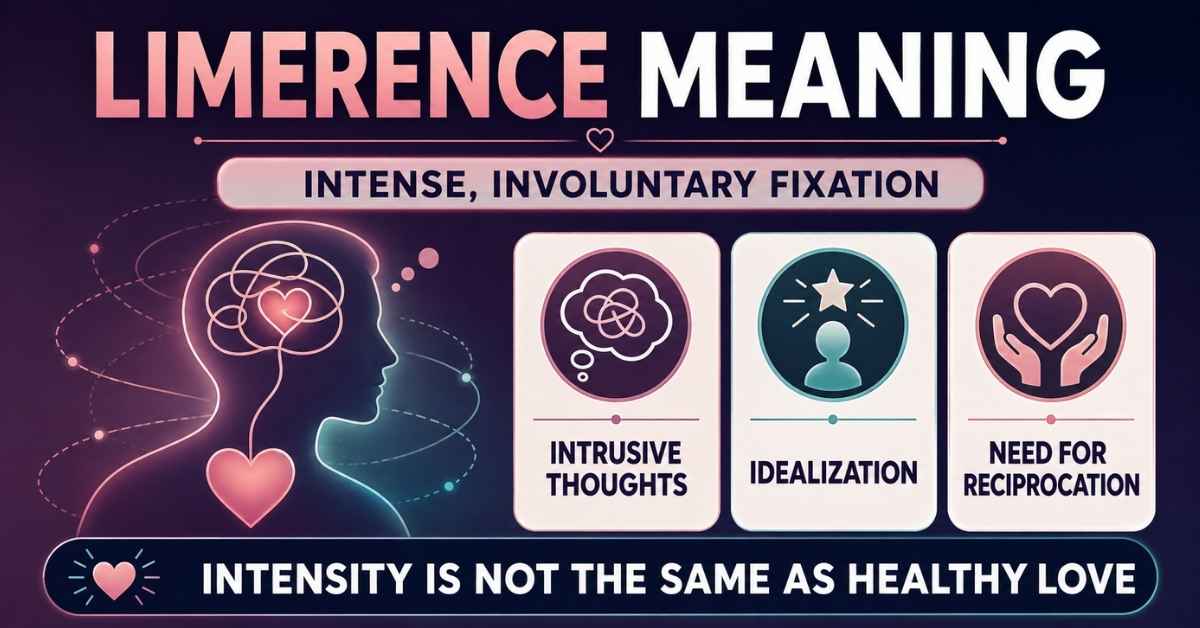
Limerence meaning refers to an intense, involuntary fixation on another person. It commonly involves intrusive thoughts, idealization, emotional dependency and a powerful desire for reciprocation. Unlike a manageable crush, limerence can make your mood depend on whether the person notices, contacts or appears to reject you.
The experience can feel exciting at first. A single message may produce euphoria, while hours of silence can cause anxiety. However, emotional intensity does not prove that two people are compatible or destined to be together.
Having these feelings does not make you a bad person. Thoughts and emotions may arise involuntarily, but everyone remains responsible for respecting consent, privacy and personal boundaries.
What Does Limerence Mean in Simple Words?
In simple terms, limerence is an overwhelming need to be wanted by one particular person. You may think about them constantly, imagine a future together and search for signs that they share your feelings.
The word is pronounced “LIM-er-ents.” Psychologist Dorothy Tennov introduced the term in the 1970s and explored it in her book Love and Limerence. She used it to describe an intense state often called “being in love,” especially when longing, uncertainty and mental preoccupation become central.
A simple example would be someone receiving a friendly message from a coworker and then spending the entire evening analyzing every word. The message is real, but the imagined romantic meaning may be based on hope rather than evidence.
What Does Limerence Feel Like?
Limerence affects thoughts, emotions and behavior. Not everyone experiences it in exactly the same way, but several patterns appear frequently.
Intrusive thoughts and fantasy
A person experiencing limerence may:
- Think about someone for much of the day
- Replay conversations repeatedly
- Imagine detailed future interactions
- Read hidden meaning into ordinary kindness
- Connect unrelated songs, posts or events to that person
- Struggle to concentrate on work or study
- Place the person on a pedestal while overlooking incompatibilities
This idealization is sometimes called crystallization. Positive qualities become magnified, while flaws are ignored, minimized or reinterpreted as attractive.
Emotional highs and lows
Mood dependence is another important sign. Attention from the desired person may create excitement, confidence and relief. Silence or perceived rejection may trigger jealousy, insecurity or despair.
Common emotional experiences include:
- A powerful desire for reciprocation
- Fear of saying the wrong thing
- Anxiety while waiting for a reply
- Hope created by mixed signals
- Shame about losing emotional control
- Jealousy without an established relationship
- Feeling valuable only when the person shows interest
Physical and behavioral signs
Limerence may also involve a racing heart, restlessness, sleep disruption or appetite changes. Behavioral signs can include compulsively checking messages, rereading conversations, visiting someone’s profile or creating reasons to encounter them.
Occasionally thinking about a crush does not necessarily indicate limerence. The more meaningful warning signs are loss of perspective, emotional dependency and interference with everyday life.
Why Uncertainty Can Strengthen Limerence
Limerence often grows in situations where the other person’s feelings remain unclear. A definite answer may be painful, but an uncertain “maybe” leaves space for hope and fantasy.
The cycle often works like this:
- The relationship feels uncertain.
- You check messages, profiles or past conversations.
- An ambiguous detail appears meaningful.
- It produces temporary hope or emotional relief.
- That relief encourages more checking.
- Checking creates more rumination and fantasy.
This explains why situationships, inconsistent communication and emotionally unavailable people can become powerful triggers. Uncertainty is not intimacy, but the mind may confuse anticipation with connection.
The role of social media
Social media can maintain limerence by providing continuous access to small, ambiguous signals. A story view, reaction or online status may feel personally significant even when it has no romantic meaning.
Repeatedly checking these cues does not provide lasting certainty. It usually supplies just enough relief or hope to keep the emotional loop active.
Limerence vs Love, a Crush and Infatuation
Limerence can feel like love because both experiences involve attraction and emotional intensity. The difference is often found in reality, mutual knowledge and emotional stability.
| Experience | Main focus | View of the person | Emotional pattern |
|---|---|---|---|
| Crush | Attraction and curiosity | Partly realistic | Usually manageable |
| Infatuation | Excitement and idealization | Based on limited knowledge | Intense but often temporary |
| Limerence | Reciprocation and obsessive longing | Frequently idealized | Strong highs and lows |
| Healthy love | Mutual care, knowledge and commitment | Increasingly realistic | More stable and reciprocal |
Love develops through shared experiences. You gradually discover the other person’s strengths, limitations, habits and values. Limerence can develop when you know relatively little about someone because missing information leaves more room for projection.
Healthy love also respects the other person’s freedom. Limerence may make their attention feel emotionally necessary.
Can limerence turn into love?
Limerence can develop into a loving relationship, but it does not automatically do so. Mutual attraction only creates an opportunity to build something real.
For the connection to become healthy love, both people must communicate, accept imperfections, respect boundaries and discover whether they are genuinely compatible. Intensity cannot replace trust, shared values or commitment.
Is Limerence a Mental Illness?
Limerence is a descriptive psychological concept, not a standalone mental-health diagnosis. It is not officially listed as a separate disorder in standard diagnostic manuals.
That does not mean the distress is imaginary. A mental-health professional can still help with related problems such as intrusive thoughts, anxiety, depression, compulsive checking or relationship difficulties.
Limerence vs OCD
Limerence and obsessive-compulsive disorder may share features such as unwanted thoughts, reassurance seeking and repetitive checking. However, similar symptoms do not make them the same condition.
Only a qualified professional can evaluate whether recurring thoughts and compulsions may be connected to OCD or another mental-health concern.
Limerence vs erotomania
Limerence usually centers on uncertainty about whether feelings are returned. Erotomania involves a fixed belief that another person is in love with you, even when clear evidence indicates otherwise.
Anyone experiencing serious difficulty assessing reality should seek professional support.
Is limerence the same as stalking?
No. Limerence describes an internal emotional state, while stalking refers to behavior. However, intense feelings never justify repeated unwanted contact, monitoring, threats or ignoring a clear rejection.
Feelings may be involuntary. Behavior remains a choice and a responsibility.
Learn More: Humility Meaning
What Causes Limerence?
There is no single proven cause of limerence. It is inaccurate to assume that everyone experiencing it has childhood trauma, low self-esteem or an attachment disorder.
Possible contributing factors include:
- Loneliness or social isolation
- Attachment anxiety
- Rejection sensitivity
- Low self-worth
- A strong need for validation
- Relationship dissatisfaction
- Recent loss or rejection
- Mixed signals
- Limited knowledge about the desired person
- An emotionally unavailable relationship
For some people, the desired person represents more than romance. Being chosen by them may seem to promise confidence, belonging, excitement or escape from an unsatisfying life.
A helpful question is:
Do I want this particular person, or do I want what being chosen by them would make me feel about myself?
Limerence, ADHD and autism
Some people connect limerence with ADHD hyperfocus, autistic special interests or rejection sensitivity. Neurodivergent traits may influence emotional focus for certain individuals, but ADHD or autism should not automatically be treated as the cause.
Research in this area remains limited. Individual experiences should not be turned into universal rules.
How Long Does Limerence Last?
There is no reliable personal timetable for how long limerence lasts. It may weaken after a short period, continue for years or return after an unexpected message or encounter.
It often lasts longer when:
- Contact remains inconsistent
- The possibility of reciprocation stays unresolved
- Social-media checking continues
- Memories are repeatedly idealized
- The person is lonely or emotionally dissatisfied
- Fantasy replaces real information
- Occasional attention renews hope
Limerence may fade after clear rejection, sustained distance, reduced checking or greater knowledge of the real person. If attraction becomes mutual, everyday reality may either support a genuine relationship or reveal incompatibilities that fantasy had concealed.
Common Real-Life Forms of Limerence
Limerence for a coworker
Professional friendliness is easy to misinterpret when attraction already exists. Keep communication work-focused, avoid creating unnecessary encounters and do not treat ordinary cooperation as romantic evidence.
Limerence for an ex
An ex-partner can remain idealized when memories focus only on positive moments. Occasional contact or profile checking may reactivate hope and prevent emotional separation.
Limerence in a situationship
Ambiguous commitment and inconsistent affection are especially powerful. The uncertainty may feel like passion, even when the connection provides little security or mutual responsibility.
Limerence while married
A married or committed person can experience limerence without automatically losing love for their partner. The experience may reflect novelty, fantasy, unmet needs or emotional escape.
Major relationship decisions should not be made solely during an intense emotional period. Focus first on boundaries, honest self-reflection and the condition of the existing relationship.
Parasocial or celebrity limerence
A public figure may feel emotionally familiar through interviews and social media, but that familiarity is not a mutual relationship. Limited real information makes projection and idealization easier.
How to Stop Limerence: The CLEAR Method
You cannot always switch off a feeling immediately, but you can weaken the behaviors that keep it active.
Check reality
Separate facts from interpretations and fantasies.
| Fact | Interpretation | Fantasy |
|---|---|---|
| They replied politely | They enjoy talking to me | They secretly want a relationship |
| They viewed my story | They saw my post | They are trying to attract my attention |
| They smiled at work | They were friendly | We share a hidden connection |
Limit reinforcement
Reduce behaviors that provide short bursts of hope:
- Checking profiles and online status
- Rereading messages
- Asking friends for information
- Revisiting photographs
- Posting content to provoke a reaction
- Manufacturing accidental encounters
Muting an account, archiving messages and setting check-free periods can be more sustainable than repeatedly blocking and unblocking someone.
Expand your life
Restore what the fixation has displaced. Reconnect with friends, responsibilities, exercise, hobbies and personal goals.
The purpose is not simply to stay busy. It is to rebuild a life that is not emotionally organized around one person.
Accept feelings while choosing behavior
Trying to suppress every thought can make it feel more important. Acknowledge the thought without analyzing it or acting on it.
You can say:
“This is a limerent thought. It feels urgent, but I do not have to respond to it.”
Reach for support
Consider professional help if intrusive thoughts, compulsive checking or emotional distress continue despite your efforts.
See More: Platonic Meaning
What If No Contact Is Impossible?
Complete no contact is not realistic when the person is a coworker, classmate, co-parent, neighbor or family connection. Use the lowest practical level of contact:
- No contact: No genuine reason to stay connected.
- Low contact: Infrequent, nonpersonal communication.
- Structured contact: Predetermined channels and subjects.
- Necessary contact: Work, parenting, education or family logistics only.
Useful boundary scripts include:
- “Please send work questions through email.”
- “I’m keeping our conversations focused on the project.”
- “I respect your decision and won’t contact you again.”
- “I’m not available for personal conversations.”
When Should You Seek Professional Help?
Consider speaking with a qualified mental-health professional if limerence is affecting your:
- Sleep or appetite
- Work or education
- Existing relationships
- Concentration
- Emotional stability
- Ability to accept rejection
- Ability to respect another person’s boundaries
Therapy may address rumination, compulsions, anxiety, grief, self-esteem or attachment patterns, even though limerence itself is not a formal diagnosis.
Seek urgent local help if the experience involves self-harm thoughts, threats, stalking behavior or an immediate risk to anyone’s safety.
If Someone Is Limerent Toward You
You do not have to debate or disprove another person’s feelings. Use direct language and avoid giving intermittent reassurance that could be interpreted as romantic hope.
State your boundary clearly. Restrict communication if it is ignored, document repeated unwanted contact and seek workplace, institutional, legal or emergency support when safety becomes a concern.
Compassion does not require continued access.
Frequently Asked Questions
Can limerence be mutual?
Two people can experience intense attraction at the same time. However, mutual intensity does not guarantee emotional health, compatibility or long-term commitment.
Does rejection always end limerence?
No. Clear rejection may help, but fantasy, social-media checking and occasional contact can preserve hope. Accepting the answer and reducing reinforcement are equally important.
Should you tell someone you are experiencing limerence?
Consider your motive. Disclosure may create clarity in an appropriate mutual context, but it should not pressure someone to manage your emotions or reconsider a boundary.
Can limerence return?
Yes. An unexpected message, loneliness, renewed contact or checking an old profile can reactivate the pattern. A relapse does not erase previous progress.
Is limerence the same as love addiction?
The ideas overlap, but they are not identical or universally accepted clinical diagnoses. Limerence usually focuses on obsessive longing for a particular person and uncertainty about reciprocation.
Can therapy help with limerence?
Yes. Therapy can help reduce intrusive thinking, compulsive behavior, anxiety and emotional dependency while improving boundaries and reality-based decision-making.
What to Remember About Limerence
Limerence is an involuntary state of intense longing, idealization and emotional dependence on possible reciprocation. It can resemble love, but intensity alone does not establish intimacy or compatibility.
Recovery begins when you separate facts from fantasy, reduce reinforcing behaviors and restore neglected parts of your life. Most importantly, remember:
Uncertainty is not intimacy, intrusive feelings are not instructions, and losing yourself is not proof of love.