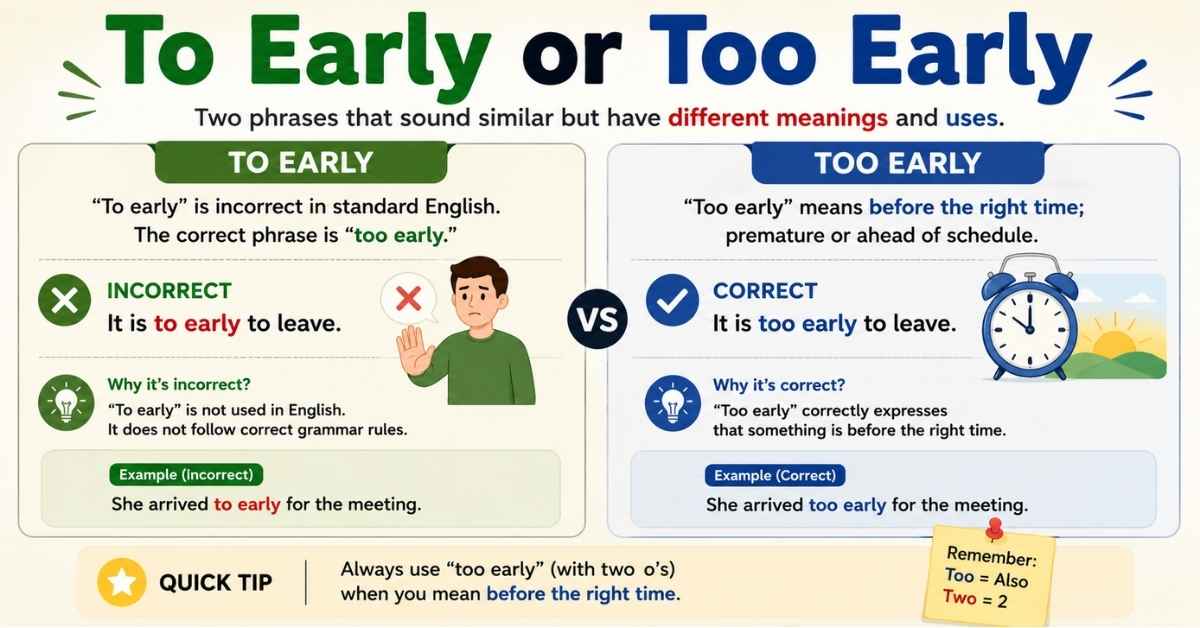
To early or too early is a common English grammar confusion that many students, writers, and English learners search online every day. If you are wondering “is it to early or too early?”, the correct phrase is “too early.” The phrase “to early” is grammatically incorrect in standard English because the word “too” is the proper adverb used to describe something excessive or happening before the expected time.
This small spelling confusion is one of the most common grammar mistakes in English writing because the words “to” and “too” sound almost identical in spoken English. However, their meanings and grammatical functions are completely different.
In this complete guide, you will learn:
- The correct usage of too early
- Why to early is wrong
- The difference between to and too
- Easy grammar rules
- Real sentence examples
- Common writing mistakes
- Tips to remember the difference forever
Whether you are an ESL learner, student, blogger, or professional writer, this article will help you understand to early or too early grammar in the simplest way possible.
Quick Answer: Is It “To Early” or “Too Early”?
The correct phrase is:
| Phrase | Correct? | Explanation |
|---|---|---|
| to early | ❌ No | Grammatically incorrect |
| too early | ✅ Yes | Correct English phrase |
The word “too” means:
- excessively
- more than needed
- earlier than expected
Example:
“I arrived too early for the meeting.”
The word “to” is usually:
- a preposition
- part of an infinitive verb
Why “Too Early” Is Correct
Understanding why too early is correct becomes easier once you know how the word “too” works in English grammar.
The word “too” is an adverb. It modifies adjectives and means:
- excessively
- more than desired
- beyond what is necessary
Since “early” is an adjective/adverb related to time, adding “too” means something happened before the appropriate or expected time.
For example:
- “It is too early to make a decision.”
- “She came too early to the party.”
- “The store opened too early today.”
In each sentence, too intensifies the meaning of early.
This is why grammar experts, editors, proofreading tools, and English dictionaries recognize too early as the correct phrase.
Why “To Early” Is Incorrect
Many English learners accidentally write to early because the pronunciation of to and too sounds similar in spoken English.
However, grammatically, to cannot correctly modify the word early in this context.
Examples:
- “Go to school.”
- “I like to study.”
- “She wants to travel.”
Notice that to connects actions, places, or directions. It does not express excessiveness.
So when someone writes:
“It is to early.”
the sentence becomes grammatically incorrect because the meaning requires an adverb of degree, which is too, not to.
To vs Too: Understanding the Difference
One of the easiest ways to avoid grammar mistakes is to understand the difference between to and too.
Meaning of “To”
The word to is commonly used:
- before verbs
- for direction
- for relationships between words
Examples:
- “I want to learn grammar.”
- “She went to the office.”
- “This letter belongs to him.”
Meaning of “Too”
The word too usually means:
- excessively
- additionally
- more than enough
Examples:
- “The coffee is too hot.”
- “He talks too fast.”
- “I arrived too early.”
Easy Trick to Remember the Difference
A simple memory trick is:
“Too” has an extra ‘O’ because it means something extra.
To Early or Too Early Grammar Explained
The phrase to early or too early grammar is searched frequently because learners want a clear grammatical explanation.
Here is the grammar breakdown:
| Word | Part of Speech | Function |
|---|---|---|
| too | Adverb | Modifies adjectives/adverbs |
| early | Adjective/Adverb | Refers to time |
When combined:
too + early
the phrase means:
earlier than expected or desired.
This follows standard English sentence structure and grammatical accuracy.
Incorrect structure:
to + early ❌
Correct structure:
too + early ✅
This grammar rule is part of broader English writing principles involving:
- modifiers
- adverbs
- sentence correction
- word usage
Is It To Early or Too Early in English Writing?
If you are asking “is it to early or too early?”, remember that professional writers, editors, and grammar correction tools always use too early.
This phrase is common in:
- academic writing
- business communication
- casual speech
- professional emails
- spoken English
Formal Writing Example
“It is too early to finalize the legal agreement.”
Casual Conversation Example
“You came too early.”
Workplace Example
“The presentation was scheduled too early in the morning.”
Academic Example
“Researchers concluded that it was too early to predict the outcome.”
Using the correct phrase improves:
- writing clarity
- grammatical accuracy
- professional communication
Examples of “Too Early” in Sentences
Learning through examples is one of the best ways to improve English grammar.
Casual Sentence Examples
- “I woke up too early today.”
- “They arrived too early for dinner.”
- “It is too early to leave.”
Formal Sentence Examples
- “The company announced the policy too early.”
- “It may be too early to discuss financial projections.”
- “The judgment was delivered too early in the process.”
Workplace Examples
- “The meeting started too early for remote employees.”
- “Sending the email too early caused confusion.”
- “The project deadline was set too early.”
Academic Examples
- “Scientists believe it is too early to confirm the results.”
- “The conclusion was drawn too early.”
- “It is too early to determine the long-term effects.”
Common Mistakes People Make With “To” and “Too”
The confusion between to and too is one of the most common writing mistakes in English.
Here are similar grammar mistakes people often make:
| Incorrect | Correct |
|---|---|
| to late | too late |
| to much | too much |
| to fast | too fast |
| to expensive | too expensive |
| to noisy | too noisy |
These errors happen because:
- pronunciation sounds similar
- English spelling can be confusing
- learners rely on spoken English instead of grammar rules
Similar Grammar Mistakes Related to “Too Early”
English grammar contains many confusing words.
Here are other examples:
| Incorrect Pair | Correct Usage |
|---|---|
| your vs you’re | “You’re welcome.” |
| their vs there | “Their car is outside.” |
| then vs than | “Better than before.” |
| affect vs effect | “The effect was noticeable.” |
How to Remember the Correct Phrase Easily
Many students ask:
“How can I remember the difference between to and too?”
Here are simple grammar tips:
The Extra “O” Rule
The word too has an extra “O” because it means:
- extra
- excessive
- more than enough
Example:
- too hot
- too cold
- too early
Read the Sentence Aloud
Sometimes spoken English helps reveal grammar confusion.
Example:
“It is too early.”
sounds natural.
Is “Too Early” Formal or Informal?
The phrase too early works in both formal and informal communication.
Formal Usage
Used in:
- academic papers
- business meetings
- legal communication
- professional emails
Example:
“It is too early to draw legal conclusions.”
Informal Usage
Used in:
- daily conversations
- texting
- social media
- casual speech
Example:
“You’re calling me too early!”
Because of its flexibility, too early is extremely common in modern English communication.
What Does “Too Early” Mean?
The phrase too early means:
before the appropriate, expected, or desired time.
It often expresses:
- inconvenience
- impatience
- unreadiness
- premature action
Examples:
- “It’s too early to celebrate.”
- “The train arrived too early.”
This phrase is widely used in:
- spoken English
- written English
- professional writing
- educational grammar
Synonyms and Alternative Phrases:
Using synonyms improves writing quality and semantic SEO relevance.
Here are alternatives to too early:
| Phrase | Meaning |
|---|---|
| prematurely | before the right time |
| ahead of time | earlier than expected |
| before schedule | earlier than planned |
| sooner than expected | unexpectedly early |
| excessively early | overly early |
Example:
“The announcement came prematurely.”
These alternatives improve:
- vocabulary
- writing variation
- contextual depth
Common Contexts Where People Use “Too Early”
The phrase appears in many real-life situations.
In Meetings
“The meeting was scheduled too early.”
In Relationships
“It is too early to make promises.”
Decision-Making
“Experts say it is too early to predict the election results.”
Travel
“We arrived at the airport too early.”
Medical Discussions
“Doctors believe it is too early to confirm the diagnosis.”
Why People Confuse “To” and “Too”
One major reason is pronunciation confusion.
In spoken English:
- to
- too
- two
English learners especially struggle because spoken pronunciation does not clearly distinguish these words.
Learn More: Awhile vs A While
Quick Grammar Rule Chart
Here is a simple grammar guide you can remember easily.
| Phrase | Correct? | Reason |
|---|---|---|
| to early | ❌ | Incorrect grammar |
| too early | ✅ | Correct phrase |
| too late | ✅ | Correct modifier |
| to late | ❌ | Wrong usage |
This quick chart is useful for:
- students
- bloggers
- writers
Why This Is One of the Most Common English Grammar Mistakes
According to language experts, the confusion between to and too happens because:
- they sound alike
- typing is fast
- autocorrect sometimes misses the error
- English contains many homophones
Even advanced writers occasionally make this mistake during casual writing.
However, learning the rule once makes correction much easier.
“Good grammar is credibility, especially online.”
Frequently Asked Questions
Is “Too Early” Grammatically Correct?
Yes. Too early is grammatically correct because too functions as an adverb modifying the word early.
Why Is “To Early” Wrong?
The word to cannot grammatically modify early in this context. The sentence requires the adverb too.
What Is the Difference Between “To” and “Too”?
- To is mainly a preposition or infinitive marker.
- Too means excessively or additionally.
Can I Use “Too Early” in Formal Writing?
Yes. The phrase is widely accepted in formal writing, business communication, and academic English.
Is “Too” an Adverb?
Yes. In this phrase, too functions as an adverb modifying early.
How Do I Remember the Difference Between “To” and “Too”?
Remember:
Too has an extra “O” because it means something extra.
What Does “Too Early” Mean?
It means something happened before the proper or expected time.
Final Verdict:
The correct phrase is always too early when referring to something happening earlier than expected, desired, or appropriate.
If you remember only one grammar rule from this article, remember this:
| Incorrect | Correct |
|---|---|
| to early | too early |
Understanding this small grammar rule can greatly improve:
- English writing
- proofreading accuracy
- communication skills
- professional credibility
Whether you are writing emails, blog posts, academic papers, or social media captions, using the correct phrase shows strong grammatical accuracy and attention to detail.
So next time someone asks:
“Is it to early or too early?”
you will confidently know the answer:
✅ Too early is always correct.