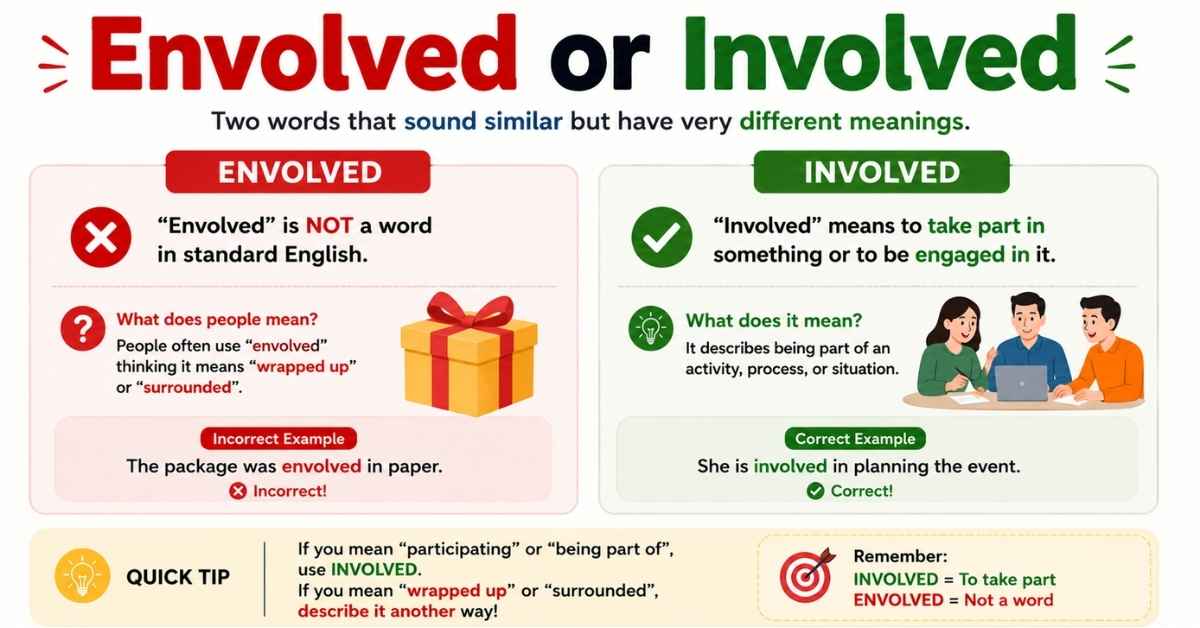
Envolved is a common spelling mistake, while involved is the correct English word. If you have ever searched for “envolved or involved,” “involved vs envolved,” or “what does envolved mean,” you are not alone. Many English learners and native speakers confuse these words because they sound similar in fast speech and casual conversation.
The simple answer is this:
“Envolved” is not a correct English word. “Involved” is the proper spelling.
This common grammar mistake appears in emails, social media posts, essays, and even professional writing. Understanding the difference between envolved vs involved can improve your English grammar, writing clarity, and communication skills.
In this complete grammar guide, you will learn:
- The meaning of “involved”
- Why people write “envolved”
- Correct sentence examples
- Common grammar mistakes
- Easy memory tricks
- Pronunciation tips
- FAQs about “envolved or involved”
Let’s break everything down in a simple and easy-to-understand way.
Quick Answer: Is It “Envolved” or “Involved”?
The correct spelling is “involved.”
| Word | Correct? | Meaning |
|---|---|---|
| Envolved | ❌ No | Misspelling |
| Involved | ✅ Yes | Correct English word |
If you write:
- ❌ He was envolved in the meeting.
It should be:
- ✅ He was involved in the meeting.
This is one of the most common English grammar mistakes because people often confuse pronunciation with spelling.
What Does Envolved Mean?
Many people search for “what does envolved mean” because they see the word online or accidentally type it themselves.
The truth is simple:
“Envolved” has no official meaning in English because it is not a real dictionary word.
It is simply a misspelling of “involved.”
People usually write “envolved” because:
- They pronounce “involved” incorrectly
- English spelling can be confusing
- Fast typing leads to mistakes
- Autocorrect sometimes fails
- ESL learners mix similar sounds
This spelling confusion is similar to mistakes like:
- definately instead of definitely
- seperate instead of separate
- occured instead of occurred
These are known as common English mistakes and happen frequently in both spoken and written English.
What Does “Involved” Mean?
The word “involved” has several meanings depending on the context. It can describe participation, emotional connection, or something complicated.
1. Involved Meaning as Participation
The most common meaning of “involved” is:
Taking part in something.
Examples
- She was involved in the school project.
- They are heavily involved in community work.
- He became involved in politics.
In this context, “involved” means:
- engaged
- participating
- included
- connected
2. Involved Meaning as Complexity
Sometimes “involved” means something is difficult or complicated.
Examples
- The instructions were very involved.
- It is an involved legal process.
- The explanation became too involved.
Here, “involved” means:
- complex
- detailed
- complicated
3. Involved Meaning in Relationships
“Involved” can also describe emotional or romantic connections.
Examples
- They became romantically involved.
- She was emotionally involved in the situation.
In this usage, the word suggests:
- emotional attachment
- personal connection
- relationship involvement
Involved vs Envolved: What’s the Difference?
Many people search for “involved vs envolved” to understand whether both spellings are acceptable.
Here is the difference:
| Feature | Involved | Envolved |
|---|---|---|
| Correct English word | ✅ Yes | ❌ No |
| Found in dictionaries | ✅ Yes | ❌ No |
| Used in professional writing | ✅ Yes | ❌ No |
| Grammatically correct | ✅ Yes | ❌ No |
| Accepted in academic writing | ✅ Yes | ❌ No |
The confusion usually happens because:
- The words sound similar in quick speech
- English pronunciation is inconsistent
- Some accents soften the “in” sound
However, in standard English grammar, only “involved” is correct.
Why Do People Write “Envolved” Instead of “Involved”?
This spelling mistake is more common than many people realize.
1. Pronunciation Confusion
Some people pronounce “involved” quickly, making it sound like “envolved.”
This is especially common in:
- casual speech
- regional accents
- spoken English
- fast conversations
2. ESL Learning Challenges
English learners often struggle with:
- vowel sounds
- prefixes
- silent letters
- spelling rules
Because of this, they may accidentally write “envolved.”
3. Typing Errors
Fast typing on phones and keyboards can lead to:
- missing letters
- swapped vowels
- spelling confusion
4. Lack of Proofreading
Many grammar mistakes happen because people:
- rush through writing
- skip proofreading
- rely too much on spell-check tools
Good proofreading improves:
- writing clarity
- sentence structure
- communication quality
How to Use “Involved” Correctly in Sentences
Learning through examples is one of the best ways to improve grammar learning and vocabulary improvement.
Participation
- ✅ She was involved in organizing the event.
- ✅ We became involved in the charity campaign.
- ✅ The students were actively involved in class discussions.
Complexity
- ✅ The project became too involved to finish quickly.
- ✅ His explanation sounded involved and technical.
Emotional Connection
- ✅ They became emotionally involved after months of talking.
- ✅ He was deeply involved in the issue.
Incorrect Examples
- ❌ She was envolved in the discussion.
- ❌ He became envolved in politics.
- ❌ They were emotionally envolved.
All these examples should use “involved.”
Common Grammar Mistakes Similar to “Envolved”
The English language contains many confusing words and spelling mistakes.
Here are some examples:
| Incorrect | Correct |
|---|---|
| Envolved | Involved |
| Definately | Definitely |
| Seperate | Separate |
| Recieve | Receive |
| Occured | Occurred |
| Alot | A lot |
| Persue | Pursue |
| Reenforce | Reinforce |
These grammar mistakes happen because English spelling rules are not always predictable.
Easy Trick to Remember the Correct Spelling
Memory tricks can help improve writing accuracy and reduce spelling confusion.
Simple Memory Trick
Remember this sentence:
“You are IN something when you are INVOLVED.”
The word begins with “IN” because it describes being included or connected.
This simple trick helps many English learners avoid the “envolved” mistake.
Another Helpful Tip
Break the word into parts:
- IN + VOLVED
This makes it easier to remember the correct spelling pattern.
Is “Envolved” Ever Correct?
No, “envolved” is never correct in standard English grammar.
It is not:
- a formal English word
- an accepted spelling variation
- recognized in dictionaries
- proper in academic writing
Even in informal writing, using “envolved” can make your writing appear careless or unprofessional.
Pronunciation of “Involved”
Correct pronunciation helps avoid pronunciation confusion and spelling mistakes.
Standard Pronunciation
Involved
/ɪnˈvɑːlvd/
Pronunciation Breakdown
- “in” sounds like “ihn”
- “volved” sounds like “volvd”
Why It Sounds Like “Envolved”
In fast spoken English:
- the “in” sound may soften
- accents change vowel sounds
- words blend together naturally
This causes many people to hear:
- “envolved” instead of:
- “involved”
Synonyms of “Involved”
Using synonyms improves:
- vocabulary
- sentence clarity
- writing variety
- SEO semantic richness
Synonyms for Participation
| Word | Meaning |
|---|---|
| Engaged | Taking part |
| Included | Part of something |
| Associated | Connected |
| Participating | Active involvement |
| Connected | Linked to something |
Synonyms for Complexity
| Word | Meaning |
|---|---|
| Complex | Difficult |
| Detailed | Full of information |
| Complicated | Hard to understand |
| Technical | Specialized |
Real-Life Examples of “Involved”
Understanding contextual meaning helps improve fluent English and grammar practice.
Workplace Example
“The manager was heavily involved in the company’s expansion strategy.”
School Example
“Parents should stay involved in their children’s education.”
Relationship Example
“They became romantically involved after working together.”
Legal Example
“The case involved several complicated contracts.”
These examples show how flexible the word “involved” can be in daily English.
Why Grammar Accuracy Matters
Some people think small spelling mistakes do not matter, but writing clarity is important in:
- professional communication
- academic writing
- business emails
- resumes
- social media branding
A small grammar mistake like “envolved” can:
- reduce credibility
- create confusion
- affect professionalism
Good grammar improves:
- communication
- readability
- trust
- confidence
How Spell Checkers Handle “Envolved”
Modern grammar correction tools usually flag “envolved” as incorrect.
Popular Grammar Tools
- Grammarly
- Microsoft Word Editor
- Google Docs
- Hemingway Editor
These tools improve:
- proofreading
- sentence structure
- language clarity
- grammar correction
However, no tool is perfect. Human proofreading is still essential.
Learn More: To Early or Too Early?
Most Commonly Confused English Words
The confusion between envolved or involved belongs to a larger group of grammar mistakes.
Frequently Confused Words
| Incorrect | Correct |
|---|---|
| Loose | Lose |
| Your | You’re |
| Affect | Effect |
| Advice | Advise |
| Then | Than |
| To | Too |
| Its | It’s |
Tips to Avoid Spelling Mistakes
Here are practical ways to improve writing accuracy.
Read More Often
Reading helps your brain recognize:
- correct spelling
- sentence patterns
- grammatical context
Slow Down While Typing
Fast typing increases:
- spelling confusion
- punctuation mistakes
- grammar errors
Use Grammar Tools Carefully
Grammar checkers help, but they should not replace:
- proofreading
- language learning
- critical thinking
Practice Writing Daily
Daily grammar practice improves:
- vocabulary improvement
- communication skills
- writing clarity
- fluent English
Case Study: Why “Envolved” Appears So Often Online
A study of online writing patterns shows that spelling mistakes increase on:
- mobile devices
- social media platforms
- fast messaging apps
For example:
- Twitter/X posts
- Facebook comments
- TikTok captions
- text messages
Quote About Good Writing
“Good writing is clear thinking made visible.”
This quote highlights why grammar and spelling matter in communication.
Even small mistakes can affect how readers understand your message.
Frequently Asked Questions
What Does Envolved Mean?
“Envolved” does not have an official meaning because it is not a real English word. It is a misspelling of “involved.”
Is Envolved a Real Word?
No. “Envolved” is not recognized in English dictionaries or formal grammar rules.
Which Is Correct: Envolved or Involved?
The correct spelling is “involved.”
Why Do People Misspell Involved?
People misspell “involved” because of:
- pronunciation confusion
- typing errors
- fast speech
- ESL learning challenges
Can Envolved Ever Be Correct?
No. Standard English grammar does not accept “envolved.”
How Do You Spell Involved Correctly?
The correct spelling is:
I-N-V-O-L-V-E-D
What Is the Difference Between Involved and Envolved?
“Involved” is a correct English word. “Envolved” is simply a misspelling.
Is Involved Formal or Informal?
“Involved” works in both:
- formal writing
- informal conversation
It is commonly used in:
- business communication
- education
- legal writing
- everyday English
Final Verdict:
If you are still wondering about “envolved or involved,” the answer is clear:
“Involved” is the correct spelling, while “envolved” is incorrect.
The confusion happens because of:
- pronunciation differences
- spelling mistakes
- typing speed
- English learning challenges
Understanding the difference between involved vs envolved improves:
- English grammar
- writing clarity
- communication skills
- professional writing accuracy
Whenever you write, remember this simple rule:
✅ Involved = Correct ❌ Envolved = Incorrect