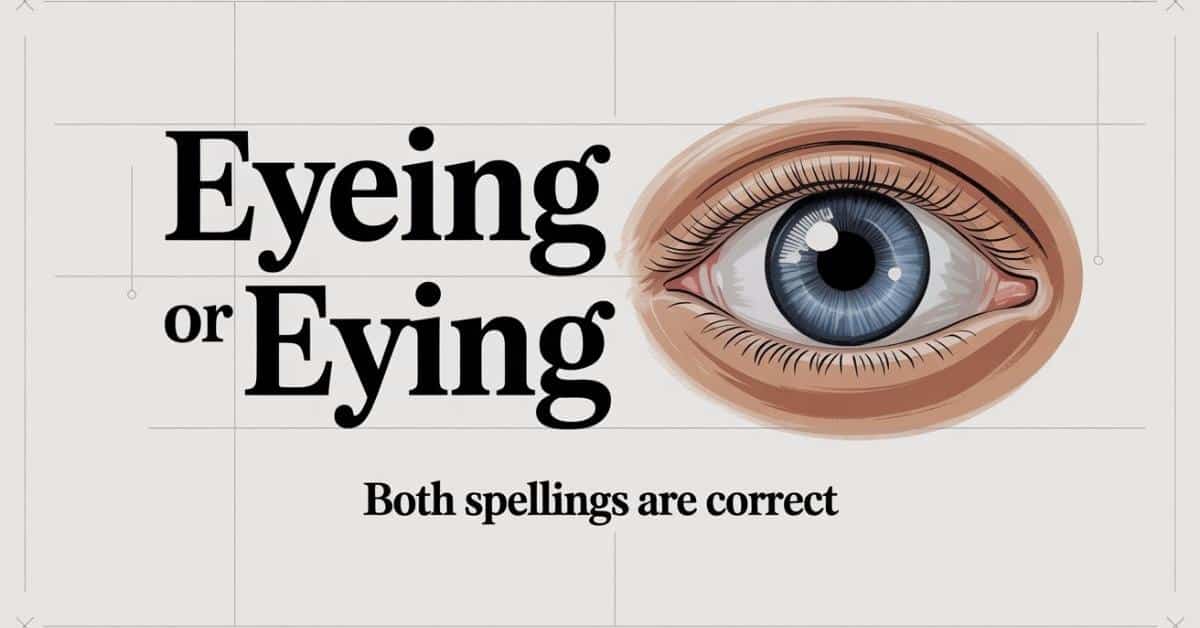
Eyeing or eying — which spelling is actually correct? The short answer is that both “eyeing” and “eying” are technically correct, but “eyeing” is the preferred and far more common spelling in modern English. In professional writing, academic work, journalism and everyday communication, “eyeing” is usually the safest and most natural-looking choice.
If you have ever paused while writing a sentence like “The company is eyeing a new market” and wondered whether the extra “e” should stay, you are not alone. Even native English speakers search for this grammar question because the spelling looks unusual at first glance. That confusion comes from how English spelling conventions handle certain verbs ending in silent “e.”
In this guide, you’ll learn:
- the difference between eyeing vs eying
- why both spellings exist
- which spelling editors and publishers prefer
- how dictionaries treat the word
- when to use each version
- and which spelling sounds most natural in modern English writing
Quick Answer: Eyeing vs Eying
| Spelling | Correct? | Common in Modern English? | Recommended for Professional Writing? |
|---|---|---|---|
| Eyeing | Yes | Very common | Yes |
| Eying | Yes | Rare | Usually no |
The Practical Recommendation
If you are writing:
- a blog post
- a business email
- academic content
- journalism
- LinkedIn content
- professional communication
Use:
Eyeing
It is the spelling most readers expect to see.
Why People Get Confused About “Eyeing” and “Eying”
The confusion around eyeing or eying comes from a basic English grammar expectation. Normally, when verbs end in a silent “e,” the “e” is dropped before adding “-ing.”
For example:
- make → making
- write → writing
- dance → dancing
So naturally, many people assume:
- eye → eying
But English spelling rules are not always perfectly consistent. Some words keep the extra “e” for readability and pronunciation clarity. That is why “eyeing” became the dominant spelling in modern usage.
Another reason this keyword gets searched so often is emotional. People worry about:
- sounding uneducated
- making grammar mistakes
- looking unprofessional
- using awkward spelling in public writing
Most users are not looking for a long grammar lecture. They simply want confidence and clarity.
Why “Eyeing” Is the Preferred Modern Spelling
Although both forms are accepted, “eyeing” is overwhelmingly more common in modern English.
Professional editors, publishers, journalists, and copywriters usually choose eyeing because:
- it looks more natural
- it preserves readability
- readers recognize it instantly
- it avoids awkward letter combinations
Compare the two visually:
- eyeing
- eying
Most readers process eyeing more easily because the original base word “eye” remains visually intact.
That matters more than many people realize. In modern publishing and digital writing, readability strongly influences spelling preference.
What Major Dictionaries Say
Major dictionaries recognize both spellings, but most modern examples heavily favor eyeing.
Merriam-Webster
Recognizes both forms but commonly displays eyeing in examples.
Cambridge Dictionary
Primarily uses eyeing in modern usage examples.
Oxford English Dictionary
Acknowledges spelling variation while showing that eyeing dominates contemporary usage.
This is important because users often assume:
“If both are correct, they must be equally common.”
That is not true.
Technically correct does not always mean equally preferred.
Is “Eying” Wrong?
No, “eying” is not grammatically incorrect.
However, it is:
- less common
- less recognizable
- visually less familiar
- rarely preferred in modern professional writing
You may still see eying in:
- older texts
- historical writing
- niche publications
- stylistic writing choices
But in modern digital communication, eyeing is generally considered the standard preferred spelling.
Why Does “Eyeing” Keep the “E”?
This is the part most competitor articles fail to explain properly.
The extra “e” remains in eyeing mainly for:
- readability
- pronunciation clarity
- visual recognition
Without the “e,” the word becomes:
- eying
That spelling can look visually awkward because the base word “eye” becomes less obvious.
English sometimes preserves letters when removing them would make a word harder to read quickly.
This happens in other English spelling patterns too.
Similar English Word Patterns
Dyeing vs Dying
- Dyeing refers to coloring fabric or hair.
- Dying refers to death.
The extra letter helps prevent confusion.
Singeing vs Singing
- Singeing means lightly burning.
- Singing relates to music.
Again, the extra “e” improves clarity.
Ageing vs Aging
This is another famous spelling variation involving modern usage preference and regional English differences.
These examples show that English spelling conventions prioritize clarity more often than strict consistency.
Eyeing vs Eying in Professional Writing
In Business Communication
Professional writers almost always use:
Eyeing
Example:
“The company is eyeing expansion into Southeast Asian markets.”
This looks polished, natural, and modern.
Using eying here may distract readers because it appears unfamiliar.
In Journalism and Media
News publications overwhelmingly favor:
- eyeing
Examples:
- “The startup is eyeing international growth.”
- “The team is eyeing a playoff position.”
Journalists prioritize readability and reader familiarity.
In Academic Writing
Academic editors typically prefer:
- eyeing
Because formal writing values:
- clarity
- consistency
- conventional spelling
If you are writing:
- essays
- dissertations
- research papers
- university assignments
Use:
Eyeing
In Content Writing
For writers and bloggers, eyeing is usually the better choice because:
- it aligns with dominant search usage
- readers recognize it faster
- grammar tools prefer it
- it reduces perceived spelling friction
It is heavily connected to user trust and readability.
Unusual spellings can subtly reduce reader confidence.
In Creative Writing
Creative writers have more flexibility.
In fiction or stylistic prose, either spelling may appear depending on:
- voice
- tone
- historical authenticity
- stylistic preference
Still, eyeing remains the more recognizable option for modern readers.
Which Spelling Should You Actually Use?
Here is the simplest answer.
Use “Eyeing” For:
- professional writing
- academic writing
- journalism
- blog posts
- LinkedIn posts
- business communication
- marketing copy
- modern digital writing
“Eying” May Still Be Acceptable In:
- historical quotations
- older texts
- stylistic fiction
- niche language preferences
But for most modern situations:
Eyeing is the better choice.
American English vs British English
Many people assume:
- eyeing = American English
- eying = British English
But the reality is more nuanced.
Both British and American publications strongly favor:
Eyeing
The difference is not as regionally divided as other spelling variations like:
- color vs colour
- canceled vs cancelled
- aging vs ageing
Globally, eyeing dominates modern publishing and online writing.
Learn More: Treck or Trek
Common Mistakes People Make
Assuming “Eying” Must Be Wrong
It is not wrong.
It is simply uncommon.
Assuming Both Forms Are Equally Popular
This is misleading.
One spelling clearly dominates modern usage:
Eyeing
Using Rare Spellings in Professional Contexts
Even technically correct spellings can look awkward if readers rarely encounter them.
Professional writing should prioritize:
- familiarity
- readability
- reader comfort
What Professional Editors Usually Recommend
Experienced editors generally choose the spelling that:
- reduces reader friction
- improves readability
- looks visually natural
- matches modern publishing standards
That is why eyeing is usually preferred.
Editors understand something many grammar articles ignore:
Reader perception matters.
If a spelling looks strange or distracting, readers pause mentally — even if the spelling is technically acceptable.
Why “Eyeing” Looks More Natural to Readers
Human brains recognize familiar word shapes quickly.
The spelling:
- eyeing
preserves the complete base word:
- eye
This makes the word easier to process visually during fast reading.
Meanwhile:
- eying
can briefly interrupt recognition because the original root word becomes less visually obvious.
That subtle readability difference strongly influences modern spelling preference.
Eyeing vs Eying: Which Spelling Is More Common?
In:
- books
- newspapers
- blogs
- online articles
- journalism
- corporate communication
Eyeing appears far more frequently than eying.
Modern search behavior also reflects this preference.
People searching:
- “eyeing or eying”
- “which spelling is correct”
- “is eying wrong”
are usually encountering eyeing more often in real-world writing.
Examples of “Eyeing” Used Naturally
Business Example
“The company is eyeing several acquisition opportunities this year.”
Marketing Example
“Brands are eyeing younger audiences through short-form video content.”
Academic Example
“Researchers are eyeing new applications for artificial intelligence in healthcare.”
Everyday Conversation Example
“She was eyeing the last slice of pizza all evening.”
Journalism Example
“The club is eyeing a major signing before the transfer window closes.”
Examples of “Eying” Used Naturally
Although rare, you may still encounter examples like:
“He was eying the painting from across the room.”
or
“Investors are eying potential opportunities overseas.”
These are grammatically acceptable, but many modern editors would still replace them with:
- eyeing
for smoother readability.
Frequently Asked Questions
Is “eying” grammatically correct?
Yes. Both eying and eyeing are technically correct spellings.
Which spelling is more common?
Eyeing is much more common in modern English.
Why is “eyeing” spelled with an extra “e”?
The extra “e” helps preserve readability and keeps the base word “eye” visually recognizable.
Which spelling should I use professionally?
Use:
Eyeing
It is the safest and most widely accepted choice.
Does Grammarly accept “eying”?
Usually yes, but Grammarly and many editing tools often prefer eyeing because it is more common.
Is “eying” outdated?
Not completely, but it is far less common in modern writing.
Do publishers prefer “eyeing”?
Yes. Most publishers, editors, and journalists use eyeing.
Is “eyeing” better for SEO writing?
Generally yes, because it aligns with dominant modern usage and reader familiarity.
Final Verdict: Eyeing or Eying?
If you want the clear modern recommendation:
Use “eyeing.”
While “eying” is technically correct, it is significantly less common and may look unusual to readers.
In professional, academic, editorial, and online writing, eyeing is the spelling most people expect to see.
So if your goal is:
- readability
- professionalism
- modern usage
- natural flow
- reader trust
Then:
Eyeing is the better choice in almost every situation.