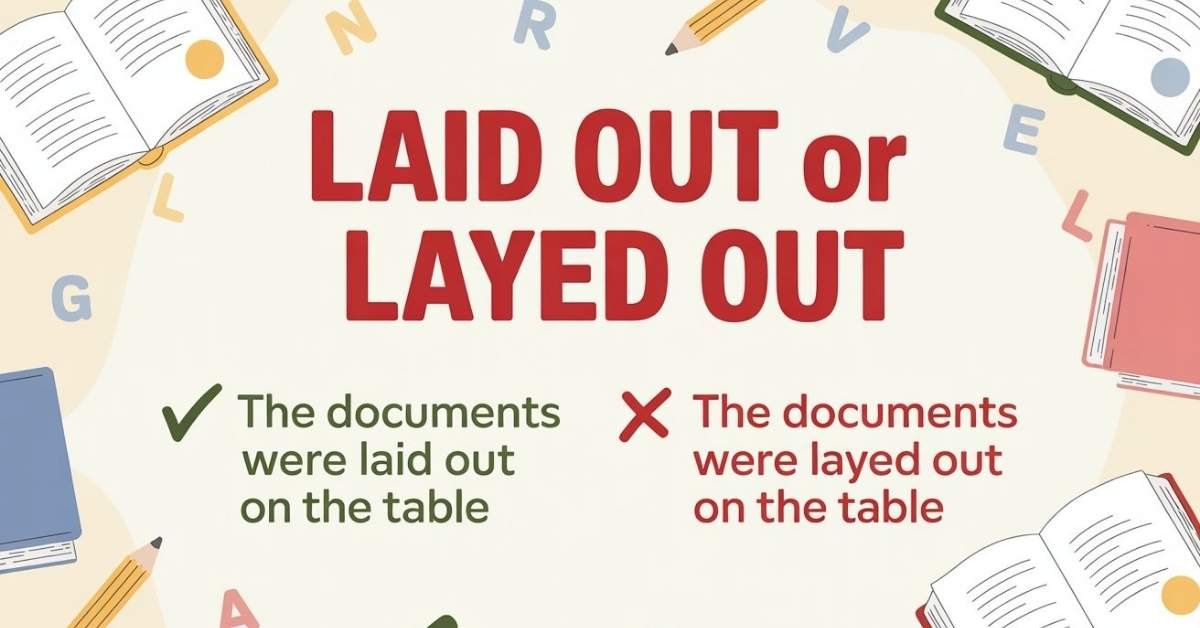
Laid out or layed out? The correct form is laid out. In standard English, “layed out” is usually incorrect and appears because people naturally expect verbs to follow regular past-tense patterns. If you’ve ever paused while writing an email, essay, caption, report, or message and wondered which version is right, you’re not alone. This guide explains why “laid out” is correct, why “layed out” feels correct, how to remember the rule permanently, and how to use it naturally in real sentences.
Quick Answer: Use “Laid Out,” Not “Layed Out”
If you only need the answer:
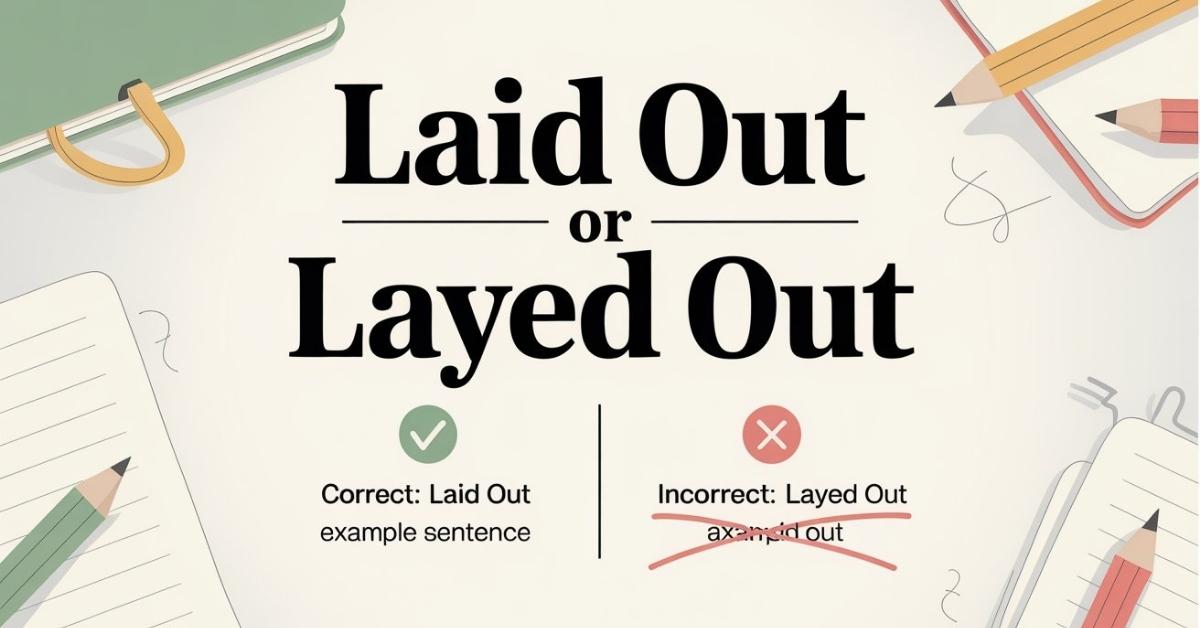
| Correct | Incorrect |
|---|---|
| Laid out | Layed out |
Examples:
✅ She laid out the documents on the desk. ✅ The manager laid out the project timeline clearly. ❌ She layed out the documents.
The Simple Rule
The verb lay is an irregular verb.
Verb forms:
- Present: lay
- Past tense: laid
- Past participle: laid
So:
- lay out → laid out
- not → layed out
The 5-Second Test
If your sentence describes something that already happened, try replacing lay with placed.
Example:
“She placed out the plan.”
Sounds like past tense?
Then use:
“She laid out the plan.”
Why So Many People Write “Layed Out” (And Why It Feels Correct)
One reason this mistake is so common is because English trains us to expect patterns.
Think about these verbs:
- play → played
- stay → stayed
- pray → prayed
So your brain expects:
- lay → layed
That feels logical.
But English includes irregular verbs, which don’t follow the normal -ed rule.
Examples:
- say → said
- pay → paid
- lay → laid
That’s why laid out vs layed out becomes such a common grammar confusion.
Even native speakers make this mistake because spoken English doesn’t always make the difference obvious.
This is not usually a vocabulary problem—it’s a verb conjugation and spelling expectation issue.
What Does “Laid Out” Actually Mean?
Many people search “laid out meaning” because they understand the spelling question but still aren’t sure how to use the phrase.
Laid out is a common phrasal verb in English and can have several meanings depending on context.
1. To Arrange or Organize Something
This meaning refers to putting things in order.
Examples:
- She laid out the clothes for tomorrow.
- The designer laid out the brochure.
- We laid out all available options.
Related contextual terms:
- arranged
- organized
- positioned
- structured
2. To Explain Something Clearly
This usage appears frequently in business and professional writing.
Examples:
- The lawyer laid out the argument.
- The teacher laid out expectations.
- The proposal laid out the complete strategy.
Co-occurring phrases:
- laid out the evidence
- laid out the process
- laid out the schedule
- laid out the roadmap
3. To Present a Plan
Examples:
- The consultant laid out a growth plan.
- Our team laid out next quarter’s goals.
Semantic relationships:
- explain
- present
- communicate
- clarify
4. To Spread Something Physically
Examples:
- They laid out blankets in the park.
- The chef laid out ingredients before cooking.
The Grammar Rule Behind “Laid Out”
Understanding the rule makes the mistake disappear permanently.
Base Form → Past → Past Participle
| Verb | Present | Past | Past Participle |
|---|---|---|---|
| Lay | lay | laid | laid |
When out is added:
- lay out
- laid out
- have laid out
Examples:
Present:
I lay out the documents.
Past:
I laid out the documents.
Present perfect:
I have laid out the documents.
Why “Lay” Is Irregular
English inherited irregular patterns from older language development.
That’s why some verbs transform unexpectedly.
Examples:
- say → said
- pay → paid
- lay → laid
Users searching:
- past tense of lay out
- is laid out correct
- why is layed wrong
When “Layed” May Appear (And Why It Usually Isn’t Standard)
This is where articles often become confusing.
Technically, layed can appear in extremely limited contexts connected to certain specialized uses of lay (such as older or industry-specific terminology), but for normal writing and everyday English:
Use “laid.”
If you’re writing:
- essays
- blogs
- emails
- reports
- captions
- professional communication
choose:
✅ laid out
Real Examples: How “Laid Out” Sounds in Everyday English
Workplace Examples
✓ The director laid out the company strategy. ✓ Our manager laid out expectations clearly. ✓ The presentation laid out next steps.
Academic Examples
✓ The researcher laid out the methodology. ✓ The professor laid out the central argument.
Everyday Conversation
✓ She laid out everything honestly. ✓ He laid out his concerns.
Professional Writing
✓ This report lays out our recommendations. ✓ The policy document laid out implementation steps.
Digital Communication
✓ I’ve laid out all details in the email. ✓ We already laid out the timeline in Slack.
Learn More: Nominator vs Nominee
How to Never Confuse “Laid Out” and “Layed Out” Again
Most grammar articles stop after explaining the rule.
That’s not enough.
Use these memory systems.
Memory Shortcut
Remember:
Play → Played Stay → Stayed Lay → Laid
This one changes.
The Replace-It Method
Replace lay with place.
Example:
“She placed out the materials.”
If past tense fits:
“She laid out the materials.”
Read-It-Aloud Method
Read both versions.
- I laid out the plan.
- I layed out the plan.
Most English speakers immediately hear the difference.
The Editor Rule
Professional editors often ask:
“Would I naturally say this in conversation?”
If yes, use the simpler standard form.
Common Mistakes People Make With “Lay”
Lay vs Lie
Confusing because:
- lay = put something down
- lie = rest
Example:
Correct:
I lay the book down.
Correct:
I lie on the couch.
Laid vs Lain
Correct:
- I have laid the documents.
- I have lain here all day.
Lay Out vs Layout
These are different.
Lay out → verb Example:
We laid out the design.
Layout → noun Example:
I like the page layout.
Mini Usage Quiz
Choose the correct version.
- She _ the clothes on the bed. Answer: laid out
- The report _ the findings clearly. Answer: laid out
- They _ the project roadmap yesterday. Answer: laid out
- He _ all options before deciding. Answer: laid out
- We already have _ expectations. Answer: laid out
Questions People Usually Ask
Is “Layed Out” Grammatically Correct?
Usually no.
Standard English uses laid out.
Is “Layed” a Real Word?
Rarely in specialized contexts, but not for normal writing.
Why Isn’t the Past Tense “Layed”?
Because lay is irregular.
Is “Laid Out” Formal?
It works in both formal and informal English.
Can You Say “Has Laid Out”?
Yes.
Example:
The company has laid out its objectives.
Is “Laid Out” Different in British and American English?
No major difference here.
Final Answer: Laid Out Is Correct
If you searched “laid out or layed out,” the correct form in standard English is laid out.
People often write layed out because English encourages regular verb patterns, but lay → laid is an irregular verb form.
The easiest rule to remember:
If you mean put, arranged, explained, presented, or organized in the past, use laid out.
Once you remember that lay becomes laid, this mistake becomes much easier to avoid.