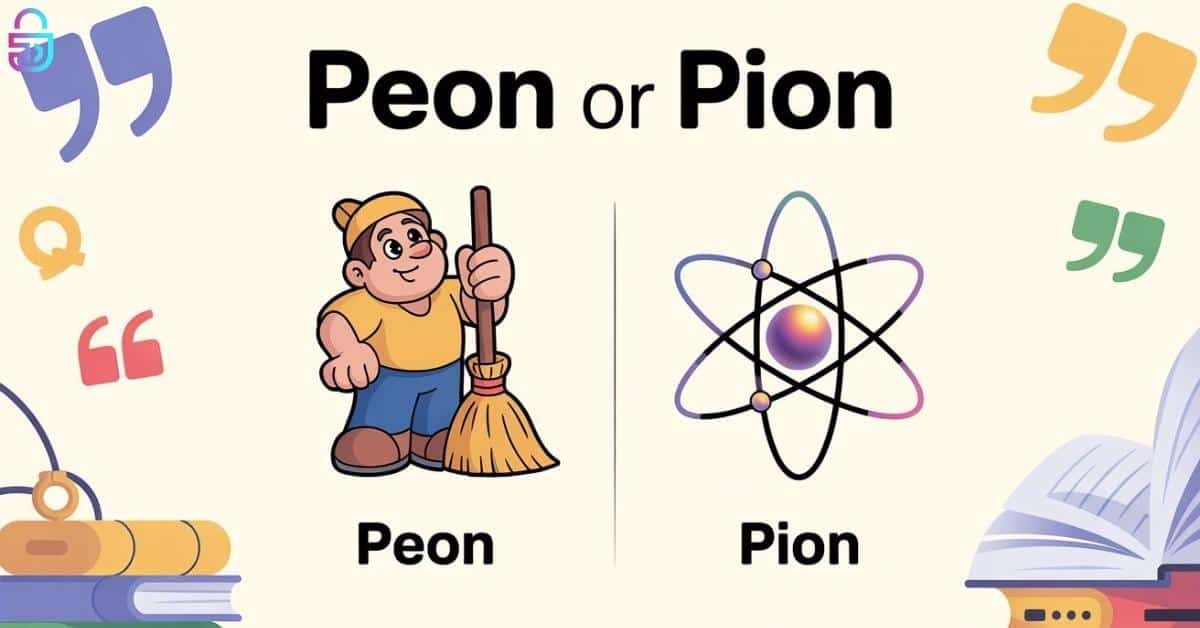
Peon or pion — which spelling is correct? The short answer is that both words are real, but they mean completely different things. “Peon” refers to a low-ranking worker, subordinate employee, or servant-like laborer, while “pion” is a scientific term used in particle physics to describe a type of subatomic particle known as a meson.
Many people confuse these words because of their similar pronunciation and spelling. However, using the wrong term in professional writing, academic communication, or everyday English can create confusion.
In this guide, you’ll learn the exact difference between peon and pion, how to use each word correctly, their pronunciation, origins, sentence examples, and why people often mix them up.
Quick Answer: Peon vs Pion
Here’s a simple comparison to understand the distinction quickly:
| Word | Meaning | Field | Example |
|---|---|---|---|
| Peon | A low-ranking worker or subordinate employee | General English | “He started as an office peon.” |
| Pion | A subatomic particle classified as a meson | Physics | “The pion plays a role in nuclear force interactions.” |
If you are writing about workplace hierarchy, laborers, office assistants, or social hierarchy, the correct word is usually peon. If you are discussing quantum physics, elementary particles, or scientific terminology, then pion is the right term.
What Does “Peon” Mean?
The word peon is commonly used in English vocabulary to describe a person with a very low position in a social or workplace hierarchy. It can refer to a laborer, office assistant, subordinate worker, or someone who performs menial tasks.
In modern English usage, “peon” is sometimes used humorously or sarcastically to describe someone at the bottom of a corporate hierarchy.
Dictionary Definition of Peon
A peon is generally defined as:
“A low-ranking worker, servant, or subordinate employee who performs routine or menial tasks.”
The term can describe:
- Office assistants
- Laborers
- Administrative helpers
- Low-level employees
- Workers with little authority
Origin and Etymology of Peon
The word “peon” comes from the Spanish word peón, which originally referred to a foot soldier or laborer. Historically, the term was associated with systems of compulsory servitude, debt bondage, and landless labor in parts of Spanish America.
Over time, the meaning evolved in English and became associated with:
- Menial worker
- Drudge
- Subordinate
- Servant-class employee
This historical background is why some people consider the term slightly negative or offensive in modern workplace communication.
Modern Usage of Peon
Today, “peon” is mostly used informally. You might hear it in:
- Corporate slang
- Gaming slang
- Workplace humor
- Online discussions
For example:
“I’m just a peon in the company.”
In this context, the speaker is jokingly referring to themselves as a low-level employee within a worker hierarchy.
Is “Peon” Offensive?
Sometimes, yes.
Because the word implies low status or subordinate social standing, it can sound disrespectful if used toward another person directly.
Better Professional Alternatives
Instead of saying “peon,” many workplaces prefer:
- Assistant
- Support staff
- Administrative worker
- Team member
- Associate
However, in informal conversation or humorous contexts, “peon” is still widely understood.
What Does “Pion” Mean?
Unlike “peon,” the word pion belongs to the world of particle physics and scientific writing.
A pion is a type of subatomic particle classified as a meson. These particles help scientists understand the strong nuclear force that holds atomic nuclei together.
So, while “peon” belongs to everyday English vocabulary, “pion” is a highly specialized scientific term.
What Is a Pion in Physics?
In physics, a pion is an elementary particle involved in nuclear interactions. Pions were among the first mesons discovered and are important in understanding how protons and neutrons interact inside an atomic nucleus.
Simple Definition
A pion is a meson particle that helps transmit the strong nuclear force between nucleons.
This concept is part of:
- Quantum physics
- Nuclear force theory
- Particle accelerator research
- Scientific terminology
Types of Pions
There are three major types of pions:
| Type | Symbol | Electric Charge |
|---|---|---|
| Positive pion | π⁺ | Positive |
| Negative pion | π⁻ | Negative |
| Neutral pion | π⁰ | Neutral |
These charged and neutral pions behave differently during particle decay and nuclear interactions.
Why Scientists Study Pions
Scientists use pion research to understand:
- Atomic structure
- Nuclear stability
- Strong force interactions
- Quantum mechanics
- Particle decay
Pions are especially important in high-energy experiments conducted with particle accelerators.
Peon vs Pion: Key Differences Explained
Although these words look similar, their meanings are completely unrelated.
| Feature | Peon | Pion |
|---|---|---|
| Meaning | Low-ranking worker | Subatomic particle |
| Category | English vocabulary | Physics terminology |
| Context | Workplace/social hierarchy | Quantum physics |
| Pronunciation | PEE-on | PIE-on |
| Usage Frequency | Common | Specialized |
| Tone | Informal or historical | Scientific |
This is why understanding contextual meaning matters so much.
Which Word Should You Use?
Choosing between “peon” and “pion” depends entirely on context.
Use “Peon” When Talking About:
- Workers
- Office hierarchy
- Administrative roles
- Social status
- Corporate slang
- Labor systems
Example
“The new employee felt like a peon doing repetitive paperwork.”
Use “Pion” When Talking About:
- Particle physics
- Scientific terminology
- Quantum mechanics
- Mesons
- Nuclear interactions
Example
“The pion plays an important role in nuclear force transmission.”
Why People Confuse Peon and Pion
One of the biggest reasons for spelling confusion is pronunciation similarity. Many users hear the words spoken aloud and assume they are alternate spellings of the same word.
Several factors contribute to this lexical confusion.
Similar Pronunciation
The words sound somewhat alike:
- Peon → “PEE-on”
- Pion → “PIE-on”
People who are unfamiliar with scientific terminology may accidentally write “pion” when they mean “peon.”
Typing and Autocorrect Errors
Online writing mistakes happen frequently because:
- Autocorrect changes words
- Users type quickly
- Both words exist in dictionaries
This creates semantic confusion in professional writing and casual communication.
Rare Usage of “Pion”
Most English speakers encounter “peon” far more often than “pion.” Since “pion” appears mainly in academic writing and particle physics, many people are unaware that it is a real word.
How to Pronounce Peon and Pion
Correct pronunciation helps avoid language confusion.
| Word | Pronunciation | Sound Guide |
|---|---|---|
| Peon | /ˈpiːɒn/ | PEE-on |
| Pion | /ˈpaɪɒn/ | PIE-on |
Common Mistake
Some people pronounce both words the same way, which increases spelling mistakes in English writing.
Examples of Peon and Pion in Sentences
Understanding sentence structure is one of the easiest ways to learn proper word usage.
Examples Using “Peon”
- The office peon delivered documents throughout the building.
- He joked that he was just another corporate peon.
- The company treated junior employees like peons.
- The historical labor system relied heavily on peon workers.
- She began her career in a low-level peon position.
Examples Using “Pion”
- Scientists observed pion decay during the experiment.
- The pion is classified as a meson particle.
- Quantum physics researchers continue studying pion interactions.
- A neutral pion has no electric charge.
- Particle accelerators are used to study pions.
Is “Pion” a Real Word?
Yes, absolutely.
Many people search “is pion a word” because they rarely encounter it outside scientific contexts. However, “pion” is a legitimate term in elementary particle physics.
The confusion exists because:
- The word is uncommon in everyday English
- It closely resembles “peon”
- Most users search for grammar clarification rather than physics information
So while “pion” is correct in scientific writing, it is usually not the word people want when discussing workers or workplace hierarchy.
Is “Peon” Still Used Today?
Yes, although usage has changed over time.
The word appears in:
- Informal business communication
- Corporate slang
- Gaming terminology
- Internet culture
- Workplace humor
For example, gamers sometimes use “peon” to describe weak or low-level characters.
In office settings, employees may jokingly refer to themselves as “corporate peons” to express frustration about authority or workload.
Peon in Gaming and Online Slang
Gaming communities often use “peon” to describe:
- Weak units
- Beginner players
- Low-ranked characters
- Worker units in strategy games
This slang usage helped keep the term popular in modern internet vocabulary.
Common Mistakes Related to Peon and Pion
Many grammar mistakes happen because users focus on spelling rather than contextual meaning.
Common Errors
| Incorrect Usage | Why It’s Wrong | Correct Version |
|---|---|---|
| “He works as a pion.” | Pion is scientific | “He works as a peon.” |
| “Scientists studied peons.” | Peon refers to workers | “Scientists studied pions.” |
| “Pion office worker” | Wrong terminology | “Peon office worker” |
Tips to Avoid Confusion
Remember This Rule:
- Peon = person
- Pion = particle
This simple memory trick helps maintain writing accuracy.
Peon vs Similar Confusing Words
The English language contains many commonly confused words. “Peon” and “pion” are just one example.
A Peon vs Pawn
| Word | Meaning |
|---|---|
| Peon | Low-ranking worker |
| Pawn | Chess piece or something used by others |
Peon vs Servant
Although similar, “servant” usually refers to domestic service, while “peon” emphasizes workplace hierarchy or labor systems.
Pion vs Proton
| Word | Scientific Meaning |
|---|---|
| Pion | Meson particle |
| Proton | Positively charged atomic particle |
This distinction matters in scientific terminology and academic writing.
Learn More: Presentor vs Presenter
Why Context Matters in English Vocabulary
Words with similar spelling can have entirely different meanings. This is why contextual meaning is essential in:
- Professional communication
- Academic writing
- Language learning
- Scientific communication
Using the wrong term can confuse readers and weaken writing quality.
For example:
- A workplace article should use “peon”
- A quantum physics article should use “pion”
Search engines also rely heavily on semantic difference and contextual relevance to understand content accurately.
Case Study: How a Single Letter Changes Meaning
Consider these two sentences:
“The company hired a new peon.”
This sentence discusses employment and worker hierarchy.
Now compare it with:
“Researchers discovered unusual pion interactions.”
This sentence belongs to particle physics.
Even though only one letter changes, the entire subject matter becomes different.
This demonstrates the importance of vocabulary clarification and language accuracy.
Expert Quote on Word Usage
“Context determines meaning far more than spelling similarity.” — Common principle in English grammar and semantic writing
This idea applies perfectly to “peon” and “pion.”
Frequently Asked Questions
Which spelling is correct: peon or pion?
Both are correct words, but they mean different things. “Peon” refers to a low-ranking worker, while “pion” is a subatomic particle in physics.
What does peon mean?
A peon is a subordinate worker, laborer, office assistant, or low-level employee.
What is a pion in physics?
A pion is a meson particle involved in strong nuclear force interactions within atomic nuclei.
Is peon offensive?
Sometimes. It can sound disrespectful because it implies low social or workplace status.
Why do people confuse peon and pion?
The words have similar spelling and pronunciation, leading to phonetic confusion and online writing mistakes.
Is pion commonly used in English?
Not in everyday communication. It is mainly used in scientific terminology and particle physics.
Can peon be used professionally?
It is better to avoid using “peon” in formal workplace communication because it may sound dismissive.
Final Verdict: Peon or Pion?
When deciding between peon or pion, the correct choice depends entirely on context.
Use “peon” when referring to:
- A low-ranking worker
- Office hierarchy
- Labor systems
- Workplace slang
Use “pion” when discussing:
- Particle physics
- Mesons
- Quantum mechanics
- Scientific terminology
Although the words look similar, they belong to completely different fields. Understanding their meanings, pronunciation, and contextual usage will help you avoid common spelling mistakes and improve your English vocabulary accuracy.
In most everyday English situations, “peon” is the word people intend to use. “Pion,” on the other hand, is reserved for scientific and academic discussions related to subatomic particles and nuclear force research.