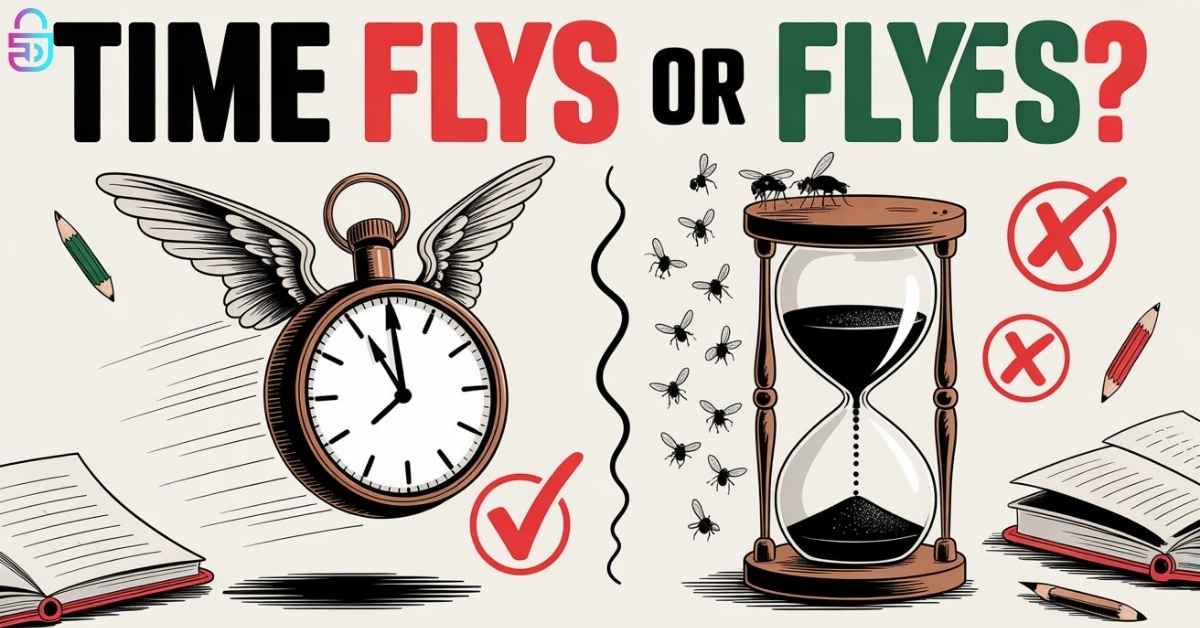
Time flys or flies — which one is correct? The right phrase is “time flies,” not “time flys.” The word flies follows standard English grammar rules, while flys is considered incorrect in modern usage. If you’ve ever hesitated while writing this phrase, you’re not alone—this is one of the most common spelling and grammar mistakes in English.
In this complete guide, you’ll learn the time flys or Theflies meaning, the correct time flys or Theflies grammar, and exactly how time flys or Theflies works in real sentences. By the end, you’ll not only understand the rule—you’ll never make this mistake again.
Quick Answer: Is It “Time Flys or Flies”?
The correct phrase is:
👉 Time flies ✅
👉 Time flys ❌ (incorrect)
Why? Because flies is the correct third person singular form of the verb fly. English grammar rules require verbs ending in consonant + y to change into -ies.
Time Flys or Flies Meaning (What Does It Actually Mean?)
Understanding the time flys or Theflies meaning helps you use it naturally.
The phrase “time flies” is an idiom, meaning:
Time passes very quickly, especially when you are enjoying yourself.
Example:
- Time flies when you’re having fun.
- I can’t believe it’s already Friday—time really flies!
This expression is widely used in everyday English, especially in conversations about busy schedules, memories, or enjoyable moments.
Time Flys or Flies Grammar Explained
To fully understand time flys or flies grammar, you need to look at how English verbs work.
Why Is It “Flies” and Not “Flys”?
The verb fly changes form depending on the subject:
| Subject | Verb Form |
|---|---|
| I / You / We / They | fly |
| He / She / It | flies |
Since time is treated as a singular subject (it), we say:
👉 Time flies
The Y → IES Rule (Core Grammar Rule)
One of the most important English grammar rules is:
If a verb ends in consonant + y, change “y” to “ies.”
Examples:
- cry → cries
- try → tries
- fly → flies
This is why “flys” is incorrect.
When You Do NOT Change Y to IES
Competitors often skip this, but it’s important.
If a verb ends in vowel + y, you simply add -s:
- play → plays
- enjoy → enjoys
- stay → stays
👉 This distinction is key to mastering verbs ending in y.
How Time Flys or Flies Works in Sentences
Let’s break down how time flys or Theflies behaves in real usage.
Correct Sentence Examples
- Time flies when you’re busy.
- Time flies during vacations.
- I didn’t notice how fast time flies.
Incorrect Usage
- Time flys ❌
- Time flys quickly ❌
Everyday Conversation Examples
- Wow, time flies—we’ve been talking for hours!
- Time flies when you love what you do.
These examples help reinforce correct sentence structure and usage.
Fly vs Flies vs Flys: Key Differences
Understanding the difference between these forms is essential.
| Word | Type | Meaning | Correct Usage |
|---|---|---|---|
| Fly | Base verb | To move through air | Birds fly |
| Flies | Correct form | Third person singular / plural noun | Time flies |
| Flys | Incorrect | Not standard English | ❌ |
👉 This comparison helps eliminate common spelling confusion.
Is “Flys” Ever a Correct Word?
Technically, flys may appear in rare or outdated contexts (like proper names), but in modern English grammar, it is considered:
👉 Incorrect spelling
This is why search queries like “is flys a real word” exist—people are unsure.
Time Flys or Flies Grammar Rule Simplified
Here’s an easy way to remember:
If the subject is singular (he/she/it), and the verb ends in consonant + y → use “ies.”
Memory Trick:
Think: 👉 “He flies, she flies, it flies… so time flies.”
Common Mistakes Related to “Time Flys or Flies”
Many learners make these errors:
- Writing flys instead of flies
- Ignoring verb agreement rules
- Misunderstanding plural vs verb forms
These are especially common among ESL learners and beginners.
Verbs Ending in Y: Complete Mini Guide
To master this topic, you need a broader view.
Rule 1: Consonant + Y → IES
- fly → flies
- study → studies
Rule 2: Vowel + Y → Add S
- play → plays
- enjoy → enjoys
Common Examples
| Base Verb | Correct Form |
|---|---|
| cry | cries |
| try | tries |
| carry | carries |
| play | plays |
Similar Grammar Mistakes You Should Avoid
Expanding beyond time flys or flies, here are related mistakes:
- try vs tries
- cry vs cries
- study vs studies
- carry vs carries
These follow the same grammar pattern, making them easy to learn together.
Learn More: Lucas’s or Lucas’
Idioms Like “Time Flies” (Semantic Expansion)
To strengthen your understanding, here are similar expressions:
- Time waits for no one
- Lost track of time
- Time passes quickly
Quote:
“Time flies over us, but leaves its shadow behind.” — Nathaniel Hawthorne
Why Do People Search “Time Flys or TheFlies”?
This question reveals user intent.
Common Reasons:
- Confusion about spelling rules
- Pronunciation (both sound similar)
- Lack of grammar knowledge
- Habitual writing mistakes
👉 This makes it a high-value informational keyword.
Quick Grammar Rules Cheat Sheet
Here’s a fast summary:
- Singular subject → add -s or -ies
- Consonant + y → ies
- Vowel + y → s only
- “Time flies” = correct
- “Time flys” = incorrect
Case Study: Real-World Usage
A student writing an essay once wrote:
“Time flys when you are happy.”
The teacher corrected it to:
👉 “Time flies when you are happy.”
After learning the rule, the student improved not just this phrase—but all similar verbs like tries, cries, studies.
👉 This shows how one concept improves overall English accuracy.
FAQs??
Is it thetime flys or time flies?
👉 Time flies is correct.
Why is flys incorrect?
Because it breaks the consonant + y → ies rule.
What does time flies mean?
It means time passes quickly.
How do you use flies in a sentence?
Example: Time flies when you’re busy.
Is flys ever correct in English?
No, not in standard modern usage.
Final Verdict: Time Flys or Flies
Let’s make it crystal clear:
👉 “Time flies” is correct
👉 “Time flys” is incorrect
Understanding the time flys or flies grammar rule not only fixes this mistake but also improves your overall command of English verb conjugation.
Final Thoughts
Mastering small grammar rules like this creates a big impact. The phrase “time flies” isn’t just about correctness—it’s about communicating clearly and confidently.
Once you understand:
- the meaning
- the grammar rule
- and how time flys or flies works in context
—you eliminate confusion forever.
And remember:
Good grammar isn’t about perfection—it’s about clarity.