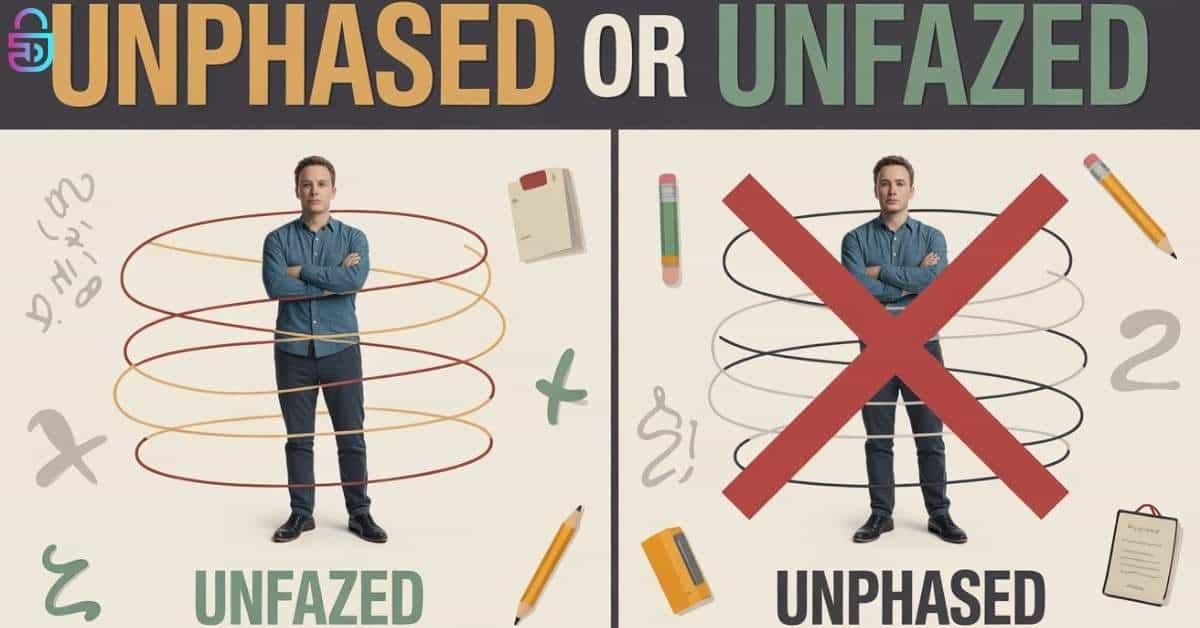
Unphased or unfazed — which one is correct? If you’ve ever hesitated while writing this word, you’re not alone. The quick answer is simple: “unfazed” is the correct spelling, while “unphased” is a common misspelling.
This confusion happens because both words sound similar, but only one is recognized in standard English. Whether you’re writing in the US or the UK (yes—even for unphased or unfazed UK usage), the correct form remains unfazed.
In this guide, you’ll learn the true meaning, correct usage, differences, examples, and memory tricks—so you never make this mistake again.
Is It Unphased or Unfazed? (Quick Answer)
If you’re wondering, is it unphased or unfazed, here’s the definitive answer:
“Unfazed” is the correct word and means not disturbed or affected by something. “Unphased” is a misspelling and is not considered correct English.
This applies globally, including both UK and US English.
Unphased or Unfazed Meaning Explained
Understanding the unphased or unfazed meaning is key to using it correctly.
Unfazed Meaning
Unfazed means:
- Not disturbed
- Not bothered
- Calm under pressure
- Emotionally unaffected
Example:
Despite the criticism, she remained unfazed and continued her work.
This word is often used in situations involving stress, pressure, or unexpected events.
Is “Unphased” a Real Word or Just a Mistake?
Let’s clear this up:
- “Unphased” is NOT a correct word in standard English
- It is a common spelling mistake
- It appears valid because of the word “phase”, which is legitimate
Why it feels correct:
- “Phase” is a familiar word (e.g., a phase in life)
- People assume “unphased” means “not affected by a phase”
But in reality, “unfazed” comes from the verb “faze,” not “phase.”
Unfazed vs Unphased: Key Differences Explained
Here’s a clear comparison to remove all confusion:
| Aspect | Unfazed | Unphased |
|---|---|---|
| Correct spelling | ✅ Yes | ❌ No |
| Meaning | Not disturbed or affected | Incorrect usage |
| Origin | From “faze” (to disturb) | Misuse of “phase” |
| Usage in English | Standard | Non-standard |
👉 Bottom line: Always use unfazed.
Why Do People Confuse “Unphased” and “Unfazed”?
This confusion isn’t random—it has clear reasons rooted in language behavior.
1. Pronunciation Similarity
Both words sound nearly identical:
- faze → /feɪz/
- phase → /feɪz/
This makes them near-homophones.
2. Cognitive Bias
People naturally connect unfamiliar words to familiar ones. Since “phase” is more common, the brain defaults to it.
3. Autocorrect & Typing Habits
Some writing tools fail to flag “unphased,” reinforcing the mistake.
4. Social Media Influence
Informal writing online spreads incorrect spelling quickly.
“Most people learn spelling from repetition—not rules.”
The Difference Between “Faze” and “Phase”
Understanding the root words solves the confusion instantly.
| Word | Meaning | Example |
|---|---|---|
| Faze | To disturb or unsettle | The noise didn’t faze him |
| Phase | A stage or period | She is in a learning phase |
Key Insight:
- Unfazed = Not disturbed
- “Unphased” = logically incorrect combination
How to Use “Unfazed” Correctly in Sentences
Here are practical examples across contexts:
Everyday Situations:
- He remained unfazed by the criticism.
- She was unfazed by the sudden changes.
Professional Context:
- The CEO appeared unfazed during the crisis.
Emotional Context:
- Despite the pressure, she stayed calm and unfazed.
Social Situations:
- He was completely unfazed by the awkward silence.
High-Stress Scenario:
- The athlete remained unfazed under intense pressure.
👉 Notice how “unfazed” always relates to calmness and composure.
Common Mistakes to Avoid
Even experienced writers make these errors:
❌ Mistake 1: Using “Unphased”
Incorrect: He was unphased by the news Correct: He was unfazed by the news
❌ Mistake 2: Confusing Context
Using “unfazed” when emotion is required:
- Wrong context: describing phases or stages
❌ Mistake 3: Overusing the Word
Use it where calmness under pressure is relevant.
Unfazed Synonyms and Similar Words
To enhance your writing, here are alternatives:
- Calm – emotionally stable
- Composed – controlled emotions
- Unbothered – not concerned
- Unaffected – unchanged emotionally
- Relaxed – free from tension
Subtle Differences:
- Unfazed → reaction to pressure
- Unaffected → broader emotional neutrality
Unfazed Pronunciation (Avoid This Mistake)
Correct pronunciation:
Unfazed = un-fayzd
Why confusion happens:
- “Faze” and “phase” sound identical
- Leads to spelling errors
👉 Tip: Focus on meaning, not sound.
Memory Trick to Remember “Unfazed”
Here’s a simple mnemonic:
“Faze = Fear” → If something doesn’t scare you, you are unfazed
This association makes it easier to remember.
Is There a Difference in UK vs US Usage?
For those searching unphased or unfazed UK, here’s the answer:
- Both UK and US English use “unfazed”
- “Unphased” is incorrect in both regions
- No regional spelling variation exists
👉 This is not like “color vs colour”—it’s a right vs wrong case.
Learn More: Vender vs Vendor
Real-Life Usage Examples (Case Study Style)
Case Study 1: Workplace Pressure
A manager facing a tight deadline:
Despite multiple challenges, she remained unfazed and delivered results.
Case Study 2: Public Speaking
A speaker dealing with criticism:
He stayed unfazed, continuing his presentation confidently.
Case Study 3: Sports Performance
An athlete in a high-pressure match:
The player was completely unfazed by the crowd noise.
Why “Unfazed” Is Often Misused Online
Modern writing habits contribute to errors:
Key Factors:
- Fast typing
- Lack of proofreading
- Over-reliance on autocorrect
- Informal communication
Fact:
Studies show that commonly confused words are among the top grammar mistakes online.
Quick Grammar Rules for Commonly Confused Words
To improve overall writing, watch out for:
- Affect vs Effect
- Its vs It’s
- Then vs Than
- Your vs You’re
👉 These fall under commonly confused words, just like unphased or unfazed.
FAQs
Is it unphased or unfazed?
The correct form is unfazed. “Unphased” is incorrect.
What does unfazed mean?
It means not disturbed or affected by something.
Is unphased ever correct?
No, it is considered a misspelling.
Why do people say unphased instead of unfazed?
Because of pronunciation similarity and familiarity with the word “phase.”
How do you remember the correct spelling?
Use the trick: “Faze = Fear → Unfazed = Not scared.”
Is unfazed formal or informal?
It works in both formal and informal contexts.
Conclusion
To wrap it up:
- Unfazed is the correct spelling
- Unphased is a common mistake
- The confusion comes from pronunciation and familiarity with “phase”
Whether you’re writing for academic, professional, or casual purposes, using unfazed correctly improves clarity and credibility.
When in doubt, remember: If something doesn’t disturb you, you are unfazed—not unphased.