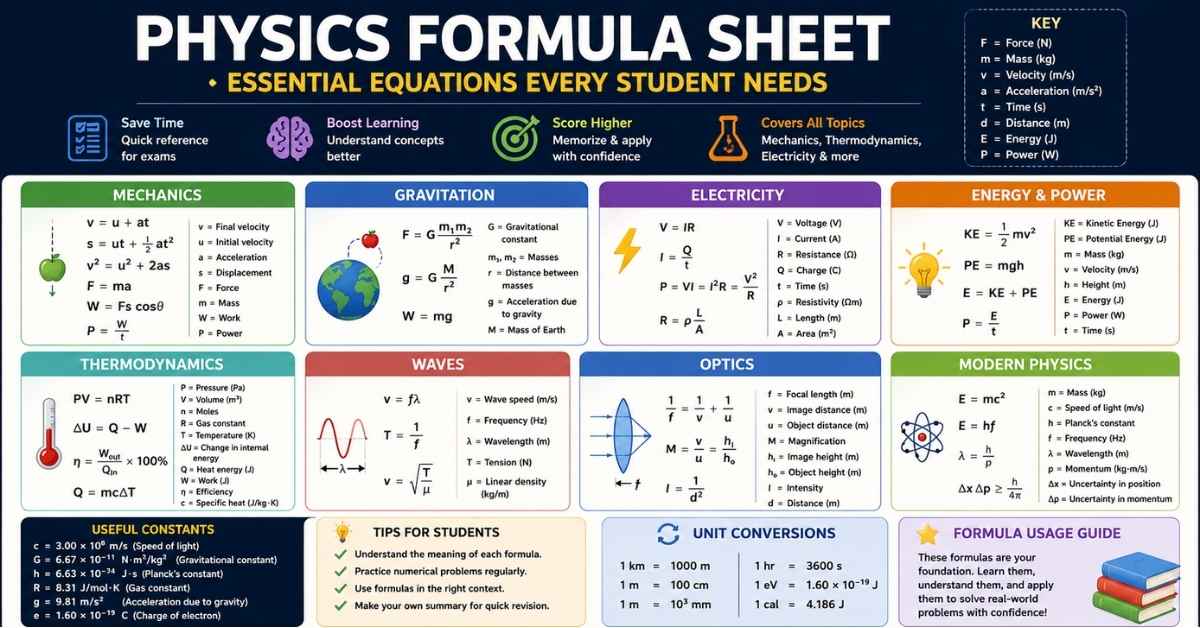
Physics can seem intimidating at first glance. Between motion, forces, energy, electricity, and waves, students often face dozens of formulas that appear impossible to memorize. That’s where a physics formula sheet becomes incredibly useful.
A physics formula sheet is a structured collection of essential physics equations that helps students solve problems, understand concepts, and prepare for exams more effectively. Instead of scrambling through textbooks to find the right formula, students can quickly reference the equations they need and focus on applying them correctly.
Whether you’re studying high school physics, preparing for college courses, or reviewing for an AP exam, a well-organized formula sheet can save time and improve confidence.
What Is a Physics Formula Sheet?
A physics formula sheet is a reference guide that contains the most important equations used across various physics topics.
Typically, it includes formulas related to:
- Kinematics
- Forces and motion
- Work and energy
- Momentum
- Electricity and circuits
- Waves and optics
- Thermodynamics
- Modern physics
Students often use formula sheets during revision sessions because they provide a clear overview of key relationships between physical quantities.
Why Every Student Should Use a Physics Formula Sheet
Many students believe success in physics depends entirely on memorization. However, understanding concepts matters far more than memorizing equations.
A good physics formula sheet helps students:
- Organize information efficiently
- Identify correct equations quickly
- Improve problem-solving skills
- Reduce exam stress
- Strengthen conceptual understanding
As a result, students spend more time learning physics and less time searching for formulas.
Core Physics Formulas Everyone Should Know
Several equations appear repeatedly across almost every physics curriculum.
Speed Formula
Speed measures how fast an object travels.
v=\frac{d}{t}
Where:
- v = velocity or speed
- d = distance
- t = time
This equation serves as one of the first formulas students encounter.
Acceleration Formula
Acceleration describes the rate of change in velocity.
a=\frac{v-u}{t}
Variables include:
- a = acceleration
- u = initial velocity
- v = final velocity
- t = time
Acceleration plays a central role in mechanics and motion analysis.
Newton’s Second Law
One of the most important equations in physics is:
F=ma
Where:
- F = force
- m = mass
- a = acceleration
This formula explains how forces influence motion.
Kinematics Formulas on a Physics Formula Sheet
Kinematics focuses on motion without considering the forces causing it.
These equations frequently appear in physics exams.
Constant Acceleration Equations
v=u+at
s=ut+\frac{1}{2}at^2
v^2=u^2+2as
Students use these formulas to calculate:
- Distance traveled
- Velocity changes
- Acceleration
- Time intervals
Mastering these relationships creates a strong foundation for advanced physics topics.
Energy and Work Formulas
Energy appears throughout every branch of physics.
Kinetic Energy
Kinetic energy refers to energy resulting from motion.
KE=\frac{1}{2}mv^2
Potential Energy
Objects possess potential energy because of their position.
Work Done
Work occurs when a force causes displacement.
W=Fd
These formulas frequently appear in classroom assignments and standardized examinations.
Momentum and Impulse Equations
The Momentum helps describe how moving objects behave during collisions.
Momentum Formula
Where:
- p = momentum
- m = mass
- v = velocity
Impulse Formula
J=F\Delta t
Impulse explains how forces acting over time affect momentum.
These concepts play a critical role in sports science, vehicle safety, and engineering.
Electricity Formulas Every Student Should Learn
Electricity powers nearly every modern technology.
Ohm’s Law
Ohm’s Law forms the foundation of circuit analysis.
Where:
- V = voltage
- I = current
- R = resistance
Electrical Power
Power measures energy transfer per unit time.
P=VI
Students frequently use these equations in electrical circuit problems.
Waves and Frequency Formulas
Wave behavior appears throughout nature.
Wave Speed Equation
Where:
- v = wave speed
- f = frequency
- λ = wavelength
This equation connects three of the most important wave properties.
Frequency and Period Relationship
Understanding this relationship helps students analyze sound, light, and electromagnetic waves.
AP Physics Formula Sheet Guide
Many students search specifically for an AP Physics formula sheet while preparing for exams.
The AP Physics curriculum covers a broad range of topics, and the official formula sheet serves as a valuable resource during testing.
Topics Included on an AP Physics Formula Sheet
Most AP Physics formula sheets contain equations related to:
- Kinematics
- Dynamics
- Work and energy
- Momentum
- Circular motion
- Gravitation
- Electricity
- Magnetism
- Waves
- Modern physics
Students should become familiar with the layout before exam day to locate equations quickly.
How to Use an AP Physics Formula Sheet Effectively
Instead of relying solely on the formula sheet during the exam, students should:
- Understand each variable.
- Practice equation rearrangement.
- Solve problems regularly.
- Learn unit conversions.
- Recognize common question types.
These habits often lead to higher AP Physics scores.
Common Mistakes When Using a Physics Formula Sheet
Even experienced students occasionally misuse formulas.
Frequent Errors
- Using incorrect units
- Selecting the wrong equation
- Forgetting conversions
- Ignoring vector directions
- Mixing variables
Careful problem analysis usually prevents these mistakes.
LEARN MORE: Physics Equation Sheet
Creating Your Own Physics Formula Sheet
Building a personalized formula sheet can significantly improve retention.
Recommended Organization
Arrange formulas under categories such as:
- Motion
- Forces
- Energy
- Momentum
- Electricity
- Waves
- Thermodynamics
Adding notes and example problems can make the sheet even more useful.
Tips for Memorizing Physics Formulas
Although formula sheets help, understanding remains essential.
Study Strategies
- Focus on concepts first.
- Practice daily.
- Draw diagrams.
- Learn units and dimensions.
- Explain formulas aloud.
- Solve real-world problems.
Consistent practice typically produces better results than memorization alone.
Frequently Asked Questions
What is a physics formula sheet?
A physics formula sheet’s is a collection of important equations used to solve physics problems and understand physical relationships.
Why is a physic’s formula sheet important?
It helps students organize formulas, improve efficiency, and prepare for exams more effectively.
What formulas should a physics formula sheet include?
Most sheets include equations for motion, forces, energy, momentum, electricity, waves, and thermodynamics.
Is the AP Physics formula sheet provided during exams?
Yes. AP Physics exams typically provide an official formula’s sheet, although students should still understand how to use the equations correctly.
Should I memorize formulas if I have a formula sheet?
Yes. Understanding formulas and their applications remains crucial even when a formula sheet is available.
How can I create an effective physics formula’s sheet?
Group formulas by topic, include variable definitions, and add notes that explain when each equation should be used.
Which physics formulas appear most often on exams?
Speed, acceleration, force, energy, momentum, Ohm’s Law, and wave equations are among the most frequently tested formulas.
Conclusion
A well-designed physics formula sheet serves as one of the most valuable study tools for physic’s students. It organizes essential equations, simplifies revision, and helps learners focus on understanding concepts rather than searching through textbooks. From motion and forces to electricity and waves, these formulas form the foundation of scientific problem-solving.
If you’re preparing for a classroom test or reviewing an AP Physics formula sheet, take time to understand what each equation means and how it applies to real-world situations. The combination of conceptual understanding and regular practice will always outperform simple memorization. Continue exploring physic’s topics, solving problems, and refining your formula’s sheet to build long-term success in science.