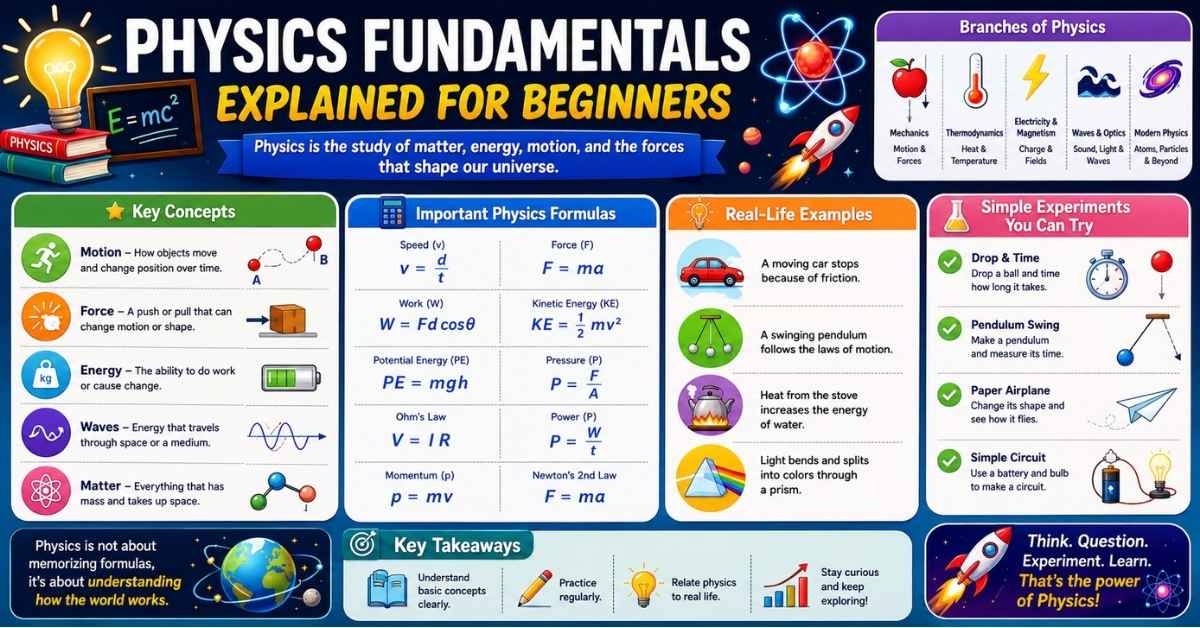
Have you ever wondered why objects fall to the ground, how airplanes stay in the air, or what powers modern electronics? The answer lies in physics fundamentals, the core principles that explain how matter, energy, forces, and motion interact throughout the universe.
Physics fundamentals are the basic concepts and laws that describe how the physical world works, including motion, energy, forces, electricity, waves, and matter. Whether you’re a student, teacher, engineer, or simply curious about science, understanding these principles provides a strong foundation for exploring more advanced topics in physics and technology.
What Are Physics Fundamentals?
Physics is often called the science of nature because it seeks to explain how the universe behaves. At its core, physics studies matter, energy, space, and time.
The main goal of physics is to identify patterns in nature and develop mathematical laws that predict physical phenomena.
Key Areas of Physics
Physics fundamentals typically include:
- Motion and mechanics
- Forces and Newton’s laws
- Energy and work
- Heat and thermodynamics
- Electricity and magnetism
- Waves and sound
- Light and optics
- Modern physics
- Quantum mechanics
- Semiconductor physics
Together, these concepts form the foundation of nearly every scientific and engineering discipline.
Why Physics Fundamentals Matter
Physics affects almost every aspect of daily life. From smartphones and vehicles to medical equipment and satellites, countless technologies rely on physical principles.
Understanding physics helps people:
- Solve real-world problems
- Develop critical thinking skills
- Understand modern technology
- Prepare for STEM careers
- Make informed scientific decisions
As technology advances, physics becomes even more important in shaping future innovations.
The Building Blocks of Physics
Before exploring advanced concepts, it is important to understand several fundamental quantities.
Matter
Matter refers to anything that has mass and occupies space.
Examples include:
- Air
- Water
- Rocks
- Animals
- Plants
- Metals
Everything around us consists of matter.
Energy
Energy is the ability to perform work or cause change.
Common forms include:
- Kinetic energy
- Potential energy
- Thermal energy
- Electrical energy
- Chemical energy
- Nuclear energy
One of the most important principles in physics states that energy cannot be created or destroyed, only transformed.
Force
A force is a push or pull that can change an object’s motion.
Examples include:
- Gravity
- Friction
- Magnetic forces
- Tension
- Applied forces
Forces play a central role in nearly every physical interaction.
Motion and Mechanics Fundamentals
Mechanics forms one of the most important branches of physics.
It focuses on how objects move and how forces affect that movement.
Distance and Displacement
Although people often use these terms interchangeably, they are different.
- Distance measures total path traveled.
- Displacement measures the shortest path between two points.
Understanding this distinction helps explain motion accurately.
Speed and Velocity
Speed describes how fast an object moves.
Velocity includes both speed and direction.
For example, a car traveling north at 60 mph has a specific velocity rather than just a speed.
Acceleration
Acceleration measures how quickly velocity changes.
A car speeding up, slowing down, or changing direction experiences acceleration.
Newton’s Laws of Motion
No discussion of physics fundamentals is complete without Newton’s laws.
First Law: Law of Inertia
An object remains at rest or in uniform motion unless an external force acts upon it.
Second Law: Force and Acceleration
F=ma
This law explains that force equals mass multiplied by acceleration.
The equation shows why heavier objects require more force to accelerate.
Third Law: Action and Reaction
Every action has an equal and opposite reaction.
For example, rocket engines push exhaust gases downward while the rocket moves upward.
Energy and Work in Physics
Energy drives all physical processes.
Work
In physics, work occurs when a force causes an object to move.
Work depends on:
- Force applied
- Distance traveled
- Direction of movement
Kinetic Energy
Kinetic energy results from motion.
Moving cars, running athletes, and flowing rivers all possess kinetic energy.
Potential Energy
Potential energy is stored energy.
Examples include:
- Water behind a dam
- A stretched rubber band
- An object positioned high above the ground
Electricity and Magnetism Fundamentals
Electricity and magnetism are closely connected phenomena.
Electric Charge
Matter contains charged particles called electrons and protons.
Opposite charges attract while similar charges repel.
Electric Current
Electric current refers to the flow of electric charge.
Modern homes, computers, and communication systems rely on electric currents.
Magnetism
Magnetic fields arise from moving electric charges.
Magnets, electric motors, and generators all operate using magnetic principles.
Waves and Light
Many physical phenomena travel through waves.
Mechanical Waves
Mechanical waves require a medium.
Examples include:
- Sound waves
- Water waves
- Seismic waves
Electromagnetic Waves
Electromagnetic waves can travel through empty space.
Examples include:
- Radio waves
- Microwaves
- Visible light
- X-rays
- Gamma rays
Light Fundamentals
Light behaves both as a wave and a particle, making it one of physics’ most fascinating subjects.
Quantum Physics Fundamentals Explained
Many students search for quantum physics fundamentals explained because quantum mechanics often seems mysterious.
Quantum physics studies matter and energy at extremely small scales, such as atoms and subatomic particles.
Core Quantum Concepts
Important quantum ideas include:
- Wave-particle duality
- Quantum superposition
- Probability distributions
- Quantum tunneling
- Uncertainty principle
Unlike classical physics, quantum mechanics focuses on probabilities rather than exact predictions.
Why Quantum Physics Matters
Quantum physics powers technologies such as:
- Semiconductors
- Lasers
- MRI machines
- Quantum computers
- Solar panels
Without quantum theory, many modern technologies would not exist.
Semiconductor Physics Fundamentals
One of the most practical applications of physics appears in electronics.
What Is a Semiconductor?
A semiconductor is a material whose electrical conductivity falls between a conductor and an insulator.
Common semiconductor materials include:
- Silicon
- Germanium
- Gallium arsenide
Why Semiconductor Physics Matters
Semiconductor physics fundamentals explain how electronic devices control electrical current.
These principles support:
- Computer processors
- Smartphones
- LEDs
- Solar cells
- Microchips
As digital technology continues to grow, semiconductor physics becomes increasingly important.
Physics Fundamentals by Coletta
Many students encounter Physics Fundamentals by Coletta while studying introductory physics concepts.
The resource is widely used to help learners understand:
- Motion
- Forces
- Energy
- Scientific reasoning
- Problem-solving methods
Students often use these materials to strengthen foundational knowledge before advancing to higher-level physics courses.
Physics Fundamentals Graph Paper
Many physics students search for physics fundamentals graph paper when completing laboratory exercises and scientific calculations.
Graph paper helps with:
- Plotting experimental data
- Drawing motion graphs
- Visualizing relationships
- Analyzing trends
- Creating scientific reports
Accurate graphing remains an important skill in both physics education and research.
Conceptual Physics Fundamentals Answers
Searches for conceptual physics fundamentals answers often come from students looking to verify homework solutions.
While answer keys can be useful for checking work, true understanding comes from learning the reasoning behind each solution.
A strong approach involves:
- Reading the concept carefully.
- Solving the problem independently.
- Comparing results.
- Reviewing mistakes.
- Practicing similar questions.
This process develops deeper scientific understanding.
How to Learn Physics Fundamentals Effectively
Physics becomes easier when students build concepts gradually.
Best Learning Strategies
- Master basic mathematics.
- Focus on concepts before formulas.
- Solve practice problems regularly.
- Use diagrams and visualizations.
- Perform simple experiments.
- Review mistakes carefully.
Consistency often produces better results than memorization.
LEARN MORE: BuffStream UFC
Common Misconceptions About Physics
Many beginners misunderstand certain concepts.
Misconception 1: Heavy Objects Fall Faster
Ignoring air resistance, all objects accelerate at the same rate due to gravity.
Misconception 2: Force Is Required to Keep Objects Moving
Newton’s first law shows that moving objects continue moving unless another force acts on them.
Misconception 3: Physics Is Only About Mathematics
Although math is important, physics primarily seeks to understand how nature works.
Frequently Asked Questions
What are physics fundamentals?
Physics fundamentals are the basic principles that explain motion, forces, energy, matter, electricity, waves, and other physical phenomena.
Why are physics fundamentals important?
They provide the foundation for understanding science, engineering, technology, and many everyday phenomena.
What is quantum physics fundamentals explained in simple terms?
Quantum physics studies how extremely small particles behave and interact at atomic and subatomic scales.
What are semiconductor physics fundamentals?
Semiconductor physics explains how materials like silicon control electrical current in electronic devices.
What is Physics Fundamentals by Coletta?
It is a popular educational resource that helps students learn introductory physics concepts and problem-solving skills.
Why do students use physics fundamentals graph paper?
Graph paper helps students plot data, create scientific graphs, and analyze experimental results.
How can beginners learn physics faster?
Beginners should focus on core concepts, practice regularly, use visual aids, and build mathematical skills gradually.
Conclusion
Understanding physics fundamentals opens the door to a deeper appreciation of how the universe operates. From motion and forces to energy, electricity, quantum physics fundamentals, and semiconductor physics fundamentals, these concepts explain the science behind countless everyday experiences and technological innovations.
Whether you’re studying Physics Fundamentals by Coletta, working with physics fundamentals graph paper, or searching for conceptual physics fundamentals answers, building a strong foundation will make advanced scientific topics far easier to understand. Continue exploring related physics topics, solve real-world problems, and keep asking questions—the universe still has plenty to teach.