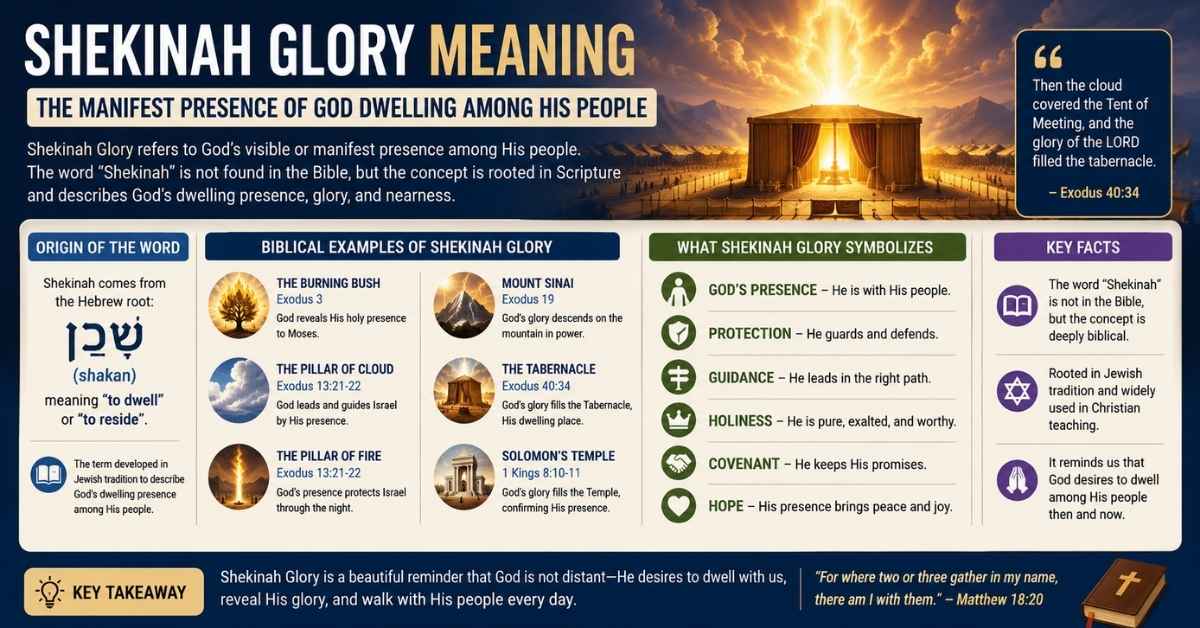
Shekinah Glory meaning refers to the manifest or dwelling presence of God. Although the word “Shekinah” does not appear directly in the Bible, it comes from Jewish tradition and describes God’s glorious presence dwelling among His people. The concept is closely connected with biblical events such as the Tabernacle, the Temple, the pillar of cloud, the pillar of fire, and God’s revealed glory throughout Scripture.
If you’ve heard the phrase in a sermon, Bible study, or worship service, you may wonder what it truly means. Is it a biblical word? Is it another name for God’s glory? Does it describe the Holy Spirit? This guide answers those questions while exploring the Hebrew background, biblical context, and spiritual significance of the Shekinah Glory in a balanced and easy-to-understand way.
Shekinah Glory Meaning (Quick Answer)
The Shekinah Glory describes God’s visible or manifest presence dwelling among His people. While the term itself developed in later Jewish tradition rather than appearing as a word in the biblical text, the concept is associated with God’s glorious presence revealed through events such as the burning bush, the pillar of cloud, Mount Sinai, the Tabernacle, and Solomon’s Temple.
For many believers, the Shekinah Glory symbolizes God’s holiness, guidance, protection, covenant, and desire to dwell with His people.
What Is the Shekinah Glory?
Many people search for the Shekinah Glory meaning because they encounter the phrase in Christian teaching or religious literature but never see the word in their Bible.
Simply put, Shekinah Glory refers to God’s dwelling presence. It describes moments when God’s glory is especially revealed or experienced among His people.
Rather than referring to one specific event, the expression summarizes many biblical accounts in which God’s presence became unmistakably evident.
A Simple Definition
The Shekinah Glory can be understood as:
- God’s manifest presence
- God dwelling among His people
- Visible expressions of divine glory
- The holy presence of God
- The revelation of God’s majesty
Although different Christian traditions explain the concept in slightly different ways, they generally agree that it emphasizes God’s nearness and holiness.
Why the Concept Matters
Throughout the Bible, one of the greatest promises God gives His people is:
“I will be with you.”
The Shekinah Glory reminds believers that God is not distant or uninvolved. Instead, He actively reveals His presence throughout biblical history.
This theme appears repeatedly from Genesis to Revelation, making God’s presence one of Scripture’s central messages.
God’s Shekinah Glory Meaning
Many readers specifically search for God’s Shekinah Glory meaning because they want to understand how God’s glory relates to His presence.
Although the terms are closely connected, they are not always used interchangeably.
What Does God’s Glory Represent?
In the Bible, God’s glory refers to the visible expression of His:
- Holiness
- Power
- Majesty
- Splendor
- Honor
- Divine greatness
Whenever God’s glory appears, people often respond with reverence, worship, and awe.
The Difference Between God’s Glory and Shekinah Glory
The following comparison helps clarify the relationship.
| God’s Glory | Shekinah Glory |
|---|---|
| God’s majesty and greatness | God’s manifest dwelling presence |
| Reveals His holiness | Emphasizes His nearness to His people |
| Appears throughout Scripture | Term developed later to describe those manifestations |
| Broad theological concept | Specific descriptive expression |
Rather than competing ideas, they complement one another.
Why God’s Presence Is Central to the Bible
One consistent theme throughout Scripture is God’s desire to dwell among His people.
Examples include:
- Walking with Adam and Eve.
- Appearing to Moses.
- Dwelling in the Tabernacle.
- Filling Solomon’s Temple.
- Dwelling among humanity through Jesus Christ.
- Promising His eternal presence with believers.
The concept of Shekinah Glory helps summarize this biblical theme.
Shekinah Glory Meaning in Hebrew
Many readers search for Shekinah Glory meaning in Hebrew to understand where the expression originated.
The answer begins with an important Hebrew root.
The Hebrew Root Shakan
The word Shekinah comes from the Hebrew root:
שכן (shakan)
This verb means:
- To dwell
- To live among
- To settle
- To reside
Although the noun Shekinah itself is not found in the Hebrew Bible, Jewish teachers later developed the term to describe God dwelling among His people.
How the Term Developed
Over time, Jewish tradition began using Shekinah to summarize the many biblical passages describing God’s presence.
Instead of inventing a new idea, the term provided a convenient way to describe a recurring biblical theme.
Is Shekinah Found in the Bible?
This is one of the most common questions.
The answer is:
No—the word “Shekinah” does not appear in the biblical text.
However, the concept appears repeatedly.
This distinction is extremely important because many articles incorrectly state that the word itself is biblical.
Shekinah Glory Meaning in English
Many people also search for Shekinah Glory meaning in English.
In simple English, the phrase can be understood as:
- God’s dwelling presence
- The visible presence of God
- God’s holy glory
- Divine presence
- Manifest presence of God
Rather than being a direct translation, these expressions communicate the idea behind the Hebrew concept.
Is the Word “Shekinah” Actually in the Bible?
One of the biggest misconceptions surrounding the Shekinah Glory meaning is the belief that the word “Shekinah” appears directly in Scripture.
The short answer is no.
The term “Shekinah” is not found in the Hebrew Bible or the New Testament. Instead, it developed later within Jewish rabbinic literature to describe God’s dwelling presence among His people.
This distinction is important because it helps readers separate biblical terminology from theological language.
Why Do Many People Think It Is?
Many pastors, Bible teachers, and Christian writers use the phrase Shekinah Glory when discussing passages that describe God’s visible presence.
As a result, many believers naturally assume the word itself appears in Scripture.
In reality:
- The word is post-biblical.
- The concept is deeply biblical.
Understanding this difference strengthens biblical accuracy without diminishing the spiritual importance of the idea.
Word vs. Concept
| Word | Concept |
|---|---|
| Shekinah | God’s dwelling presence |
| Not found in the Bible | Found throughout Scripture |
| Developed in Jewish tradition | Seen in many biblical events |
This distinction is one of the biggest opportunities to provide more value than competing articles.
Biblical Examples Commonly Associated with Shekinah Glory
Although the word Shekinah doesn’t appear in Scripture, many biblical events are commonly associated with God’s manifest presence.
These passages help explain God’s Shekinah Glory meaning through real biblical narratives.
| Biblical Event | Reference | Connection to God’s Glory |
|---|---|---|
| Burning Bush | Exodus 3 | God’s holy presence revealed to Moses |
| Pillar of Cloud | Exodus 13 | God’s guidance during the Exodus |
| Pillar of Fire | Exodus 13 | God’s protection at night |
| Mount Sinai | Exodus 19–24 | God’s majestic presence during the covenant |
| Tabernacle | Exodus 40 | God’s glory fills His dwelling place |
| Solomon’s Temple | 1 Kings 8 | God’s glory fills the temple |
| Ezekiel’s Vision | Ezekiel 1 & 10 | A prophetic vision of God’s glory |
| Transfiguration | Matthew 17 | Jesus’ divine glory revealed |
| Pentecost* | Acts 2 | Some Christian traditions see this as a continuation of God’s manifest presence |
*The connection between Pentecost and the Shekinah Glory is a theological interpretation held by some Christian traditions rather than an explicit biblical statement.
The Burning Bush
One of the earliest examples associated with God’s manifest presence is the burning bush.
When Moses encountered the bush that burned without being consumed, he was standing on holy ground.
This event teaches several important truths:
- God reveals Himself.
- God’s presence transforms ordinary places.
- Holiness requires reverence.
- God calls people for His purposes.
Many theologians view this as an early example of the concept later described as Shekinah Glory.
The Pillar of Cloud
During Israel’s journey through the wilderness, God led His people by a pillar of cloud during the day.
The cloud symbolized:
- Guidance
- Protection
- Leadership
- God’s nearness
Rather than abandoning Israel, God visibly demonstrated His presence throughout their journey.
The Pillar of Fire
At night, the cloud became a pillar of fire.
This remarkable sign reminded Israel that God remained with them even in darkness.
The fire represented:
- Protection
- Light
- Direction
- Hope
The image beautifully connects with the broader biblical symbolism of light overcoming darkness.
Mount Sinai
When God gave the Law to Moses, Mount Sinai became a powerful demonstration of His holiness.
The mountain was surrounded by:
- Thick cloud
- Fire
- Smoke
- Thunder
- Lightning
These dramatic signs emphasized God’s majesty and the seriousness of His covenant with Israel.
Rather than inspiring fear alone, they revealed God’s desire to establish a relationship with His people.
The Tabernacle
The Tabernacle provides one of the clearest biblical illustrations associated with the Shekinah Glory.
After its construction, God’s glory filled the Tabernacle, showing that His presence now dwelt among Israel.
This moment fulfilled God’s promise:
“I will dwell among them.”
The Tabernacle became far more than a place of worship—it represented God’s willingness to live among His covenant people.
Solomon’s Temple
A similar event occurred when Solomon dedicated the Temple.
According to Scripture, the glory of the Lord filled the Temple, preventing the priests from continuing their ministry for a time because of the overwhelming manifestation of God’s presence.
For many readers, this is one of the strongest biblical examples connected with the Shekinah Glory meaning.
It highlights:
- God’s holiness
- Divine acceptance
- Worship
- Covenant faithfulness
Ezekiel’s Vision
The prophet Ezekiel received extraordinary visions of God’s glory during a difficult period in Israel’s history.
His visions emphasize that:
- God’s sovereignty extends beyond one location.
- God’s glory cannot be limited to a building.
- God’s presence remains active even during national crisis.
These passages continue to inspire both theological study and personal reflection.
The Transfiguration of Jesus
In the New Testament, the Transfiguration reveals Jesus in radiant glory before Peter, James, and John.
Many Christians see this event as another powerful revelation of God’s divine glory.
The scene emphasizes:
- Christ’s divine identity
- Heavenly approval
- Fulfillment of God’s redemptive plan
While the Bible does not use the word Shekinah, many theologians associate the event with the same theme of God’s manifest presence.
Pentecost and God’s Presence
Some Christian traditions also connect Pentecost with the broader idea of God’s dwelling presence.
When the Holy Spirit descended upon the disciples, Scripture describes:
- Tongues of fire
- Powerful wind
- Divine empowerment
Although the Bible does not explicitly call this Shekinah Glory, some theologians view it as another example of God dwelling with His people in a new covenant context.
Because interpretations vary, it’s helpful to distinguish between what Scripture explicitly states and later theological interpretations.
What Does Shekinah Glory Symbolize?
Beyond its historical and theological background, the Shekinah Glory carries profound symbolic meaning.
God’s Presence
Above all, it reminds believers that God desires to dwell with His people, not remain distant.
Holiness
Whenever God’s glory appears in Scripture, holiness becomes a central theme.
People respond with:
- Reverence
- Worship
- Humility
- Obedience
Guidance
Just as the pillar of cloud guided Israel, God’s presence symbolizes direction during life’s uncertainties.
Protection
God’s glory also communicates His care and protection, especially during times of difficulty.
Covenant
Finally, the Shekinah Glory points to God’s faithfulness in keeping His covenant promises throughout biblical history.
Jewish and Christian Views of Shekinah Glory
Understanding the Shekinah Glory meaning becomes easier when we recognize that Judaism and Christianity often discuss the concept from different perspectives. Both traditions emphasize God’s presence, but they explain its significance in different ways.
Jewish Understanding
In Jewish tradition, Shekinah describes God’s dwelling presence among His people. The term developed in rabbinic literature to express the idea that although God is infinite and beyond human understanding, He graciously chooses to make His presence known.
Jewish writings commonly associate the Shekinah with:
- The Tabernacle
- The Temple in Jerusalem
- God’s covenant with Israel
- Worship and holiness
- God’s nearness to His people
Rather than describing a separate being, the Shekinah refers to God’s presence dwelling with humanity.
Christian Understanding
Many Christian teachers use the phrase God’s Shekinah Glory meaning to describe the visible or manifest presence of God revealed throughout Scripture.
Christians often connect the concept with:
- The glory filling the Tabernacle
- The glory filling Solomon’s Temple
- The Transfiguration of Jesus
- God’s continuing presence among believers
While the word Shekinah itself is not found in the Bible, many Christians use it as a helpful theological term to describe biblical accounts of God’s glory.
Similarities and Differences
| Jewish Perspective | Christian Perspective |
|---|---|
| Emphasizes God’s dwelling presence | Emphasizes God’s manifest glory and presence |
| Rooted in rabbinic tradition | Commonly used in theology and preaching |
| Connected with the Temple and covenant | Connected with biblical manifestations of God’s glory |
| Uses post-biblical terminology | Uses the term as a theological description rather than biblical vocabulary |
Despite these differences, both traditions affirm the importance of God’s holy presence.
Shekinah Glory vs. God’s Glory vs. the Holy Spirit
These terms are sometimes used interchangeably, but they are not identical.
| Concept | Meaning | Key Difference |
|---|---|---|
| Shekinah Glory | God’s manifest or dwelling presence | A theological term describing God’s presence |
| God’s Glory | God’s majesty, holiness, and greatness | A broader biblical concept |
| Holy Spirit | The third Person of the Trinity in Christian theology | Refers to God personally at work rather than simply His manifested glory |
Understanding these distinctions helps prevent confusion and encourages more accurate Bible study.
What Can We Learn from the Shekinah Glory Today?
Although the biblical events associated with the Shekinah Glory took place thousands of years ago, they continue to offer meaningful spiritual lessons for many believers.
God’s Presence Brings Hope
One of the strongest themes running throughout Scripture is that God does not abandon His people.
Whether through the pillar of cloud, the burning bush, or the Tabernacle, God’s presence reassured His people that He was with them.
Holiness Invites Reverence
The biblical accounts associated with God’s glory consistently call people to approach Him with humility, worship, and respect.
The Shekinah Glory reminds readers that God’s presence is both comforting and holy.
God’s Guidance Matters
The pillar of cloud and pillar of fire illustrate how God’s presence guided Israel through uncertainty.
For many believers today, these stories encourage trust in God’s direction even when the future seems unclear.
Worship Is More Than Ritual
The Shekinah Glory teaches that worship is ultimately about meeting with God, not simply performing religious activities.
Throughout Scripture, God’s presence transforms ordinary places into sacred moments.
LEARN MORE: Lumos Meaning
Common Misconceptions About Shekinah Glory
Several misunderstandings appear repeatedly online. Addressing them helps readers develop a more accurate understanding.
Myth 1: The Word “Shekinah” Appears in the Bible
Fact: The concept appears throughout Scripture, but the term “Shekinah” does not appear in the biblical text.
Myth 2: Shekinah Is Another Name for the Holy Spirit
Fact: While some Christian teachings connect God’s manifest presence with the work of the Holy Spirit, Shekinah and the Holy Spirit are not synonymous terms.
Myth 3: Every Appearance of God’s Glory Is Called Shekinah
Fact: The Bible never labels these events as “Shekinah.” The term developed later as a way to describe God’s dwelling presence.
Myth 4: All Churches Define Shekinah Glory the Same Way
Fact: Different Christian traditions explain the concept differently, while sharing the common belief that God reveals His presence throughout Scripture.
Interesting Facts About Shekinah Glory
Here are a few fascinating insights that many readers don’t encounter in shorter articles:
- Shekinah comes from the Hebrew root shakan, meaning “to dwell.”
- The term became popular in Jewish rabbinic writings, not in the biblical text itself.
- The Tabernacle and Solomon’s Temple are two of the most significant biblical settings associated with God’s manifest presence.
- The concept has influenced centuries of Jewish thought, Christian theology, worship, and biblical scholarship.
- The idea of God dwelling among His people reaches its fulfillment in the overarching biblical narrative, making it one of Scripture’s most significant themes.
Frequently Asked Questions
What does Shekinah Glory mean?
Shekinah Glory meaning refers to God’s manifest or dwelling presence. Although the word Shekinah is not found directly in the Bible, the concept is associated with many biblical accounts where God’s glory is revealed.
What is the Shekinah Glory?
The Shekinah Glory is a theological expression describing God’s holy presence dwelling among His people.
What is God’s Shekinah Glory meaning?
God’s Shekinah Glory meaning emphasizes God’s desire to dwell with His people while revealing His holiness, power, and glory.
What is Shekinah Glory meaning in Hebrew?
Shekinah Glory meaning in Hebrew is connected to the root שכן (shakan), meaning “to dwell” or “to reside.” The noun Shekinah later developed within Jewish tradition to describe God’s dwelling presence.
What is Shekinah Glory meaning in English?
Shekinah Glory meaning in English can be understood as:
- God’s dwelling presence
- Divine presence
- Manifest presence of God
- Holy glory
Is Shekinah found in the Bible?
The word is not found in Scripture, but the concept appears repeatedly in accounts describing God’s presence.
Why isn’t the word Shekinah in Scripture?
The term developed later within Jewish theological tradition as a way of describing biblical passages about God’s dwelling presence.
What is the difference between God’s Glory and Shekinah Glory?
God’s glory refers broadly to His majesty and holiness, while Shekinah Glory specifically describes God’s manifested or dwelling presence.
Is Shekinah the Holy Spirit?
No. Although some Christian teachings relate God’s manifest presence to the work of the Holy Spirit, the terms are not identical.
What does Shekinah symbolize?
The concept symbolizes:
- God’s presence
- Holiness
- Guidance
- Protection
- Covenant
- Hope
- Faithfulness
Can believers experience God’s presence today?
Different Christian traditions answer this question differently. Many believe God’s presence continues to be experienced through worship, prayer, and the work of the Holy Spirit, while interpretations vary regarding the use of the term Shekinah.
Why is Shekinah Glory important?
Understanding the Shekinah Glory helps readers appreciate one of the Bible’s central themes: God’s desire to dwell with His people and reveal His holiness, love, and faithfulness throughout history.
Final Thoughts
The Shekinah Glory meaning is far more profound than a simple definition. While the word Shekinah itself comes from Jewish tradition rather than the biblical text, it beautifully expresses a theme that runs throughout Scripture—God’s desire to dwell among His people. From the burning bush and the pillar of cloud to the Tabernacle, Solomon’s Temple, and the revelation of God’s glory throughout the Bible, the concept points to His holiness, guidance, covenant, and enduring presence.
Whether you’re studying the Shekinah Glory meaning in Hebrew, exploring the Shekinah Glory meaning in English, or seeking a clearer understanding of God’s Shekinah Glory meaning, the most important takeaway is that the Bible consistently portrays a God who is not distant but actively involved with His people. By understanding the historical background, the Hebrew roots, and the biblical context, readers gain a richer appreciation of one of Scripture’s most meaningful theological themes.
Key Takeaway: The Shekinah Glory represents God’s manifest or dwelling presence. Although the term developed outside the biblical text, it provides a meaningful way to describe the many biblical moments where God’s holy presence was revealed among His people.