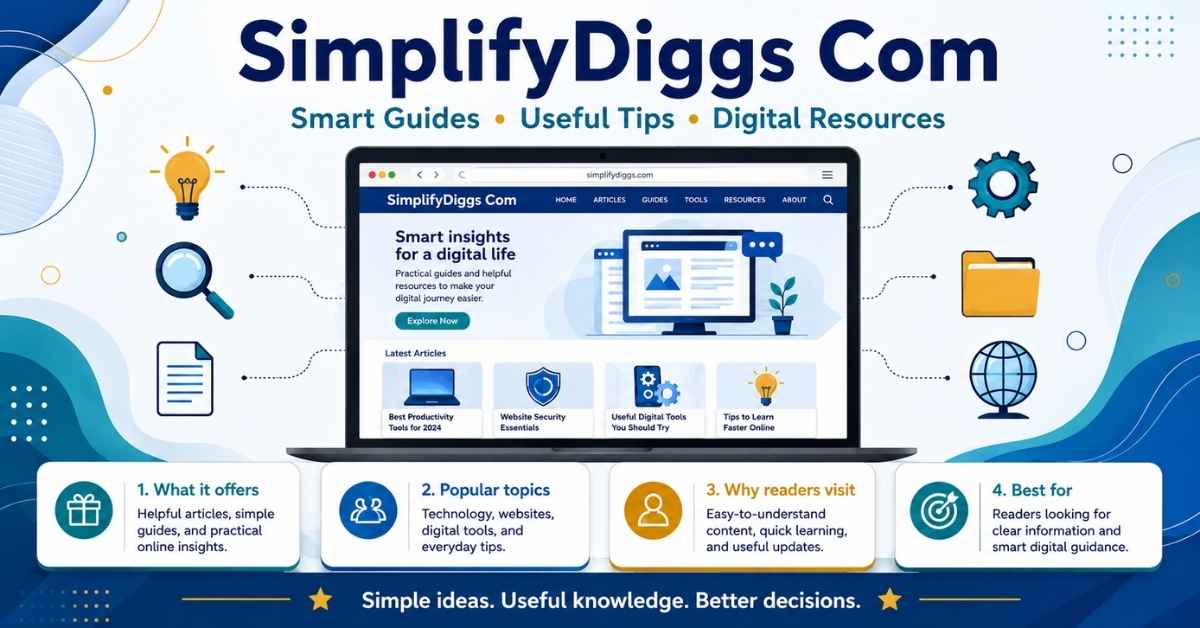
SimplifyDiggs com appears to be a functioning multi-niche informational blog that publishes articles across technology, business, automotive, finance, health, travel, entertainment, lifestyle, and other general-interest categories. It is not clearly documented as a productivity application, task-management platform, cybersecurity company, or dedicated smart-living service. While the website may help readers discover unfamiliar topics, its unclear ownership, limited author transparency, uneven topical depth, and possible commercial publishing signals mean important claims should be verified through stronger specialist sources.
That distinction matters because existing SimplifyDiggs com reviews do not always agree on what the site is. Some describe it as a technology platform. Others present it as a productivity resource, smart-home guide, or digital organization service. The visible website structure, however, more closely resembles a broad online publication.
This review examines what the site publishes, who may be responsible for its content, whether it is safe to browse, how reliable its guides appear, and whether a SimplifyDiggs backlink has meaningful SEO value.
SimplifyDiggs Com at a Glance
| Question | Current assessment |
|---|---|
| What is SimplifyDiggs.com? | A broad, multi-topic informational blog |
| Is it a software platform? | No clearly functioning software product is visible |
| Is it safe to browse? | Basic browsing may be low risk, but technical safety does not prove editorial reliability |
| Is the content trustworthy? | It depends on the article, sources, author expertise, and subject |
| Does it cover cybersecurity? | Yes, but it does not appear to be a dedicated cybersecurity authority |
| Does it offer task-management tools? | No clear dashboard, project board, or productivity application is documented |
| Does it accept guest posts? | Commercial publishing signals may exist, but terms should be confirmed directly |
| Is a backlink valuable? | Only when relevance, indexing, traffic, placement, and link attributes are verified |
| Should it be used for important decisions? | Not as the only source for health, finance, security, legal, or major purchase advice |
What Is SimplifyDiggs Com?
SimplifyDiggs.com is best understood as a general-interest content website rather than a narrowly focused brand or software product.
Its visible categories cover a wide range of subjects, potentially including:
- Automotive
- Business
- Education
- Entertainment
- Fashion
- Finance
- Health
- Lifestyle
- Movies and music
- Online gaming
- Real estate
- Sports
- Technology
- Travel
A large category menu can make a website look like a full digital magazine. However, the presence of many menu items does not automatically mean each category contains deep, expert-led coverage.
A specialist cybersecurity publication, for example, normally employs security researchers, technical editors, or experienced practitioners. A dedicated automotive site may include road tests, ownership data, maintenance comparisons, and named industry writers. A broad content blog may cover both areas, but readers should not assume the same level of authority.
Is SimplifyDiggs a Blog or a Digital Tool?
Some third-party pages describe SimplifyDiggs as a digital productivity or information-management platform. A genuine software platform would normally provide features such as:
- User registration
- Personal dashboards
- Project workspaces
- Task lists
- Team permissions
- Calendar integrations
- Automated notifications
- Subscription plans
- Account settings
If those functions are not available, it is more accurate to describe SimplifyDiggs as an informational blog that may publish productivity-related articles, not a task-management application.
This is one of the main weaknesses in existing review SimplifyDiggs com content: several reviewers appear to infer the website’s purpose from its name instead of examining its actual functionality.
Why SimplifyDiggs Com Reviews Give Different Answers
The disagreement surrounding the website may come from several sources.
The Name Encourages Assumptions
The word “Simplify” suggests productivity, decluttering, organization, or efficiency. “Diggs” could imply discovery or research. Together, the name may sound like a tool designed to organize information or simplify daily tasks.
That interpretation is understandable, but a brand name is not proof of functionality.
Competitors May Be Repeating One Another
When one article describes a website as a productivity platform, another publisher may repeat the description without conducting an independent review. Over time, repeated claims can appear credible even when they originated from a single unsupported interpretation.
The Website May Have Changed Direction
Domains sometimes change ownership, design, content strategy, or commercial purpose. A website that once focused on one subject may later become a general blog or guest-post publication.
A reliable investigation should therefore examine:
- Archived homepage versions
- Historical category structures
- Older publication dates
- Changes in author profiles
- Previous business descriptions
- Domain-registration history
Without that evidence, claims about the site’s previous purpose remain speculative.
Is SimplifyDiggs Com Legit?
The word legit should be divided into several separate questions.
A website can be real and accessible while still lacking strong editorial credibility. Similarly, a page can be technically safe to open but unsuitable for financial, health, or cybersecurity decisions.
Technical Legitimacy
Basic technical legitimacy includes:
- A working HTTPS connection
- No browser malware warnings
- No forced file downloads
- No deceptive pop-ups
- No unexpected redirects
- No fake security notifications
- Functional mobile and desktop pages
These signals help determine whether a website is reasonably safe to browse. They do not prove that every article is accurate or that commercial services are reliable.
Organizational Legitimacy
A transparent publisher should make it easy to identify:
- The legal owner
- The operating company
- A professional contact email
- A business address
- Named editors
- Responsible authors
- A clear About page
- A corrections process
When these details are missing or difficult to verify, readers have fewer ways to request corrections, challenge inaccurate information, or resolve commercial disputes.
Editorial Legitimacy
Strong editorial signals include:
- Qualified authors
- Detailed biographies
- Reliable external sources
- Fact-checking procedures
- Update dates
- Corrections policies
- Clear separation of opinion and fact
- Expert review for high-stakes topics
A readable article is not automatically a reliable one. Ease of reading and factual authority are different qualities.
Commercial Legitimacy
If SimplifyDiggs publishes guest posts, paid placements, affiliate content, or sponsored dealership features, readers should be able to recognize those relationships.
Commercial transparency may include:
- Sponsored-content labels
- Affiliate disclosures
- Contributor guidelines
- Paid-link attributes
- Advertising policies
- Publication terms
- Refund or replacement conditions
Promotional content is not inherently untrustworthy. The problem arises when commercial relationships are hidden or unclear.
Is SimplifyDiggs Com Safe to Visit?
For ordinary browsing, SimplifyDiggs.com may not present an obvious high-risk environment. However, “safe” has more than one meaning.
Technical Safety
Before interacting with any unfamiliar website, check for:
- A valid HTTPS connection
- Unexpected download prompts
- Requests to enable browser notifications
- Multiple advertising redirects
- Misleading “Continue” buttons
- Fake virus alerts
- Requests for unnecessary personal information
If the website asks for a file download or permission unrelated to the article, close the page and investigate further.
Privacy Safety
Readers should also consider:
- Cookies and tracking technologies
- Analytics scripts
- Advertising partners
- Data-sharing practices
- Email collection
- Account-deletion options
- Privacy-request procedures
A privacy policy should explain what data is collected and why. A generic policy that does not clearly describe actual practices offers limited reassurance.
Editorial Safety
The greatest risk may not be malware. It may be following inaccurate advice.
Before acting on a SimplifyDiggs article, ask:
- Who wrote it?
- Does the author have relevant experience?
- Are official or expert sources included?
- When was the article last updated?
- Could following the advice cause financial, technical, legal, or health harm?
- Does the article promote a product or business?
- Are limitations and risks explained?
The higher the potential consequence, the stronger the evidence should be.
Who Owns and Operates SimplifyDiggs Com?
Ownership transparency is an important part of website trust.
Readers and business partners should be able to determine:
- Who owns the domain
- Who controls editorial decisions
- Who handles commercial placements
- Who manages personal data
- Who is responsible for corrections
- Which legal entity issues invoices
Useful places to check include:
- About page
- Contact page
- Privacy policy
- Terms and conditions
- Copyright notice
- Author pages
- Business records
- Domain-registration information
A privacy-protected domain registration is not automatically suspicious. Many legitimate website owners use privacy services. The concern increases when private registration is combined with no visible company, no named editors, no author biographies, and no reliable contact information.
Who Writes the Articles?
Author transparency helps readers judge whether a writer is qualified to discuss a subject.
A strong author profile should include:
- Full name
- Relevant professional experience
- Education or certifications
- Areas of specialization
- Links to other work
- Social or professional profiles
- Editorial contact information
The Roland and Brijesh Question
Some reviewers have noted a possible mismatch between a visible “Roland” byline and an author archive containing the name “Brijesh.”
This observation should be handled carefully.
What can reasonably be said is:
- The visible byline and author URL may not match.
- The profile may have been renamed or repurposed.
- It could be a shared publishing account.
- It may reflect a WordPress username that was never updated.
What cannot be concluded without evidence is that either identity is fake.
The correct response is not accusation. It is a request for clear author biography and editorial accountability.
Can One Writer Cover Every Subject?
A general writer can research and explain many topics. However, high-stakes subjects require stronger expertise.
One author covering cybersecurity, finance, health, automotive ownership, business, travel, and gaming may be able to produce basic summaries, but readers should ask whether those articles were reviewed by specialists.
Expert review becomes especially important for:
- Security configuration
- Medical symptoms or treatment
- Investments and taxes
- Insurance
- Legal rights
- Vehicle financing
- Business compliance
How Frequently Is SimplifyDiggs Updated?
A website does not need to publish every day to be useful. However, publication patterns can reveal how the site operates.
A proper review should map:
- Posts by year
- Posts by month
- Active categories
- Long publishing gaps
- Sudden topic clusters
- Articles updated after publication
- Older content that may now be outdated
Irregular publishing could indicate:
- A small team
- An inactive project
- Guest-post-driven publishing
- Search-focused content experiments
- A repurposed domain
- Limited editorial planning
None of those possibilities automatically proves poor quality. They simply mean that freshness must be checked article by article.
Does SimplifyDiggs Have Topical Authority?
Topical authority comes from sustained, interconnected, expert-led coverage—not from placing many subjects in a navigation menu.
A strong topic cluster normally contains:
- A comprehensive main guide
- Supporting articles
- Internal links
- Specialist authors
- Updated information
- Original examples
- Reliable sources
- Clear topical relationships
A category containing only one or two isolated articles should not be treated as evidence of deep expertise.
Category-Depth Framework
SimplifyDiggs categories can be assessed using five levels:
| Category status | Meaning |
|---|---|
| Established | Multiple useful and interconnected articles |
| Developing | Some relevant content but limited depth |
| Thin | Only one or two isolated posts |
| Inactive | Existing content but no recent publishing |
| Empty | No meaningful visible content |
This approach is more useful than simply counting menu items.
Cybersecurity Content on SimplifyDiggs Com
Searches for cybersecurity SimplifyDiggs com suggest that users may encounter technology or network-security articles on the site.
Cybersecurity advice can carry serious consequences. Incorrect instructions may expose accounts, devices, or business systems to risk.
What Strong Cybersecurity Content Should Include
A trustworthy security article should provide:
- A named technical author
- Relevant professional experience
- Current software versions
- Official vendor documentation
- A defined threat model
- Practical mitigation steps
- Backup and recovery advice
- Warnings about limitations
- A visible update history
How to Review a Cybersecurity Article
Use this process:
- Identify each technical claim.
- Compare it with official vendor documentation.
- Check whether commands or settings are current.
- Confirm that prerequisites are explained.
- Look for missing security risks.
- Test instructions only in a safe environment.
- Review every recommended external tool.
- Check whether the article distinguishes privacy from security.
Common Cybersecurity Red Flags
Be cautious when an article:
- Promises complete protection
- Recommends tools without explaining risks
- Omits software versions
- Provides commands with no backup warning
- Confuses encryption with anonymity
- Ignores account recovery
- Uses fear to promote a product
For malware removal, business security, cloud configuration, or data-breach response, use official technical documentation or an established security organization.
Decluttering Advice on SimplifyDiggs Com
The phrase decluttering SimplifyDiggs com reflects a different type of intent. Readers may be looking for practical lifestyle guidance rather than technical expertise.
Good decluttering advice should recognize that clutter is not only a storage problem. It is often connected to emotion, identity, guilt, and decision fatigue.
A Practical Decluttering Process
Define the Outcome
Decide what success means:
- Easier cleaning
- Less visual stress
- More usable storage
- Faster morning routines
- A calmer workspace
Start With a Low-Emotion Area
Begin with:
- A bathroom drawer
- A kitchen cabinet
- An entryway
- A downloads folder
- Old email subscriptions
Starting small creates visible progress without emotional overload.
Use Four Decisions
Every item should be:
- Kept
- Relocated
- Donated or sold
- Disposed of responsibly
Avoid creating a large “decide later” pile. That only moves the problem.
Prevent Clutter From Returning
Use habits such as:
- One item in, one item out
- A weekly reset
- Assigned storage locations
- A waiting period before purchases
- Regular digital-file reviews
How to Evaluate a SimplifyDiggs Decluttering Guide
A useful guide should answer:
- Does it include specific steps?
- Does it acknowledge emotional barriers?
- Are the examples realistic?
- Can the method work in small U.S. apartments?
- Does it recommend buying storage products before reducing possessions?
- Does it include a maintenance plan?
A shallow decluttering article often turns a behavioral problem into a shopping list.
Smart Living and SimplifyDiggs Com
The keyword smart living SimplifyDiggs com may refer to articles about home technology, organization, digital routines, or efficient daily living.
Smart living is not simply purchasing connected devices. It means using technology and systems intentionally to improve daily life.
Practical Smart-Living Areas
- Energy monitoring
- Home security
- Household budgeting
- Meal planning
- Cleaning routines
- Digital organization
- Remote-work setup
- Automation
- Healthier technology habits
Questions to Ask Before Buying a Smart Device
- What problem does it solve?
- How much time or money could it save?
- Does it require a subscription?
- What personal data does it collect?
- Does it work without internet access?
- Will the manufacturer support it long term?
- Can every household member use it?
- What happens if the company closes?
A smart-home article should discuss privacy, compatibility, security, cost, and long-term support, not only convenience.
Task Management and SimplifyDiggs Com
Searches for task management SimplifyDiggs com may come from readers who assume the site offers productivity software.
Unless a working dashboard, project board, calendar, or collaborative workspace is available, SimplifyDiggs should not be described as a task-management application.
It may still publish useful productivity advice.
A Simple Task-Management System
Capture
Keep every commitment in one trusted place.
Clarify
Turn vague ideas into specific actions.
Instead of “website,” write “draft the homepage service section.”
Prioritize
Evaluate each task by:
- Importance
- Urgency
- Effort
- Impact
- Deadline
Schedule
Assign time only to tasks that genuinely require it. Over-scheduling creates constant failure.
Review
Check your list daily and conduct a deeper weekly review.
Complete, Delegate, or Remove
A task should eventually be finished, delegated, postponed intentionally, or deleted.
Useful Productivity Metrics
- Completion rate
- Overdue-task percentage
- Average task age
- Planned versus completed work
- Deep-work hours
- Number of active priorities
- Time lost to switching tasks
The goal is not to manage more tasks. It is to complete the right work with less friction.
Optimization Advice on SimplifyDiggs Com
The phrase optimization SimplifyDiggs com can relate to content, websites, workflows, or digital performance.
Optimization should mean improving measurable results—not simply adding more tools, keywords, or processes.
Content Optimization
Effective content optimization includes:
- Matching search intent
- Answering the main question early
- Removing filler
- Adding first-hand evidence
- Strengthening author credibility
- Improving internal links
- Updating old information
- Using clear headings
- Adding practical examples
Website Optimization
Website performance depends on:
- Loading speed
- Mobile usability
- Core Web Vitals
- Image compression
- Clear navigation
- Accessibility
- Secure connections
- Structured data
Claims that a website is “fast” or “mobile optimized” should be supported by actual testing.
Workflow Optimization
Personal and business workflows can be improved by:
- Standardizing recurring processes
- Automating repetitive tasks
- Reducing task switching
- Creating decision rules
- Removing unnecessary approvals
- Measuring outcomes
- Reviewing failures
More complexity does not always mean better performance.
How Helpful Are SimplifyDiggs Guides?
People searching guide SimplifyDiggs com likely want to know whether its tutorials are practical enough to follow.
A strong guide should include:
- A clear outcome
- Required tools
- Ordered instructions
- Real examples
- Common mistakes
- Troubleshooting
- Safety warnings
- Success criteria
- Updated sources
Guide Quality Checklist
| Criterion | What to check |
|---|---|
| Clarity | Can a beginner follow the explanation? |
| Accuracy | Are claims supported by reliable evidence? |
| Completeness | Are important steps missing? |
| Practicality | Can the reader apply the advice? |
| Expertise | Does the author understand the subject? |
| Freshness | Is the information current? |
| Originality | Does it add anything new? |
| Safety | Are risks and limitations explained? |
Beginner readers need definitions and clear steps. Advanced readers need trade-offs, benchmarks, edge cases, and measurement.
A good guide should serve both without becoming repetitive.
Does SimplifyDiggs Publish Guest Posts?
Commercial signals may suggest that SimplifyDiggs accepts contributed or paid content. However, buyers should confirm the arrangement directly.
Before purchasing a placement, ask:
- Who owns the website?
- Is the article labeled sponsored?
- What link attribute is used?
- Will the page remain live?
- Does the page receive organic traffic?
- Can the publisher remove or edit the link?
- Is an invoice provided?
- Is there a replacement policy?
- Are prohibited niches clearly defined?
A guest post can be useful for branding, referral traffic, or SEO, but only when the page is relevant, indexed, useful, and editorially credible.
SEO Value of a SimplifyDiggs Com Backlink
Searches for SEO value SimplifyDiggs com are likely commercial. Link builders and website owners may want to know whether paying for a placement is worthwhile.
The answer cannot be determined from Domain Authority or Domain Rating alone.
Factors That Determine Backlink Value
Evaluate:
- Topical relevance
- Page-level organic traffic
- U.S. traffic share
- Keyword rankings
- Page indexing
- Editorial placement
- Anchor-text quality
- Link attributes
- Outbound-link density
- Content quality
- Site reputation
- Placement permanence
SimplifyDiggs Backlink Checklist
| Area | What to verify |
|---|---|
| Relevance | Does the article genuinely match your niche? |
| Traffic | Does the page rank or receive visitors? |
| Indexing | Is the URL indexed consistently? |
| Placement | Is the link placed naturally inside useful content? |
| Attribute | Is it follow, nofollow, or sponsored? |
| Permanence | Is the placement guaranteed? |
| Disclosure | Is paid content clearly identified? |
| Risk | Does the site publish large volumes of unrelated commercial links? |
A link may have limited SEO value when:
- The topic is unrelated
- The page receives no traffic
- The article is thin
- The anchor text is aggressively commercial
- The page contains many paid links
- The URL is not indexed
- The placement is temporary
For buyers, verifiable traffic and relevance are more persuasive than a high metric displayed without context.
Are the Automotive Articles Promotional?
Some reviews have questioned whether luxury-car or Charlotte dealership content may be commercially aligned.
A promotional tone does not prove that an article was paid for.
A fair assessment should examine:
- Frequency of dealership mentions
- Outbound links
- Calls to action
- Inclusion of competing sellers
- Discussion of disadvantages
- Sponsorship labels
- Local keyword targeting
- Author experience
Content can be classified as:
- Clearly sponsored
- Apparently promotional
- Commercially aligned
- Editorially independent
- Relationship unknown
A balanced automotive article should discuss:
- Purchase price
- Depreciation
- Insurance
- Maintenance
- Warranty
- Service availability
- Financing
- Total ownership cost
- Competing models
Purely positive language is less useful to someone making an expensive purchase.
Pros and Cons of SimplifyDiggs Com
Potential Strengths
- Broad range of subjects
- Accessible writing style
- Useful for discovering unfamiliar topics
- Simple article structure
- Coverage of both lifestyle and technology
- Potential value as a starting point for research
Important Weaknesses
- Unclear ownership
- Limited author biographies
- Possible author-name inconsistency
- Uneven topical depth
- Irregular publishing
- Limited specialist review
- Unclear commercial disclosures
- Weak source transparency
- Conflicting descriptions of the website
LEARN MORE: Adswynk Com Review
Who Should Use SimplifyDiggs Com?
| User | Appropriate use | Main caution |
|---|---|---|
| Casual reader | Basic topic discovery | Verify factual claims |
| Beginner | Introductory explanations | Check whether instructions are complete |
| Student | Background orientation | Use stronger sources for citations |
| Small business | Content and marketing ideas | Verify commercial claims |
| SEO buyer | Preliminary placement research | Audit relevance, traffic, indexing, and links |
| Health or finance reader | General orientation only | Use professional sources |
| Cybersecurity user | Basic overview | Follow official technical documentation |
Better Alternatives by Topic
Cybersecurity
Use:
- Official vendor documentation
- Government cybersecurity agencies
- Established security research organizations
- Qualified technical professionals
Smart Living and Decluttering
Look for:
- Professional organizers
- Established home publications
- Evidence-based productivity experts
- Long-term product testing
Task Management
Use:
- Official software documentation
- Reputable project-management publications
- Tested productivity systems
- Professional workflow consultants
Automotive Research
Consult:
- Manufacturer documentation
- Independent vehicle-testing publications
- Reliability databases
- Multiple dealer quotes
- Owner communities
Finance and Health
Prioritize:
- Government agencies
- Regulated institutions
- Credentialed professionals
- Medically or financially reviewed publications
Guest Posting and SEO
Choose websites with:
- Topical relevance
- Transparent contributor policies
- Real organic traffic
- Clearly disclosed commercial links
- Strong editorial standards
The INSPECT Framework
Use this framework before trusting SimplifyDiggs or any unfamiliar content website.
I — Identify the Website Type
Determine whether it is a blog, product, marketplace, or service.
N — Name the Responsible People
Find the owner, authors, editors, and commercial partners.
S — Sample Multiple Articles
Review technical, commercial, lifestyle, and high-stakes content.
P — Plot the Publishing History
Map article dates, category depth, gaps, and updates.
E — Examine Commercial Signals
Check guest-post banners, sponsored articles, affiliate links, and brand mentions.
C — Check Claims Against Primary Sources
Fact-check important information instead of judging writing quality alone.
T — Trust According to the Stakes
Use casual content for discovery. Demand stronger evidence for decisions involving money, health, security, or major purchases.
Final Verdict: Can You Trust SimplifyDiggs Com?
SimplifyDiggs.com appears to be a real, functioning multi-niche informational blog rather than a dedicated cybersecurity, smart-living, task-management, or productivity platform.
For casual readers, it may provide useful introductions and topic ideas. Its broad structure and accessible language can make unfamiliar subjects easier to approach.
However, readers should remain cautious because:
- Ownership is not immediately clear.
- Author expertise may be difficult to verify.
- Some categories may lack depth.
- Publishing appears inconsistent.
- Commercial relationships may not always be obvious.
- Specialist review is not clearly documented.
For cybersecurity, finance, health, legal matters, and major purchase decisions, SimplifyDiggs should not be used as the only source.
For SEO professionals considering a guest post or backlink, request evidence of page-level traffic, indexing, topical relevance, link attributes, disclosure terms, and placement permanence before purchasing.
The most balanced conclusion is simple:
Use SimplifyDiggs.com to discover a topic, but verify important information before making a decision.
Frequently Asked Questions
What is SimplifyDiggs com?
SimplifyDiggs.com appears to be a broad informational blog publishing content across technology, business, lifestyle, automotive, travel, finance, health, and entertainment.
Is SimplifyDiggs com legit?
The website appears to be active and functional. However, organizational transparency, author credentials, and commercial disclosures should be evaluated separately.
Is SimplifyDiggs com safe to visit?
It may be reasonably safe for ordinary browsing, but readers should avoid unexpected downloads, notification requests, or suspicious redirects. Technical safety does not guarantee accurate content.
Is SimplifyDiggs a cybersecurity website?
No. It may publish cybersecurity articles, but it does not appear to be a dedicated specialist security publication.
Does SimplifyDiggs offer task-management tools?
No clearly documented task-management dashboard, project board, team workspace, or productivity application appears to be available.
Does SimplifyDiggs publish decluttering guides?
It may publish lifestyle or organization-related content. Readers should judge such guides by their practical steps, examples, and understanding of emotional barriers.
Is SimplifyDiggs a smart-living platform?
It may discuss smart-living topics, but publishing smart-home or productivity articles does not make it a dedicated smart-living service.
Who writes SimplifyDiggs articles?
Public author information may be limited. A reported mismatch between the Roland byline and a Brijesh author URL raises a transparency question, but it does not prove false authorship.
Who owns SimplifyDiggs.com?
Clear ownership information may not be immediately visible. Readers and commercial buyers should review legal pages, domain records, and business information.
Is SimplifyDiggs content reliable?
Reliability depends on the individual article, author, sources, freshness, and subject. Casual content may be useful, while high-stakes claims require stronger verification.
Does SimplifyDiggs accept guest posts?
Commercial publishing signals may indicate that guest posts are available, but contributors should confirm terms, disclosures, link attributes, and permanence directly.
Is a SimplifyDiggs backlink good for SEO?
It may have value when the article is relevant, indexed, useful, and receives real traffic. Domain metrics alone are not enough.
Are SimplifyDiggs reviews accurate?
Some reviews correctly identify it as a multi-niche blog. Others appear to invent unsupported productivity, smart-home, or software features.
What are the best SimplifyDiggs alternatives?
The best alternative depends on the topic. Use official technical documentation for cybersecurity, professional sources for health and finance, independent publications for automotive research, and relevant editorial websites for guest posting.