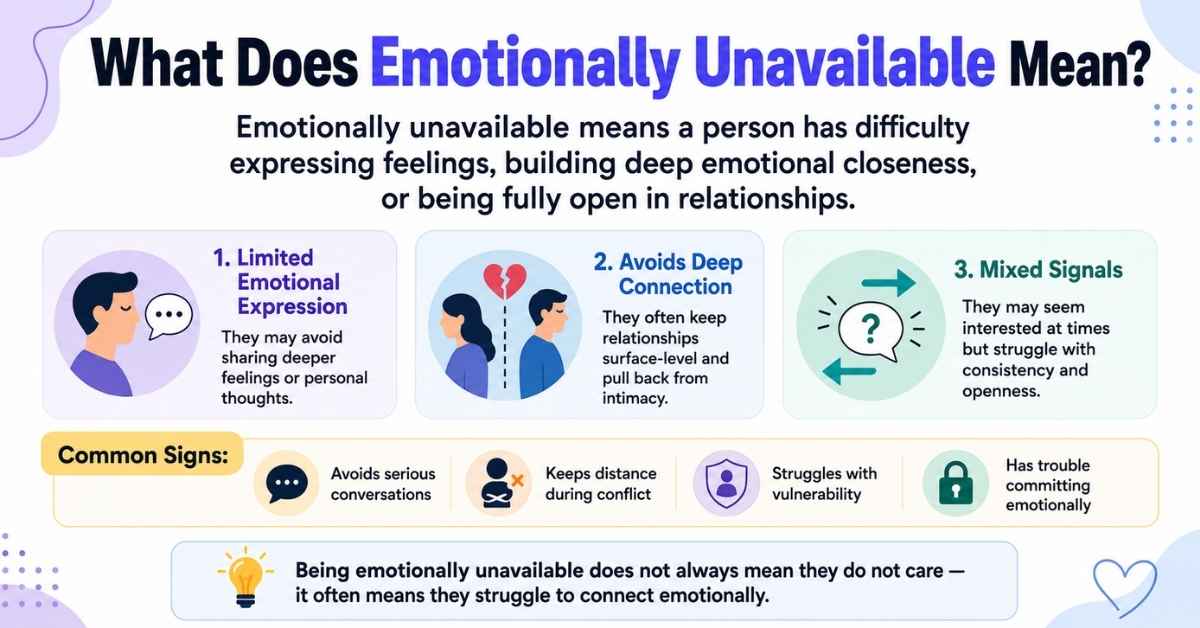
What does emotionally unavailable mean? Emotionally unavailable means a person has difficulty expressing, sharing, or responding to emotions in a healthy and consistent way. They may struggle with emotional intimacy, vulnerability, or forming deep emotional connections with others. This behavior is often linked to attachment styles, past experiences, childhood emotional neglect, trauma, or a fear of being hurt—not necessarily a lack of love or care.
If you’ve ever wondered why someone seems affectionate one day but distant the next, avoids serious conversations, or struggles to open up, you may be dealing with emotional unavailability. It can affect romantic relationships, marriages, friendships, family dynamics, and even workplace interactions. While emotionally unavailable people may genuinely care about others, they often find it difficult to communicate their feelings or build lasting emotional closeness.
Understanding emotionally unavailable meaning is about more than learning a definition. It’s about recognizing behavioral patterns, understanding the psychology behind them, and knowing what they mean for your relationships. Whether you’re trying to understand a partner, a friend, a family member, or even yourself, this guide will help you identify the signs, explore the causes, and learn practical ways to navigate emotionally distant behavior with empathy and confidence.
What Does Emotionally Unavailable Mean?
At its core, being emotionally unavailable means having difficulty creating or maintaining a deep emotional connection with other people. An emotionally unavailable person may find it challenging to express emotions openly, respond to another person’s emotional needs, or feel comfortable with vulnerability.
Unlike someone who is simply shy or reserved, an emotionally unavailable individual often avoids situations that require emotional openness. They may pull away when relationships become more serious, change the subject during meaningful conversations, or struggle to discuss their feelings honestly.
A Simple Definition
In everyday language, an emotionally unavailable person is someone who:
- Has trouble expressing emotions.
- Avoids emotional intimacy.
- Feels uncomfortable with vulnerability.
- Keeps others at an emotional distance.
- Finds it difficult to build or maintain close relationships.
This doesn’t necessarily mean they don’t care. In many cases, they do—but their ability to express affection, trust, or emotional support is limited by internal fears or learned behaviors.
The Psychological Meaning of Emotional Unavailability
From a psychological perspective, emotional availability refers to a person’s ability to:
- Recognize their own emotions.
- Understand the emotions of others.
- Respond with empathy.
- Communicate feelings honestly.
- Build healthy emotional intimacy.
When someone is emotionally unavailable, one or more of these abilities may be impaired.
Many psychologists associate emotional unavailability with patterns related to:
- Avoidant attachment
- Fearful-avoidant attachment
- Emotional regulation difficulties
- Fear of intimacy
- Low emotional awareness
- Past emotional trauma
These patterns don’t develop overnight. They’re often shaped by early life experiences, family relationships, cultural expectations, or previous romantic experiences.
Emotional Unavailability Isn’t Always Intentional
One of the biggest misconceptions is that emotionally unavailable people choose to hurt others.
In reality, many don’t realize they’re emotionally distant.
Some grew up in families where emotions were rarely discussed. Others learned to suppress their feelings after painful experiences such as rejection, betrayal, abandonment, or emotional neglect.
Instead of processing emotions openly, they develop protective behaviors like:
- Avoiding vulnerability.
- Keeping conversations superficial.
- Distracting themselves with work or hobbies.
- Pulling away when relationships become emotionally intense.
These coping mechanisms may have helped them survive difficult situations in the past, but they can create challenges in healthy adult relationships.
What Emotional Unavailability Looks Like in Everyday Life
The concept becomes much easier to understand when viewed through real-life situations.
Example 1: Dating
Sarah notices that her boyfriend is charming, thoughtful, and affectionate during fun dates. However, whenever she tries to discuss the future or share her deeper feelings, he changes the subject or jokes to avoid the conversation.
He’s physically present but emotionally distant.
This is a common example of emotional unavailability in relationships.
Example 2: Marriage
After several years of marriage, Mark rarely shares what’s bothering him. When disagreements arise, he becomes silent instead of talking through the issue.
His spouse feels alone, even though they live together.
The relationship lacks emotional intimacy, not necessarily love.
Example 3: Friendship
A close friend always asks for advice but never talks about their own feelings.
Whenever conversations become personal, they quickly switch topics.
Over time, the friendship feels one-sided because emotional openness never develops.
Example 4: Family Relationships
A parent provides financial support and practical help but rarely expresses affection, encouragement, or empathy.
Their children know they’re loved but struggle to feel emotionally connected.
Emotionally Unavailable vs. Similar Behaviors
Not everyone who struggles to express emotions is emotionally unavailable. Understanding the differences helps prevent unfair assumptions.
Emotionally Unavailable vs. Introverted
Many people mistakenly confuse introversion with emotional distance.
An introvert enjoys solitude to recharge energy, but they can still develop deep emotional connections and communicate openly with people they trust.
An emotionally unavailable person, on the other hand, often avoids emotional closeness regardless of how comfortable they are socially.
| Introverted | Emotionally Unavailable |
|---|---|
| Enjoys quiet time | Avoids emotional intimacy |
| Can express feelings with trusted people | Struggles to express feelings consistently |
| Values close relationships | May fear emotional closeness |
| Needs alone time | Creates emotional distance |
Emotionally Unavailable vs. Private
Being private doesn’t automatically mean someone is emotionally unavailable.
A private person:
- Shares selectively.
- Builds trust gradually.
- Opens up over time.
An emotionally unavailable person often keeps emotional walls up even after trust has been established.
Emotionally Unavailable vs. Emotionally Immature
Although these concepts overlap, they’re not identical.
An emotionally immature person may react impulsively, avoid responsibility, or struggle with empathy.
An emotionally unavailable person may actually be mature in many areas of life but still fear vulnerability or emotional closeness.
Someone can be emotionally mature yet emotionally unavailable.
Emotionally Unavailable vs. Avoidant Attachment
This is one of the most searched questions related to emotionally unavailable meaning.
Avoidant attachment is an attachment style that often contributes to emotional unavailability, but they aren’t exactly the same.
| Avoidant Attachment | Emotional Unavailability |
|---|---|
| Psychological attachment pattern | Behavioral relationship pattern |
| Often develops in childhood | Can result from many causes |
| Fear of dependence | Difficulty maintaining emotional closeness |
| May improve through therapy | May improve through self-awareness and healing |
Understanding this distinction helps avoid oversimplifying someone’s behavior.
Emotionally Unavailable vs. Temporary Stress
Life circumstances can temporarily affect emotional availability.
Someone experiencing:
- Burnout
- Grief
- Anxiety
- Depression
- Job loss
- Major life changes
may seem emotionally distant for a period of time.
The key difference is consistency.
Temporary emotional withdrawal improves as circumstances improve.
Chronic emotional unavailability remains a recurring relationship pattern.
The Most Common Signs of an Emotionally Unavailable Person
Recognizing the signs can help you understand whether someone’s behavior reflects a temporary challenge or a deeper emotional pattern.
Remember, one sign alone doesn’t make someone emotionally unavailable. Look for consistent behaviors over time rather than isolated incidents.
1. They Avoid Deep Emotional Conversations
Whenever discussions become meaningful, they change the subject, make jokes, or suddenly become distracted.
Topics like:
- Future plans
- Personal fears
- Emotional needs
- Relationship concerns
often make them uncomfortable.
2. They Struggle With Vulnerability
Being emotionally open requires trust.
An emotionally unavailable person may rarely talk about:
- Childhood experiences
- Personal insecurities
- Emotional pain
- Regrets
- Dreams
Instead, conversations remain surface-level.
3. They Send Mixed Signals
One day they’re affectionate.
The next day they’re distant.
This inconsistency creates confusion because their actions don’t always match their words.
Partners often describe this as “hot and cold behavior.”
4. They Pull Away When Relationships Become Serious
Everything seems wonderful until emotional intimacy begins to deepen.
Then they might:
- Become less communicative.
- Cancel plans.
- Focus excessively on work.
- Need “space.”
- Avoid discussing commitment.
This fear of closeness is often linked to fear of intimacy rather than lack of affection.
5. They Avoid Conflict Instead of Resolving It
Healthy relationships require honest conversations.
Emotionally unavailable people often respond to conflict by:
- Shutting down.
- Walking away.
- Ignoring messages.
- Changing the topic.
- Pretending nothing happened.
Avoidance may reduce immediate discomfort, but it usually weakens long-term relationship satisfaction.
6. They Rarely Express Their Feelings
They may struggle to say:
- “I’m hurt.”
- “I miss you.”
- “I’m scared.”
- “I appreciate you.”
- “I love you.”
Even if they genuinely feel these emotions, expressing them can feel overwhelming or unsafe.
7. They Fear Commitment
Commitment often requires emotional openness.
Someone who is emotionally unavailable may hesitate to:
- Define the relationship.
- Make long-term plans.
- Discuss marriage.
- Introduce partners to family.
- Build a shared future.
This hesitation often reflects anxiety about vulnerability rather than a simple dislike of commitment.
8. They Have Difficulty Trusting Others
Trust is essential for healthy emotional intimacy.
Past betrayals, unresolved trauma, or negative relationship experiences may make them believe that emotional closeness leads to pain.
As a result, they protect themselves by keeping others at a distance.
9. They Seem Present Physically but Absent Emotionally
Perhaps the most painful sign is when someone is physically there but emotionally disconnected.
They may:
- Listen without engaging.
- Offer solutions instead of empathy.
- Avoid comforting conversations.
- Appear detached during emotional moments.
Over time, partners often describe feeling lonely—even within the relationship itself.
Expert Insight
Emotional unavailability isn’t defined by a single behavior. It’s the repeated pattern of avoiding emotional closeness, vulnerability, and open communication over time. Looking at consistent actions—not isolated moments—is the most reliable way to understand whether someone is truly emotionally unavailable.
Why Do People Become Emotionally Unavailable?
It’s easy to assume that an emotionally unavailable person simply doesn’t care about others. In reality, the opposite is often true. Many people who struggle with emotional availability genuinely want close relationships but have learned—consciously or unconsciously—to protect themselves from emotional pain.
Understanding the causes of emotional unavailability doesn’t excuse hurtful behavior, but it does provide valuable insight into why these patterns develop.
1. Childhood Emotional Neglect
One of the most common causes of emotional unavailability is childhood emotional neglect.
If a child grows up in an environment where emotions are ignored, criticized, or dismissed, they may learn that expressing feelings is unsafe or pointless.
For example:
- A child who is told to “stop crying” instead of being comforted may begin suppressing emotions.
- Parents who rarely express affection may unintentionally teach that emotional closeness isn’t important.
- Children raised in highly critical households often learn to hide vulnerability to avoid judgment.
As adults, these early experiences can make emotional intimacy feel unfamiliar or uncomfortable.
2. Past Trauma and Painful Relationships
Previous emotional wounds often leave lasting effects.
Someone who has experienced:
- Betrayal
- Infidelity
- Abandonment
- Divorce
- Emotional abuse
- Bullying
- Loss of a loved one
may develop emotional walls as a form of self-protection.
Instead of risking another painful experience, they keep people at a distance.
3. Fear of Vulnerability
Being emotionally close to someone requires vulnerability.
For many emotionally unavailable individuals, vulnerability feels risky because it creates the possibility of:
- Rejection
- Judgment
- Disappointment
- Heartbreak
- Loss of control
Rather than expressing difficult emotions, they may avoid conversations altogether.
4. Avoidant Attachment Style
According to attachment theory, people develop relationship patterns based on their earliest caregiving experiences.
Individuals with an avoidant attachment style often value independence so strongly that emotional closeness begins to feel uncomfortable.
Common behaviors include:
- Pulling away when relationships deepen.
- Avoiding dependence on others.
- Suppressing emotional needs.
- Prioritizing self-reliance over vulnerability.
Not every emotionally unavailable person has an avoidant attachment style, but there is significant overlap.
5. Low Emotional Awareness
Some people simply struggle to recognize and name their own emotions.
Instead of identifying feelings such as:
- disappointment,
- loneliness,
- shame,
- frustration,
- fear,
they may only recognize that something feels “off.”
Without emotional awareness, expressing emotions becomes much more difficult.
6. Mental Health Challenges
Temporary or ongoing mental health concerns can reduce a person’s emotional availability.
These may include:
- Depression
- Anxiety disorders
- Burnout
- Chronic stress
- Post-traumatic stress
- Grief
It’s important not to automatically label someone as emotionally unavailable if they’re navigating a significant mental health challenge. Sometimes emotional withdrawal is temporary and improves with treatment and support.
7. Cultural and Family Expectations
In some families or cultures, emotional expression is discouraged.
People may grow up hearing messages such as:
- “Stay strong.”
- “Don’t show weakness.”
- “Keep your feelings to yourself.”
- “Real men don’t cry.”
Over time, these beliefs can make emotional openness feel uncomfortable, even in healthy relationships.
Can Emotionally Unavailable People Love?
This is one of the most searched questions online—and one of the most misunderstood.
The Short Answer
Yes, emotionally unavailable people can love someone.
However, loving someone and knowing how to express love consistently are two very different things.
A person may genuinely care for their partner while still struggling to:
- Express affection.
- Share emotions.
- Handle vulnerability.
- Offer emotional support.
- Build emotional intimacy.
This mismatch between feelings and behavior often leaves partners confused.
When Actions Don’t Match Feelings
Imagine someone who:
- Always remembers your birthday.
- Helps you during difficult times.
- Supports your goals.
Yet they avoid conversations about emotions, struggle to say “I love you,” or become distant after moments of closeness.
Their actions may demonstrate care, but their emotional expression remains limited.
This is why many partners receive mixed signals.
Love Isn’t Always Enough
Even when love exists, a relationship may still struggle if emotional needs consistently go unmet.
Healthy relationships require:
- Communication
- Trust
- Empathy
- Emotional safety
- Vulnerability
- Conflict resolution
Without these elements, partners often experience loneliness despite being in a committed relationship.
How Emotional Unavailability Affects Relationships
Emotional unavailability doesn’t only affect romantic relationships—it can influence every meaningful connection.
Dating
In the early stages of dating, emotionally unavailable people often appear charming, confident, and independent.
Challenges usually emerge when the relationship becomes more serious.
Common patterns include:
- Pulling away after emotional closeness.
- Avoiding labels or commitment.
- Sending inconsistent messages.
- Keeping conversations superficial.
The other person may constantly wonder:
“Do they actually like me?”
Marriage
In marriage, emotional distance can become even more painful.
One partner may feel as though they’re carrying the entire emotional weight of the relationship.
Common experiences include:
- Feeling unheard.
- Lack of affection.
- Avoiding difficult conversations.
- Emotional loneliness despite living together.
Over time, unresolved emotional distance can reduce relationship satisfaction.
Friendships
Emotional unavailability isn’t limited to romantic relationships.
Friends who never share their own feelings, avoid meaningful conversations, or disappear during emotionally difficult moments may unintentionally create one-sided friendships.
Family Relationships
Parents, siblings, or adult children can also be emotionally unavailable.
Examples include:
- Rarely expressing affection.
- Avoiding emotional conversations.
- Offering practical help but little emotional support.
- Dismissing difficult feelings instead of acknowledging them.
Workplace Relationships
Although professional boundaries matter, emotional availability still influences teamwork.
Emotionally unavailable coworkers or leaders may struggle with:
- Empathy.
- Constructive feedback.
- Trust-building.
- Collaborative communication.
How to Tell If Your Partner Is Emotionally Unavailable—or Just Going Through a Difficult Time
Many people confuse temporary emotional withdrawal with chronic emotional unavailability.
The difference usually lies in consistency, communication, and willingness to reconnect.
Ask Yourself These Questions
Has this behavior always existed?
If emotional distance only started after:
- losing a job,
- grieving,
- experiencing burnout,
- becoming overwhelmed,
it may be temporary.
Do They Try to Reconnect?
Emotionally healthy people may withdraw briefly during stressful periods but usually return and explain what happened.
Emotionally unavailable people often repeat the same distancing pattern without meaningful discussion.
Are They Open to Honest Conversations?
Someone facing temporary stress might say:
“I’m overwhelmed right now, but I want to talk when I’m ready.”
Someone who is emotionally unavailable may avoid the conversation indefinitely.
Do Their Actions Change Over Time?
Consistent effort matters.
If someone recognizes the issue and actively works to improve communication, emotional availability can grow.
What If You Think You Might Be Emotionally Unavailable?
Many readers arrive at this article expecting to understand someone else—only to realize some behaviors sound familiar.
Self-awareness isn’t about blame.
It’s about recognizing patterns that may affect your relationships.
Common Signs
You might be emotionally unavailable if you:
- Avoid discussing feelings.
- Become uncomfortable with vulnerability.
- End relationships when they become serious.
- Keep partners at emotional distance.
- Fear depending on others.
- Struggle to trust people.
- Find emotional conversations exhausting.
Quick Self-Reflection Checklist
Ask yourself:
- Do I avoid talking about difficult emotions?
- Do I struggle to say how I feel?
- Do I pull away when relationships deepen?
- Do I fear being emotionally dependent?
- Do I find vulnerability uncomfortable?
- Do I often feel safer keeping people at a distance?
Answering “yes” to several questions doesn’t automatically mean you’re emotionally unavailable, but it may suggest areas worth exploring.
Can Emotional Unavailability Change?
One of the most hopeful aspects of this topic is that emotional unavailability is not always permanent.
People can become more emotionally available through:
- Self-awareness.
- Honest reflection.
- Healthy relationships.
- Therapy.
- Practice.
- Emotional education.
What Makes Change Possible?
Positive change often begins when someone recognizes how their behavior affects others.
Important factors include:
- Willingness to grow.
- Motivation to improve relationships.
- Learning emotional regulation skills.
- Developing healthier communication habits.
- Addressing unresolved trauma.
What Can Slow Progress?
Change becomes difficult when someone:
- Denies the problem.
- Blames everyone else.
- Refuses emotional conversations.
- Rejects feedback.
- Avoids personal responsibility.
Without personal willingness, lasting change is unlikely.
How Therapy Can Help
Working with a qualified mental health professional can help individuals:
- Understand attachment patterns.
- Process past trauma.
- Improve emotional regulation.
- Build healthier communication skills.
- Practice vulnerability in safe ways.
Therapy isn’t about changing someone’s personality—it’s about helping them develop healthier emotional habits.
How to Communicate With an Emotionally Unavailable Person
Conversations with emotionally unavailable people often become frustrating because emotional needs and communication styles differ.
Approaching these discussions thoughtfully can increase the chances of a productive outcome.
Focus on Specific Behaviors
Instead of saying:
“You never care about my feelings.”
Try:
“When we stop talking after disagreements, I feel disconnected. I’d like us to work through problems together.”
Specific examples reduce defensiveness and encourage dialogue.
Use “I” Statements
Express your feelings without assigning blame.
Examples:
- “I feel lonely when we avoid difficult conversations.”
- “I feel closer to you when we talk openly.”
Avoid Trying to Fix Them
No matter how much you care, you cannot force another person to become emotionally available.
Real change happens only when they choose to participate in it.
Set Healthy Boundaries
Healthy boundaries protect both people.
For example:
- Communicate your emotional needs clearly.
- Decide what behaviors you can and cannot accept.
- Avoid repeatedly sacrificing your own well-being in hopes that someone else will change.
Boundaries are not punishments—they’re expressions of self-respect.
Know When to Step Back
If repeated conversations lead nowhere and your emotional needs continue to go unmet, it may be necessary to reassess the relationship.
Choosing your own emotional well-being is not selfish—it’s an important part of maintaining healthy relationships.
Should You Stay in the Relationship?
There is no universal answer, but asking the right questions can provide clarity.
You May Choose to Stay If…
- Your partner acknowledges the issue.
- They show genuine effort to improve.
- Communication gradually becomes more open.
- Both of you are willing to work together.
- Mutual respect remains strong.
You May Need to Reconsider If…
- Emotional neglect has become a long-term pattern.
- Honest conversations are consistently avoided.
- Your emotional needs are dismissed or minimized.
- You feel isolated despite repeated efforts to connect.
- There is no willingness to seek help or make changes.
A healthy relationship should allow both partners to feel seen, heard, respected, and emotionally safe.
How to Become More Emotionally Available
Whether you’ve recognized these patterns in yourself or simply want to build healthier relationships, the good news is that emotional availability can be developed. Like any other skill, it requires self-awareness, patience, and consistent practice.
1. Build Emotional Awareness
The first step is learning to recognize your own emotions before trying to express them.
Instead of saying, “I’m fine,” pause and ask yourself:
- What am I actually feeling?
- Why do I feel this way?
- What do I need right now?
Keeping a journal or using an emotions wheel can help you identify feelings that are difficult to describe.
2. Expand Your Emotional Vocabulary
Many people only describe emotions as:
- Happy
- Sad
- Angry
- Stressed
However, emotions are much more nuanced.
Try using words like:
- Disappointed
- Overwhelmed
- Anxious
- Grateful
- Rejected
- Embarrassed
- Hopeful
- Lonely
- Content
- Insecure
The better you understand your emotions, the easier they become to communicate.
3. Practice Healthy Vulnerability
Being vulnerable doesn’t mean sharing everything with everyone.
It means allowing trusted people to know the real you.
Start with small steps:
- Share something meaningful about your day.
- Express appreciation openly.
- Admit when you’re struggling.
- Ask for support when needed.
Over time, vulnerability becomes less frightening and more natural.
4. Improve Communication Skills
Healthy relationships depend on honest, respectful communication.
Practice:
- Listening without interrupting.
- Asking thoughtful questions.
- Validating other people’s feelings.
- Expressing emotions calmly.
- Discussing problems instead of avoiding them.
Remember, communication isn’t about winning arguments—it’s about understanding each other.
5. Heal Past Emotional Wounds
If unresolved trauma, childhood emotional neglect, or painful relationships continue to influence your present, healing those experiences is essential.
Helpful approaches may include:
- Individual therapy
- Couples therapy
- Emotionally Focused Therapy (EFT)
- Cognitive Behavioral Therapy (CBT)
- Mindfulness practices
- Journaling
- Support groups
Seeking help is a sign of strength, not weakness.
6. Build Healthier Relationship Habits
Small daily actions often make the biggest difference.
Examples include:
- Checking in with loved ones.
- Expressing gratitude.
- Offering emotional support.
- Following through on commitments.
- Being honest about your feelings.
- Respecting healthy boundaries.
Trust grows through consistency.
A Simple 30-Day Emotional Growth Roadmap
| Week | Focus | Daily Practice |
|---|---|---|
| Week 1 | Self-awareness | Identify and write down your emotions each day. |
| Week 2 | Communication | Share one genuine feeling with someone you trust. |
| Week 3 | Vulnerability | Have one meaningful conversation you’ve been avoiding. |
| Week 4 | Healthy Habits | Practice empathy, active listening, and consistent communication every day. |
Common Myths About Emotional Unavailability
Many misconceptions create unnecessary confusion. Let’s separate fact from fiction.
| Myth | Reality |
|---|---|
| Emotionally unavailable people don’t love anyone. | Many do love deeply but struggle to express emotions consistently. |
| They’re simply selfish. | Emotional unavailability is often linked to fear, trauma, or learned coping strategies rather than selfishness. |
| They never change. | Change is possible with self-awareness, effort, and sometimes professional support. |
| Only men are emotionally unavailable. | Anyone, regardless of gender, can experience emotional unavailability. |
| Being emotionally unavailable is the same as having an avoidant attachment style. | The concepts overlap but are not identical. Emotional unavailability can have several different causes. |
| If someone needs space, they must be emotionally unavailable. | Healthy people sometimes need space. The key difference is whether they reconnect and communicate openly afterward. |
Real-Life Examples of Emotional Unavailability
Example 1: A New Relationship
Emma enjoys spending time with Alex. Their dates are fun, but every time Emma asks about the future, Alex changes the topic or jokes instead of answering.
What this suggests: Difficulty with emotional intimacy and vulnerability—not necessarily a lack of interest.
Example 2: Marriage
After ten years together, Daniel always solves practical problems but rarely talks about emotions. When disagreements happen, he becomes silent for days.
What this suggests: Emotional withdrawal that affects connection and conflict resolution.
Example 3: Friendship
A close friend is always willing to help you move house or fix your car but never discusses their own fears, hopes, or personal struggles.
What this suggests: Emotional distance despite reliable behavior.
Example 4: Family
A father works tirelessly to provide for his family but rarely says, “I’m proud of you,” offers hugs, or asks about his children’s emotional well-being.
What this suggests: Love may be present, but emotional expression is limited.
Green Flags of Emotional Availability
Recognizing healthy behaviors is just as important as spotting warning signs.
An emotionally available person typically:
- Communicates honestly, even during difficult conversations.
- Expresses emotions without fear of judgment.
- Listens with empathy instead of becoming defensive.
- Takes responsibility for mistakes.
- Keeps promises and follows through on commitments.
- Respects healthy boundaries while remaining emotionally present.
- Handles conflict with a willingness to solve problems rather than avoid them.
- Supports emotional growth for both themselves and their partner.
Healthy Emotional Availability vs. Emotional Unavailability
| Emotionally Available | Emotionally Unavailable |
|---|---|
| Open communication | Avoids emotional discussions |
| Consistent behavior | Sends mixed signals |
| Comfortable with vulnerability | Avoids emotional closeness |
| Resolves conflict respectfully | Withdraws or shuts down |
| Builds trust over time | Keeps emotional distance |
| Shares feelings honestly | Suppresses or hides emotions |
Learn More: What Does <3 Mean
Quick Self-Check Quiz
Take a moment to reflect. Answer Yes or No to the following questions:
- Do you avoid discussing your feelings?
- Do you become uncomfortable when someone gets emotionally close?
- Do you often pull away when relationships become serious?
- Do you fear relying on other people?
- Do you struggle to trust others, even without a clear reason?
- Do you hide your emotions instead of expressing them?
- Do you avoid conflict rather than resolving it?
- Do you often feel emotionally disconnected from loved ones?
- Do people describe you as distant or difficult to read?
- Do you find vulnerability uncomfortable?
Understanding Your Answers
- 0–2 Yes answers: You likely demonstrate healthy emotional availability, though everyone has moments of emotional distance.
- 3–5 Yes answers: Some patterns may be limiting emotional connection. Self-reflection and open communication can help.
- 6 or more Yes answers: Emotional unavailability may be affecting your relationships. Exploring these patterns with self-help resources or a qualified mental health professional could be beneficial.
This checklist is for self-reflection only and is not a clinical diagnosis.
Key Takeaways
- What does emotionally unavailable mean? It refers to someone who has difficulty expressing emotions, building emotional intimacy, or responding consistently to the emotional needs of others.
- Emotional unavailability often stems from attachment patterns, childhood emotional neglect, trauma, fear of vulnerability, or learned coping mechanisms.
- It can affect dating, marriage, friendships, family relationships, and professional relationships.
- Emotionally unavailable people can love, but love alone doesn’t guarantee healthy communication or emotional closeness.
- Emotional unavailability exists on a spectrum and is not always permanent.
- With self-awareness, healthy communication, emotional regulation, and professional support when needed, many people can become more emotionally available.
Frequently Asked Questions
Is being emotionally unavailable a mental illness?
No. Emotional unavailability is not a mental illness. It’s a pattern of emotional behavior that may be influenced by attachment styles, life experiences, trauma, or mental health challenges, but it is not a diagnosis on its own.
Can emotionally unavailable people have healthy relationships?
Yes. Healthy relationships are possible when both partners communicate honestly, recognize unhealthy patterns, and are willing to grow together. Consistent effort and mutual respect are essential.
Can emotionally unavailable people change?
Yes. Change is possible when someone develops greater self-awareness, learns healthier communication skills, addresses unresolved emotional wounds, and remains committed to personal growth.
Can childhood trauma cause emotional unavailability?
It can. Experiences such as childhood emotional neglect, inconsistent caregiving, or traumatic events may influence how a person learns to express emotions and build relationships later in life.
Can emotionally unavailable people miss someone?
Absolutely. Many emotionally unavailable people experience love, longing, and grief. The challenge often lies in expressing those emotions or acting on them consistently.
Is emotional unavailability the same as narcissism?
No. Although some behaviors may appear similar, narcissistic personality traits and emotional unavailability are different concepts. Many emotionally unavailable people genuinely care about others but struggle with vulnerability rather than empathy.
What’s the difference between emotional unavailability and emotional immaturity?
An emotionally immature person may have difficulty managing emotions responsibly, while an emotionally unavailable person often struggles specifically with emotional intimacy, openness, and vulnerability. A person can experience one without the other.
How do therapists help someone become emotionally available?
Therapists often help clients identify attachment patterns, process unresolved experiences, improve emotional regulation, strengthen communication skills, and develop healthier relationship habits using evidence-based approaches such as CBT or Emotionally Focused Therapy (EFT).
Can emotionally unavailable people be good parents?
Yes. Many provide love, safety, and stability. However, if they struggle to express emotions or validate a child’s feelings consistently, it may affect emotional connection. Developing emotional awareness can strengthen these relationships.
Is emotional unavailability temporary or permanent?
It depends. Emotional distance caused by grief, burnout, stress, or depression may improve as circumstances change. Long-standing patterns rooted in attachment or unresolved trauma often require intentional personal growth and, in some cases, professional support.
Conclusion
Understanding what does emotionally unavailable mean goes far beyond learning a definition. It means recognizing how emotional availability, vulnerability, trust, and communication shape every meaningful relationship.
An emotionally unavailable person isn’t always uncaring or unwilling to love. More often, they are navigating fears, past experiences, or learned behaviors that make emotional closeness difficult. While these patterns can create frustration and loneliness, they are not always permanent.
Whether you’re trying to understand a partner, strengthen your own relationships, or recognize these traits in yourself, remember that lasting emotional connection begins with awareness. Healthy relationships are built through honest communication, empathy, emotional safety, and mutual effort. With patience, self-reflection, and the right support when needed, it is possible to build stronger, deeper, and more fulfilling emotional connections.