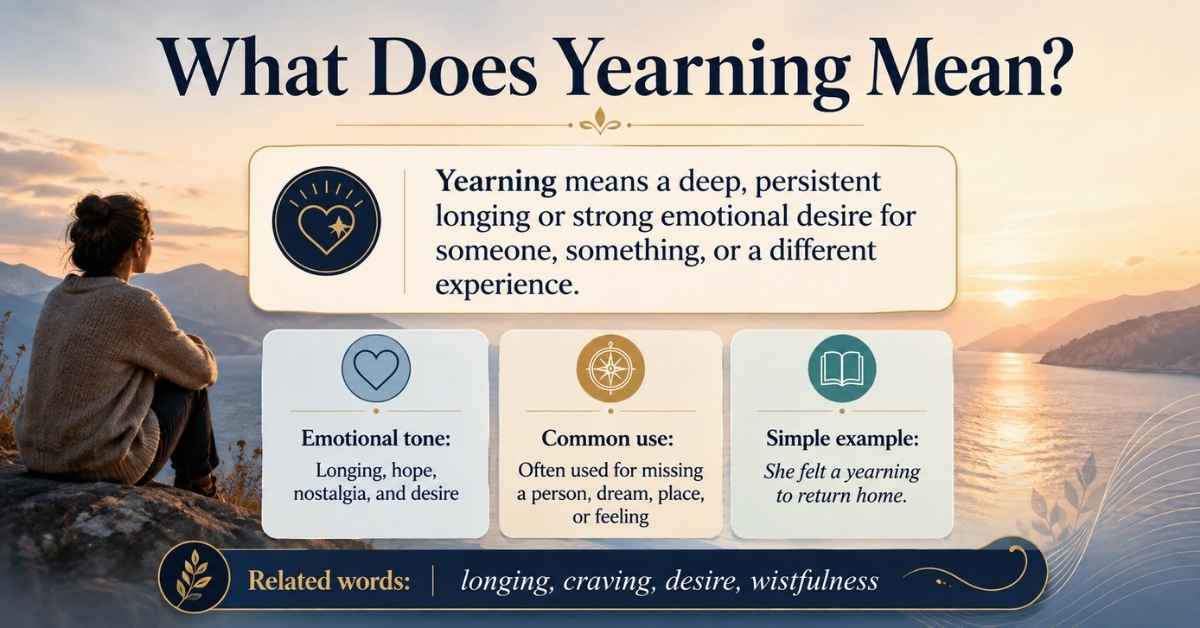
What does yearning mean? Yearning means feeling a deep, persistent, and emotionally powerful desire for someone or something, especially when it feels absent, distant, uncertain, lost, or difficult to attain. It is more intense than simply wanting something because it often combines hope, emotional importance, longing, and a sense of ache.
You can yearn for a person, your childhood home, a meaningful career, emotional closeness, freedom, peace, or even a future you have never experienced. Although the word often appears in romantic stories, yearning is not always about love.
The simplest way to understand it is through this emotional formula:
Yearning = deep desire + emotional importance + distance or absence + persistence
The desired person, place, experience, or outcome matters deeply, but something prevents complete fulfillment. That distance may be physical, emotional, practical, social, or permanent.
What Does Yearning Mean in Simple Words?
In simple words, yearning is wanting someone or something so deeply that its absence creates an emotional pull or ache.
A normal want may disappear quickly. You may want a cup of coffee, a new pair of shoes, or a quiet afternoon. Yearning usually lasts longer and carries more emotional weight.
For example, someone who moved far away may yearn for home. They do not merely want to visit a familiar location. They miss the people, language, food, routines, memories, and sense of belonging connected to that place.
The person may feel:
- Deep longing
- Emotional restlessness
- Hope for reunion or fulfillment
- Sadness caused by distance
- A repeated pull toward the desired person or outcome
- Tenderness mixed with frustration
Yearning can therefore feel both beautiful and painful.
A Simple Example of Yearning
Imagine a person who lives thousands of miles from their family.
They regularly think about shared meals, familiar voices, childhood streets, and family traditions. They hope to return, but work, money, or distance makes that difficult.
This person is not experiencing a passing wish. They feel a persistent emotional longing for home, which is a clear example of yearning.
Another example might involve a person who always dreamed of becoming a musician but chose a different career. Years later, they still imagine performing, writing songs, and living a creative life.
That repeated emotional desire may be described as a yearning for creative expression.
What Does Yearning Feel Like?
Yearning does not feel exactly the same for everyone. It may be quiet and reflective, or it may become intense and distracting.
Common emotional qualities include:
- Hope
- Tenderness
- Sadness
- Anticipation
- Frustration
- Vulnerability
- Restlessness
- Melancholy
- Emotional ache
- A sense that something important is missing
Someone may feel hopeful because the desired outcome remains possible. At the same time, they may feel sad because it has not happened yet.
This mixture of desire and distance is central to the meaning of yearning.
The Mental Side of Yearning
Yearning may affect what a person repeatedly thinks about.
They might:
- Imagine a future reunion
- Replay meaningful conversations
- Think about a missed opportunity
- Picture a different life
- Return mentally to old memories
- Notice reminders of the person or place they miss
- Wonder what might have happened under different circumstances
The imagination often strengthens yearning because it fills the space between present reality and desired possibility.
The Physical Side of Yearning
Some people describe yearning in physical language. They may experience:
- Tightness in the chest
- A heavy or hollow feeling
- Restlessness
- Difficulty concentrating
- A strong urge to move toward the desired outcome
- A feeling of being emotionally pulled
These sensations are not required for the word to apply. They are simply ways people sometimes experience intense longing.
Can Yearning Feel Good?
Yes. Yearning is not always entirely negative.
It can feel meaningful because it reveals what a person values deeply. It may inspire:
- Creative writing
- Music
- Art
- Personal growth
- Honest communication
- Travel
- Career changes
- Reconnection with family or culture
The feeling can also make anticipation emotionally powerful. This is one reason yearning is common in poetry, romance novels, films, and music.
However, prolonged uncertainty or nonfulfillment can make the same feeling painful.
What Makes Yearning Different From Ordinary Wanting?
The main difference is emotional intensity and persistence.
Wanting can be practical or temporary. Yearning usually involves something personally significant that remains absent, incomplete, or difficult to reach.
| Feeling | Core meaning | Typical emotional quality |
|---|---|---|
| Wanting | A general wish for something | May be brief or practical |
| Desire | A stronger wish or attraction | Broad and context-dependent |
| Longing | Sustained desire for something absent | Tender, sad, or hopeful |
| Yearning | Deep and persistent emotional longing | Hope mixed with ache, distance, or restlessness |
| Craving | An urgent appetite or need | Often physical or immediate |
| Pining | Suffering because a desire remains unfulfilled | Prolonged sadness or hopelessness |
Consider these examples:
- “I want a holiday” expresses a general preference.
- “I desire a more meaningful career” carries more emotional importance.
- “I yearn to return to the home I left as a child” suggests persistent longing, memory, and emotional distance.
The words overlap, but they create different emotional impressions.
Does Yearning Have to Be Unfulfilled?
Yearning does not have to involve something completely impossible, but some form of distance, limitation, absence, uncertainty, or incompleteness is usually present.
The desired person or experience may be:
- Temporarily unavailable
- Physically distant
- Emotionally distant
- Difficult but possible to reach
- Delayed by circumstances
- Permanently lost
- Present but incomplete
For example, someone may yearn to start a business even though doing so is possible. The barriers might include money, confidence, family responsibilities, or fear of failure.
The possibility exists, but the goal still feels distant.
Can You Yearn for Someone You Already Have?
Yes. A person can yearn for someone who is already part of their life.
They may yearn for:
- More emotional closeness
- Greater honesty
- Physical reunion after separation
- More affection
- Reassurance
- Better communication
- A return to an earlier relationship dynamic
In this situation, the person is not necessarily yearning for the partner’s physical presence. They may be yearning for a missing quality within the relationship.
Someone can also yearn for a partner during a business trip, military deployment, study program, or long-distance period, even when the relationship is loving and mutual.
Can Yearning Be Fulfilled?
Yes, but fulfillment may change the feeling.
When the desired outcome becomes real, yearning may turn into:
- Satisfaction
- Relief
- Contentment
- Gratitude
- A new form of desire
- Disappointment if reality differs from the imagined outcome
Sometimes people discover that they were yearning not only for a person or achievement, but for what it represented—such as safety, recognition, belonging, or freedom.
What Does It Mean to Yearn for Someone?
To yearn for someone means to feel a deep, continuing desire for their presence, affection, attention, closeness, or reciprocation.
Romantic yearning often develops when a person feels emotionally connected to someone but cannot experience the relationship in the way they desire.
Possible causes include:
- Physical separation
- Emotional distance
- Unrequited love
- Fear of rejection
- A breakup
- Uncertain feelings
- Social or family barriers
- Poor timing
- An emotionally unavailable partner
- A relationship that cannot progress
What Romantic Yearning Can Look Like
A person who yearns for someone may:
- Think repeatedly about seeing them
- Replay meaningful interactions
- Miss their voice or presence
- Imagine future conversations
- Hope for emotional closeness
- Notice small reminders of them
- Feel drawn to contact them
- Experience a mixture of hope and sadness
However, yearning is an internal emotion. It does not automatically determine how a person behaves.
What Yearning Does Not Prove
Feeling intense yearning does not prove that:
- The other person feels the same way
- The relationship would be healthy
- Both people are compatible
- The person is emotionally available
- The relationship is destined to happen
- Strong feelings should always be acted upon
Emotional intensity is not the same as mutuality, compatibility, or commitment.
A person’s feelings can be genuine while the relationship remains unrealistic, unavailable, or unsuitable.
Can Romantic Yearning Be Mutual?
Yes. Mutual yearning occurs when two people deeply want closeness but remain separated by fear, distance, timing, misunderstanding, duty, or circumstance.
This idea is common in slow-burn romance stories, where both characters care deeply but do not immediately express or act on their feelings.
In real life, however, mutuality should be based on communication and observable behavior rather than assumptions.
Is Yearning Always Romantic?
No. Yearning can involve almost anything that feels emotionally important.
The word may describe longing related to love, home, identity, purpose, freedom, achievement, grief, or spirituality.
Romantic Yearning
Romantic yearning is a deep desire for:
- Love
- Affection
- Intimacy
- Reunion
- Reciprocation
- Emotional connection
It often appears when closeness is delayed or uncertain.
Nostalgic Yearning
Nostalgic yearning is a longing for:
- Childhood
- A former home
- A previous relationship
- An earlier stage of life
- A lost tradition
- A past version of oneself
The past may feel emotionally meaningful because it represents safety, simplicity, family, or identity.
Homesick Yearning
Someone living away from home may yearn for:
- Family
- Familiar language
- Traditional food
- Local customs
- Childhood places
- Cultural belonging
This experience can involve both homesickness and nostalgia.
Aspirational Yearning
A person may feel a deep yearning for:
- Creative expression
- Career success
- Recognition
- Independence
- Adventure
- Justice
- Meaningful work
- A more authentic life
Aspirational yearning can motivate change, but it may also create frustration when progress feels slow.
Grief-Related Yearning
Grief can include a powerful longing to:
- See someone again
- Hear their voice
- Share another conversation
- Return to life before the loss
- Recover a sense of safety or normality
In this context, yearning may be especially painful because ordinary fulfillment is impossible.
Spiritual or Existential Yearning
Some people yearn for:
- Inner peace
- Faith
- Moral clarity
- Purpose
- Transcendence
- Connection with something greater
- A stronger sense of belonging
Religious, philosophical, and literary writing often uses yearning in this broader sense.
Yearning for a Life Never Lived
A person can also yearn for something they never actually experienced.
Examples include:
- A career they did not pursue
- A relationship that never began
- A country they have never visited
- A family life they imagined
- A more confident version of themselves
- A future that did not happen
This type of longing is often connected with possibility, imagination, regret, or identity.
Yearning vs. Longing
Yearning and longing are close synonyms, and people often use them interchangeably.
Both describe sustained desire for someone or something absent. However, yearning often suggests a stronger sense of:
- Emotional urgency
- Tenderness
- Restlessness
- Vulnerability
- Ache
- Personal significance
For example:
- “She felt a longing for home” sounds natural and emotionally warm.
- “She felt a deep yearning for home” sounds more intense and persistent.
The difference is one of emphasis rather than a strict rule.
Yearning vs. Desire
Desire is a broad word. It can refer to romantic attraction, personal ambition, material wants, physical needs, or practical preferences.
Yearning usually feels more emotionally charged and sustained.
A person may desire a promotion, but they may yearn for recognition after years of feeling overlooked.
Yearning vs. Craving
A craving is often an immediate, physical, or difficult-to-ignore urge.
People commonly crave:
- Food
- Sugar
- Nicotine
- Stimulation
- Physical comfort
Yearning usually involves an emotionally meaningful person, experience, place, relationship, or future.
Saying “I yearn for pizza” is possible as humorous exaggeration, but “I crave pizza” is usually more natural.
Yearning vs. Pining
Yearning describes the deep desire itself. Pining emphasizes the sadness or suffering created by unfulfilled desire.
Someone may yearn for a former partner while still living a healthy daily life.
Someone who is pining may appear consumed, weakened, or persistently unhappy because the relationship or reunion remains impossible.
Yearning vs. Missing Someone
Missing someone means feeling their absence.
Yearning for someone goes further. It includes a powerful desire for:
- Reunion
- Physical presence
- Affection
- Intimacy
- Attention
- Reciprocation
You may miss a colleague who left the company without deeply yearning for them. Yearning usually suggests greater emotional intensity.
Yearning vs. Nostalgia
Nostalgia is sentimental longing for the past.
Yearning can focus on:
- The past
- The present
- The future
- A person
- A place
- A goal
- A relationship
- An ideal
Nostalgia can therefore be one form of yearning, but yearning is much broader.
Yearning vs. Infatuation
Infatuation involves intense attraction, fascination, or excitement toward another person.
Yearning emphasizes what is absent or unfulfilled.
A person may feel infatuated with someone they see every day. They may begin yearning when emotional or physical closeness remains unavailable.
Yearning vs. Limerence
Yearning is a broad and normal human emotion.
Limerence is generally used to describe a more specific pattern that may include:
- Intrusive preoccupation
- Idealization
- Emotional dependence on perceived signals
- Strong desire for reciprocation
- Uncertainty about the other person’s feelings
- Mood changes based on small interactions
Yearning alone does not mean someone is experiencing limerence.
A person can feel deep longing without becoming consumed by intrusive thoughts or losing touch with reality.
Yearning vs. Obsession
Obsession usually suggests thoughts, urges, or behaviors that become difficult to control or interfere with daily functioning.
Yearning can be intense while remaining manageable.
A person may yearn for someone but still:
- Respect boundaries
- Maintain work and relationships
- Accept reality
- Avoid unwanted contact
- Make thoughtful decisions
The feeling itself is not the same as harmful behavior.
What Does “Yearner” Mean in Slang?
A yearner is someone who deeply experiences or openly expresses emotional or romantic longing.
Online, the term is often used affectionately or humorously to describe someone who:
- Loves deeply
- Romanticizes emotional connection
- Misses people intensely
- Enjoys slow-burn romance
- Expresses vulnerability
- Wants meaningful affection
- Refuses to pretend they do not care
A yearner may be a real person, a fictional character, or a humorous online identity.
What Does “Certified Yearner” Mean?
A certified yearner is a playful social-media label for someone who strongly identifies with emotional or romantic longing.
It may describe someone who enjoys:
- Unspoken affection
- Long-distance romance
- Emotional tension
- Lingering glances
- Love letters
- Slow-burn relationships
- Dramatic romantic music
- Stories about delayed fulfillment
It is not a medical or psychological term.
What Is “Yearner Energy”?
Yearner energy usually refers to behavior or personality associated with:
- Emotional openness
- Romantic idealism
- Affection
- Devotion
- Vulnerability
- Tenderness
- Dramatic but self-aware longing
The phrase may be sincere, humorous, or slightly exaggerated depending on the context.
What Does Yearning Mean on TikTok or BookTok?
On TikTok and BookTok, yearning often describes romantic tension created by:
- Lingering looks
- Almost-confessions
- Unsent messages or letters
- Forbidden attraction
- Physical separation
- Emotional restraint
- Mutual feelings left unspoken
- Delayed romantic fulfillment
Readers often praise fictional relationships for their yearning because the emotional tension makes the eventual connection feel more meaningful.
Yearning in Romance Books and Storytelling
Yearning is powerful in fiction because it creates a gap between what a character wants and what they can have.
That gap produces emotional tension.
Writers may create yearning through:
- Missed timing
- Social barriers
- Conflicting duties
- Fear of rejection
- Proximity without intimacy
- Unspoken affection
- Shared history
- Separation
- Private acts of care
- Almost-touching
- Almost-confessing
Yearning vs. Slow Burn
Yearning is an emotion. Slow burn is the pace at which a relationship or story develops.
A slow-burn romance often contains yearning, but the two terms are not identical.
Two characters may slowly develop affection without experiencing intense longing. Another story may feature powerful yearning immediately, even if the relationship never develops.
How Writers Can Describe Yearning Naturally
Strong emotional writing does not always require dramatic declarations.
Writers can show yearning through:
- What a character notices
- What they avoid saying
- How they react to absence
- Small acts of attention
- Memories they cannot release
- Physical distance
- Hesitation
- Repeated almost-moments
Specific details often feel more convincing than repeatedly using words such as ache, longing, or yearning.
Examples of Yearning in Writing
Subtle: She looked toward the empty chair before remembering he would not be there.
Romantic: He wanted to reach for her hand, but the space between them carried years of things left unsaid.
Nostalgic: The smell of rain carried her back to a home that existed only in memory.
Aspirational: Every unfinished sketch reminded him of the life he still hoped to claim.
Grief-related: For one quiet second, she yearned to hear his key turn in the door.
How to Use Yearning in a Sentence
Yearning is commonly used as a noun and as the present participle of the verb yearn.
Yearning for Someone or Something
Use yearning for before a person, place, object, quality, or outcome.
Examples:
- She felt a deep yearning for home.
- He could not hide his yearning for companionship.
- They shared a quiet yearning for a simpler life.
- Her yearning for freedom influenced every decision.
- His voice revealed a yearning for acceptance.
Yearning to Do Something
Use yearning to before a verb.
Examples:
- She had a yearning to travel.
- He felt a growing yearning to reconnect with his family.
- They shared a yearning to build a better future.
- She experienced a deep yearning to create something meaningful.
Using the Verb “Yearn”
Examples:
- She yearned for emotional closeness.
- He yearned to return home.
- They yearned for peace.
- The child yearned to be accepted.
- She yearned for a life that felt more authentic.
Descriptive Phrases
Common expressions include:
- A yearning look
- Yearning eyes
- A yearning voice
- A yearning heart
- Deep yearning
- Quiet yearning
- Secret yearning
- Unspoken yearning
- Romantic yearning
- Filled with yearning
Natural, Humorous, and Overwritten Usage
| Usage | Example | Evaluation |
|---|---|---|
| Natural | She yearned for emotional connection. | Clear and appropriate |
| Natural | He felt a deep yearning to return home. | Correct noun construction |
| Literary | His eyes held a quiet yearning. | Suitable for fiction |
| Humorous | I yearn for pizza. | Intentionally exaggerated |
| Vague | She was yearning. | Correct but lacks context |
| Overwritten | His soul burned with infinite cosmic yearning. | May sound melodramatic outside poetry |
Word Forms Related to Yearning
| Word | Part of speech | Meaning | Example |
|---|---|---|---|
| Yearn | Verb | To feel deep longing | She yearned for home. |
| Yearning | Noun or participle | A deep emotional desire | He felt a yearning for change. |
| Yearner | Noun | Someone who yearns | The character is a romantic yearner. |
| Yearningly | Adverb | In a way that shows longing | She looked yearningly toward the door. |
Yearningly is grammatically correct, but it is less common in everyday speech. Writers often prefer clearer phrases such as “with longing” or “with a yearning expression.”
How Do You Pronounce Yearning?
Yearning is pronounced approximately:
YUR-ning
It has two syllables:
- Year
- Ning
The first syllable receives the main stress.
Is Yearning Healthy or Unhealthy?
Yearning is a normal human emotion. It is not automatically healthy or unhealthy.
Its effect depends on:
- Intensity
- Duration
- Context
- Realism
- Behavior
- Personal boundaries
- Impact on daily life
When Yearning Can Be Constructive
Yearning may be helpful when it:
- Reveals what matters deeply
- Inspires creative work
- Motivates positive change
- Encourages honest communication
- Identifies an unmet emotional need
- Supports meaningful personal goals
- Creates appreciation for relationships or opportunities
For example, yearning for creative expression may encourage someone to begin painting, writing, or learning music.
When Yearning Can Become Difficult
Yearning may become emotionally disruptive when it:
- Dominates most waking thoughts
- Interferes with sleep, work, or study
- Causes a person to ignore reality
- Encourages idealization
- Prevents acceptance of clear rejection
- Leads to repeated boundary violations
- Damages existing relationships
- Creates severe or persistent distress
The problem is not simply feeling deeply. The concern is how the feeling affects behavior, judgment, boundaries, and daily functioning.
LEARN MORE: What Does SRT Mean?
Feeling Is Not the Same as Action
A person can acknowledge yearning without acting impulsively.
They may choose to:
- Respect another person’s boundaries
- Avoid unwanted contact
- Communicate honestly when appropriate
- Accept that a relationship is unavailable
- Focus on achievable needs
- Seek support when distress becomes overwhelming
A valid emotion does not automatically justify every action.
Why Do People Romanticize Yearning?
Yearning is often romanticized because it makes desire feel intense, meaningful, and emotionally significant.
Several factors contribute to its appeal:
Anticipation
Waiting can increase emotional tension. The possibility of fulfillment may feel exciting.
Uncertainty
When the outcome is unclear, the imagination remains active.
Idealization
Distance allows people to imagine the desired person or future without confronting every practical reality.
Emotional Restraint
Unspoken feelings can appear powerful because the emotion exists beneath the surface.
Delayed Fulfillment
Stories often feel more satisfying when characters struggle before reaching emotional resolution.
However, real relationships require more than intensity. They depend on:
- Communication
- Consent
- Reliability
- Compatibility
- Mutual effort
- Emotional availability
- Respect for boundaries
Strong yearning can make a relationship feel important, but it does not guarantee that the relationship is healthy or sustainable.
Practical Ways to Understand Your Own Yearning
You can understand yearning more clearly by examining what sits beneath it.
Identify What You Want
Ask whether you are yearning for:
- A person
- A place
- A relationship
- Recognition
- Safety
- Freedom
- A different career
- Closure
- Belonging
- A former version of life
Identify What It Represents
Sometimes the visible object is not the complete need.
For example:
- Yearning for an ex may represent a desire for familiarity or emotional safety.
- Yearning for home may represent belonging.
- Yearning for career success may represent recognition.
- Yearning for travel may represent freedom.
- Yearning for a relationship may represent connection or validation.
Identify the Distance
What separates you from the desired outcome?
The obstacle may be:
- Physical
- Emotional
- Financial
- Social
- Practical
- Temporary
- Permanent
- Based on uncertainty
Separate Reality From Imagination
Ask:
- What do I know?
- What am I assuming?
- What evidence supports my hope?
- Have I idealized the person or outcome?
- Am I longing for reality or for what it symbolizes?
This does not invalidate the feeling. It helps place it in a clearer context.
Decide Whether Meaningful Action Is Possible
Depending on the situation, constructive action may involve:
- Communicating respectfully
- Creating a realistic plan
- Developing a new skill
- Reconnecting with family
- Accepting a boundary
- Grieving what cannot return
- Redirecting the desire toward an achievable need
The Yearning Meaning Test
When you encounter the word yearning, use this seven-question framework:
- What is desired? A person, place, experience, relationship, identity, or future?
- Why is it emotionally important? What need, value, or memory does it represent?
- What creates the distance? Separation, loss, fear, uncertainty, timing, or impossibility?
- How persistent is the desire? Is it temporary, recurring, or long-lasting?
- What emotions accompany it? Hope, tenderness, sadness, frustration, nostalgia, or restlessness?
- Is it describing an emotion or behavior? Do not infer actions or mutual feelings from the word alone.
- Can “deep, persistent longing” replace it? If the sentence still makes sense, yearning is probably being used conventionally.
Common Mistakes to Avoid
Treating Every Want as Yearning
A brief preference usually does not have enough emotional weight to be yearning.
You may want a snack or crave coffee. You are more likely to yearn for home, love, meaning, freedom, or a different life.
Assuming Yearning Is Always Romantic
Yearning can involve careers, family, identity, faith, justice, home, creativity, or the past.
Assuming Strong Emotion Proves Love
Yearning may arise from:
- Love
- Attraction
- Loneliness
- Nostalgia
- Grief
- Idealization
- Uncertainty
- Emotional need
The intensity of the feeling does not identify its exact cause.
Assuming the Feeling Is Mutual
Someone’s own yearning does not prove that another person feels the same way.
Mutual interest requires communication and evidence.
Confusing It With Limerence
It is a broad emotion. Limerence refers to a narrower pattern of intense romantic preoccupation and desire for reciprocation.
Romanticizing Boundary Violations
Deep feelings do not justify pressure, unwanted pursuit, repeated messaging, or ignoring rejection.
Using This When Craving Is More Natural
Immediate physical urges are normally called cravings.
“Yearning for chocolate” may be used humorously, but “craving chocolate” is more natural in ordinary conversation.
Synonyms
Possible synonyms include:
- Longing
- Desire
- Pining
- Craving
- Wistfulness
- Hunger
- Thirst
- Aspiration
- Ache
- Wishfulness
- Homesickness
- Lovesickness
The best synonym depends on context.
Use:
- Longing for sustained emotional desire
- Pining when suffering is emphasized
- Craving for an urgent physical or immediate need
- Nostalgia for sentimental longing for the past
- Aspiration for a goal or ambition
- Homesickness for longing connected with home
Antonyms
Possible opposites include:
- Contentment
- Satisfaction
- Fulfillment
- Indifference
- Detachment
- Disinterest
- Aversion
There is no single perfect antonym for every sentence.
Contentment is often the best opposite when It means wanting something absent. Indifference works better when the opposite is a lack of emotional desire.
Real-Life Examples
Long-Distance Relationship
A person repeatedly imagines reuniting with a partner who lives abroad. They feel love, absence, hope, and emotional ache.
This is romantic yearning.
Unrequited Attraction
Someone deeply desires closeness with a friend who does not share the same romantic feelings.
The desire is yearning, while the lack of reciprocation makes it unrequited.
Existing Relationship
A person loves their partner but yearns for deeper communication and affection.
They are longing for a missing quality rather than an absent person.
Homeland
A migrant misses familiar food, language, traditions, relatives, and places.
This is homesick or nostalgic yearning.
Unrealized Career
An adult continues to imagine the artistic career they never pursued.
The repeated desire represents aspirational yearning.
Grief
A grieving person wishes to hear a loved one’s voice again.
This is a painful form of yearning connected with irreversible loss.
Personal Transformation
Someone yearns to become more confident, independent, or authentic.
The desired object is a future version of themselves.
Quick Knowledge Check
Someone briefly wants coffee after lunch. Is that yearning?
Usually not. Wanting or craving is more natural because the desire is immediate and physical.
Someone repeatedly imagines returning to their childhood country and feels sadness when thinking about it. What is this?
This is nostalgic or homesick yearning.
A fictional character loves someone but remains silent because of fear and social expectations. What creates the yearning?
The yearning develops through deep desire, restraint, uncertainty, and emotional distance.
Someone experiences intense feelings but accepts the other person’s rejection. Can the feeling still be yearning?
Yes. It describes the emotion. Respecting the rejection describes the person’s behavior.
Frequently Asked Questions
What does It mean in simple words?
It means deeply and persistently wanting someone or something that feels absent, distant, uncertain, or difficult to attain.
What does It feel like?
It may feel like hope, tenderness, sadness, restlessness, anticipation, or an emotional ache caused by wanting something important.
Is It stronger than desire?
It often sounds more emotionally intense and persistent than general desire, although the words can overlap.
Is It the same as longing?
They are close synonyms. It may place more emphasis on emotional urgency, tenderness, restlessness, or pain.
Does It have to be painful?
No. It can feel hopeful, romantic, inspiring, bittersweet, or painful depending on the situation.
Is This always unfulfilled?
Not always, but it usually involves some form of distance, limitation, uncertainty, absence, or incompleteness.
What does it mean to yearn for someone?
It means feeling a deep and continuing desire for their presence, affection, closeness, attention, or reciprocation.
Does It mean love?
Not necessarily. It can involve love, attraction, loneliness, grief, nostalgia, idealization, or a desire for connection.
Can It be mutual?
Yes. Two people may yearn for each other while remaining separated by distance, timing, fear, or circumstance.
Can you yearn for someone you are already with?
Yes. You may yearn for deeper intimacy, affection, communication, reassurance, or reunion during a separation.
Is It always romantic?
No. People can yearn for home, freedom, peace, purpose, belonging, creative expression, or a different future.
Can you yearn for something you never had?
Yes. A person can yearn for an imagined relationship, unrealized career, unvisited place, or future that never occurred.
Can you yearn for the past?
Yes. This for the past often overlaps with nostalgia.
Is It healthy?
It is a normal emotion. Its impact depends on its intensity, duration, context, behavior, and effect on daily life.
Is It the same as obsession?
No. Obsession generally involves thoughts or urges that become difficult to control or disruptive. It can remain intense without becoming obsessive.
What is the difference between yearning and limerence?
It is a broad emotional longing. Limerence commonly involves intrusive preoccupation, idealization, uncertainty, and a strong need for reciprocation.
What does yearner mean?
A yearner is someone who deeply experiences or openly expresses emotional or romantic longing.
What does certified yearner mean?
It is a playful online label for someone who strongly identifies with romantic longing, emotional intensity, or slow-burn affection.
What is yearner energy?
Yearner energy describes emotionally expressive, affectionate, idealistic, vulnerable, or romantically intense behavior.
What does It mean on TikTok?
On TikTok, It often refers to deep romantic longing, emotional restraint, delayed fulfillment, and visible desire for connection.
What is It in romance books?
In romance books, It is the emotional tension created when characters deeply want each other but cannot immediately be together.
What is the difference between yearning and slow burn?
It is an emotion. Slow burn describes the gradual pace at which a fictional or real relationship develops.
How do you use It in a sentence?
Example: She felt a deep yearning to return home.
Is It a noun or verb?
It can be a noun, as in “a yearning for home,” or a participle of the verb yearn, as in “she was yearning for change.”
What is the opposite of This?
Possible opposites include contentment, satisfaction, fulfillment, indifference, and detachment.
Conclusion
It means a deep, persistent, and emotionally significant desire for someone or something that feels absent, distant, uncertain, lost, or difficult to attain. It is stronger than a passing want because it often combines emotional importance with hope, imagination, and ache.
Remember these distinctions:
- Wanting may be brief or practical.
- Desire is a broad wish or attraction.
- Longing is sustained desire for something absent.
- Yearning adds emotional intensity, persistence, tenderness, or restlessness.
- Craving is often immediate or physical.
- Pining emphasizes suffering.
- Limerence involves a more intrusive and reciprocation-focused pattern.
The easiest way to recognize yearning is to ask four questions: What is desired, why does it matter, what creates the distance, and how persistently does the feeling return?