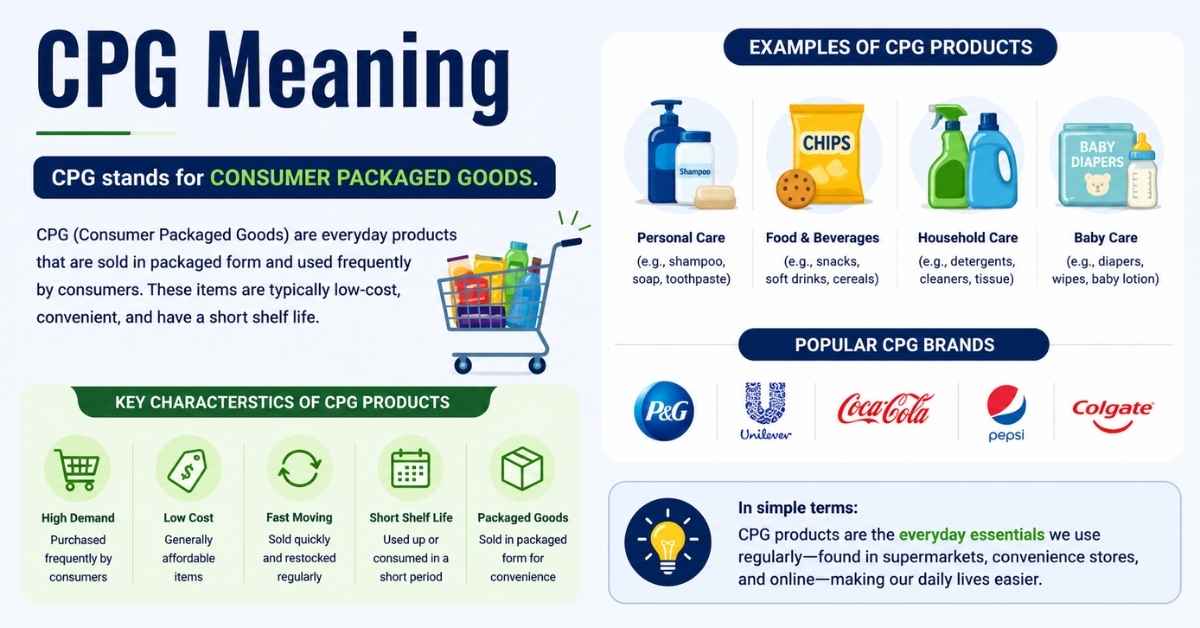
CPG meaning is Consumer Packaged Goods. These are everyday products that consumers buy, use, and replace regularly, such as food, beverages, toothpaste, shampoo, soap, cleaning supplies, cosmetics, and paper products. In business and retail, the term CPG refers to the industry that manufactures, markets, distributes, and sells these fast-moving consumer products. While Consumer Packaged Goods is the most common meaning, CPG can also stand for other terms in healthcare and specialized industries depending on the context.
Quick Answer
| Question | Answer |
|---|---|
| Full Form of CPG | Consumer Packaged Goods |
| Most Common Use | Business, Retail & Marketing |
| Similar Term | FMCG (Fast-Moving Consumer Goods) |
| Used By | Manufacturers, Retailers, Marketers, Supply Chain Professionals, Brand Managers |
Introduction
CPG meaning is Consumer Packaged Goods, a term used to describe products that people buy frequently, consume quickly, and replace regularly. Whether you’re reading a LinkedIn job description, browsing a marketing article, preparing for an interview, or learning about the retail industry, you’ve probably come across the acronym CPG.
Think about the products you use every day—a bottle of shampoo in your bathroom, a box of cereal in your kitchen, a tube of toothpaste, your favorite soft drink, or a pack of tissues. These everyday essentials all belong to the Consumer Packaged Goods (CPG) industry. Behind each item is a complex ecosystem involving manufacturing, packaging, inventory management, distribution, retail merchandising, consumer behavior analysis, and brand management.
However, many people become confused because CPG doesn’t always mean the same thing. In healthcare, for example, it often stands for Clinical Practice Guideline, while in other industries it may have different meanings. That’s why understanding the context is essential.
In this guide, you’ll learn what CPG means, why it matters, how the CPG industry works, examples of CPG products and companies, how it compares with FMCG, and why employers frequently ask for CPG experience. By the end, you’ll have a clear understanding of the term from both a consumer and business perspective.
What Does CPG Mean?
The Full Form of CPG
The full form of CPG is Consumer Packaged Goods.
These are physical products that consumers purchase frequently, use relatively quickly, and replace on a regular basis. Unlike durable goods such as furniture or appliances, CPG products have a shorter usage cycle and are designed for repeated purchases.
Some of the most common examples include:
- Toothpaste
- Soap
- Laundry detergent
- Bottled water
- Coffee
- Breakfast cereal
- Chocolate
- Shampoo
- Paper towels
- Baby diapers
These products may seem ordinary, but together they represent one of the world’s largest and most competitive industries.
A Simple Definition Anyone Can Understand
Imagine walking into a supermarket with a shopping list. Almost everything you place in your cart—snacks, milk, cleaning spray, tissues, shampoo, or pet food—is a Consumer Packaged Good.
A simple way to define CPG is:
Consumer Packaged Goods are everyday products that are packaged, sold to consumers, used within a relatively short period, and purchased repeatedly.
Unlike products you buy once every several years, such as a refrigerator or television, CPG products are consumed regularly and therefore require continuous production, marketing, and distribution.
Why the Term “Consumer Packaged Goods” Exists
The phrase Consumer Packaged Goods isn’t just a marketing buzzword—it serves a practical purpose.
Businesses needed a way to classify products that share similar characteristics:
- They are packaged for sale.
- They are purchased by individual consumers.
- They move through retail stores quickly.
- They require frequent replenishment.
- They depend heavily on branding and marketing.
Grouping these products under one category helps manufacturers, retailers, logistics providers, and marketers develop specialized strategies for production, inventory planning, promotions, and distribution.
Why This Industry Is Called CPG Instead of Something Else
The word “consumer” emphasizes that these products are intended for everyday buyers rather than industrial businesses.
The word “packaged” highlights that the items are prepared, labeled, and packaged before reaching store shelves.
Word “goods” simply refers to physical products sold in the marketplace.
Together, the term describes an industry centered around high-volume, repeat-purchase consumer products.
Where You’ll See the Term CPG in Everyday Life
Many people first encounter the term CPG without realizing what it means. Once you know where it’s commonly used, the acronym becomes much easier to understand.
On LinkedIn Job Listings
Recruiters frequently mention CPG experience when hiring for positions such as:
- Brand Manager
- Marketing Manager
- Category Manager
- Sales Representative
- Supply Chain Analyst
- Demand Planner
- Product Manager
When employers ask for CPG experience, they usually want candidates who understand how consumer products are developed, marketed, distributed, and sold through retail channels.
Example:
“Seeking a marketing manager with 5+ years of CPG industry experience.”
This doesn’t necessarily mean you’ve worked for a famous global brand—it means you understand the dynamics of selling products that consumers buy repeatedly.
Expert Insight: Experience with consumer brands, retail merchandising, trade promotions, and shopper marketing often counts as valuable CPG experience.
In Marketing and Advertising
Marketing professionals regularly discuss:
- CPG marketing
- Consumer behavior
- Brand loyalty
- Retail promotions
- Product launches
- Trade marketing
- Shopper marketing
Because consumers have many choices, CPG brands invest heavily in advertising, packaging design, pricing strategies, and promotional campaigns to encourage repeat purchases.
During Job Interviews
Interviewers often ask questions like:
- Have you worked in the CPG industry?
- How would you market a new CPG product?
- What challenges do CPG companies face?
- How do you analyze consumer buying behavior?
Understanding these concepts can help job seekers communicate more confidently during interviews.
In Retail Stores
Every supermarket, pharmacy, convenience store, and wholesale retailer is filled with Consumer Packaged Goods.
Common retail categories include:
- Groceries
- Frozen foods
- Dairy products
- Household cleaners
- Beauty products
- Personal care
- Baby products
- Pet supplies
- Paper products
Retailers constantly monitor inventory levels, shelf placement, and sales performance because CPG products move quickly.
In Business News
Business publications often report headlines such as:
- “CPG companies invest in AI.”
- “The CPG market continues to grow.”
- “Major CPG brands expand into e-commerce.”
- “Consumer packaged goods sales increase.”
These stories typically focus on how companies adapt to changing consumer preferences, technology, and market conditions.
In Company Reports
Annual reports from leading brands frequently reference:
- Consumer demand
- Brand performance
- Supply chain efficiency
- Inventory optimization
- Distribution channels
- Category growth
- Retail partnerships
Understanding the meaning of CPG makes these reports much easier to interpret.
In E-commerce
The growth of online shopping has transformed the CPG industry.
Consumers now purchase everyday essentials through:
- Grocery delivery apps
- Online marketplaces
- Brand websites
- Subscription services
- Mobile shopping apps
Modern CPG companies combine physical retail with e-commerce, creating an omnichannel retail experience that allows customers to shop whenever and wherever they prefer.
What Products Are Considered Consumer Packaged Goods?
One of the easiest ways to understand Consumer Packaged Goods is by looking at real-world examples.
Although product categories vary across regions, most CPG products share one important characteristic: they are purchased frequently and consumed relatively quickly.
Food & Beverages
This is the largest segment of the CPG industry.
Examples include:
- Breakfast cereal
- Rice
- Pasta
- Bread
- Coffee
- Tea
- Soft drinks
- Bottled water
- Juice
- Chocolate
- Frozen meals
- Yogurt
- Snacks
These items require continuous production because consumers buy them regularly.
Household Cleaning Products
Every home depends on cleaning products that fall under the Consumer Packaged Goods category.
Examples include:
- Laundry detergent
- Dishwashing liquid
- Surface cleaners
- Glass cleaner
- Floor cleaner
- Disinfectant sprays
- Air fresheners
These products are replaced frequently, making them ideal examples of CPG products.
Personal Care Products
Personal care is another major category within the CPG market.
Examples include:
- Shampoo
- Conditioner
- Soap
- Toothpaste
- Toothbrushes
- Deodorant
- Shaving cream
- Body wash
- Moisturizer
Consumers purchase these items repeatedly throughout the year.
Beauty & Cosmetics
Beauty brands are an important part of the Consumer Packaged Goods industry.
Products include:
- Foundation
- Lipstick
- Mascara
- Face cream
- Sunscreen
- Skincare products
- Makeup remover
Innovation, branding, and customer loyalty play a significant role in this category.
Baby Products
Parents regularly purchase:
- Baby diapers
- Baby wipes
- Baby lotion
- Formula
- Baby shampoo
These recurring purchases contribute significantly to the global CPG market.
Health & Wellness Products
Many over-the-counter wellness products also fall under the CPG umbrella.
Examples include:
- Vitamins
- Pain relievers
- First-aid supplies
- Nutritional supplements
- Electrolyte drinks
Because these items are packaged for consumer use and purchased regularly, they’re commonly classified as Consumer Packaged Goods.
Pet Care Products
Pet owners contribute to one of the fastest-growing segments of the industry by purchasing:
- Pet food
- Treats
- Cat litter
- Grooming products
- Pet hygiene supplies
Paper Goods
Essential household products include:
- Paper towels
- Toilet paper
- Facial tissues
- Napkins
These everyday necessities demonstrate the repetitive purchasing behavior that defines the CPG industry.
Examples of Consumer Packaged Goods
| Product | Is It a CPG Product? | Why? |
|---|---|---|
| Toothpaste | ✅ Yes | Purchased and replaced regularly |
| Shampoo | ✅ Yes | Everyday personal care product |
| Breakfast Cereal | ✅ Yes | Frequently consumed food item |
| Laundry Detergent | ✅ Yes | Household essential with repeat purchases |
| Bottled Water | ✅ Yes | Fast-moving consumer product |
| Pet Food | ✅ Yes | Regularly replenished household item |
| Lipstick | ✅ Yes | Packaged beauty product |
| Paper Towels | ✅ Yes | Disposable household product |
What Is a CPG Company?
A CPG company is a business that develops, manufactures, markets, distributes, and sells consumer packaged goods. Its success depends on understanding consumer needs, building strong brands, maintaining efficient supply chains, and ensuring products are consistently available wherever customers shop.
Unlike companies that sell durable goods purchased only occasionally, CPG businesses rely on high-volume, repeat purchases. Even small improvements in product quality, packaging, pricing, or shelf placement can have a significant impact because millions of units may be sold each year.
Common characteristics of successful CPG companies include:
- Strong brand management
- Extensive distribution networks
- Efficient inventory management
- Data-driven demand forecasting
- Continuous product innovation
- Effective shopper marketing and merchandising
How the CPG Industry Works: From Factory to Consumer
When people hear the term Consumer Packaged Goods (CPG), they often think only about the products sitting on supermarket shelves. In reality, every item has completed a long journey involving manufacturing, packaging, logistics, inventory management, retail partnerships, merchandising, and consumer demand forecasting before it reaches your shopping cart.
Understanding this process helps explain why the CPG industry is one of the most sophisticated sectors in the global economy.
1. Product Research and Development
Every successful CPG product starts with an idea.
Before launching a new product, companies conduct extensive research to understand:
- Consumer behavior
- Market trends
- Customer preferences
- Buying habits
- Competitor products
- Pricing opportunities
For example, if consumers begin demanding healthier snacks or eco-friendly packaging, CPG companies invest in developing products that meet those expectations.
2. Manufacturing
Once the product is finalized, manufacturing begins.
Factories produce thousands—or even millions—of units while maintaining strict quality standards.
Manufacturers focus on:
- Product consistency
- Food safety (where applicable)
- Quality control
- Production efficiency
- Cost management
Because Consumer Packaged Goods are sold in high volumes, even a small production delay can affect retailers worldwide.
3. Packaging
Packaging is much more than making a product look attractive.
It also protects the product, communicates important information, and influences purchasing decisions.
Modern CPG packaging is designed to:
- Protect products during transportation
- Display nutritional or ingredient information
- Strengthen brand identity
- Attract customers on store shelves
- Improve sustainability
Today, many brands are also investing in recyclable and environmentally friendly packaging as consumers become more conscious of sustainability.
4. Distribution and Logistics
After manufacturing, products move through an extensive distribution network.
This stage includes:
- Warehouses
- Distribution centers
- Transportation companies
- Wholesalers
- Retail partners
- E-commerce fulfillment centers
Efficient logistics ensure products reach stores before shelves become empty.
This is why inventory optimization and supply chain management are critical for every CPG company.
5. Retail Placement
Getting products into stores is only half the battle.
Brands also compete for the best shelf locations.
Retailers analyze:
- Sales history
- Consumer demand
- Category performance
- Seasonal trends
- Product profitability
Prime shelf placement often leads to higher sales, making category management and merchandising essential parts of the CPG business.
6. Consumer Purchase
When customers walk into a supermarket or browse an online store, they see only the final step of a much larger process.
Their purchasing decisions are influenced by:
- Price
- Packaging
- Brand recognition
- Promotions
- Product availability
- Customer reviews
- Advertising
This is where shopper marketing and brand equity become valuable competitive advantages.
7. Repeat Purchase Cycle
Unlike durable goods, CPG products are consumed quickly.
This creates a continuous buying cycle:
Need → Purchase → Use → Replenish → Repeat
Because repeat purchases drive revenue, brand loyalty is one of the most valuable assets for any CPG business.
How a CPG Product Reaches You
| Stage | What Happens? |
|---|---|
| Research | Consumer needs are identified |
| Product Development | Products are designed and tested |
| Manufacturing | Large-scale production begins |
| Packaging | Products are labeled and packaged |
| Distribution | Goods move through warehouses and logistics networks |
| Retail | Products are placed in physical and online stores |
| Consumer Purchase | Customers buy and use the product |
| Repeat Buying | The purchasing cycle continues |
Why CPG Products Are Different From Other Consumer Goods
Not every consumer product belongs to the CPG industry.
One of the biggest misconceptions is that all physical products are considered Consumer Packaged Goods.
In reality, products are classified based on how often consumers buy and replace them.
CPG Products
These are products consumers purchase frequently.
Examples include:
- Toothpaste
- Coffee
- Soap
- Shampoo
- Soft drinks
- Laundry detergent
- Paper towels
Characteristics:
- Low purchase price
- High purchase frequency
- Short lifespan
- Fast inventory turnover
Durable Goods
Durable goods last much longer.
Examples include:
- Refrigerators
- Washing machines
- Sofas
- Laptops
- Smartphones
- Cars
Characteristics:
- Higher cost
- Long lifespan
- Purchased infrequently
- Lower replacement frequency
Comparison Table
| Feature | CPG Products | Durable Goods |
|---|---|---|
| Purchase Frequency | High | Low |
| Lifespan | Short | Long |
| Replacement | Frequent | Rare |
| Price | Usually lower | Usually higher |
| Examples | Shampoo, cereal, soap | TV, furniture, refrigerator |
Understanding this difference helps explain why CPG marketing, inventory management, and distribution strategies differ significantly from those used for durable goods.
CPG vs. FMCG: Are They the Same?
One of the most common questions people ask after learning the CPG meaning is:
“Is CPG the same as FMCG?”
The short answer is:
Almost—but not exactly.
Although both terms describe products consumers buy regularly, there are subtle differences depending on geography and industry usage.
What Does FMCG Mean?
FMCG stands for Fast-Moving Consumer Goods.
The emphasis is on how quickly products are sold and replaced.
Examples include:
- Milk
- Bread
- Chips
- Soda
- Soap
- Toothpaste
What Does CPG Mean?
Consumer Packaged Goods emphasizes that products are:
- Packaged
- Sold to consumers
- Replenished frequently
The focus is more on the packaged nature of the products than on sales velocity.
Regional Differences
The terminology often depends on location.
- United States: CPG is the preferred term.
- Europe: FMCG is more common.
- Asia: FMCG is widely used.
- International companies: Often use both interchangeably.
CPG vs. FMCG Comparison
| Feature | CPG | FMCG |
|---|---|---|
| Full Form | Consumer Packaged Goods | Fast-Moving Consumer Goods |
| Primary Focus | Packaged consumer products | High sales velocity |
| Common Usage | United States | Europe, Asia, Global Markets |
| Product Types | Everyday packaged goods | Frequently purchased goods |
| Examples | Shampoo, cereal, toothpaste | Similar products |
For most practical purposes, the two terms refer to nearly the same industry, though regional preferences influence which acronym companies use.
Why the CPG Industry Is So Important
The Consumer Packaged Goods industry touches nearly every household.
From the moment you wake up until you go to bed, you’re likely to use dozens of CPG products without giving them much thought.
A typical day might include:
- Brushing your teeth
- Drinking coffee
- Washing clothes
- Cooking dinner
- Cleaning your home
- Feeding your pet
Each of these everyday activities depends on products created by CPG companies.
A Major Contributor to the Economy
The industry supports millions of jobs worldwide across:
- Manufacturing
- Retail
- Marketing
- Supply chain
- Distribution
- Logistics
- Product development
- Data analytics
- Customer service
Because consumer demand remains relatively stable, the CPG sector is often considered one of the most resilient parts of the global economy.
LEARN MORE: CBFW Meaning
Constant Innovation
Consumer preferences change rapidly.
Today’s shoppers increasingly value:
- Sustainable packaging
- Health-conscious products
- Organic ingredients
- Personalized experiences
- Digital shopping convenience
To remain competitive, CPG brands continuously innovate by improving products, introducing new flavors, redesigning packaging, and embracing new technologies.
Strong Brand Competition
Consumers often choose between similar products based on:
- Trust
- Familiarity
- Quality
- Price
- Packaging
- Availability
This intense competition explains why companies invest heavily in brand management, consumer insights, and shopper marketing.
Careers in the CPG Industry
One reason many people search for CPG meaning in business is because they’ve encountered the acronym in job descriptions.
The Consumer Packaged Goods industry offers career opportunities across numerous specialties.
Brand Management
Brand managers oversee the growth of individual products.
Responsibilities include:
- Product positioning
- Advertising campaigns
- Consumer research
- Product launches
- Market analysis
Marketing
Marketing teams focus on:
- Digital marketing
- Advertising
- Consumer behavior
- Social media campaigns
- Brand awareness
- Promotional strategies
Sales
Sales professionals build relationships with:
- Retailers
- Wholesalers
- Distributors
- Supermarkets
- Convenience stores
Their goal is to ensure products remain widely available.
Supply Chain
Supply chain specialists coordinate:
- Inventory
- Warehousing
- Transportation
- Procurement
- Distribution
- Demand planning
Efficient supply chains reduce costs while improving customer satisfaction.
Product Development
Innovation teams create:
- New products
- Improved formulas
- Better packaging
- Sustainable alternatives
They work closely with consumer research teams to identify emerging trends.
Data Analytics
Modern CPG companies rely heavily on data.
Analysts examine:
- Consumer purchasing behavior
- Sales performance
- Market trends
- Inventory levels
- Promotional effectiveness
These insights help companies make smarter business decisions.
Popular CPG Careers
| Role | Primary Responsibility | Key Skills |
|---|---|---|
| Brand Manager | Grow product brands | Marketing, Strategy |
| Marketing Manager | Promote products | Advertising, Consumer Insights |
| Sales Manager | Increase retail sales | Negotiation, Relationship Building |
| Supply Chain Analyst | Optimize logistics | Inventory, Planning |
| Category Manager | Improve retail performance | Merchandising, Analytics |
| Product Manager | Develop new products | Innovation, Market Research |
| Data Analyst | Analyze consumer trends | Statistics, Business Intelligence |
Why Employers Ask for “CPG Experience”
If you’ve ever applied for a marketing, sales, or retail role, you’ve probably seen a requirement like:
“2–5 years of CPG experience preferred.”
This often confuses applicants who aren’t sure whether their background qualifies.
In most cases, employers want candidates who understand the unique dynamics of selling products that consumers purchase repeatedly.
They value experience with:
- Consumer behavior
- Retail partnerships
- Category management
- Trade promotions
- Brand management
- Demand forecasting
- Inventory planning
- Merchandising
- Product launches
For example, someone who has worked with grocery brands, household cleaning products, cosmetics, beverages, or personal care items may already have relevant CPG experience, even if they never used the acronym in their job title.
Understanding what recruiters mean can help you better tailor your résumé, highlight transferable skills, and prepare more confidently for interviews.
Practical Examples of CPG in Everyday Life
One of the easiest ways to understand the CPG meaning is by looking at the products you interact with every day. Most people use dozens of Consumer Packaged Goods without realizing they belong to one of the world’s largest industries.
Let’s look at a few real-life scenarios.
Example 1: Your Morning Routine
Before leaving home, you might use:
- Toothpaste
- Toothbrush
- Shampoo
- Body wash
- Deodorant
- Moisturizer
- Coffee
- Breakfast cereal
Every one of these products is a Consumer Packaged Good because it is packaged, purchased regularly, and replaced after use.
Example 2: Grocery Shopping
Imagine walking into a supermarket with your weekly shopping list.
Your cart might include:
- Milk
- Bread
- Eggs
- Rice
- Pasta
- Bottled water
- Frozen vegetables
- Chips
- Soft drinks
- Yogurt
- Cooking oil
- Cleaning spray
- Laundry detergent
- Paper towels
These products are manufactured, packaged, distributed, stocked on shelves, and purchased repeatedly—making them classic CPG products.
Example 3: Online Shopping
Today, consumers don’t just buy Consumer Packaged Goods from physical stores.
Many people order:
- Pet food
- Vitamins
- Coffee pods
- Protein bars
- Baby diapers
- Household cleaners
- Beauty products
through e-commerce platforms, subscription services, and brand websites.
This shift toward omnichannel retail has transformed how CPG companies interact with customers.
Example 4: Pharmacy Purchases
A quick visit to the pharmacy often includes:
- Pain relievers
- Vitamins
- First-aid supplies
- Cough syrup
- Hand sanitizer
- Sunscreen
These products are typically classified as Consumer Packaged Goods because they are purchased frequently and consumed over time.
Example 5: Pet Care
Pet owners regularly purchase:
- Dog food
- Cat food
- Treats
- Cat litter
- Pet shampoo
These recurring purchases represent another fast-growing segment of the CPG industry.
How to Identify a Consumer Packaged Good
If you’re unsure whether a product belongs to the CPG industry, ask yourself these questions:
- ✔️ Is it packaged for consumers?
- ✔️ Is it purchased frequently?
- ✔️ Does it need to be replaced after use?
- ✔️ Is it sold through retail stores or e-commerce?
- ✔️ Is it intended for everyday consumer use?
If the answer to most of these questions is yes, it’s likely a Consumer Packaged Good.
Key Terms You Should Know Alongside CPG
Understanding CPG meaning becomes much easier when you’re familiar with other common business and retail terms that are closely related.
| Term | Meaning |
|---|---|
| CPG (Consumer Packaged Goods) | Everyday packaged products purchased and replaced regularly by consumers. |
| FMCG (Fast-Moving Consumer Goods) | Products sold quickly and replenished frequently; often used interchangeably with CPG outside the U.S. |
| Retail | The sale of goods directly to consumers through physical or online stores. |
| Supply Chain | The complete process of producing, transporting, and delivering products to customers. |
| Inventory Management | Monitoring and controlling stock levels to avoid shortages or excess inventory. |
| Distribution | Moving products from manufacturers to warehouses, retailers, and consumers. |
| Logistics | Planning and managing transportation, storage, and product movement efficiently. |
| Brand Management | Building, maintaining, and growing a product’s reputation and market position. |
| Category Management | Managing groups of related products to improve sales and customer satisfaction. |
| Merchandising | Displaying and promoting products to encourage purchases. |
| Consumer Behavior | Studying how and why people make buying decisions. |
| Demand Forecasting | Predicting future customer demand using sales data and market trends. |
| Shopper Marketing | Marketing strategies designed to influence customers at the point of purchase. |
| Brand Equity | The value and trust consumers associate with a brand. |
| SKU (Stock Keeping Unit) | A unique code used to identify and track individual products. |
| Omnichannel Retail | Providing a seamless shopping experience across physical stores, websites, apps, and marketplaces. |
| Direct-to-Consumer (DTC) | Selling products directly to customers without traditional retail intermediaries. |
Learning these terms gives you a broader understanding of how the Consumer Packaged Goods industry operates and why it remains one of the most competitive sectors worldwide.
Frequently Asked Questions
What does CPG stand for?
CPG stands for Consumer Packaged Goods. These are everyday products that consumers purchase, use, and replace regularly, such as food, beverages, toiletries, household cleaners, and personal care items.
What is a CPG company?
A CPG company manufactures, markets, distributes, and sells Consumer Packaged Goods. These businesses focus on products with high purchase frequency and rely on strong branding, efficient supply chains, and retail partnerships.
What products are considered CPG?
Examples of CPG products include:
- Toothpaste
- Shampoo
- Soap
- Coffee
- Soft drinks
- Breakfast cereal
- Paper towels
- Laundry detergent
- Pet food
- Cosmetics
- Baby diapers
Is CPG the same as FMCG?
They are very similar but not always identical.
CPG (Consumer Packaged Goods) is the preferred term in the United States, while FMCG (Fast-Moving Consumer Goods) is more commonly used in Europe, Asia, and many international markets. Both refer to products that consumers buy and replace frequently.
Why is it called Consumer Packaged Goods?
The term describes products that are:
- Intended for consumers
- Packaged before sale
- Purchased repeatedly
- Sold through retail stores or online channels
The name distinguishes these items from industrial goods and long-lasting durable products.
Is Amazon a CPG company?
No. Amazon is primarily an e-commerce and technology company, not a traditional CPG company. However, it sells millions of Consumer Packaged Goods and also offers some private-label consumer products.
Is Coca-Cola a CPG company?
Yes. Coca-Cola is one of the world’s best-known CPG companies because it produces packaged beverages that consumers purchase regularly.
What does CPG mean in healthcare?
In healthcare, CPG commonly stands for Clinical Practice Guideline. These are evidence-based recommendations that help healthcare professionals make informed clinical decisions.
What does CPG mean in gaming?
In gaming, CPG may have different meanings depending on the game or community. Unlike the business definition, there is no universally accepted gaming expansion, so the context is essential.
What jobs are available in the CPG industry?
Popular careers include:
- Brand Manager
- Marketing Manager
- Sales Manager
- Category Manager
- Supply Chain Analyst
- Demand Planner
- Product Manager
- Data Analyst
- E-commerce Manager
- Consumer Insights Specialist
Why do employers ask for CPG experience?
Recruiters often seek candidates who understand:
- Consumer behavior
- Brand management
- Retail operations
- Merchandising
- Demand forecasting
- Inventory management
- Trade promotions
- Supply chain processes
Experience in these areas demonstrates familiarity with the fast-paced nature of the Consumer Packaged Goods industry.
Is every packaged product considered a CPG?
Not necessarily. While most everyday packaged items qualify, expensive products purchased infrequently—such as televisions or refrigerators—are generally classified as durable goods, not Consumer Packaged Goods.
Key Takeaways
If you remember only a few things about CPG meaning, make them these:
- CPG stands for Consumer Packaged Goods.
- These are everyday products that consumers purchase, use, and replace regularly.
- Common examples include food, beverages, personal care products, household cleaners, cosmetics, paper goods, and pet supplies.
- CPG companies rely on brand management, supply chain efficiency, inventory management, consumer insights, merchandising, and marketing to succeed.
- CPG and FMCG are closely related terms, with regional differences in usage.
- Understanding the term is valuable for job seekers, marketers, retailers, business students, and anyone interested in consumer industries.
- In healthcare, CPG can also mean Clinical Practice Guideline, so context always matters.
Conclusion
Understanding the CPG meaning goes beyond simply knowing that it stands for Consumer Packaged Goods. It represents an industry that powers everyday life by delivering the products consumers rely on—from breakfast foods and beverages to personal care items, cleaning supplies, and household essentials.
Whether you’re exploring a career in the CPG industry, preparing for a job interview, studying marketing or retail, or simply trying to understand a business acronym you’ve seen online, knowing how Consumer Packaged Goods fit into the broader retail ecosystem provides valuable insight into how products are created, marketed, distributed, and purchased.
As consumer expectations continue to evolve, CPG companies are embracing artificial intelligence, data analytics, omnichannel retail, sustainable packaging, demand forecasting, and direct-to-consumer strategies to remain competitive. For professionals, students, and curious consumers alike, understanding these concepts offers a stronger foundation for navigating the modern business landscape.