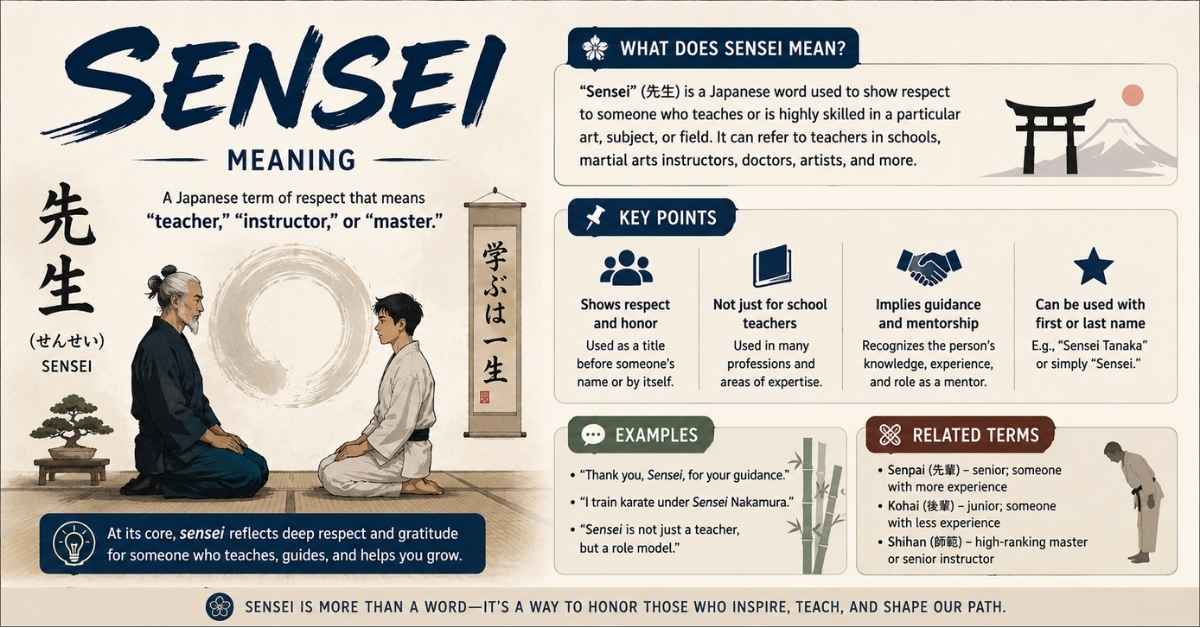
Sensei meaning is “teacher” or “one who came before,” but its true significance goes far beyond a simple translation. In Japanese culture, Sensei (先生) is an honorific title used to show respect for people who possess knowledge, experience, and expertise. While it is commonly associated with school teachers and martial arts instructors, the title is also used for doctors, lawyers, professors, artists, writers, and other respected professionals.
If you’ve ever watched anime, practiced karate, or studied Japanese, you’ve probably heard someone say “Sensei.” Many people assume it simply means “master” or “teacher,” but that’s only part of the story. Understanding the sensei meaning in Japanese requires looking at the language, culture, etiquette, and traditions behind the word.
In this guide, you’ll learn what does sensei mean, its literal meaning, origin, pronunciation, correct usage, differences between Sensei vs. Senpai, common myths, and how Japanese people actually use the title in everyday life.
What Does “Sensei” Mean?
The simplest sensei definition is “teacher” or “instructor.” However, in Japan, the word carries a much deeper meaning than its English translation.
A Sensei is someone who has gained knowledge, experience, wisdom, or professional expertise and is respected for guiding or educating others. Rather than describing a job title, Sensei is an honorific—a respectful way of addressing someone whose skills or experience deserve recognition.
Unlike many Western titles, becoming a Sensei isn’t about receiving a formal promotion. Instead, it’s about earning the respect of students, clients, or the community through years of dedication and learning.
The Simple Definition
In everyday English, Sensei is commonly translated as:
- Teacher
- Instructor
- Mentor
- Educator
- Respected expert
Although these translations are helpful, none fully capture the cultural significance of the Japanese term.
Literal Meaning of Sensei (先生)
The word Sensei is written in Japanese as 先生.
It consists of two kanji characters:
| Kanji | Meaning |
|---|---|
| 先 (Sen) | Before, ahead, earlier |
| 生 (Sei) | Life, birth, living |
When combined, 先生 literally means:
“One who was born before.”
This doesn’t mean someone is older in age. Instead, it refers to someone who has gone before others in learning, experience, or professional development.
In Japanese society, people who have walked a path before you are respected because they can provide guidance based on their experience. This philosophy is one of the reasons the title Sensei carries such importance.
Expert Insight: The literal translation explains the origin of the word, but its modern cultural meaning emphasizes respect, knowledge, and mentorship rather than age.
Why “Teacher” Is Only Part of the Meaning
Many dictionaries define Sensei as teacher, but this translation is incomplete.
A classroom teacher is certainly a Sensei, yet so are many professionals outside education.
For example, in Japan, you may hear people respectfully address:
- A physician as Sensei
- A university professor as Sensei
- A lawyer as Sensei
- A manga artist as Sensei
- A martial arts instructor as Sensei
This broad usage highlights an important distinction: Sensei is not limited to teaching in a classroom. It recognizes individuals whose expertise benefits others.
Think of Sensei as someone who teaches through knowledge, skill, guidance, and experience, whether in a school, a hospital, a courtroom, or a dojo.
Where Did the Word “Sensei” Come From?
Understanding the sensei meaning in Japanese becomes much easier when you explore its history.
The title has existed for centuries and reflects one of Japan’s core cultural values: respecting those who dedicate their lives to learning and helping others.
Unlike many modern professional titles, Sensei has deep linguistic and historical roots that continue to shape its meaning today.
Historical Origins in Japan
The word Sensei originated from Classical Chinese, where the same characters referred to someone who was “born before” and therefore possessed greater knowledge and wisdom.
As Chinese writing influenced Japan, the characters 先生 became part of the Japanese language. Over time, the meaning shifted from simply indicating seniority to recognizing individuals who had developed exceptional expertise in a particular field.
Historically, the title was used for:
- Scholars
- Philosophers
- Teachers
- Religious leaders
- Physicians
As Japanese society evolved, the honorific expanded to include other respected professionals while retaining its core idea of acknowledging experience and learning.
How the Meaning Has Evolved Over Time
Today, Sensei is no longer limited to traditional education.
Modern Japanese speakers commonly use the title for professionals who guide, advise, or educate others, including:
- School teachers
- University lecturers
- Medical doctors
- Lawyers
- Politicians
- Artists
- Novelists
- Manga creators
- Martial arts instructors
This evolution demonstrates that the title reflects professional respect rather than a specific occupation.
Why the Term Represents Respect Rather Than Rank
One of the biggest misconceptions is that Sensei is a rank.
It isn’t.
Unlike military titles or martial arts belt levels, Sensei is an honorific form of address.
For example:
- A karate instructor may be called Sensei, regardless of belt color.
- A doctor becomes Sensei because of professional expertise—not because the title is part of a ranking system.
- A university professor may be addressed as Sensei, even though their academic rank is something entirely different.
This distinction is important because many English speakers mistakenly assume Sensei means “master.”
In reality, the title reflects respect for someone’s knowledge and experience, not superiority over others.
Did You Know? In Japanese culture, showing respect through language is an essential part of everyday communication. Honorifics such as Sensei, Senpai, and -san help reflect social relationships and courtesy.
Who Is Called a Sensei in Japan?
Many people outside Japan believe only martial arts instructors are called Sensei.
That belief is largely influenced by movies, anime, and popular culture.
In reality, the title is used much more broadly across Japanese society.
Anyone who has developed recognized expertise and serves as a guide, educator, or trusted professional may be addressed as Sensei.
School Teachers
Perhaps the most familiar example is a classroom teacher.
From elementary school through high school, students typically address their teachers as Sensei.
Rather than using “Mr.” or “Mrs.,” students simply say:
- Tanaka Sensei
- Suzuki Sensei
The title reflects appreciation for the teacher’s role in educating and guiding students.
Martial Arts Instructors
Outside Japan, this is where most people first encounter the word.
Whether someone practices:
- Karate
- Judo
- Aikido
- Kendo
- Iaido
their instructor is often respectfully addressed as Sensei.
However, it’s important to remember that Sensei is not a martial arts rank. A black belt alone does not automatically make someone a Sensei. The title is typically used for instructors who teach and mentor students.
University Professors
In Japanese universities, professors and lecturers are commonly called Sensei.
Students may address professors this way during lectures, office hours, research discussions, and academic correspondence.
The title recognizes their expertise and contributions to education.
Doctors and Medical Professionals
One fact that surprises many learners is that doctors are also called Sensei in Japan.
Patients often use the title when speaking with physicians because medical professionals dedicate years to mastering their field and helping others.
This demonstrates that Sensei is associated with professional expertise, not simply teaching.
Lawyers and Legal Experts
Attorneys, judges, and other legal professionals may also be addressed as Sensei.
Their specialized knowledge, education, and responsibility for advising others make the title appropriate within Japanese culture.
Artists, Writers, and Manga Creators
Many famous authors and manga creators are affectionately called Sensei by readers and fans.
The title acknowledges years of creativity, skill, and contribution to their craft.
For example, manga artists are frequently referred to as Sensei in interviews, publications, and fan communities as a sign of admiration and respect.
Other Respected Professionals
Depending on the situation, Sensei may also be used for:
| Profession | Commonly Called “Sensei”? | Why |
|---|---|---|
| School Teacher | ✅ Yes | Educates students |
| Martial Arts Instructor | ✅ Yes | Teaches skills and discipline |
| University Professor | ✅ Yes | Academic expertise |
| Doctor | ✅ Yes | Medical knowledge |
| Lawyer | ✅ Yes | Legal expertise |
| Judge | ✅ Yes | Professional authority |
| Manga Artist | ✅ Often | Creative expertise |
| Novelist | ✅ Often | Literary contribution |
| Politician | Sometimes | Respectful professional address |
The common thread is knowledge, experience, and the ability to guide others.
When Should You Use the Title “Sensei”?
Knowing what does Sensei mean is only half the story. Using the title correctly is equally important.
Japanese culture places great value on respectful language, and using honorifics appropriately helps build positive relationships.
Correct Situations
Use Sensei when addressing someone who is widely recognized as a teacher or respected professional, such as:
- Your school teacher
- A university professor
- A martial arts instructor
- A physician
- A lawyer
- An accomplished artist or writer in contexts where the title is customary
If you’re in Japan or interacting with Japanese speakers, following local customs is generally the most respectful approach.
Situations Where You Should Avoid It
Not everyone with knowledge or experience is automatically called Sensei.
Avoid using the title:
- For friends or classmates
- As a substitute for every professional title
- Without understanding the cultural context
- When someone prefers another form of address
Using Sensei indiscriminately can sound unnatural or overly formal.
Can You Call Yourself Sensei?
In Japanese etiquette, people do not normally refer to themselves as “Sensei.”
The title is something others use to show respect. Calling yourself Sensei can be perceived as boastful or inappropriate because honorifics are meant to be given by others, not claimed.
Common Etiquette Mistakes Foreigners Make
If you’re learning Japanese or practicing martial arts, avoid these common errors:
- Assuming Sensei means only “master.”
- Believing every black belt is automatically a Sensei.
- Calling yourself Sensei.
- Using the title for every older person.
- Forgetting that Sensei is an honorific, not a formal rank.
Quick Checklist: Should You Call This Person “Sensei”?
✅ Do they teach, mentor, or guide others in a recognized professional or educational role? ✅ Are they commonly addressed as Sensei within Japanese culture or your organization? ✅ Are you using the title as a sign of respect, not as a description of status?
If the answer is yes, then Sensei is usually the appropriate and respectful form of address.
Learn More: Ohio Slang Meaning
Does Sensei Mean “Teacher” or “Master”?
One of the most common questions people ask is, “Does sensei mean teacher or master?” The confusion comes from English translations, martial arts movies, and anime, where the title is sometimes interpreted differently.
The short answer is:
Sensei does not literally mean “master.” It is most accurately translated as “teacher,” “instructor,” “mentor,” or “one who came before.” More importantly, it is an honorific title that expresses respect for a person’s knowledge, experience, and guidance.
Understanding this distinction helps you use the term naturally and respectfully.
Why Many English Translations Are Misleading
When Japanese words are translated into English, some of their cultural meaning is lost.
Many websites simplify the sensei definition to teacher, while others incorrectly translate it as master. Both translations capture only part of the meaning.
A classroom teacher is certainly a Sensei, but so are many professionals who don’t teach in a traditional classroom. Likewise, calling every Sensei a “master” can create misunderstandings because the title does not automatically imply supreme authority or a formal rank.
Japanese honorifics often reflect relationships rather than exact job titles. In the case of Sensei, the relationship is one of learning, guidance, and respect.
Teacher vs. Master vs. Mentor
To understand the sensei meaning in English, it helps to compare similar words.
| Term | Meaning | Best Used For |
|---|---|---|
| Teacher | Someone who educates others | Schools, universities |
| Instructor | Someone who teaches practical skills | Martial arts, training, workshops |
| Mentor | Someone who guides through experience | Professional and personal development |
| Master | Someone with exceptional mastery or authority | Traditional crafts or certain martial arts contexts |
| Sensei | A respected teacher, instructor, mentor, or expert | Japanese culture, education, professions, martial arts |
As you can see, Sensei overlaps with several English words, but no single translation captures its complete cultural meaning.
What Native Japanese Speakers Actually Mean
When Japanese people say Sensei, they are rarely thinking about the English word teacher.
Instead, they’re expressing respect toward someone who has:
- Knowledge
- Experience
- Professional expertise
- The ability to guide others
Whether the person is teaching students, treating patients, or writing bestselling novels, the title reflects appreciation for their expertise.
This is why a physician, lawyer, or manga creator can all be called Sensei.
Myth vs. Fact
| Myth | Fact |
|---|---|
| Sensei means master. | Sensei usually means teacher, mentor, or respected professional, not master. |
| Only martial arts instructors are called Sensei. | Teachers, doctors, lawyers, professors, artists, and many other professionals may also be addressed as Sensei. |
| Sensei is a rank. | It is an honorific title, not a belt rank or official position. |
| Every black belt is automatically a Sensei. | Teaching ability and recognized leadership matter more than belt color. |
| You can introduce yourself as Sensei. | In Japanese etiquette, others use the title to address you; you don’t normally use it for yourself. |
Sensei vs. Other Japanese Titles
Japanese has many respectful forms of address, and each one has a different purpose. Understanding these differences prevents common mistakes and gives you a better appreciation of Japanese honorifics.
Sensei vs. Senpai
This is one of the most misunderstood comparisons.
A Senpai is someone who joined a school, company, sports club, or organization before you. They have more experience in that specific environment but are not necessarily your teacher.
A Sensei, on the other hand, is someone who teaches, mentors, or possesses recognized professional expertise.
Example
- Your karate instructor = Sensei
- The senior student helping beginners = Senpai
Simply put:
- Senpai = Senior peer
- Sensei = Teacher or respected expert
Sensei vs. Shihan
Another title commonly seen in martial arts is Shihan.
While Sensei is a respectful way of addressing an instructor, Shihan generally refers to a highly accomplished senior instructor recognized for exceptional teaching ability.
Not every Sensei is a Shihan, but many Shihan are also addressed as Sensei.
Sensei vs. Sifu (Chinese)
People often compare Sensei with Sifu, but they come from different cultures.
- Sensei belongs to Japanese traditions.
- Sifu comes from Chinese martial arts and culture.
Although both titles express respect for a teacher or mentor, they have different linguistic origins and cultural meanings.
Sensei vs. Professor
In English-speaking countries, “Professor” is an academic rank.
In Japan, however, university professors are often addressed simply as Sensei.
This highlights another important point:
Sensei is a respectful form of address, not an official job title.
Sensei vs. Instructor
An instructor teaches specific skills.
A Sensei teaches skills while also earning respect through experience, knowledge, and mentorship.
This subtle distinction explains why Sensei carries more cultural weight than the English word instructor.
Quick Comparison Table
| Title | Meaning | Typical Context | Focus |
|---|---|---|---|
| Sensei | Teacher, mentor, respected professional | Schools, martial arts, medicine, law | Respect and expertise |
| Senpai | Senior member | Schools, companies, clubs | Experience within a group |
| Shihan | Senior master instructor | Advanced martial arts | Leadership and teaching authority |
| Sifu | Teacher or master | Chinese martial arts | Traditional mentorship |
| Professor | Academic position | Universities | Formal educational role |
How “Sensei” Is Used in Martial Arts
For many people around the world, sensei meaning in martial arts is the first definition they encounter.
While martial arts have helped popularize the title internationally, its use is rooted in Japanese traditions of respect, discipline, and lifelong learning.
Karate
In karate, students usually address their instructor as Sensei.
The title reflects appreciation for the instructor’s experience, technical ability, and responsibility for developing students both physically and mentally.
Karate emphasizes values such as:
- Respect
- Discipline
- Patience
- Humility
- Continuous improvement
These values align perfectly with the deeper meaning of Sensei.
Judo
Judo practitioners also commonly address instructors as Sensei.
The relationship extends beyond teaching throws and techniques. A Sensei is expected to model discipline, ethics, and perseverance while helping students develop character.
Aikido
In Aikido, the instructor is typically called Sensei because they guide students through both technical practice and personal growth.
Many dojos emphasize that martial arts are about more than physical ability—they are also about developing self-control and respect for others.
Kendo
Kendo schools likewise use Sensei for instructors.
Students are encouraged to respect not only the instructor’s knowledge but also the years of dedication required to master the art.
Taekwondo (When It Is and Isn’t Used)
Although Taekwondo originated in Korea, some international schools influenced by Japanese martial arts traditions use Sensei informally.
However, traditional Korean terminology generally uses titles such as Sabom or Sabomnim instead.
Using the correct title shows respect for the cultural origins of each martial art.
Is Sensei a Rank?
This question appears frequently in search results.
The answer is no.
A Sensei is not a belt level or official martial arts rank.
Someone may hold a high black belt but not teach students.
Likewise, someone recognized as a respected instructor is often addressed as Sensei because of their role as a teacher, not because of a specific rank.
Expert Note: Different martial arts organizations may have their own traditions, but in general, Sensei reflects respect for teaching and mentorship rather than technical rank.
How Japanese People Use “Sensei” in Everyday Life
Outside Japan, many people associate Sensei almost exclusively with martial arts.
Inside Japan, however, the title appears in many everyday situations.
Understanding these real-life examples helps learners appreciate how naturally the word fits into Japanese society.
Schools
Students address teachers as Sensei throughout their education.
For example:
“Good morning, Tanaka Sensei.”
This is the normal and respectful way to speak to teachers in Japanese schools.
Hospitals
Patients often address doctors as Sensei.
Example:
“Thank you, Sensei.”
The title acknowledges the doctor’s expertise and professional responsibility rather than suggesting that the doctor teaches classes.
Universities
University professors are also commonly addressed as Sensei during lectures, seminars, and research meetings.
Graduate students may use the title throughout their academic careers.
Law Offices
Lawyers are frequently called Sensei, especially by clients and colleagues.
This reflects respect for their legal knowledge and years of specialized education.
Creative Industries
Accomplished authors, illustrators, and manga creators are often referred to as Sensei by editors, publishers, students, and fans.
For example, manga readers frequently refer to famous creators as “Sensei” to recognize their artistic achievements.
Everyday Conversations
Here are a few simple examples of natural usage:
At School
Student: “Good morning, Sato Sensei.”
Teacher: “Good morning. Please take your seats.”
At a Dojo
Student: “Sensei, could you show me that technique again?”
Instructor: “Of course. Watch my foot placement carefully.”
At a Hospital
Patient: “Thank you, Sensei. Your advice was very helpful.”
At a University
Student: “Sensei, may I ask a question about today’s lecture?”
These examples illustrate that Sensei is woven into daily communication wherever knowledge, guidance, and professional expertise are respected.
See More: Cyber Sigilism Explained
Why Anime and Manga Made “Sensei” Famous Worldwide
If you’ve watched popular anime or read manga, you’ve almost certainly heard the word Sensei. Series such as Naruto, Jujutsu Kaisen, My Hero Academia, Assassination Classroom, and many others have introduced millions of viewers to this Japanese honorific.
While anime has made the term globally recognizable, it has also created a few misunderstandings about the sensei meaning.
Common Anime Examples
Anime characters frequently use Sensei when addressing:
- School teachers
- Martial arts instructors
- Mentors
- Doctors
- Experts in a particular field
For example:
- Students call their classroom teacher Sensei.
- Ninja apprentices call experienced mentors Sensei.
- Artists and manga creators are sometimes referred to as Sensei in interviews and behind-the-scenes content.
These examples reflect genuine Japanese usage, although the context may vary depending on the story.
Does Anime Use the Word Correctly?
Most of the time, yes.
Anime generally uses Sensei in the same respectful way that Japanese speakers do in real life. However, because many anime focus on schools or martial arts, international viewers may mistakenly believe the title is limited to those settings.
In reality, Sensei is also widely used for doctors, lawyers, university professors, writers, and other respected professionals.
Misconceptions Created by Pop Culture
Anime has unintentionally spread several myths.
Some viewers believe:
- Sensei means master.
- Only martial arts instructors can be called Sensei.
- Every skilled fighter is automatically a Sensei.
- Sensei is a martial arts rank.
These assumptions aren’t accurate.
The title represents respect for knowledge, expertise, and guidance, not fighting ability or seniority alone.
Quick Tip: Anime is an excellent way to hear authentic Japanese honorifics, but it’s always worth understanding the cultural context behind the words.
How to Pronounce “Sensei” Correctly
Correct pronunciation helps you use the word naturally and respectfully.
English Pronunciation
The closest English pronunciation is:
Sen-say
The stress is usually placed gently on the second syllable.
Japanese Pronunciation
Japanese pronunciation is smoother and more even:
Sen-sei
Each syllable receives nearly equal emphasis.
Common Pronunciation Mistakes
Avoid saying:
- “Sen-see”
- “Seen-say”
- “Sen-sigh”
These pronunciations sound unnatural to native Japanese speakers.
Pronunciation Tip: Think of “sen” as in send (without the “d”) and “sei” as sounding like say.
Common Myths About the Word “Sensei”
The popularity of Japanese culture has led to several misconceptions. Let’s separate fact from fiction.
| Myth | Reality |
|---|---|
| Sensei means “master.” | It usually means teacher, mentor, or respected professional, not master. |
| Only martial arts instructors are Sensei. | Teachers, professors, doctors, lawyers, artists, and many other experts may also be called Sensei. |
| Sensei is a rank. | No. It is an honorific title, not a belt rank or official position. |
| Anyone with a black belt is a Sensei. | Teaching responsibility and recognized expertise matter more than belt color. |
| You should introduce yourself as Sensei. | In Japanese etiquette, others give you the title—you don’t normally use it for yourself. |
| Sensei has a separate female version. | No. Sensei is gender-neutral and used for both men and women. |
Understanding these myths helps you use the word accurately and respectfully.
Real-Life Examples of Using “Sensei”
Learning vocabulary is easier when you see it used in everyday situations.
In a Classroom
Student: Good morning, Tanaka Sensei.
Teacher: Good morning, everyone. Let’s begin today’s lesson.
In a Dojo
Student: Sensei, could you explain this technique one more time?
Instructor: Certainly. Watch how your balance changes during the movement.
At a Hospital
Patient: Thank you, Sensei. I appreciate your advice.
Doctor: You’re welcome. Please follow the treatment plan and come back next week.
At a Law Office
Client: Thank you for your guidance, Sensei.
Lawyer: I’ll prepare the necessary documents and explain the next steps.
At a University
Student: Sensei, may I ask a question about today’s lecture?
Professor: Of course. That’s an excellent question.
These simple conversations show that Sensei naturally fits many professional settings—not just martial arts schools.
Quick Comparison Table
| Title | Meaning | Commonly Used For | Purpose |
|---|---|---|---|
| Sensei | Teacher, mentor, respected professional | Teachers, professors, doctors, lawyers, martial arts instructors | Showing respect for expertise |
| Senpai | Senior member | Schools, clubs, companies | Respecting someone with more experience in the same group |
| Shihan | Senior instructor | Advanced martial arts | Recognizing high-level teaching authority |
| Sifu | Teacher or master (Chinese) | Chinese martial arts | Respecting a teacher in Chinese traditions |
| Teacher | Educator | Schools | General English term |
Frequently Asked Questions
What does Sensei literally mean?
The literal meaning of Sensei (先生) is “one who came before” or “one who was born before.” In modern Japanese, it refers to someone whose knowledge and experience deserve respect.
Does Sensei mean teacher or master?
The most accurate translation is teacher, mentor, or respected instructor. Although some people translate it as master, that translation can be misleading because Sensei is an honorific rather than a title of supreme authority.
Is Sensei a rank?
No. Sensei is not a martial arts belt rank or official professional title. It is a respectful way of addressing someone who teaches or has recognized expertise.
Can foreigners be called Sensei?
Yes. If a foreign teacher, professor, or martial arts instructor serves in a role where the title is customary, students or colleagues may respectfully address them as Sensei.
Can you call yourself Sensei?
Generally, no. In Japanese culture, honorifics are given by others as a sign of respect. Referring to yourself as Sensei is usually considered inappropriate.
Why are doctors called Sensei in Japan?
Doctors spend many years developing specialized medical knowledge and helping others. The title Sensei acknowledges their professional expertise and respected role in society.
Is there a female version of Sensei?
No. Sensei is a gender-neutral title used for both men and women.
How do you pronounce Sensei?
The closest English pronunciation is:
Sen-say
In Japanese, both syllables are pronounced evenly:
Sen-sei
Is Sensei only used in martial arts?
Not at all.
The title is widely used for:
- Teachers
- Professors
- Doctors
- Lawyers
- Artists
- Writers
- Politicians
- Martial arts instructors
Why do anime characters say Sensei so often?
Many anime are set in schools, training academies, or environments where respected mentors play important roles. Using Sensei reflects authentic Japanese language and etiquette.
What is the difference between Sensei and Senpai?
A Sensei teaches or mentors others through recognized expertise.
A Senpai is simply someone who joined a school, company, or organization earlier and has more experience within that group.
Is “Sensei” used outside Japan?
Yes.
Today, the title is commonly used around the world in:
- Karate schools
- Judo clubs
- Aikido dojos
- Japanese language classes
- Cultural organizations
Its usage outside Japan generally follows Japanese traditions of respect.
Conclusion
The sensei meaning is much richer than simply “teacher.” At its heart, Sensei represents respect, lifelong learning, mentorship, and professional expertise. Whether you’re addressing a school teacher, martial arts instructor, doctor, lawyer, or university professor, the title acknowledges someone who has walked the path before you and is willing to share their knowledge with others.
As Japanese language and culture continue to influence people around the world through education, martial arts, travel, and anime, understanding the true meaning of Sensei becomes more than learning a vocabulary word—it’s about appreciating a cultural tradition that values humility, wisdom, and respect. By using the title appropriately and understanding its deeper significance, you’ll not only speak more accurately but also show genuine respect for one of Japan’s most meaningful honorifics.