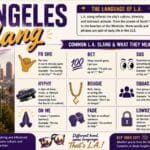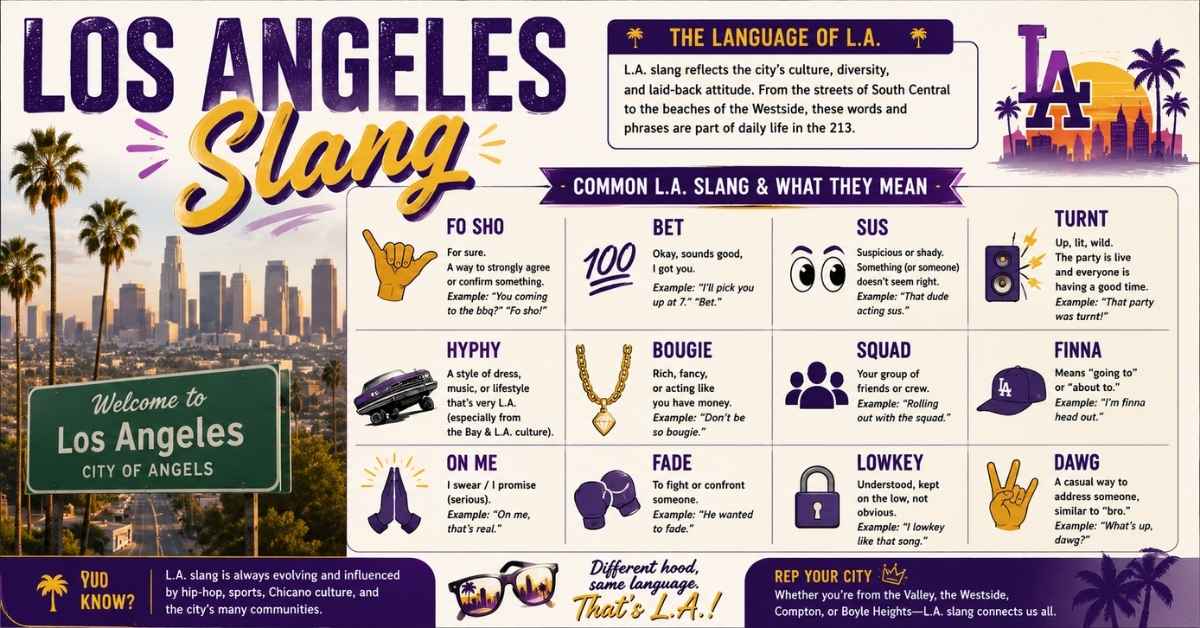
Los Angeles slang is the collection of informal words, phrases, and expressions commonly used by people across Los Angeles. Influenced by Hollywood, hip-hop, Latino culture, surf and skate communities, social media, and Southern California’s diverse neighborhoods, LA slang reflects the city’s unique identity and constantly evolving culture. Whether you’re visiting the city, moving there, writing authentic dialogue, or simply curious about LA slang, this guide explains what these expressions mean, who uses them, and how to use them naturally in everyday conversations.
Unlike a typical glossary, this guide goes beyond simple definitions. You’ll discover real-life examples, learn which phrases are still popular in 2026, understand the cultural stories behind them, and avoid outdated expressions that can make conversations feel unnatural. By the end, you’ll have a much better understanding of how people really talk in Los Angeles.
What Is Los Angeles Slang?
Los Angeles slang refers to the casual language and local expressions that have developed throughout the city over decades. Because Los Angeles is one of the world’s most culturally diverse cities, its vocabulary is shaped by many different communities rather than a single dialect.
You’ll hear influences from:
- West Coast English
- African American Vernacular English (AAVE)
- Mexican American and Chicano culture
- Surf culture
- Skateboarding communities
- Hollywood and the entertainment industry
- Street fashion
- Music scenes
- TikTok and internet culture
This mix makes LA slang one of the most recognizable regional varieties of American English.
Many expressions that started in Los Angeles have eventually spread across the United States through movies, television, rap music, influencers, and social media. However, plenty of phrases still carry a distinctly local flavor that reflects the city’s lifestyle and cultural diversity.
Why Los Angeles Has One of America’s Most Influential Regional Dialects
Few cities have influenced modern English as much as Los Angeles. Every day, millions of people around the world consume content created in or inspired by the city, from blockbuster films and streaming series to podcasts, music videos, and viral TikTok clips.
When celebrities, musicians, athletes, and creators use certain expressions repeatedly, those phrases often become part of everyday speech far beyond Southern California.
Several factors continue to shape Los Angeles slang:
- The global reach of Hollywood
- The city’s thriving music industry
- Rich multicultural communities
- Skateboarding and surfing lifestyles
- Youth culture
- Digital creators and influencers
- Fashion trends
- Sports culture
Because language constantly evolves, modern LA slang also changes quickly. Some words remain popular for decades, while others disappear within a few years as new expressions emerge online.
How Movies, Music, and Social Media Shape LA Slang
Entertainment has always been one of Los Angeles’ strongest cultural exports. A phrase heard in a hit movie, chart-topping song, or viral video can quickly become recognizable across the globe.
Today’s Los Angeles slang words often spread through:
- Netflix series
- Hollywood films
- Hip-hop artists
- YouTube creators
- TikTok trends
- Instagram Reels
- Twitch streamers
- Podcasts
- Professional athletes
- Influencers
This explains why many people recognize certain LA expressions even if they’ve never visited California.
However, it’s important to remember that what becomes popular online isn’t always representative of how every local speaks. Language differs across age groups, neighborhoods, professions, and communities.
Is Los Angeles Slang Different From California Slang?
One of the biggest misconceptions is that Los Angeles slang and California slang are exactly the same. While they overlap, they’re not interchangeable.
| Los Angeles Slang | General California Slang |
|---|---|
| Strong influence from entertainment and music | Shared across many California cities |
| More diverse due to multicultural communities | Often broader and statewide |
| Includes neighborhood-specific expressions | Less region-specific |
| Frequently evolves through pop culture | Changes more gradually |
| Often reflects urban life | Includes coastal, suburban, and rural influences |
Think of it this way: all Los Angeles slang is part of California slang, but not all California slang originates in Los Angeles.
The Most Common Los Angeles Slang Words You’ll Actually Hear
Instead of listing random vocabulary alphabetically, let’s explore the Los Angeles slang words locals genuinely use in everyday conversations.
For each expression, you’ll learn:
- Meaning
- Example
- Who commonly uses it
- Current popularity
- When to use it
Everyday Greetings & Casual Expressions
What’s Good?
Meaning: A casual way of asking “What’s happening?” or “How are you?”
Example:
“Hey, what’s good? Haven’t seen you in a while.”
Who Uses It
Popular among younger speakers and frequently heard in urban communities throughout Los Angeles.
Current Usage: ⭐⭐⭐⭐⭐ Very Common
Yo
Although used nationwide, “Yo” remains one of the easiest ways to greet friends casually.
Example
“Yo, you heading downtown later?”
Best Used
- Friends
- Classmates
- Casual conversations
What’s Up?
Simple, friendly, and timeless.
You’ll hear it nearly everywhere—from college campuses to coffee shops.
Example
“What’s up? Ready for the game?”
Current Popularity: ⭐⭐⭐⭐⭐
Sup?
A shortened version of “What’s up?”
Often used in text messages and quick conversations.
Example
“Sup? You around?”
Words for Friends and People
Homie
One of the most recognizable Los Angeles slang words.
Meaning
A trusted friend or close companion.
Example
“That’s my homie—we grew up together.”
Current Usage
Still widely used throughout Southern California.
Bro
Originally associated with surfing culture, “bro” has become part of everyday conversation across Los Angeles.
Example
“Bro, traffic today was unbelievable.”
Common Among
- Students
- Surfers
- Athletes
- Young professionals
Fam
Short for family, but used for close friends.
Example
“Appreciate you, fam.”
It expresses familiarity and trust rather than literal family ties.
Dude
Perhaps the most famous California expression.
Despite its age, “dude” remains surprisingly common.
Example
“Dude, you have to check out that taco place.”
It works for nearly any casual conversation.
Compliments and Positive Reactions
Fire
Meaning
Excellent, impressive, or exciting.
Example
“That new album is fire.”
Current Usage: ⭐⭐⭐⭐⭐
Extremely common across younger generations.
Clean
Used when something looks stylish, neat, or well-designed.
Example
“Those sneakers are clean.”
You’ll hear this in conversations about:
- Fashion
- Cars
- Homes
- Photography
- Design
Sick
Despite sounding negative, “sick” usually means something is extremely good.
Example
“That skate trick was sick.”
Popular among skateboarding and surfing communities.
Legit
Means genuine, impressive, or trustworthy.
Example
“That restaurant is legit.”
It can describe:
- Businesses
- Skills
- Food
- People
- Experiences
Dope
Although decades old, “dope” continues to appear in casual conversations.
Example
“That’s a dope jacket.”
Still common within music, fashion, and creative circles.
Expressions for Surprise or Disbelief
No Way
One of the simplest yet most common reactions.
Example
“No way! You actually met that actor?”
For Real?
Used when expressing surprise or asking for confirmation.
Example
“For real? You moved to LA last week?”
Wild
Describes something unbelievable or unexpected.
Example
“That story is wild.”
Current popularity has grown significantly through social media.
Crazy
Depending on context, it may mean:
- Amazing
- Shocking
- Unexpected
Example
“Traffic was crazy this morning.”
Food, Lifestyle & Weekend Vocabulary
Los Angeles has a vibrant food culture, so casual conversations often revolve around trying new places, grabbing coffee, or finding the best taco truck.
Grab a Bite
Rather than saying “eat lunch,” locals often say:
“Let’s grab a bite.”
Simple, casual, and extremely common.
Brunch
While not exclusive to Los Angeles, brunch culture is deeply woven into the city’s weekend lifestyle.
Example
“We’re meeting for brunch in Silver Lake.”
Taco Run
A spontaneous trip to grab tacos, especially late at night.
Example
“Who’s down for a taco run?”
It reflects Los Angeles’ strong Mexican culinary influence.
Hang Out
One of the most frequently used expressions in everyday LA conversations.
Example
“We’re just hanging out at the beach.”
Simple, natural, and timeless.
Driving, Traffic & City Life
If there’s one thing nearly every Angeleno talks about, it’s traffic. Living in a city where commuting is part of daily life has shaped its conversational vocabulary.
Gridlock
Meaning: Heavy, slow-moving traffic where vehicles can barely move.
Example
“The freeway was in complete gridlock after work.”
Although it’s not exclusive to Los Angeles, you’ll hear it often because of the city’s famous traffic congestion.
The 405
One of the most recognizable roadway references in Southern California.
Locals often include the article “the” before freeway numbers, saying:
- The 405
- The 101
- The 10
- The 5
For example:
“Avoid the 405 around rush hour.”
This naming style is a distinctive feature of Southern California speech and one visitors quickly notice.
Los Angeles Slang by Community and Culture
One of the biggest mistakes people make is assuming there’s a single version of Los Angeles slang. In reality, Los Angeles is home to hundreds of neighborhoods and communities, each contributing unique vocabulary, pronunciation, and expressions.
From South LA to East LA, from beach towns to the San Fernando Valley, the way people speak reflects their cultural background, age, interests, and social circles. That’s why you’ll hear different LA slang depending on where you are and who you’re talking to.
Understanding this diversity helps you appreciate the language without reducing it to stereotypes.
Hip-Hop and Urban Culture Influences
Few cultural movements have shaped Los Angeles slang words as much as hip-hop. Artists, DJs, producers, dancers, and local communities have introduced expressions that later became part of everyday American English.
Common examples include:
Lit
Meaning: Exciting, energetic, or extremely fun.
Example
“That concert was lit.”
Current Popularity: ⭐⭐⭐⭐⭐
Although used nationwide today, it’s still common in casual conversations throughout Los Angeles.
Bet
Meaning: Okay, sounds good, or I agree.
Example
“Meet at seven?”
“Bet.”
It’s short, natural, and frequently used in text messages.
Lowkey
Meaning: Quietly, secretly, or somewhat.
Example
“I lowkey want pizza tonight.”
It softens opinions without making them sound too strong.
Highkey
The opposite of lowkey, meaning openly or strongly.
Example
“I’m highkey excited for the game.”
Learn More: Baddie Girl Meaning
Latino Community Contributions
Los Angeles has one of the largest Latino populations in the United States, and Spanish has naturally influenced everyday conversation.
Many bilingual speakers switch between English and Spanish effortlessly, creating a conversational style often called code-switching.
You may hear familiar Spanish words such as:
- Amigo
- Carnal
- Órale
- Mijo
- Prima
- Abuela
Whether these expressions appear depends on family traditions, neighborhood, and social context. Not every Angeleno uses them, but they are an important part of the city’s linguistic identity.
Understanding these influences helps explain why Los Angeles expressions often differ from slang used elsewhere in California.
Surf and Beach Culture
Southern California’s coastline has influenced language for generations.
Many words associated with surf culture eventually became part of mainstream American English.
Stoked
Meaning: Extremely excited.
Example
“I’m stoked for tomorrow’s beach trip.”
Even outside surfing communities, it’s still widely understood.
Gnarly
Originally used by surfers to describe difficult waves.
Today it can mean:
- Incredible
- Intense
- Dangerous
- Extreme
Example
“That mountain road was gnarly.”
Rad
Short for radical.
Although considered nostalgic by some, it’s still heard occasionally in relaxed beach communities.
Example
“That’s a rad view.”
Skateboarding Culture
Los Angeles helped shape modern skateboarding, and its vocabulary reflects that influence.
Bail
Meaning: To jump off a skateboard before falling or to leave unexpectedly.
Example
“I had to bail before I hit the curb.”
Shred
Meaning: To skateboard or surf exceptionally well.
Example
“She absolutely shredded at the skatepark.”
Session
Refers to spending time practicing skateboarding or surfing.
Example
“We’re having a sunset skate session.”
Hollywood and Entertainment Industry Language
Living near one of the world’s entertainment capitals has introduced unique expressions into everyday conversation.
Audition
Not slang itself, but in Los Angeles you’ll hear it used casually.
“I’ve got three auditions this week.”
Wrap
Means finishing filming for the day.
Example
“We wrapped at midnight.”
Pilot
A television episode created to pitch a new series.
“She’s working on a new pilot.”
Even people outside the industry often recognize these terms because entertainment plays such a large role in Los Angeles culture.
College and Young Adult Slang
Universities and social media have accelerated the spread of new expressions across Los Angeles.
Common examples include:
Vibe
Meaning: Atmosphere or feeling.
Example
“This café has a great vibe.”
Vibing
Relaxing, enjoying the moment, or getting along well.
Example
“We’re just vibing at the beach.”
Ghost
To suddenly stop replying to someone.
Example
“He ghosted everyone after graduation.”
Flex
Showing off achievements or possessions.
Example
“That’s a weird flex.”
Usually used humorously.
Popular Los Angeles Slang Phrases You’ll Hear in Real Conversations
Learning complete phrases makes it much easier to understand how people talk in Los Angeles than memorizing individual words.
“I’m Down.”
Meaning
I’m interested. I’m willing.
Example
“Want tacos tonight?”
“I’m down.”
One of the most common casual responses throughout Southern California.
“That’s On Me.”
Meaning
I take responsibility.
Example
“Sorry I was late. That’s on me.”
This phrase has become increasingly common among younger speakers.
“Say Less.”
Meaning
You don’t need to explain anymore. I understand.
Example
“Need help moving?”
“Say less.”
It’s confident, casual, and widely recognized.
“No Cap.”
Meaning
I’m being completely honest.
Example
“That burger was the best I’ve had, no cap.”
Although popular nationwide, it’s frequently heard among younger Angelenos.
“I’m Dead.”
No, it doesn’t literally mean someone has died.
Instead, it expresses extreme laughter.
Example
“That video was hilarious. I’m dead.”
Mostly used online and in casual conversations.
“It’s Giving…”
A newer internet-inspired expression.
Meaning
Something reminds you of a particular mood, style, or personality.
Example
“It’s giving old Hollywood.”
Widely used on TikTok and Instagram.
Slang You’ll Hear in Different Parts of Los Angeles
Although Los Angeles slang overlaps across the city, local communities often develop their own speech patterns.
These aren’t strict rules—people move, interact, and influence one another—but understanding regional tendencies adds valuable context.
West Los Angeles
You’ll often hear conversations centered around:
- Beach life
- Fitness
- Coffee culture
- Wellness
- Surfing
Common expressions include:
- Stoked
- Chill
- Vibe
- Bro
East Los Angeles
The area’s rich Mexican American heritage has shaped everyday language through bilingual conversations and cultural traditions.
Code-switching between English and Spanish is common among many families and friend groups.
South Los Angeles
Music, sports, entrepreneurship, and neighborhood culture continue to influence conversational language.
Many expressions that later spread nationally gained popularity through communities in South LA.
The San Fernando Valley
Popular culture often associates “Valley Girl” speech with this area, though modern language is far more diverse than that stereotype suggests.
You’ll hear plenty of contemporary slang alongside traditional California expressions.
Beach Communities
Cities like Santa Monica, Venice, and Manhattan Beach continue to reflect surf-inspired vocabulary.
Common words include:
- Stoked
- Epic
- Chill
- Bro
- Session
Which Los Angeles Slang Is Still Popular in 2026?
One thing users care about most is whether a phrase is actually used today. Language evolves quickly, especially in a city influenced by entertainment, fashion, and social media.
Still Common Today
These expressions remain widely understood and frequently used:
- Dude
- Bro
- Fire
- Legit
- Bet
- Vibe
- Chill
- Homie
- What’s up?
- Lowkey
- Highkey
- Stoked
- Say less
- For real?
- No way
Becoming Less Common
These words still appear but aren’t as dominant as they once were:
- Rad
- Gnarly
- Tight
- Sweet
- Bomb
- Hella (more strongly associated with Northern California)
You’ll still hear them occasionally, especially among older speakers or in nostalgic conversations.
Mostly Heard in Movies or Older Media
Some expressions became famous through films and television but aren’t used as frequently in everyday conversations anymore.
Examples include:
- Talk to the hand
- As if!
- Totally tubular
- Grody
These phrases are more likely to appear in pop culture references than in daily speech.
New Expressions Influenced by TikTok and Social Media
Social media continues to reshape modern LA slang.
Popular internet-inspired phrases include:
- It’s giving…
- Delulu
- Ate
- Cooked
- Mid
- Main character energy
- NPC
- Core (as in “coastal core” or “clean girl core”)
Some of these may evolve rapidly, but they reflect how online communities influence spoken language in Los Angeles.
Los Angeles Slang vs. New York Slang vs. General American Slang
Many visitors assume all American slang sounds the same. In reality, regional language reflects different histories, communities, and lifestyles.
| Feature | Los Angeles Slang | New York Slang | General American Slang |
|---|---|---|---|
| Main influences | Hollywood, surf, skate, hip-hop, Latino culture | East Coast, immigrant communities, urban culture | Nationwide media and internet |
| Speaking style | Relaxed and conversational | Fast-paced and direct | Varies by region |
| Popular words | Bro, vibe, stoked, fire | Mad, deadass, brick | Cool, awesome, dude |
| Lifestyle references | Beaches, traffic, entertainment | Subways, boroughs, city life | General everyday experiences |
| Evolution | Strongly influenced by pop culture and social media | Shaped by local neighborhoods and traditions | Influenced by national trends |
Understanding these differences helps you recognize that Los Angeles slang reflects the city’s unique blend of cultures rather than representing all of California or the United States.
How to Use Los Angeles Slang Naturally
Learning Los Angeles slang isn’t about memorizing dozens of trendy words—it’s about understanding when, where, and why people use them. Locals rarely force slang into every sentence. Instead, they naturally sprinkle familiar expressions into casual conversations.
If you’re visiting Los Angeles, moving there, writing realistic dialogue, or simply curious about how people talk in Los Angeles, these tips will help you sound more authentic.
Learn the Context Before the Word
The same slang can have different meanings depending on the situation.
For example, “fire” could describe:
- Amazing food
- A great song
- Stylish clothes
- An exciting event
Rather than memorizing definitions, pay attention to how locals use expressions in conversation.
Match Your Audience
Language changes depending on who you’re speaking with.
A phrase that sounds natural among close friends may feel out of place in a job interview or business meeting.
Understanding your audience is one of the easiest ways to communicate confidently.
Don’t Force Every Expression
One mistake many visitors make is trying to use every new slang word they learn.
Instead, choose a few expressions that feel natural, such as:
- What’s up?
- I’m down.
- For real?
- That’s fire.
- Legit.
Used occasionally, these sound authentic. Used in every sentence, they can feel exaggerated.
Listen More Than You Speak
If you’re new to Los Angeles, spend time listening.
You’ll quickly notice that vocabulary varies by:
- Age
- Neighborhood
- Profession
- Friend group
- Cultural background
This observation helps you understand real-world LA expressions rather than relying only on online lists.
Know When Standard English Works Better
Slang is designed for casual communication.
In professional settings, classrooms, official emails, or formal presentations, standard English is usually the better choice.
Being able to switch comfortably between informal and formal language is a valuable communication skill.
Common Mistakes People Make With Los Angeles Slang
Even native English speakers occasionally misunderstand regional language. Avoiding these common mistakes will help you use Los Angeles slang words more naturally.
Assuming Every Californian Speaks the Same Way
California is enormous, and speech differs between cities and communities.
Someone from Los Angeles, San Diego, Sacramento, or the San Francisco Bay Area may use different slang despite living in the same state.
Using Outdated Expressions
Language evolves quickly.
Words popular twenty years ago aren’t necessarily part of modern conversations.
If your goal is to sound current, focus on expressions that people genuinely use today rather than phrases remembered mainly from older movies or TV shows.
Confusing Internet Slang With Regional Slang
Expressions like “NPC,” “delulu,” or “main character energy” became popular online before appearing in everyday speech.
They’re recognized by many younger people across the country—not just in Los Angeles.
Understanding this distinction helps you recognize what is truly LA slang versus what is simply internet culture.
Ignoring Cultural Context
Many popular expressions originated in Black communities, Latino communities, surf culture, or skateboarding culture before becoming mainstream.
Learning where words come from encourages respectful use and provides a deeper appreciation of Los Angeles’ rich cultural diversity.
Trying Too Hard
Ironically, the quickest way to sound unnatural is trying to sound “cool.”
Most locals use slang casually and sparingly.
Confidence comes from understanding context, not from using the greatest number of trendy words.
Why Los Angeles Slang Changes So Quickly
One reason modern Los Angeles slang fascinates linguists and travelers alike is its constant evolution.
Unlike traditional vocabulary, slang responds rapidly to changes in culture, entertainment, and technology.
Several forces continue to shape the city’s language.
Entertainment Industry
Hollywood introduces millions of people to new expressions through:
- Films
- Television
- Streaming platforms
- Interviews
- Award shows
When memorable dialogue becomes popular, everyday speech often follows.
Music
Artists from Los Angeles have influenced global vocabulary for decades.
Hip-hop, pop, Latin music, and independent artists regularly introduce phrases that later become mainstream.
Social Media
Platforms like TikTok, Instagram, YouTube, and short-form video apps spread expressions faster than ever before.
A phrase can become internationally recognized within days.
Multicultural Communities
Los Angeles is one of the world’s most diverse cities.
Daily interaction between cultures naturally creates new vocabulary, pronunciation styles, and expressions that reflect shared experiences.
Youth Culture
Every generation creates new slang.
Some expressions disappear quickly, while others become permanent parts of everyday English.
This constant renewal is one reason Los Angeles slang remains so influential worldwide.
Los Angeles Slang Cheat Sheet
| Slang | Meaning | Example | Popularity (2026) |
|---|---|---|---|
| Bro | Friend | “Thanks, bro.” | ⭐⭐⭐⭐⭐ |
| Dude | Person or friend | “Dude, that’s awesome.” | ⭐⭐⭐⭐⭐ |
| Homie | Close friend | “My homie is coming over.” | ⭐⭐⭐⭐☆ |
| Fire | Excellent | “That pizza is fire.” | ⭐⭐⭐⭐⭐ |
| Legit | Genuine or impressive | “That place is legit.” | ⭐⭐⭐⭐⭐ |
| Stoked | Very excited | “I’m stoked for the concert.” | ⭐⭐⭐⭐☆ |
| Chill | Relaxed | “Let’s have a chill evening.” | ⭐⭐⭐⭐⭐ |
| Bet | Okay or agreed | “Bet, see you later.” | ⭐⭐⭐⭐⭐ |
| Lowkey | Somewhat or secretly | “I lowkey miss summer.” | ⭐⭐⭐⭐⭐ |
| Highkey | Strongly or openly | “I highkey love this song.” | ⭐⭐⭐⭐☆ |
| Say Less | I understand | “Say less, I’m on my way.” | ⭐⭐⭐⭐☆ |
| No Cap | Honestly | “No cap, that movie was amazing.” | ⭐⭐⭐⭐☆ |
| Vibe | Atmosphere | “This café has a great vibe.” | ⭐⭐⭐⭐⭐ |
| For Real? | Really? | “For real? That’s incredible!” | ⭐⭐⭐⭐⭐ |
| I’m Down | I’m interested | “I’m down for tacos tonight.” | ⭐⭐⭐⭐⭐ |
Frequently Asked Questions About Los Angeles Slang
What is the most common Los Angeles slang?
Some of the most commonly heard Los Angeles slang words include bro, dude, homie, chill, fire, legit, vibe, bet, lowkey, and I’m down. These expressions are widely recognized and naturally fit everyday conversations.
Is LA slang different from California slang?
Yes. Los Angeles slang is part of California slang, but it has stronger influences from Hollywood, multicultural communities, hip-hop, surfing, skateboarding, and the entertainment industry. Other parts of California have their own regional expressions and speech patterns.
Can tourists use Los Angeles slang?
Absolutely. Visitors can use familiar expressions like What’s up?, I’m down, or That’s fire without sounding unusual. The key is to use them naturally and avoid forcing unfamiliar slang into every sentence.
What slang is unique to Los Angeles?
Some expressions are especially associated with Los Angeles because of the city’s culture and media influence, while many others have spread nationwide. References tied to local freeways (such as “the 405”), entertainment industry language, and surf culture are particularly connected to Southern California.
Is Los Angeles slang influenced by Spanish?
Yes. Because of the city’s large Latino population, Spanish has influenced many everyday conversations. In bilingual communities, code-switching between English and Spanish is common and reflects Los Angeles’ multicultural identity.
Does everyone in Los Angeles use the same slang?
No. Speech varies depending on factors such as age, neighborhood, profession, cultural background, and personal experience. That’s part of what makes Los Angeles slang so dynamic and interesting.
How often does LA slang change?
New expressions appear every year, especially through social media, music, fashion, and youth culture. While classics like dude and bro have remained popular for decades, newer terms often evolve much more quickly.
Why is Los Angeles slang popular around the world?
Los Angeles has a global influence through movies, television, music, sports, influencers, and digital media. As a result, many local expressions eventually become part of everyday English in other regions and even other countries.
Final Thoughts
Los Angeles slang is much more than a collection of trendy words—it’s a reflection of the city’s history, creativity, diversity, and cultural identity. From the beaches of Santa Monica to the neighborhoods of East LA and the studios of Hollywood, the language spoken across Los Angeles continues to evolve as new communities, artists, and generations shape the way people communicate.
Whether you’re planning a trip, relocating, learning English, writing a screenplay, or simply exploring American culture, understanding LA slang helps you connect with conversations on a deeper level. Instead of memorizing every phrase, focus on listening, observing context, and appreciating the stories behind the words. That’s the best way to understand how people really talk in Los Angeles—and to use these expressions with confidence and authenticity.