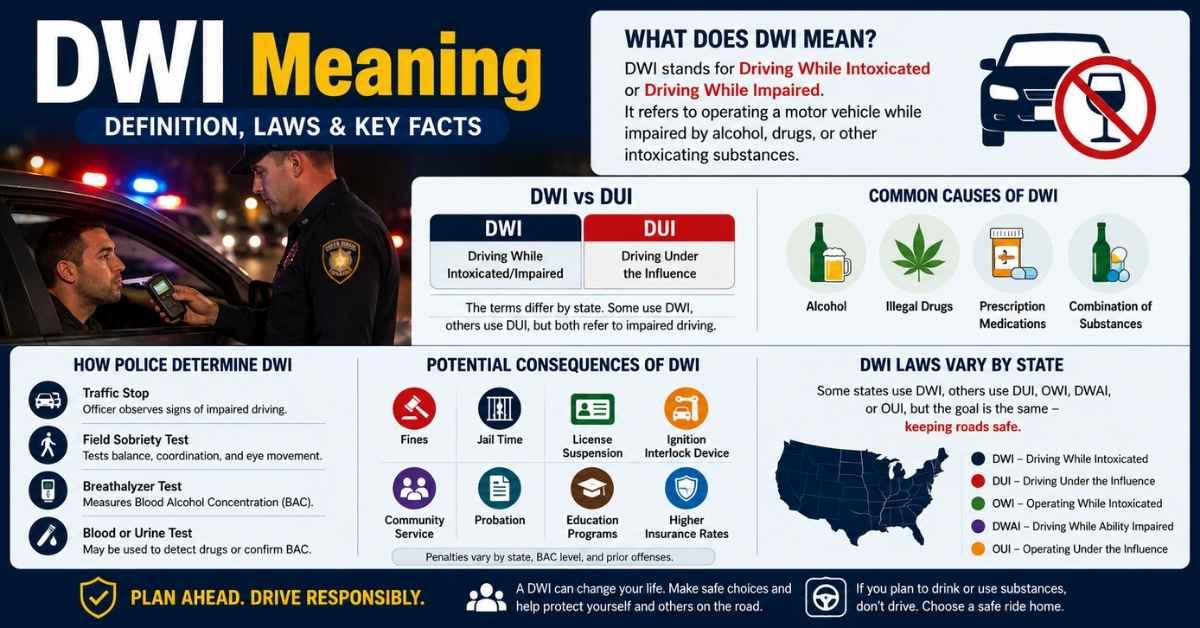
DWI meaning refers to Driving While Intoxicated or, in some states, Driving While Impaired. It is a legal term used to describe operating a motor vehicle while a person’s ability to drive is impaired by alcohol, drugs, or certain medications. Although the exact legal definition of DWI varies by jurisdiction, it generally involves driving with a Blood Alcohol Concentration (BAC) above the legal limit or driving while impaired by alcohol or other substances. Understanding the DWI meaning is important because it helps drivers recognize the legal, financial, and personal consequences associated with impaired driving.
Many people also confuse DWI with DUI (Driving Under the Influence). While the two terms are closely related, they are not always the same, and their definitions depend on the laws of each state. This guide explains DWI meaning in simple words, compares DUI vs. DWI, and answers the most common questions about this important legal term.
| Quick Facts About DWI | Details |
|---|---|
| Full Form | Driving While Intoxicated or Driving While Impaired |
| Category | Traffic and Criminal Law |
| Common Causes | Alcohol, illegal drugs, prescription medication |
| Applies To | Drivers operating a motor vehicle while impaired |
| Related Terms | DUI, OWI, DWAI, OUI |
| Common Evidence | BAC test, Breathalyzer, Field Sobriety Test |
What Does DWI Mean?
The simplest DWI definition is:
DWI means Driving While Intoxicated or Driving While Impaired, referring to operating a vehicle while your ability to drive is affected by alcohol, drugs, or other impairing substances.
The exact meaning depends on state law, but the purpose remains the same: protecting public safety by preventing impaired drivers from operating vehicles.
DWI Full Form
The abbreviation DWI usually stands for:
- Driving While Intoxicated
- Driving While Impaired (used in some jurisdictions)
Both versions describe impaired driving, although the wording differs depending on where the offense occurs.
DWI Meaning in Simple Words
Simply put,
DWI means driving a car or another motor vehicle after consuming enough alcohol or drugs to reduce your ability to drive safely.
This includes situations where:
- Judgment is impaired.
- Reaction time slows.
- Coordination decreases.
- Vision is affected.
- Decision-making becomes unsafe.
Even if someone does not appear visibly drunk, they may still be considered impaired under applicable laws.
What Does DWI Stand For?
Many users specifically search:
What does DWI stand for?
The answer is straightforward.
DWI = Driving While Intoxicated or Driving While Impaired.
Although these phrases sound similar, each state may define them differently.
Some states use:
- DWI
- DUI
- OWI (Operating While Intoxicated)
- DWAI (Driving While Ability Impaired)
- OUI (Operating Under the Influence)
The terminology varies, but the overall goal is to discourage impaired driving and improve road safety.
DWI Meaning in Law
From a legal perspective, DWI refers to operating a motor vehicle while impaired by alcohol, drugs, or another intoxicating substance according to the laws of the jurisdiction where the incident occurs.
Because traffic laws differ across states, there is no single nationwide definition of DWI in the United States.
Alcohol Impairment
Alcohol is the most common reason for a DWI charge.
It affects:
- Coordination
- Balance
- Judgment
- Concentration
- Vision
- Reaction time
These impairments increase the risk of crashes and injuries.
Drug Impairment
A DWI is not limited to alcohol.
Impairment may also result from:
- Illegal drugs
- Prescription medications
- Certain over-the-counter medications
- A combination of alcohol and drugs
Depending on local law, driving while impaired by these substances may also result in a DWI charge.
Blood Alcohol Concentration (BAC)
One of the most common measurements used in impaired driving cases is Blood Alcohol Concentration (BAC).
BAC measures the percentage of alcohol present in a person’s bloodstream.
While many U.S. jurisdictions use 0.08% BAC as the general legal limit for adult drivers, thresholds can differ based on driver category (such as commercial or underage drivers) and local law.
Field Sobriety Tests
If an officer suspects impairment, they may request a field sobriety test.
These tests generally evaluate:
- Balance
- Walking ability
- Eye movement
- Coordination
- Ability to follow instructions
Field sobriety tests are one part of a broader investigation and may be used alongside other evidence.
Breathalyzer Tests
A breathalyzer estimates a driver’s BAC by analyzing a breath sample.
Depending on the jurisdiction, officers may also use blood or urine testing when appropriate.
DWI Meaning in Text
Another common search is:
DWI meaning text
In everyday text messages or online conversations, DWI almost always refers to Driving While Intoxicated or Driving While Impaired, especially in legal, news, or traffic-related discussions.
Occasionally, people may use abbreviations differently in casual conversations, but the legal meaning remains by far the most widely recognized interpretation.
Example:
“He was arrested for DWI after failing a breathalyzer test.”
DUI and DWI Meaning
One of the biggest sources of confusion is understanding the difference between DUI and DWI meaning.
Both involve impaired driving, but the terminology varies.
DUI
DUI stands for:
Driving Under the Influence
DWI
DWI stands for:
Driving While Intoxicated or Driving While Impaired
Some states treat these terms as identical.
Other states assign different legal definitions to each.
For example, one jurisdiction may reserve DWI for more serious alcohol impairment, while another uses DUI as the primary offense.
Because laws differ, it’s important to check the specific rules that apply where the incident occurred.
DWI Meaning vs. DUI
Many readers search:
- DWI meaning vs DUI
- DUI vs DWI meaning
- Difference between DUI and DWI
The answer depends largely on the jurisdiction.
| Feature | DWI | DUI |
|---|---|---|
| Full Form | Driving While Intoxicated/Impaired | Driving Under the Influence |
| Common Cause | Alcohol or drugs | Alcohol or drugs |
| Used In | Certain states | Many states |
| Legal Meaning | Varies by jurisdiction | Varies by jurisdiction |
| Purpose | Address impaired driving | Address impaired driving |
Is DWI Worse Than DUI?
There is no universal answer.
In some jurisdictions:
- DWI may carry more severe penalties.
- DUI may be the only legal offense.
- Both terms may refer to the same offense.
Always remember that state law determines how these terms are defined and enforced.
DWI Compared With Other Driving Offenses
The United States uses several different terms for impaired driving.
| Term | Meaning |
|---|---|
| DWI | Driving While Intoxicated or Impaired |
| DUI | Driving Under the Influence |
| OWI | Operating While Intoxicated |
| DWAI | Driving While Ability Impaired |
| OUI | Operating Under the Influence |
Although the names differ, they all address the same public safety concern: operating a vehicle while impaired.
Aggravated DWI Meaning
Another frequently searched phrase is:
Aggravated DWI meaning
An aggravated DWI generally refers to a more serious form of impaired driving offense based on circumstances defined by state law.
Examples may include:
- A significantly elevated BAC.
- Repeat impaired-driving offenses.
- Driving with a child passenger where prohibited by law.
- Causing injury or serious property damage.
- Other aggravating factors established by statute.
Because legal definitions vary, the exact circumstances that qualify as aggravated DWI depend on the jurisdiction.
Common Causes of a DWI Charge
Several situations may lead to a DWI investigation.
The most common include:
- Alcohol consumption.
- Illegal drug use.
- Prescription medications that impair driving ability.
- Combining alcohol with medication.
- Other substances that reduce safe driving ability.
Regardless of the cause, the key issue is whether the driver’s ability to safely operate a motor vehicle has been impaired.
How Police Determine a DWI
Law enforcement officers use several methods to determine whether a driver may be impaired. A DWI arrest is generally based on the totality of the circumstances rather than a single observation.
The process often begins with a routine traffic stop and may progress through several stages of investigation.
Traffic Stop
A police officer may stop a vehicle for reasons such as:
- Swerving between lanes
- Driving significantly below or above the speed limit
- Ignoring traffic signals
- Sudden or unsafe braking
- Other signs of unsafe driving
During the stop, the officer looks for signs that may indicate alcohol impairment or drug impairment.
Field Sobriety Test
If impairment is suspected, an officer may request a field sobriety test.
These standardized tests are designed to assess:
- Balance
- Coordination
- Eye movement
- Ability to follow instructions
- Divided attention skills
Field sobriety tests are only one part of an investigation and are typically considered together with other observations and evidence.
Breathalyzer Test
A breathalyzer test estimates a driver’s Blood Alcohol Concentration (BAC) using a breath sample.
BAC is one factor that may be considered in determining whether a driver is legally impaired. In some situations, officers may also request blood or urine testing, depending on the circumstances and applicable law.
Implied Consent Laws
Many jurisdictions have implied consent laws, meaning that by obtaining a driver’s license and operating a vehicle, drivers agree to comply with certain lawful chemical testing requirements. The consequences of refusing a test vary by jurisdiction and may include administrative or legal penalties.
General Consequences of a DWI
A DWI conviction can have legal, financial, and personal consequences. The severity depends on factors such as local law, prior offenses, BAC level, and the specific facts of the case.
Important: The information below is a general overview. Penalties vary by state and country.
Possible Criminal Charges
Depending on the jurisdiction and circumstances, a DWI may be classified as:
- A misdemeanor
- A felony (in certain situations, such as repeat offenses or serious injury)
License Suspension or Revocation
Many jurisdictions may suspend or revoke a driver’s license following a DWI-related offense.
The length of the suspension often depends on:
- State law
- BAC level
- Prior driving history
- Whether the driver refused chemical testing
Fines
Financial penalties are common and may include:
- Court fines
- Administrative fees
- License reinstatement costs
- Mandatory education program fees
Jail Time
Some jurisdictions impose jail sentences, particularly for repeat offenses or cases involving aggravating factors.
Probation and Community Service
Courts may order:
- Probation
- Community service
- Alcohol education programs
- Substance abuse treatment
- Victim impact panels
Ignition Interlock Device
An ignition interlock device is installed in some vehicles after certain DWI-related offenses.
The driver must provide a breath sample before the vehicle will start, helping prevent impaired driving.
How a DWI May Affect Your Life
Beyond legal penalties, a DWI can influence many areas of daily life.
Employment
Some employers review criminal records during hiring.
A DWI may affect opportunities in positions involving:
- Commercial driving
- Government employment
- Professional licensing
- Security-sensitive occupations
The impact depends on the employer, job requirements, and local laws.
Car Insurance
Insurance companies often evaluate driving history when determining premiums.
A DWI may result in:
- Higher insurance rates
- Additional coverage requirements
- Policy restrictions
Requirements vary by insurer and jurisdiction.
Professional Licenses
Certain licensed professionals may need to report criminal convictions to their licensing boards, depending on applicable regulations.
College Admissions
Educational institutions have different admission policies. A DWI does not automatically prevent admission, but applicants should review the requirements of each institution.
Travel Restrictions
Some countries have entry rules that consider criminal convictions. Travelers should check official government guidance before making international travel plans.
Driving Privileges
A DWI may affect:
- Driver’s license status
- Eligibility for restricted driving privileges
- Commercial driving privileges
- Future license renewals
DWI Laws by State
One of the most important facts about DWI meaning is that there is no single legal definition across the United States.
Each jurisdiction decides:
- Which impaired-driving term to use
- How impairment is defined
- Applicable BAC thresholds
- Investigation procedures
- Penalties
States Using DWI
Some states primarily use DWI (Driving While Intoxicated or Driving While Impaired) as their legal term.
States Using DUI
Many jurisdictions instead use DUI (Driving Under the Influence).
States Using OWI, DWAI, or OUI
Other jurisdictions use terms such as:
- OWI (Operating While Intoxicated)
- DWAI (Driving While Ability Impaired)
- OUI (Operating Under the Influence)
Although the names differ, all of these laws are designed to reduce impaired driving and improve public safety.
Common Misconceptions About DWI
Misunderstanding DWI laws can lead to confusion. Here are some common myths and the facts behind them.
Myth: DWI Always Means Alcohol
Fact: A DWI may involve alcohol, illegal drugs, prescription medications, or other substances that impair a person’s ability to drive safely, depending on applicable law.
Myth: Prescription Medication Cannot Lead to a DWI
Fact: Some prescription and over-the-counter medications can impair judgment, coordination, or reaction time. Driving while impaired by these medications may lead to legal consequences under certain laws.
Myth: Every State Defines DWI the Same Way
Fact: Each jurisdiction has its own definitions, terminology, and enforcement procedures.
Myth: DWI Is Always a Felony
Fact: A DWI may be classified as a misdemeanor or a felony depending on local law and the circumstances, such as repeat offenses or serious injury.
Myth: DWI Is Always Worse Than DUI
Fact: Neither term is universally more serious. The legal meaning of DWI vs. DUI depends entirely on the jurisdiction.
Tips to Prevent a DWI
The safest approach is to avoid driving whenever impairment may affect your ability to operate a vehicle safely.
Helpful practices include:
- Plan transportation before consuming alcohol.
- Use a designated driver.
- Choose a taxi or rideshare service if needed.
- Use public transportation where available.
- Read medication labels carefully for driving warnings.
- Never combine alcohol with medications that impair alertness.
- If you feel impaired, do not drive.
Responsible choices protect both you and everyone sharing the road.
Quick Comparison Table
| Term | Full Form | Primary Meaning | Common Usage |
|---|---|---|---|
| DWI | Driving While Intoxicated / Impaired | Operating a vehicle while impaired | Used in several U.S. jurisdictions |
| DUI | Driving Under the Influence | Driving under the influence of alcohol or drugs | Common in many U.S. jurisdictions |
| OWI | Operating While Intoxicated | Operating a vehicle while impaired | Used in certain states |
| DWAI | Driving While Ability Impaired | Reduced ability to drive safely | Used in some states |
| OUI | Operating Under the Influence | Operating a vehicle under the influence | Used in certain jurisdictions |
This comparison shows that while terminology differs, the primary objective is the same: preventing impaired driving and protecting public safety.
LEARN MORE: Los Angeles Slang
Real-Life DWI Examples
Understanding DWI is easier with practical examples.
Example 1: Alcohol Impairment
A driver attends a party, consumes enough alcohol to become impaired, and chooses to drive home. During a traffic stop, officers observe signs of impairment and conduct further testing as permitted by law.
Example 2: Prescription Medication
A person takes medication that causes drowsiness and slowed reaction time. Even without consuming alcohol, driving while significantly impaired could lead to legal consequences depending on the jurisdiction.
Example 3: Drug Impairment
A driver uses an illegal substance before operating a vehicle. If law enforcement determines that the driver’s ability to drive is impaired, the individual may face an impaired-driving charge under applicable law.
These examples illustrate that DWI is about impaired driving, not solely alcohol consumption.
Frequently Asked Questions
What does DWI mean?
DWI stands for Driving While Intoxicated or, in some jurisdictions, Driving While Impaired. It refers to operating a motor vehicle while impaired by alcohol, drugs, or other intoxicating substances. The exact legal definition depends on the laws of the state or jurisdiction.
What does DWI stand for?
The DWI full form is:
- Driving While Intoxicated
- Driving While Impaired (used in certain states)
Both terms describe operating a vehicle when your ability to drive safely has been affected by alcohol or drugs.
What is DWI meaning in law?
In legal terms, DWI is a traffic-related criminal offense that generally involves driving while impaired by alcohol, drugs, or another intoxicating substance. The legal definition, evidence required, and penalties vary depending on the jurisdiction.
What is DWI meaning in text?
In text messages, social media, or online discussions, DWI almost always refers to Driving While Intoxicated or Driving While Impaired, especially when discussing traffic incidents, legal matters, or news.
Example:
“He received a DWI after failing a roadside breath test.”
Although abbreviations can have different meanings in specific communities, this is by far the most widely recognized interpretation.
What is aggravated DWI meaning?
An aggravated DWI generally refers to a more serious impaired-driving offense based on circumstances defined by law. Common aggravating factors may include:
- A significantly high Blood Alcohol Concentration (BAC)
- Repeat impaired-driving offenses
- Driving with a child passenger where prohibited by law
- Causing injury or substantial property damage
The exact legal criteria differ by jurisdiction.
What is the difference between DUI and DWI?
The difference between DUI and DWI depends on state law.
Some jurisdictions:
- Use only DUI
- Use only DWI
- Use both terms with different legal meanings
In many places, both terms describe impaired driving, but one may apply to specific levels of impairment or particular circumstances.
Is DWI worse than DUI?
There is no universal answer.
Some states treat DWI as the more serious offense, while others use DUI as the primary legal term. In many jurisdictions, both terms refer to similar impaired-driving offenses.
Always refer to the laws of the relevant jurisdiction for precise definitions.
Can prescription medication result in a DWI?
Yes. Some prescription and over-the-counter medications can impair:
- Alertness
- Coordination
- Judgment
- Reaction time
Driving while impaired by medication may result in legal consequences, depending on the applicable law.
What BAC leads to a DWI?
Many U.S. jurisdictions use 0.08% Blood Alcohol Concentration (BAC) as the general legal limit for adult drivers. However, lower or different limits may apply to:
- Commercial drivers
- Underage drivers
- Certain special circumstances
Always remember that laws vary by state and country.
Is DWI a criminal offense?
Yes. In many jurisdictions, a DWI is treated as a criminal offense, although the exact classification depends on local law and the facts of the case.
Is DWI a felony or misdemeanor?
A DWI may be either:
- Misdemeanor
- Felony
Factors influencing the classification may include:
- Previous offenses
- BAC level
- Serious injury
- Death
- Other aggravating circumstances
Can drugs cause a DWI?
Yes.
Many impaired-driving laws apply to:
- Illegal drugs
- Prescription medications
- Certain over-the-counter medications
- Combinations of alcohol and drugs
The key issue is whether the substance impaired the driver’s ability to operate a vehicle safely.
Does every state use DWI?
No.
Different jurisdictions use different legal terms, including:
- DWI
- DUI
- OWI
- DWAI
- OUI
Although the terminology differs, all are intended to address impaired driving.
Can a DWI affect employment?
Potentially, yes.
A DWI may affect employment opportunities depending on factors such as:
- Job responsibilities
- Employer policies
- Professional licensing requirements
- Local laws
The impact varies from one situation to another.
Can a DWI affect insurance?
Many insurance companies consider driving history when determining premiums.
A DWI may lead to:
- Higher insurance costs
- Additional coverage requirements
- Policy changes
Insurance rules differ by provider and jurisdiction.
Can a DWI be removed from your record?
In some jurisdictions, certain records may be eligible for expungement, record sealing, or other forms of relief under specific conditions. Eligibility varies widely based on local law and individual circumstances.
If you need guidance about your own situation, consult the appropriate official resources or a qualified legal professional.
Key Takeaways
Here are the most important points to remember about DWI meaning:
- DWI stands for Driving While Intoxicated or Driving While Impaired.
- The exact legal definition varies by jurisdiction.
- A DWI may involve alcohol, illegal drugs, prescription medication, or other impairing substances.
- Blood Alcohol Concentration (BAC) is commonly used as one measure of alcohol impairment, though legal limits and rules differ.
- DWI, DUI, OWI, DWAI, and OUI all relate to impaired driving, but the terminology depends on state law.
- Penalties can include license suspension, fines, probation, community service, ignition interlock requirements, and in some cases jail time.
- Responsible driving and planning ahead are the best ways to avoid impaired-driving offenses and protect public safety.
“The safest choice is always to avoid driving whenever alcohol, drugs, or medication could impair your ability to operate a vehicle safely.”
Conclusion
DWI meaning goes beyond simply standing for Driving While Intoxicated or Driving While Impaired. It represents a legal concept designed to protect drivers, passengers, and everyone on the road from the dangers of impaired driving. While the terminology, definitions, and penalties vary between jurisdictions, the core purpose remains the same: preventing individuals from operating a motor vehicle when alcohol, drugs, or other substances have reduced their ability to drive safely.
Understanding the differences between DWI, DUI, OWI, DWAI, and OUI, along with concepts such as Blood Alcohol Concentration (BAC), field sobriety tests, breathalyzer testing, and aggravated DWI, helps readers better understand how impaired-driving laws work in general terms. It also clarifies why a DWI meaning vs. DUI comparison often depends on the specific laws of the jurisdiction involved.
Most importantly, making informed and responsible decisions—such as using a designated driver, choosing a rideshare service, or avoiding driving after consuming alcohol or impairing substances—helps reduce accidents, protect lives, and support safer roads for everyone. If you need guidance about a specific legal matter, always consult the official laws of your jurisdiction or seek advice from a qualified legal professional.