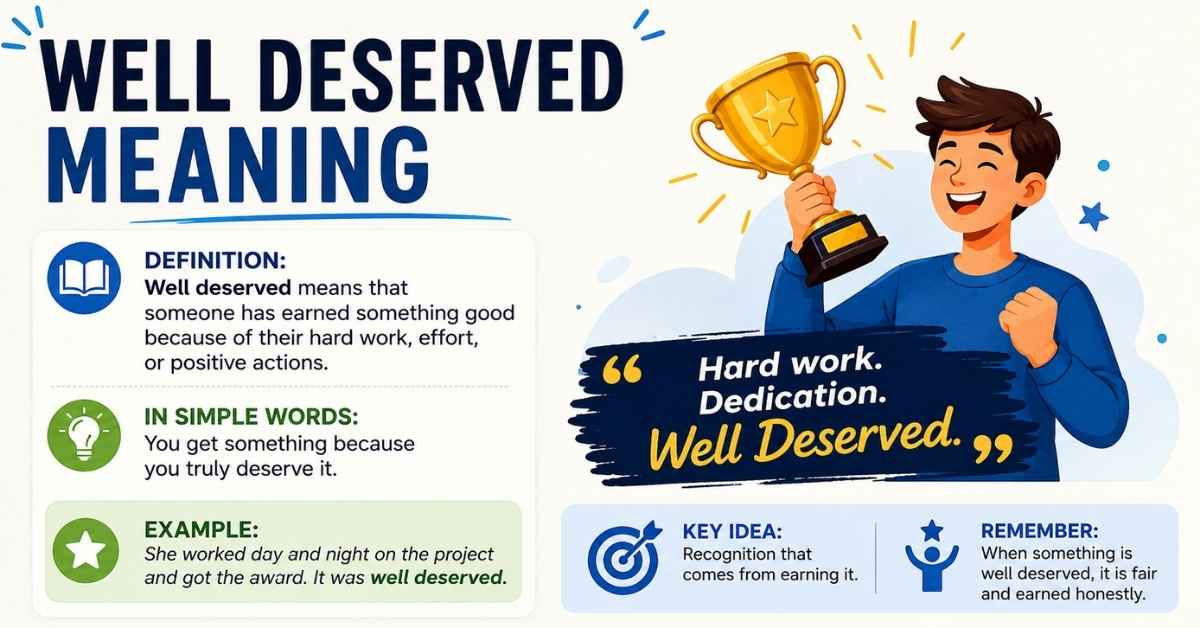
Well deserved meaning refers to something earned through genuine effort, hard work, talent, or achievement. When someone says an award, promotion, vacation, or success is well deserved, they mean the person has truly earned it and deserves the recognition or reward. The phrase expresses admiration, appreciation, and acknowledgment of someone’s efforts. Whether you’re writing a congratulatory message, speaking in a professional setting, or simply trying to understand the expression, knowing how to use well deserved correctly—including when to write well-deserved with a hyphen—can make your English sound more natural and confident.
Unlike a simple dictionary definition, this guide explains the meaning, grammar, real-life usage, examples, synonyms, and common mistakes so you can use the phrase accurately in both personal and professional communication.
What Does “Well Deserved” Mean?
At its core, well deserved means that someone has earned something through effort, ability, dedication, or positive actions. It suggests that the outcome is fair and justified because the person worked hard or demonstrated qualities worthy of recognition.
Meaning in Simple Words
In everyday English, well deserved simply means:
Someone earned something because of their hard work or good actions.
For example:
- Your promotion is well deserved because you’ve worked tirelessly all year.
- After months of studying, her excellent grades were well deserved.
- The team celebrated a well-deserved victory after an incredible season.
Therefore, In each example, the reward matches the person’s effort, making the recognition feel fair and meaningful.
Dictionary Meaning vs. Real-Life Meaning
Most dictionaries define well deserved as something that is rightly earned or merited. While this definition is accurate, native English speakers often use the phrase with a deeper emotional meaning.
In real conversations, well deserved is more than just a description. It communicates:
- Respect
- Recognition
- Appreciation
- Support
- Validation
Imagine a colleague receives a promotion after years of dedication. Saying “Congratulations! It’s well deserved.” tells them that you recognize their effort and genuinely believe they earned the opportunity.
That emotional warmth is one reason the phrase is so common in workplaces, schools, sports, and everyday conversations.
Why This Phrase Feels So Positive
People naturally appreciate having their efforts recognized. The phrase well deserved carries positive emotional weight because it acknowledges that success wasn’t based on luck alone—it resulted from perseverance and commitment.
It often reflects qualities such as:
- Hard work
- Dedication
- Persistence
- Skill
- Achievement
- Merit
- Excellence
- Determination
When someone hears “Your success is well deserved,” they often feel valued because their effort has been noticed.
When Do People Say “Well Deserved”?
The expression appears in many situations where recognition is appropriate. Understanding these contexts helps you use it naturally.
After a Promotion
One of the most common uses is in professional settings.
Example:
Congratulations on your promotion. It’s truly well deserved.
Therefore, This tells the recipient that their career advancement reflects their abilities and hard work.
After Winning an Award
Awards recognize achievement, making well deserved a natural expression.
Example:
Her leadership award was well deserved after years of inspiring the team.
Academic Success
Teachers, classmates, and parents frequently use the phrase when celebrating educational achievements.
Examples:
- Your scholarship is well deserved.
- That excellent grade was well deserved after all your studying.
Sports Achievements
Athletes hear this phrase after demonstrating dedication and outstanding performance.
Examples:
- Their championship title was well deserved.
- The player received a well-deserved standing ovation.
Retirement
Retirement messages often include the expression because they recognize years of commitment.
Example:
Enjoy your well-deserved retirement. You’ve earned every moment of it.
Personal Milestones
People also use well deserved to celebrate personal accomplishments.
Examples include:
- Buying a first home
- Completing a marathon
- Starting a new business
- Recovering after a difficult period
- Finishing a major project
Example:
After everything you’ve overcome, this happiness is well deserved.
Taking a Break
The phrase commonly describes rest after sustained effort most importantly .
Examples:
- Enjoy your well-deserved vacation.
- Take a well-deserved break.
- Everyone needs a well-deserved day off once in a while.
Here, the focus is not only on achievement but also on rewarding hard work with rest.
Is “Well Deserved” a Compliment?
Yes. In almost every situation, well deserved is considered a sincere compliment.
You tell someone that something is well deserved, in saying:
- You earned this.
- Your effort paid off.
- You deserve recognition.
- I’m happy for your success.
Most importantly, That’s why it’s frequently used in:
- Workplace congratulations
- Award ceremonies
- Graduation speeches
- Retirement celebrations
- Performance reviews
- Employee recognition programs
For example:
Your award is well deserved because you’ve consistently gone above and beyond.
This sounds encouraging, respectful, and genuine.
Can It Ever Sound Negative?
Occasionally, yes—but only if someone uses it sarcastically.
For example:
“Well deserved…”
Depending on tone and context, this could imply criticism rather than praise.
Therefore, In written communication, however, readers usually interpret well deserved as positive unless there are clear signs of sarcasm.
How to Use “Well Deserved” Correctly
Knowing the meaning is only part of using the phrase effectively. It’s equally important to understand where it fits in a sentence.
As Part of a Sentence
One of the most common sentence patterns is:
Something + was + well deserved
Examples:
- The recognition was well deserved.
This construction sounds natural in both spoken and written English.
Before a Noun
When well deserved comes before a noun, it is usually written with a hyphen.
Examples:
- a well-deserved promotion
- a well-deserved vacation
- a well-deserved award
- a well-deserved break
- a well-deserved reputation
This is one of the most common grammar questions surrounding the phrase.
After a Verb
The phrase follows a linking verb such as is, was, or were, it is generally written without a hyphen.
Examples:
- The promotion was well deserved.
Therefore,This pattern is widely accepted in modern English writing.
Spoken English vs. Written English
In conversation, people rarely think about hyphens because they aren’t visible when speaking.
In writing, however, choosing the correct form helps your work appear polished and grammatically accurate.
Therefore, Professional documents, business emails, articles, and formal messages should follow standard hyphenation rules.
Well Deserved or Well-Deserved? The Grammar Rule Everyone Gets Wrong
One of the biggest sources of confusion is deciding whether to use a hyphen.
The good news is that the rule is straightforward once you understand how the phrase functions in a sentence.
When to Use “Well-Deserved”
Use well-deserved with a hyphen when it comes before a noun and acts as a compound adjective.
Examples:
- a well-deserved promotion
- a well-deserved award
- a well-deserved vacation
- a well-deserved rest
- a well-deserved celebration
In these examples, well-deserved describes the noun that follows.
When to Use “Well Deserved”
Use well deserved without a hyphen when it appears after a verb.
Examples:
- The promotion was well deserved.
- His success was well deserved.
- Their recognition was well deserved.
- The applause was well deserved.
Here, the phrase functions as part of the predicate rather than directly modifying a noun.
An Easy Rule to Remember
A simple way to decide is to ask yourself where the phrase appears.
- Before a noun? Use well-deserved.
- After a verb? Use well deserved.
This quick rule will help you avoid one of the most common grammar mistakes involving the expression.
Quick Comparison
| Correct Form | Example | Why It’s Correct |
|---|---|---|
| well-deserved | A well-deserved promotion | Compound adjective before a noun |
| well deserved | The promotion was well deserved. | Predicate after a linking verb |
| well-deserved | Enjoy your well-deserved vacation. | Describes the noun “vacation” |
| well deserved | Your success is well deserved. | Appears after the verb “is” |
Therefore, Understanding this distinction makes your writing more natural and demonstrates a stronger command of English grammar.
Learn More: Naur Meaning
Common Examples of “Well Deserved” in Everyday English
One of the best ways to understand the well deserved meaning is to see how native English speakers naturally use it. The phrase appears in many personal and professional situations where someone has genuinely earned recognition, praise, or a reward through effort and dedication.
Therefore, Below are practical examples that sound natural in everyday conversation.
In the Workplace
Professional environments are one of the most common places where people use well deserved.
Examples:
- Congratulations on your promotion. It’s truly well deserved.
- Your Employee of the Month award is well deserved.
- After leading the project successfully, her recognition was well deserved.
- Everyone agreed that his leadership award was well deserved.
Managers often use this phrase because it acknowledges hard work, commitment, and consistent performance.
In School and Education
Teachers, classmates, and parents frequently use the phrase to celebrate academic achievements.
Examples:
- Your scholarship is well deserved after all the effort you put into your studies.
- That A+ grade was well deserved.
- Her graduation honors were well deserved because she never gave up.
- The student received a well-deserved standing ovation during graduation.
The phrase reinforces that success comes from discipline, persistence, and learning.
In Sports
Athletes, coaches, and commentators regularly use well deserved when discussing victories and achievements.
Examples:
- The championship was well deserved after an incredible season.
- Their victory was well deserved because they dominated the match.
- She earned a well-deserved gold medal.
- The fans gave the team a well-deserved round of applause.
Here, the phrase emphasizes performance, teamwork, and dedication.
Among Family and Friends
The phrase also fits naturally into personal conversations.
Examples:
- You’ve worked so hard. This happiness is well deserved.
- Enjoy your well-deserved vacation—you’ve earned it!
- That relaxing weekend is well deserved after such a busy month.
- Your success couldn’t have happened to a more deserving person.
Using well deserved in these situations adds warmth and sincerity.
In Business Emails
Many professionals use the phrase in congratulatory emails.
Example:
Congratulations on your promotion! This achievement is well deserved, and I wish you continued success in your new role.
The expression sounds respectful, positive, and professional.
On Social Media
People often use well deserved when celebrating achievements online.
Examples:
- Congratulations! So proud of you—well deserved!
- A well-deserved win after months of hard work.
- This recognition is absolutely well deserved.
- Enjoy your well-deserved break!
Because the phrase is short and meaningful, it works well in captions and comments.
Common Mistakes to Avoid
Although well deserved is a simple phrase, people frequently make mistakes when using it. Understanding these common errors will help your English sound more fluent and natural.
| ❌ Incorrect | ✅ Correct | Why |
|---|---|---|
| He is well deserved. | He deserves it. / His success is well deserved. | The phrase describes an achievement, not a person directly. |
| A well deserved promotion | A well-deserved promotion | Use a hyphen before a noun. |
| The award is well-deserved. | The award is well deserved. | No hyphen after a linking verb. |
| Much deserved vacation | Well-deserved vacation | “Well-deserved” is the natural expression. |
| She is a well deserved employee. | She is a deserving employee. | “Well deserved” does not normally describe people directly. |
Mistake 1: Using the Phrase for a Person
Many English learners write:
❌ She is well deserved.
This is incorrect because well deserved describes an achievement, reward, or recognition, not the person.
Instead, say:
- She deserves it.
- Her success is well deserved.
- She is very deserving.
Mistake 2: Forgetting the Hyphen
Another common mistake is writing:
❌ well deserved promotion
Instead, write:
✅ well-deserved promotion
Remember:
- Before a noun → well-deserved
- After a verb → well deserved
Mistake 3: Overusing the Phrase
Repeating well deserved too often can make your writing sound repetitive.
Instead, vary your language with suitable alternatives depending on the context.
Well Deserved vs. Similar Expressions
Many expressions share a similar meaning, but each has a slightly different tone.
| Expression | Meaning | Best Used When |
|---|---|---|
| Well deserved | Earned through effort | Everyday communication |
| Deserved | Fairly earned | Neutral writing |
| Richly deserved | Strongly deserved | Formal praise or awards |
| Hard-earned | Achieved through significant effort | Highlighting perseverance |
| Merited | Officially justified | Academic or formal writing |
| Earned | Achieved through work | General communication |
Well Deserved vs. Deserved
Deserved simply means something was earned.
Well deserved adds emphasis, suggesting the reward or recognition is especially justified.
Examples:
- The promotion was deserved.
- The promotion was well deserved.
The second sentence sounds warmer and more appreciative.
Well Deserved vs. Richly Deserved
Richly deserved is stronger and more formal.
Example:
- The humanitarian award was richly deserved.
It often appears in speeches, journalism, and formal writing.
Well Deserved vs. Hard-Earned
Hard-earned focuses on the effort required.
Example:
- He enjoyed his hard-earned vacation.
Well deserved focuses more on the fairness of receiving the reward.
Well Deserved vs. Earned
Earned is factual.
Therefore, Well deserved expresses both fact and admiration.
Compare:
- She earned the award.
- The award was well deserved.
The second sentence conveys emotional recognition.
Best Synonyms for “Well Deserved”
Using different expressions can make your writing more engaging while preserving the intended meaning.
Professional Writing
- Well earned
- Merited
- Rightfully earned
- Justified
- Appropriately recognized
Example:
Your promotion was truly well earned.
Casual Conversations
- You’ve earned it.
- Totally deserved.
- You deserve this.
- Good for you!
- Couldn’t have happened to a better person.
Academic Writing
- Merited
- Deserved
- Appropriate recognition
- Earned distinction
Celebrations
- Richly deserved
- Well earned
- Hard-earned
- Fully deserved
Formal Speeches
Examples:
- This honor is richly deserved.
- Your dedication has earned this recognition.
- This award reflects years of exceptional commitment.
Therefore,These alternatives keep speeches varied and impactful.
See More: What Does SDIYBT Mean
Can You Say “Well Deserved” to a Person?
This is one of the most common questions English learners ask.
The answer is yes—but not in every sentence structure.
Natural examples include:
- Congratulations! It’s well deserved.
- Your success is well deserved.
- Your promotion is well deserved.
- Your award is well deserved.
However, avoid saying:
❌ You are well deserved.
Instead, say:
- You deserve it.
- You’ve earned it.
- Your achievement is well deserved.
This subtle distinction makes your English sound much more natural.
Formal vs. Informal Usage
One reason well deserved is so popular is that it works in both formal and informal situations.
| Situation | Appropriate? | Example |
|---|---|---|
| Workplace email | ✅ Yes | Your promotion is well deserved. |
| Performance review | ✅ Yes | Your recognition is well deserved. |
| Graduation speech | ✅ Yes | Your achievements are well deserved. |
| Award ceremony | ✅ Yes | This honor is well deserved. |
| LinkedIn post | ✅ Yes | Congratulations on your well-deserved success. |
| Text message | ✅ Yes | Well deserved! Proud of you! |
| Casual conversation | ✅ Yes | You really earned it. |
Whether you’re writing an email, giving a speech, or sending a message to a friend, the phrase feels sincere and respectful.
How Native English Speakers Actually Use This Phrase
One weakness of many dictionary-style articles is that they explain the definition but not how the phrase sounds in real life.
Native speakers often combine well deserved with specific nouns known as common collocations.
Examples include:
- well-deserved promotion
- well-deserved vacation
- well-deserved break
- well-deserved award
- well-deserved recognition
- well-deserved praise
- well-deserved success
- well-deserved reputation
- well-deserved victory
- well-deserved rest
They also frequently use conversational expressions like:
- You earned it.
- It’s about time—you deserved this.
- Nobody deserves it more than you.
- I’m so happy for you. It’s well deserved.
These phrases sound natural because they reflect how people genuinely express appreciation, admiration, encouragement, and recognition.
Rather than memorizing the definition alone, learning these natural patterns will help you use well deserved confidently in conversations, professional writing, emails, speeches, and everyday English.
Real-Life Examples That Sound Natural
Understanding the well deserved meaning becomes much easier when you see how native English speakers use the phrase in real conversations. Instead of isolated sentences, these examples reflect everyday situations where recognition, appreciation, and encouragement are expressed naturally.
Workplace Conversation
Manager: Congratulations on your promotion! Employee: Thank you. I really appreciate it. Manager: It’s well deserved. Your hard work and leadership made a real difference.
Here, well deserved acknowledges consistent effort and professional achievement.
Graduation Celebration
Parent: We’re so proud of you! Graduate: Thank you! It took a lot of late nights. Parent: This success is well deserved. You never gave up.
The phrase highlights perseverance and academic accomplishment.
Sports Achievement
Coach: You played an incredible tournament. Player: Thanks, Coach. Coach: That trophy is well deserved. You earned every bit of it.
This use emphasizes dedication, teamwork, and performance.
Friends Celebrating Success
Friend 1: I finally got the job! Friend 2: That’s amazing! It’s absolutely well deserved. I knew you’d get it.
The phrase communicates genuine happiness and support.
Retirement Celebration
Colleague: Congratulations on your retirement! Retiree: Thank you. It’s been an incredible journey. Colleague: Enjoy your well-deserved retirement. You’ve earned every moment of it.
This is one of the most common real-world uses of the expression.
Why “Well Deserved” Has Such a Positive Emotional Impact
The phrase well deserved does more than describe an achievement—it validates the journey behind it.
People naturally want their hard work, commitment, and perseverance to be recognized. When someone hears, “Your success is well deserved,” they don’t just hear congratulations. They hear that their effort has been noticed and appreciated.
That is why the phrase is commonly associated with:
- Recognition
- Respect
- Admiration
- Gratitude
- Encouragement
- Achievement
- Professional appreciation
- Personal validation
Whether you’re congratulating a coworker, praising a student, or celebrating a loved one’s milestone, using This reinforces that their success was earned through genuine effort.
Quick Reference Guide
| Question | Answer |
|---|---|
| What does “well deserved” mean? | It means something has been earned fairly through hard work, effort, or achievement. |
| Is “well deserved” a compliment? | Yes. It expresses sincere recognition and appreciation. |
| Is it grammatically correct? | Yes, when used in the correct sentence structure. |
| Should it be “well deserved” or “well-deserved”? | Use well-deserved before a noun and well deserved after a linking verb. |
| Can I use it in professional emails? | Yes. It is widely accepted in workplace communication. |
| Is it formal or informal? | It works naturally in both formal and informal situations. |
| Can I say it to someone? | Yes. For example: “Congratulations! It’s well deserved.” |
Frequently Asked Questions
What does “well deserved” mean in English?
Well deserved means that someone has rightfully earned recognition, success, or a reward through their effort, ability, dedication, or achievements. It expresses that the outcome is fair and justified.
Is It grammatically correct?
Yes. The phrase is grammatically correct and widely used in both spoken and written English.
Examples:
- She enjoyed a well-deserved vacation.
Should I write “well deserved” or “well-deserved”?
It depends on how the phrase is used.
- Well-deserved (with a hyphen) comes before a noun.
- A well-deserved break.
- Well deserved (without a hyphen) comes after a linking verb.
- The break was well deserved.
Is It Is a compliment?
In short, Absolutely. It is one of the most common ways to acknowledge that someone’s success, recognition, or reward was earned through hard work and commitment.
Can I use “well deserved” in professional writing?
Yes. The phrase is appropriate in:
- Business emails
- Performance reviews
- Recommendation letters
- Award announcements
- Employee recognition messages
- LinkedIn posts
- Workplace presentations
It conveys respect while maintaining a professional tone.
Can I say “well deserved” to someone directly?
Yes, but the sentence structure matters.
Natural examples include:
- Congratulations! It’s well deserved.
Avoid saying:
- ❌ You are well deserved.
Instead, say:
- You deserve it.
- You’ve earned it.
Best synonyms for “well deserved”
Depending on the context, you can use:
- Well earned
- Richly deserved
- Hard-earned
- Merited
- Rightfully earned
- Earned
- Justified
Choose the alternative that best matches the tone of your writing.
Opposite of “well deserved”?
Some common opposites include:
- Undeserved
- Unearned
- Unjustified
- Unwarranted
- Unmerited
In short, These words describe rewards or recognition that have not been fairly earned.
Can “well deserved” describe a vacation or a break?
Yes. This is one of the most common uses of the phrase.
Examples:
- Enjoy your well-deserved vacation.
- Take a well-deserved break.
- She finally got a well-deserved day off.
Why do people say “well deserved”?
In short, People use the phrase to express that someone’s achievement, reward, or recognition reflects their effort, dedication, and ability. It communicates both congratulations and genuine appreciation.
Final Thoughts
The well deserved meaning goes beyond a simple dictionary definition. It represents the idea that success, recognition, or rewards have been earned through genuine effort, perseverance, and merit. Whether you’re congratulating a colleague on a promotion, celebrating a student’s graduation, recognizing an athlete’s victory, or encouraging a friend, this phrase conveys respect, appreciation, and sincere admiration.
Remember the simple grammar rule: use well-deserved before a noun (a well-deserved award) and well deserved after a linking verb (The award was well deserved). Mastering this distinction will help you write more confidently and speak more naturally in both personal and professional settings.
in short, By understanding the phrase’s meaning, grammar, emotional tone, common collocations, and real-world usage, you’ll be able to use well deserved correctly in emails, conversations, speeches, social media posts, and everyday English with confidence.