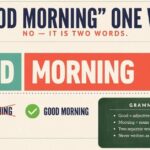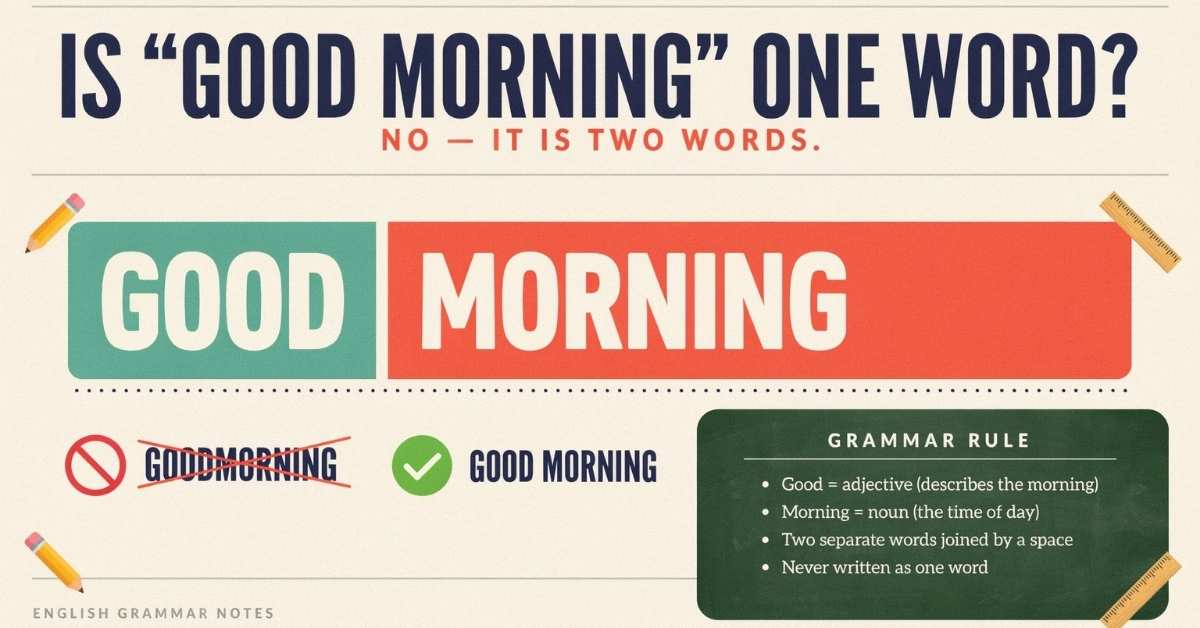
Is good morning one word? No, “good morning” is not one word. The correct spelling is “good morning,” written as two separate words in standard English. Writing “Goodmorning” as a single word is considered incorrect in formal writing, professional emails, academic work, and everyday English. While you may see #GoodMorning in hashtags or branding, standard English grammar and dictionaries recognize good morning as a two-word greeting.
If you’ve ever paused before sending an email, writing a message, or preparing a greeting card because you weren’t sure whether to write good morning or goodmorning, you’re not alone. Many people are confused by the way greetings appear on social media, in logos, or on decorative signs. In this guide, you’ll learn the correct spelling of good morning, the grammar rule behind it, when to capitalize it, where to use commas, and why similar expressions like goodnight follow a different pattern.
The Quick Answer
Quick Answer: “Good morning” is always written as two words in standard English. The one-word form “Goodmorning” is not accepted in dictionaries or formal writing.
At a Glance
| Question | Answer |
|---|---|
| Is good morning one word? | No. |
| Is good morning two words? | Yes. |
| Is “Goodmorning” correct? | No. |
| Can I write “goodmorning” in an email? | No. Use “good morning.” |
| Should I capitalize “Good Morning”? | It depends on the context. |
Remember: Whenever you’re using it as a greeting, the correct form is good morning.
Why “Good Morning” Is Written as Two Words
Understanding the grammar behind the phrase makes it much easier to remember the correct spelling.
Understanding the Grammar Rule
In English, good morning is an open compound. An open compound is made up of two separate words that work together to express one idea but remain written with a space between them.
In this phrase:
- Good is an adjective.
- Morning is a noun.
- Together, they form a greeting or salutation.
Because English treats this expression as an open compound phrase, the words stay separate.
Correct Examples
- Good morning, Sarah.
- Good morning, everyone.
- I wish you a good morning.
- Good morning! How are you today?
Incorrect Examples
- ❌ Goodmorning, Sarah.
- ❌ I hope you have a Goodmorning.
- ❌ Good-Morning everyone.
The spacing is part of the standard spelling, not an optional style choice.
What Is an Open Compound?
English has three common types of compound words:
| Type | Example |
|---|---|
| Open Compound | good morning, post office, high school |
| Hyphenated Compound | well-known, mother-in-law |
| Closed Compound | notebook, football, sunflower |
Since good morning belongs to the open compound category, the words are written separately.
This grammar rule also applies to:
- good afternoon
- good evening
- good day
These greetings are also written as two words.
Why People Think It’s One Word
If dictionaries and grammar books clearly write good morning as two words, why do so many people search for “is good morning one word?”
There are several reasons.
1. Social Media Hashtags
On platforms like Instagram, X, Facebook, and LinkedIn, you’ll often see hashtags such as:
- #GoodMorning
- #MondayMorning
- #MorningMotivation
Hashtags remove spaces because they function as a single searchable tag. This formatting rule does not change standard English spelling.
2. Logos and Brand Names
Businesses sometimes combine words for branding purposes.
Examples include:
- GoodMorning Coffee
- GoodMorning Travel
- GoodMorning Foods
These are brand names, not grammar rules. Companies often merge words to create memorable names or domain names.
3. Decorative Designs
Greeting cards, posters, wall art, and digital graphics frequently display:
GOODMORNING
This is usually a design choice rather than a grammatical one.
When writing an email, assignment, article, or professional document, always use good morning.
4. Autocorrect and Typing Habits
Many people type quickly on smartphones.
Predictive keyboards sometimes remember previously typed words or usernames, making users think Goodmorning is acceptable.
Always double-check important writing, especially:
- business emails
- cover letters
- resumes
- client communications
- academic assignments
A quick proofread helps avoid simple spelling mistakes.
Correct vs. Incorrect Usage at a Glance
The easiest way to remember the rule is by comparing correct and incorrect forms.
| Incorrect | Correct | Why |
|---|---|---|
| Goodmorning | Good morning | Standard English uses two words. |
| goodmorning | good morning | Incorrect compound spelling. |
| Good-Morning | Good morning | No hyphen is needed. |
| Good Morning* | Good morning* | Capitalization depends on context. |
*When used as a title or heading, title case may be appropriate. In ordinary sentences and greetings, capitalize according to normal writing rules.
Memory Trick
Here’s a simple trick editors use:
If you’re greeting someone, write good morning as two separate words.
Think of it this way:
- Good describes the type of morning you’re wishing someone to have.
Since the adjective modifies the noun, English keeps them separate.
When to Capitalize “Good Morning”
Another common question is whether Good Morning should always be capitalized.
The answer depends on where and how you’re using the phrase.
At the Beginning of a Sentence
Capitalize the first word because every sentence begins with a capital letter.
Examples
✅ Good morning. I hope you’re doing well.
✅ Good morning! Welcome to today’s meeting.
In Email Greetings
Professional emails often begin with:
Good morning, David,
or
Good morning, team,
This is considered the standard and most professional format.
If you begin your email with the greeting, capitalize Good because it starts the line.
In Titles and Headings
If you’re writing a heading or title, you may use title case.
Examples:
- Good Morning Messages
- Good Morning Quotes
- Good Morning Wishes
This is a formatting convention rather than a grammar rule.
In Text Messages
Texting is generally less formal.
These are all acceptable depending on style:
- Good morning!
- good morning!
- Morning!
However, even in casual texting, the phrase remains two words.
On Greeting Cards and Invitations
Greeting cards often use decorative capitalization.
Examples include:
- Good Morning
- GOOD MORNING
These stylistic choices are acceptable for design purposes, but they do not change the standard spelling.
Do You Need a Comma After “Good Morning”?
Many writers know the correct spelling but struggle with punctuation.
The rule is straightforward.
Use a Comma When Addressing Someone Directly
If you’re speaking to or writing to a person by name, add a comma after morning.
Correct Examples
- Good morning, Sarah.
- Good morning, Professor Ahmed.
- Good morning, everyone.
- Good morning, team.
The comma separates the greeting from the person being addressed.
When a Comma Isn’t Necessary
Sometimes good morning isn’t followed by a person’s name or direct address.
Examples:
- I wish you a good morning.
- She said good morning before leaving.
- Every good morning starts with gratitude.
Here, the phrase is part of the sentence rather than a standalone greeting, so the punctuation changes naturally.
Quick Reference Table
| Situation | Correct Example |
|---|---|
| Greeting one person | Good morning, Emma. |
| Greeting a group | Good morning, everyone. |
| Greeting colleagues | Good morning, team. |
| Within a sentence | She wished everyone a good morning. |
Why “Goodnight” Is One Word but “Good Morning” Is Two
This is one of the biggest reasons people become confused.
At first glance, both phrases seem similar:
- good morning
- goodnight
So why does one contain a space while the other often appears as a single word?
The answer lies in how the English language has evolved over time.
Good morning remains an open compound, meaning the adjective good and the noun morning are written separately when used as a greeting. In contrast, goodnight has become widely accepted as a closed compound in certain contexts, particularly as a farewell. This change happened gradually through common usage rather than because of a single grammar rule.
It’s also important to distinguish between good night and goodnight:
- Good night (two words) is commonly used as a farewell or wish: Good night, everyone.
- Goodnight (one word) can function as a noun or adjective in specific contexts, such as a goodnight kiss or their goodnight routine.
By comparison, good morning, good afternoon, and good evening remain standard two-word greetings in modern English and should not be combined into a single word in formal writing.
Real-World Examples You Can Copy
Understanding the grammar rule is only half the battle. Knowing how to use good morning naturally in everyday situations is what helps you avoid mistakes.
Below are practical examples you can adapt for work, school, or personal communication.
Good Morning in Professional Emails
A professional email often begins with a polite salutation, and good morning is one of the most common choices.
Example 1
Good morning, Sarah,
I hope you’re having a great start to your day. I wanted to follow up regarding yesterday’s meeting.
Example 2
Good morning, Mr. Williams,
Thank you for your email. I’ve attached the requested documents for your review.
And Example 3
Good morning, team,
Before today’s meeting begins, I’d like to share a few important updates.
Learn More: Torta Woman Meaning
Why These Examples Work
They follow three simple rules:
- Good morning is written as two words.
- The greeting starts with a capital G because it begins the email.
- A comma separates the greeting from the recipient.
This format is widely accepted in business communication, professional writing, and workplace communication.
Good Morning in Business Meetings
When speaking in meetings, the greeting remains exactly the same.
Examples:
- Good morning, everyone.
- Good morning, ladies and gentlemen.
- Good morning, colleagues.
- Good morning, everyone, and thank you for joining us today.
Using the correct greeting helps create a professional first impression.
Good Morning in School Assignments
Students often begin presentations with:
Good morning, respected teacher and dear classmates.
or
Good morning, everyone. Today I’ll be presenting my project on climate change.
These examples follow standard English and are appropriate for classrooms, presentations, and speeches.
Good Morning in Text Messages
Text messages are usually less formal, but the spelling rule doesn’t change.
Correct examples include:
- Good morning!
- Good morning 😊
- Good morning! Hope you slept well.
- Good morning! Have a wonderful day.
Even if you use emojis or abbreviations, good morning should still be written as two words.
Good Morning in Customer Service
Businesses often begin customer conversations with a friendly greeting.
Examples:
Good morning. How may I assist you today?
Good morning, Ms. Khan. Thank you for contacting our support team.
This wording sounds courteous, professional, and approachable.
Good Morning on Social Media
Social media is more flexible, but there is an important distinction.
In Normal Text
✔ Good morning, everyone!
✔ Good morning! Wishing you a productive day.
In Hashtags
✔ #GoodMorning
✔ #GoodMorningEveryone
The hashtag removes spaces because of platform formatting—not because the spelling changes.
This is one of the biggest reasons people mistakenly believe Goodmorning is correct.
Good Morning on Greeting Cards
Greeting cards often use decorative typography.
Examples:
Good Morning
GOOD MORNING
These stylistic choices are perfectly acceptable for design.
However, if you’re writing a sentence inside the card, use standard grammar.
Example:
Good morning, Grandma. I hope your day is filled with happiness.
Common Mistakes People Make
Although the grammar rule is simple, several common mistakes continue to appear in emails, social media posts, and school assignments.
Let’s look at the most frequent ones.
Mistake 1: Writing “Goodmorning”
❌ Goodmorning, John.
✔ Good morning, John.
This is the most common spelling mistake.
Remember:
Good morning is always written as two separate words in standard English.
Mistake 2: Adding a Hyphen
❌ Good-Morning
✔ Good morning
No hyphen is required because the phrase is an open compound, not a hyphenated compound.
Mistake 3: Forgetting the Comma
❌ Good morning Sarah.
✔ Good morning, Sarah.
Whenever you’re directly addressing a person or group, use a comma after morning.
Mistake 4: Capitalizing Every Word Unnecessarily
Many writers assume both words should always begin with capital letters.
That’s not true.
Examples:
Sentence:
✔ Good morning, everyone.
Middle of sentence:
✔ She wished everyone good morning before leaving.
Only capitalize according to normal writing rules or title formatting.
Mistake 5: Copying Branding Styles
Many businesses intentionally merge words.
Examples:
- GoodMorning Cafe
- GoodMorning Bakery
These are brand names, not grammar examples.
Never imitate branding when writing formal English.
Mistake 6: Confusing Hashtags with Grammar
People frequently see:
#GoodMorning
This doesn’t mean the phrase has become one word.
Hashtags simply remove spaces so platforms can recognize a searchable tag.
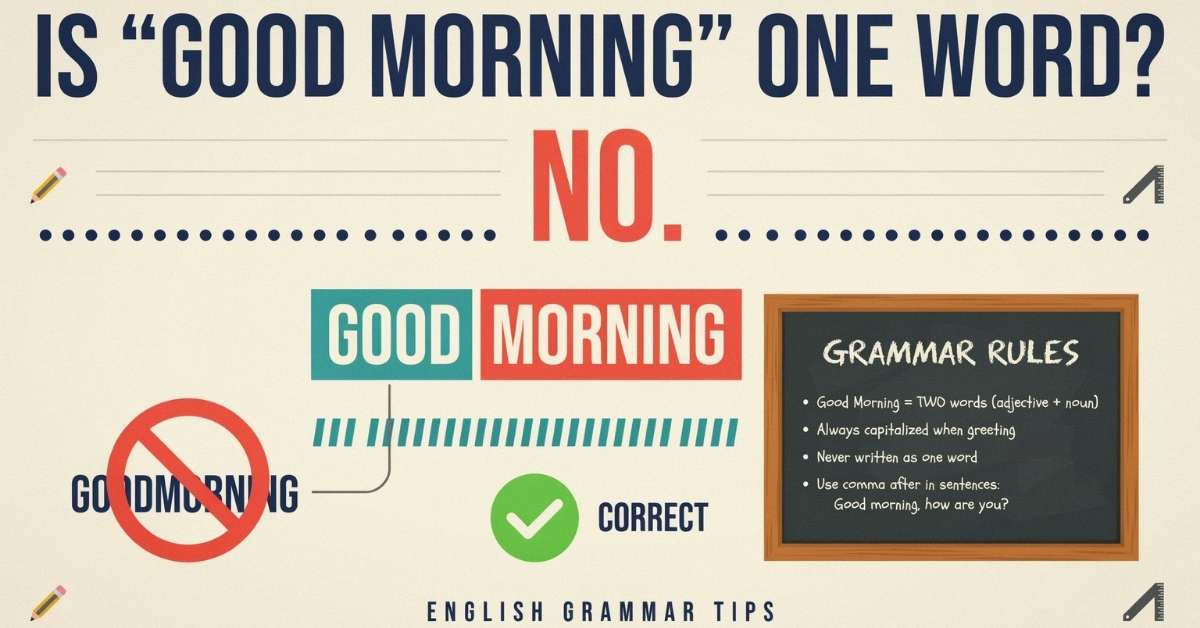
Pro Tip: A Simple Memory Trick
If you’re unsure, ask yourself this question:
Am I greeting someone?
If the answer is yes, write:
✅ Good morning
Never:
❌ Goodmorning
This quick check can save you from embarrassing mistakes in professional communication.
Is “Good Morning” Ever Written as One Word?
This is another question that appears frequently in search results.
The short answer is:
Not in standard English.
However, there are a few situations where you’ll see GoodMorning without a space.
Brand Names
Companies often combine words for marketing purposes.
Examples:
- GoodMorning Coffee
- GoodMorning Health
- GoodMorning Studio
These are branding decisions, not grammar rules.
Website Domains
Because website addresses cannot contain spaces, you’ll often see:
- goodmorning.com
- goodmorningnews.com
Again, this has nothing to do with standard spelling.
Usernames
Social media usernames often remove spaces.
Examples:
- @GoodMorningJane
- @GoodMorningWorld
This is simply a platform limitation.
Hashtags
Hashtags are another exception.
Examples:
- #GoodMorning
- #GoodMorningSunshine
The words are joined for technical reasons rather than grammatical ones.
Graphic Design
Designers sometimes combine words to create cleaner visuals.
Examples include:
- Posters
- Digital banners
- Logos
- Wallpapers
These artistic choices don’t change the correct spelling.
Good Morning in Professional Writing
Professional writing demands accuracy.
Whether you’re writing to a client, employer, professor, or colleague, using the correct greeting reflects attention to detail and professionalism.
Workplace Emails
Correct:
Good morning, Olivia,
Incorrect:
Goodmorning Olivia,
A small spelling mistake in a greeting can create a poor first impression, especially in formal communication.
Cover Letters
Example:
Good morning, Hiring Manager,
Thank you for considering my application.
This greeting sounds polite, natural, and professional.
Client Communication
Customer relationships benefit from polished communication.
Example:
Good morning, Mr. Patel.
I wanted to update you on your project timeline.
Professional greetings help establish trust and respect.
Academic Writing
Students writing formal emails to teachers or professors should use:
Good morning, Professor Ahmed,
instead of:
Goodmorning Professor Ahmed
Small details like these demonstrate good writing habits.
Quick Grammar Checklist
Before you send your email or message, use this checklist.
- Write good morning as two words.
- Never write Goodmorning in standard English.
- Capitalize according to context.
- Use a comma when directly addressing someone.
- Avoid copying branding or hashtag styles.
- Proofread before sending important emails.
Keeping this checklist in mind can help you avoid one of the most common English grammar mistakes.
See More: Take Effect or Take Affect
Expert Tips for Never Getting It Wrong Again
Editors and proofreaders rely on simple habits to maintain consistency. These tips can help you do the same.
1. Think About Your Audience
If you’re writing to:
- a client
- your boss
- a teacher
- a recruiter
- a customer
always choose the standard form:
Good morning
Professional communication should prioritize clarity over style.
2. Separate Grammar from Branding
It’s easy to assume that because you’ve seen GoodMorning on a logo or website, it’s acceptable everywhere.
Remember:
Branding follows marketing rules.
Grammar follows language rules.
The two are not always the same.
3. Proofread Greetings First
Your greeting is one of the first things readers notice.
Before clicking Send, quickly check:
- Is good morning written as two words?
- Is the capitalization correct?
- Did you include the comma?
- Does the greeting match the level of formality?
This takes only a few seconds but can significantly improve the professionalism of your writing.
4. Use Context to Guide Capitalization
A common source of confusion is capitalization. Instead of memorizing multiple rules, think about the context:
- Beginning of a sentence: Good morning, everyone.
- Email greeting: Good morning, Maria,
- Middle of a sentence: She wished us good morning before leaving.
- Title or heading: Good Morning Messages for Friends
Understanding the context makes it easier to apply the rule consistently.
5. Focus on Clarity, Not Trends
Social media trends, decorative typography, and creative branding often bend traditional writing conventions. While those styles have their place, standard English values consistency and readability.
When in doubt, choose the form that readers, editors, teachers, and employers expect:
Good morning
It’s clear, correct, and universally understood.
Frequently Asked Questions
Is good morning one word or two?
Good morning is two words. The one-word form Goodmorning is not considered correct in standard English. Whether you’re writing an email greeting, a business message, or a school assignment, always write good morning with a space between the two words.
Is Goodmorning incorrect?
Yes. Goodmorning is incorrect in formal and standard English writing.
You may see it used in:
- Brand names
- Website domains
- Social media usernames
- Hashtags
- Graphic designs
However, these are stylistic or technical choices, not grammar rules. In everyday writing, the correct spelling is good morning.
Why is good morning written as two words?
Good morning is an open compound, meaning two separate words work together to express a single idea while remaining individually written.
In the phrase:
- Good is an adjective.
- Morning is a noun.
Together, they create a polite greeting or salutation, but English grammar keeps them as two separate words.
Should Good Morning be capitalized?
It depends on the context.
Use capitalization like this:
- Good morning, Emma. ✔
- Good morning! ✔
- She said good morning to everyone. ✔
- Good Morning Quotes (title) ✔
The phrase follows normal capitalization rules rather than having a special grammar rule of its own.
Do you put a comma after good morning?
Yes—when directly addressing someone.
Correct examples:
- Good morning, John.
- Good morning, everyone.
- Good morning, team.
If you’re not addressing a person directly, the comma may not be needed.
Example:
She wished everyone a good morning before the meeting started.
Can good morning ever be one word?
Not in standard English.
The only exceptions are situations where spacing is removed for practical or stylistic reasons, such as:
- #GoodMorning
- GoodMorning Cafe
- Website domains
- Social media usernames
- Logos and branding
These exceptions don’t change the accepted grammar rule.
Is good morning correct in professional emails?
Yes. In fact, it’s one of the most common and professional email greetings.
Examples:
Good morning, David,
Good morning, Ms. Ali,
This greeting is appropriate for:
- Workplace communication
- Business emails
- Cover letters
- Academic emails
- Client correspondence
Is good morning an interjection or a phrase?
It can function as both, depending on how it’s used.
When used as a greeting:
Good morning, everyone!
it functions as an interjection or salutation.
Within a sentence:
She wished everyone a good morning.
it acts as a noun phrase.
The context determines its grammatical role.
Is good morning hyphenated?
No.
The correct form is:
Good morning
Not:
- Good-Morning
- Goodmorning
Since it’s an open compound, no hyphen is required.
Is there a difference between British and American English?
No significant difference exists for this phrase.
Both British English and American English write good morning as two separate words.
Whether you’re writing to someone in London, New York, Sydney, or Toronto, the standard spelling remains the same.
Finals:
If you only remember a few things from this guide, make them these:
- “Good morning” is always written as two words in standard English.
- “Goodmorning” is not the correct spelling for formal or everyday writing.
- Good is an adjective, and morning is a noun, making good morning an open compound.
- Capitalize the phrase according to normal writing rules, such as at the beginning of a sentence or in a heading.
- Use a comma when directly addressing a person or group.
- Don’t confuse hashtags, brand names, or logos with standard grammar.
- Good morning is the preferred greeting for professional emails, business communication, academic writing, and everyday conversations.
By understanding not just what the correct spelling is but why it follows this grammar rule, you’ll be able to use good morning confidently in any situation. Whether you’re sending an important email, greeting colleagues in a meeting, writing a school assignment, or simply wishing someone well, choosing the correct form helps your writing appear polished, professional, and grammatically accurate.