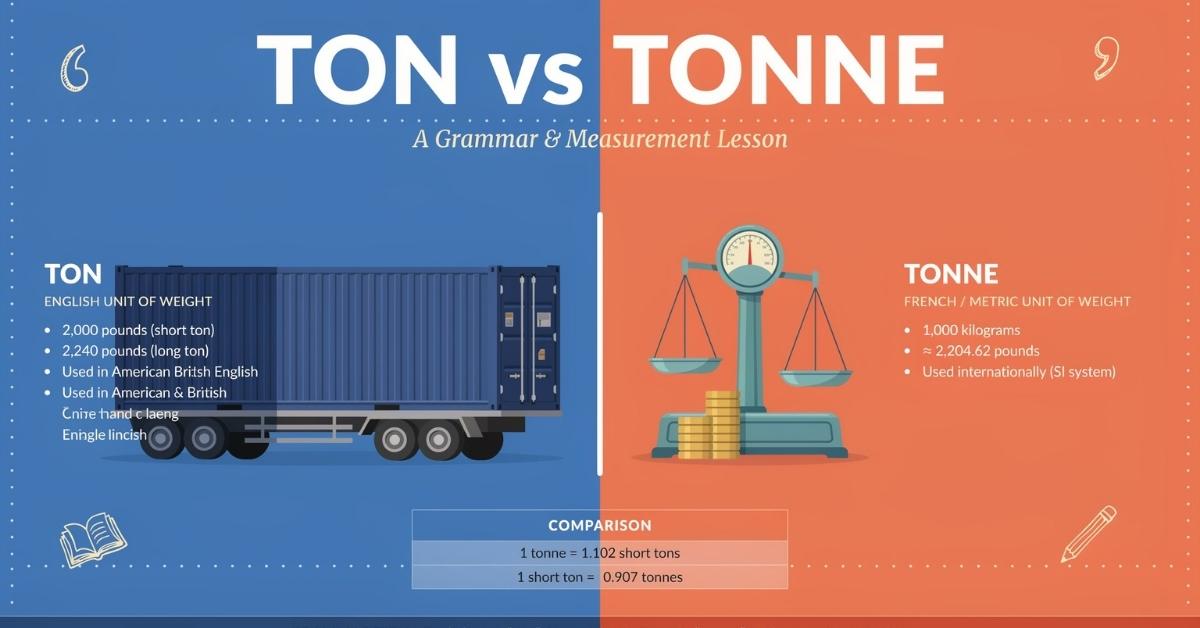
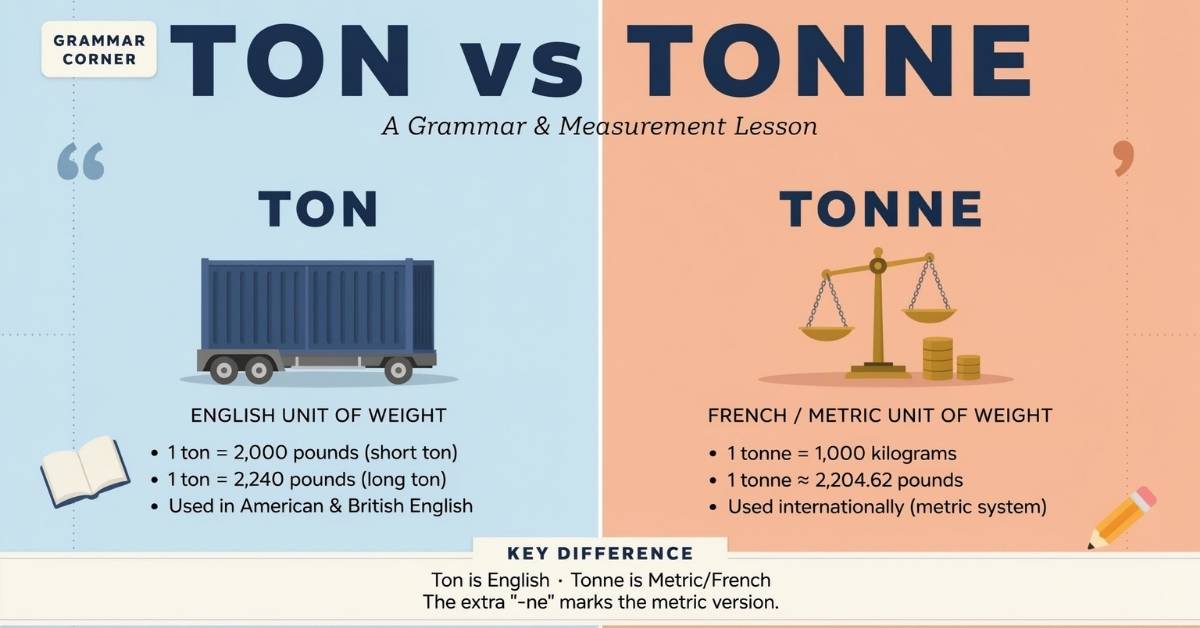
Ton or tonne is a common comparison that confuses students, professionals, writers, engineers, and anyone working with weights and measurements. The short answer is simple: a tonne equals exactly 1,000 kilograms (2,204.62 pounds) and is the standard metric unit of mass, while a ton can mean either the US short ton (2,000 pounds) or the UK long ton (2,240 pounds) depending on the country and context. Because these units are not always equal, using the wrong one can lead to costly mistakes in industries like shipping, construction, mining, agriculture, manufacturing, and international trade.
Whether you’re wondering “Is a tonne heavier than a ton?”, trying to understand metric ton vs tonne, or deciding which term to use in a report or business document, this guide has you covered. You’ll learn the exact differences, real-world examples, conversion methods, regional usage, and expert tips to confidently use the correct measurement every time.
Ton vs Tonne at a Glance
If you’re short on time, this comparison table explains the difference instantly.
| Feature | Ton (US Short Ton) | Tonne (Metric Ton) | Long Ton (UK) |
| Weight | 907.18 kg | 1,000 kg | 1,016.05 kg |
| Pounds | 2,000 lb | 2,204.62 lb | 2,240 lb |
| Measurement System | Imperial/US Customary | Metric System | Imperial |
| Common Regions | United States | Most countries worldwide | Historical UK & maritime sectors |
| Primary Industries | Construction, transportation | Shipping, mining, agriculture, manufacturing | Maritime, historical trade |
| Abbreviation | ton | t (or tonne) | LT (Long Ton) |
The One-Sentence Difference
A tonne is always 1,000 kilograms, while a ton can represent different weights depending on whether you’re referring to the US short ton or the UK long ton.
What Is a Ton?
A ton is a unit used to measure weight (or more precisely, mass in most practical contexts). Unlike the tonne, the word “ton” doesn’t always refer to a single fixed value.
Its exact weight depends on the measurement system being used.
Today, the term ton generally refers to one of two measurements:
- US Short Ton
- UK Long Ton
Understanding this distinction is essential because using the wrong unit can create confusion in engineering calculations, freight documentation, scientific discussions, and commercial contracts.
The US Short Ton Explained
The US short ton is the standard ton used throughout the United States.
Weight
- 2,000 pounds
- 907.18 kilograms
You’ll commonly see the short ton used in:
- Construction projects
- Highway weight limits
- Waste management
- Manufacturing
- Transportation
- American engineering documents
Real-World Example
Suppose a trucking company states that a shipment weighs 25 tons.
If the shipment originates in the United States, it almost always means:
25 US short tons = approximately 22.68 metric tonnes.
That difference may seem small at first, but for large cargo shipments, it can significantly affect:
- Freight costs
- Equipment capacity
- Loading calculations
- Safety regulations
The UK Long Ton Explained
The long ton, also called the Imperial ton, was traditionally used in the United Kingdom and several Commonwealth countries.
Weight
- 2,240 pounds
- 1,016.05 kilograms
Although the long ton has largely been replaced by the metric tonne, it still appears in:
- Historical documents
- Maritime records
- Naval engineering
- Some legacy industrial publications
Why It Still Matters
You may encounter the long ton when reading:
- Historical trade records
- Old engineering manuals
- Naval specifications
- Maritime regulations
- Historical mining reports
Understanding the long ton prevents misinterpreting older technical documents.
Why the Word “Ton” Can Be Confusing
One of the biggest reasons people search for “ton or tonne” is that the same word means different things in different countries.
For example:
Imagine three engineers discussing a shipment weighing 100 tons.
One is from the United States.
Another is from the United Kingdom.
The third works for an international logistics company.
Each may interpret that measurement differently unless the unit is clearly specified.
This ambiguity is why international organizations increasingly recommend using metric tonnes in global communication.
What Is a Tonne?
A tonne is the internationally recognized metric unit equal to 1,000 kilograms.
It is often referred to as the metric ton, although tonne is the official spelling used to distinguish it from the various definitions of ton.
Weight
- 1,000 kilograms
- 2,204.62 pounds
Unlike the word ton, the value of a tonne never changes.
No matter where you are in the world, one tonne always equals exactly 1,000 kg.
This consistency makes it the preferred unit for international communication.
Why It’s Also Called a Metric Ton
Many people ask:
Is a metric ton the same as a tonne?
Yes.
Both terms describe exactly the same measurement.
- 1 Metric Ton = 1 Tonne = 1,000 Kilograms
The difference is purely in naming.
In scientific writing and many international publications, you’ll often see the word tonne, while some industries—particularly in North America—still use the phrase metric ton.
Why Most Countries Prefer the Tonne
The metric system is now the global standard for measurement.
Because the tonne belongs to the metric system, it’s widely used across:
- Europe
- Australia
- Canada
- Asia
- Africa
- South America
It is also the preferred measurement in:
- International trade
- Scientific research
- Manufacturing
- Commodity markets
- Environmental reporting
Using tonne eliminates confusion caused by the multiple meanings of ton.
Industries That Commonly Use Tonnes
Many global industries rely on the metric tonne because international transactions require standardized units.
Some of the most common examples include:
Shipping and Logistics
Cargo weights, freight documents, and shipping manifests are typically measured in tonnes to ensure consistency across countries.
Construction
Large quantities of steel, cement, sand, and aggregate are frequently sold by the tonne, especially outside the United States.
Mining
Mining companies report production in metric tonnes when discussing coal, iron ore, copper, lithium, and other minerals.
Agriculture
Grain, wheat, rice, corn, and fertilizer are commonly traded internationally using tonnes.
Manufacturing
Factories measure raw materials and finished products in metric tonnes for easier global reporting.
Environmental Reporting
Governments and environmental organizations almost always report:
- Tonnes of CO₂
- Carbon emissions
- Greenhouse gas emissions
- Recycling volumes
- Waste generation
Using a standardized unit ensures that data remains consistent across international reports.
Ton vs Tonne: Key Differences Explained
Although these terms sound similar, their meanings are not always interchangeable.
Here’s a side-by-side comparison.
| Feature | Ton | Tonne |
| Definition | A unit that may refer to a US short ton or UK long ton | A metric unit equal to exactly 1,000 kg |
| Kilograms | 907.18 kg (US) or 1,016.05 kg (UK) | 1,000 kg |
| Pounds | 2,000 lb (US) or 2,240 lb (UK) | 2,204.62 lb |
| Measurement System | US Customary / Imperial | Metric System |
| International Standard | No | Yes |
| Scientific Usage | Rare | Common |
| Global Trade | Limited | Widely used |
| Construction Usage | Regional | International |
| Shipping Usage | Depends on country | Standard choice |
| Common Abbreviation | ton | t |
Which One Should You Use?
Use tonne when:
- Writing for an international audience
- Working with the metric system
- Preparing scientific or technical reports
- Handling international trade or shipping documents
- Reporting environmental data such as carbon emissions
Use ton when:
- Referring specifically to US short tons
- Following American industry standards
- Working with historical UK long ton references
- Using regional terminology required by local regulations
Choosing the correct unit avoids misunderstandings, improves accuracy, and ensures your writing aligns with industry expectations.
Which Countries Use Ton and Which Use Tonne?
The choice between ton and tonne often depends on the country’s preferred measurement system. While the metric tonne has become the international standard, some regions still use tons for specific industries or domestic purposes.
Understanding these regional differences is especially important if you work in international trade, logistics, engineering, construction, manufacturing, or scientific research, where precise terminology helps prevent costly misunderstandings.
United States
The United States primarily uses the US short ton (2,000 pounds) in transportation, construction, waste management, and many commercial applications. However, industries involved in global trade may also use the metric tonne when dealing with international partners.
United Kingdom
The UK has largely adopted the metric tonne for modern commerce, manufacturing, and government reporting. The long ton still appears occasionally in historical references, maritime records, and legacy engineering documents, but it is no longer the standard measurement in everyday business.
Canada
Canada officially uses the metric system, making the tonne the standard unit for most industries. Because of its close economic ties with the United States, you’ll sometimes encounter short tons in cross-border trade and transportation.
Australia
Australia uses the metric tonne across nearly all sectors, including agriculture, mining, construction, and environmental reporting. Seeing the term ton without clarification is uncommon in modern Australian publications.
Europe
Most European countries exclusively use It as part of the metric system. Whether discussing industrial production, freight, recycling, or commodity markets, the metric tonne is the accepted standard.
Asia
Across much of Asia, the metric tonne is widely used in manufacturing, export industries, shipping, and infrastructure projects. Countries engaged in global commerce rely on metric measurements to maintain consistency with international standards.
International Organizations
Organizations involved in global trade, environmental monitoring, scientific research, and transportation almost always use the tonne to avoid confusion caused by the multiple definitions of ton. International standards favor clear, universally understood units, making the tonne the preferred choice for cross-border communication.
Learn More: Below or Bellow
Why Are There Three Different Types of Tons?
One of the biggest reasons people search for “ton or tonne” is that they discover there isn’t just one type of ton. In fact, there are three commonly recognized units:
- US Short Ton
- UK Long Ton
- Metric Tonne (Metric Ton)
Each developed in a different historical and regional context. While this may seem unnecessarily complicated today, these measurements evolved long before there was a single international system for weights and measures.
A Brief Historical Timeline
| Period | Development | Why It Matters Today |
| Medieval Europe | The word “ton” originated from large casks (tun) used to transport wine and other goods. | The term became associated with heavy loads rather than a fixed weight. |
| 18th–19th Century | Britain standardized the Long Ton (2,240 lb). | Widely used throughout the British Empire and maritime trade. |
| 19th Century | The United States adopted the Short Ton (2,000 lb). | Became the standard for American industry and transportation. |
| 20th Century | Countries increasingly adopted the Metric System. | The Tonne (1,000 kg) became the international standard for trade and science. |
Today, the metric tonne is the preferred unit worldwide, while the US short ton remains common within the United States. The UK long ton is now mostly limited to historical references and specialized maritime contexts.
Metric Ton vs Tonne: Are They the Same?
A common long-tail search is:
“Metric ton vs tonne”
The answer is straightforward:
Yes. A metric ton and a tonne are exactly the same measurement.
Both equal:
- 1,000 kilograms
- 2,204.62 pounds
The difference is terminology, not weight.
- It is the internationally recognized spelling used to distinguish it from other types of ton.
- Metric ton is a descriptive term still used in some industries, particularly in North America.
Why Do Two Names Exist?
The word “tonne” was introduced to avoid confusion with the short ton and long ton. Since “ton” can refer to different weights depending on the country, the distinct spelling tonne makes it immediately clear that you’re referring to 1,000 kilograms.
Professional Tip
If you’re writing for an international audience, using tonne is generally the clearest choice because it reduces ambiguity.
Ton, Tonne, Kilogram, and Pound Compared
Understanding how these units relate makes conversions much easier.
| Unit | Kilograms | Pounds | Common Usage |
| Kilogram (kg) | 1 | 2.20462 | Everyday metric measurement |
| Pound (lb) | 0.453592 | 1 | US customary system |
| US Short Ton | 907.18 | 2,000 | United States |
| Metric Tonne | 1,000 | 2,204.62 | International standard |
| UK Long Ton | 1,016.05 | 2,240 | Historical UK and maritime use |
Quick Comparison
- 1 tonne = 1,000 kilograms
- 1 US short ton = 907.18 kilograms
- 1 UK long ton = 1,016.05 kilograms
This table highlights why it’s important to identify which “ton” someone is referring to before making calculations or comparisons.
Real-Life Examples to Make the Difference Easy to Understand
Numbers alone can be difficult to visualize. Here are a few practical examples.
A Family Car
Many compact cars weigh around 1.2 to 1.8 tonnes.
That means saying a car weighs “1.5 tonnes” is more precise than simply saying “about one and a half tons,” which could mean different things depending on the country.
An African Elephant
A large African elephant typically weighs between 5 and 7 tonnes.
Using the metric tonne provides a consistent reference for wildlife research across different countries.
Shipping Containers
International shipping companies almost always express cargo weights in metric tonnes.
For example:
A loaded shipping container may weigh 28 tonnes.
This standardization helps avoid costly misunderstandings in freight, logistics, and international trade.
Steel Production
Steel manufacturers often report annual production in millions of metric tonnes.
Using a globally recognized unit allows companies, governments, and investors to compare production figures accurately.
Grain Harvests
Agricultural exports such as wheat, corn, rice, and soybeans are commonly traded in tonnes, particularly in international commodity markets.
Carbon Emissions
Climate reports typically refer to:
- Tonnes of CO₂
- Greenhouse gas emissions
- Carbon footprints
The metric tonne is the accepted unit because environmental reporting is global in scope.
When Should You Use “Ton” or “Tonne”?
Choosing the correct unit depends on where you’re writing, who your audience is, and the industry you’re working in.
Academic Writing
Most universities and scientific publications prefer tonne when discussing metric measurements. If you’re writing a research paper with an international audience, the metric terminology is usually the safest option.
Business Documents
Businesses operating across borders often use tonnes because the unit is universally understood and avoids ambiguity.
If your company only operates within the United States, short ton may still be appropriate—but it’s best to specify “US short ton” rather than simply writing “ton.”
Scientific Research
Scientists almost always use metric units, making the tonne the preferred measurement when dealing with large masses.
International Trade
Commodity trading, freight contracts, customs documentation, and import/export agreements commonly use metric tonnes.
Examples include:
- Iron ore
- Coal
- Wheat
- Fertilizer
- Crude oil
- Cement
- Steel
Using a standardized unit reduces the risk of contractual disputes.
Construction
Construction terminology varies by region.
- In the United States, suppliers often use short tons.
- In countries using the metric system, construction materials are generally measured in tonnes.
Always check local regulations and supplier documentation before placing large orders.
Freight and Logistics
International freight companies almost always rely on metric tonnes for shipping documents, cargo manifests, and transportation planning.
Domestic transportation may continue using local measurement systems.
Environmental Reports
Organizations reporting:
- Carbon emissions
- Recycling rates
- Waste generation
- Sustainability metrics
almost always use metric tonnes because these reports are intended for an international audience.
Common Mistakes People Make
Even experienced professionals occasionally confuse these units. Here are some of the most common misconceptions.
Mistake #1: A Ton and a Tonne Are the Same
They are not always the same.
A tonne equals 1,000 kg, while a ton could mean either 907.18 kg (US short ton) or 1,016.05 kg (UK long ton).
Mistake #2: Tonne Is Just British Spelling
This is incorrect.
Although It is commonly used in British English, it is actually the internationally recognized term for the metric unit of 1,000 kilograms.
Mistake #3: Metric Ton and Tonne Are Different Units
They are exactly the same.
The difference is simply the wording used.
Mistake #4: The Long Ton Is Still Widely Used
The long ton is now relatively uncommon.
Most industries have transitioned to metric tonnes, while the US short ton remains standard in American domestic applications.
Mistake #5: Every Country Uses the Same Definition of Ton
Different countries have historically used different standards.
Whenever possible, specify whether you’re referring to:
- US Short Ton
- UK Long Ton
- Metric Tonne
Doing so eliminates confusion.
See More: In Process or In Progress
How to Convert Between Tons and Tonnes
Knowing a few simple formulas makes conversions much easier.
Basic Conversion Formulas
- 1 tonne = 1.1023 US short tons
- 1 US short ton = 0.9072 tonnes
- 1 UK long ton = 1.016 tonnes
- 1 tonne = 0.9842 UK long tons
Quick Conversion Table
| From | To | Multiply By |
| Tonne | US Short Ton | 1.1023 |
| US Short Ton | Tonne | 0.9072 |
| Long Ton | Tonne | 1.016 |
| Tonne | Long Ton | 0.9842 |
Mental Math Tips
If you only need an approximate answer:
- A tonne is slightly heavier than a US short ton.
- A long ton is slightly heavier than a tonne.
- Remember the order:
US Short Ton → Tonne → UK Long Ton
This simple sequence makes it easier to estimate weights without a calculator.
Common Conversion Examples
- 10 tonnes ≈ 11.02 US short tons
- 50 US short tons ≈ 45.36 tonnes
- 100 tonnes ≈ 98.42 UK long tons
- 25 long tons ≈ 25.40 tonnes
These examples are particularly useful when working with shipping, engineering, construction, and commodity trading documents.
Ton vs Tonne in Different Industries
The preferred unit often depends on the industry and geographic region.
| Industry | Common Unit | Reason |
| Shipping & Logistics | Metric tonne | International standard for cargo and freight |
| Construction | Ton or tonne | Depends on local regulations and measurement system |
| Mining | Metric tonne | Global commodity reporting |
| Agriculture | Metric tonne | International grain and fertilizer trade |
| Manufacturing | Metric tonne | Consistent reporting across global supply chains |
| Transportation | Ton or tonne | Regional standards vary |
| Environmental Reporting | Metric tonne | Standard for carbon emissions and sustainability |
| Scientific Research | Metric tonne | Metric system consistency |
Expert Insight
If your work involves international communication, engineering, global supply chains, or scientific reporting, using metric tonnes helps ensure everyone interprets the measurement the same way—regardless of country or industry.
Historical Origins
Understanding where these terms came from makes it easier to see why multiple definitions still exist today.
The word “ton” originated from the Old English and Old French word “tun,” which referred to a large cask or barrel used to transport wine, beer, and other goods. Over time, merchants began using the term to describe the approximate weight that a fully loaded cask could carry. As trade expanded across Europe, different countries developed their own standards, leading to variations in the weight represented by a ton.
During the Industrial Revolution, the United Kingdom formally adopted the long ton (2,240 pounds), while the United States later standardized the short ton (2,000 pounds) for domestic commerce and transportation.
As international trade and scientific collaboration increased in the 20th century, countries adopting the metric system needed a single, unambiguous unit for large masses. This led to the widespread adoption of the tonne, defined as exactly 1,000 kilograms.
Today, the metric tonne is the preferred measurement in most parts of the world because it aligns with the International System of Units (SI) and simplifies communication between countries.
Frequently Asked Questions
Is a tonne heavier than a ton?
Yes, if you’re comparing it with the US short ton. A tonne weighs 1,000 kilograms, while a US short ton weighs 907.18 kilograms. However, a UK long ton (1,016.05 kilograms) is slightly heavier than a tonne.
How many kilograms are in a ton?
The answer depends on which ton you mean:
- US short ton = 907.18 kg
- UK long ton = 1,016.05 kg
- Metric tonne = 1,000 kg
Always specify the type of ton to avoid confusion.
Is a metric ton the same as a tonne?
Yes. A metric ton and a tonne are exactly the same unit, both equal to 1,000 kilograms (2,204.62 pounds).
Why do Americans use “ton” instead of “tonne”?
The United States continues to use the US customary measurement system for many domestic applications. As a result, industries such as transportation, construction, and manufacturing commonly refer to the short ton rather than the metric tonne.
Why do most other countries use “tonne”?
Most countries use the metric system, making the tonne the standard unit for measuring large weights in science, engineering, agriculture, mining, shipping, and international trade.
Which unit is used in shipping?
International shipping and logistics typically use the metric tonne because it provides a single global standard for cargo weights, freight calculations, and customs documentation.
Which unit should I use in scientific writing?
If you’re writing for an international or scientific audience, use the metric tonne when referring to large masses. It aligns with the metric system and avoids ambiguity.
How do I convert tons to tonnes?
Multiply US short tons by 0.9072 to convert them into tonnes.
For example:
- 20 US short tons × 0.9072 = 18.14 tonnes
What is the abbreviation?
The official symbol for a tonne is t.
Example:
- 15 t = 15 metric tonnes
Does the UK still use the long ton?
The long ton is now uncommon in everyday business. Modern UK industries primarily use the metric tonne, although the long ton may still appear in historical documents, maritime records, or legacy engineering references.
Is tonne an SI unit?
Strictly speaking, the tonne is not one of the seven SI base units, but it is an SI-accepted unit that is widely used with the International System of Units (SI) for expressing large masses.
Why are there different definitions of a ton?
Different definitions developed because countries established their own measurement systems before international standards became common. The metric tonne was later introduced to provide a consistent global standard.
Quick Reference Cheat Sheet
If you only remember one section from this guide, make it this one.
| Unit | Kilograms | Pounds | Common Regions | Best Used For | Abbreviation |
| US Short Ton | 907.18 kg | 2,000 lb | United States | Domestic transportation, construction | ton |
| Metric Tonne | 1,000 kg | 2,204.62 lb | Worldwide | Shipping, science, trade, manufacturing | t |
| UK Long Ton | 1,016.05 kg | 2,240 lb | Historical UK use | Maritime and historical references | LT |
Quick Memory Trick
Remember this simple order:
US Short Ton → Metric Tonne → UK Long Ton
From lightest to heaviest:
- US Short Ton = 907.18 kg
- Metric Tonne = 1,000 kg
- UK Long Ton = 1,016.05 kg
This is one of the easiest ways to remember the differences.
Common Scenarios: Which Unit Should You Use?
| Situation | Recommended Unit |
| International shipping | Metric tonne |
| Scientific research | Metric tonne |
| Carbon emissions reporting | Metric tonne |
| Global commodity trading | Metric tonne |
| US construction projects | US short ton |
| US trucking and transportation | US short ton |
| Historical UK engineering documents | UK long ton |
| Academic writing for an international audience | Metric tonne |
Using the correct terminology not only improves accuracy but also makes your communication more professional and easier for readers around the world to understand.
Final Thoughts
The debate over “ton or tonne” isn’t about one term being right and the other being wrong—it’s about using the correct unit for the right context. While these measurements are closely related, they represent different values depending on the measurement system, country, and industry.
For global communication, the metric tonne has become the preferred standard because it provides a clear, consistent, and internationally recognized measurement. Whether you’re preparing a scientific report, calculating freight costs, comparing commodity prices, estimating construction materials, or interpreting environmental data such as tonnes of CO₂, understanding these distinctions helps you avoid costly mistakes and communicate with confidence.
Whenever you’re unsure, remember this simple rule:
- Use “tonne” for international and metric-based contexts.
- Use “US short ton” or “UK long ton” only when those specific regional measurements apply.
By understanding the difference between ton, tonne, metric ton, short ton, and long ton, you’ll be able to interpret weight measurements accurately, choose the correct terminology, and avoid one of the most common sources of confusion in global measurement systems.