Introduction
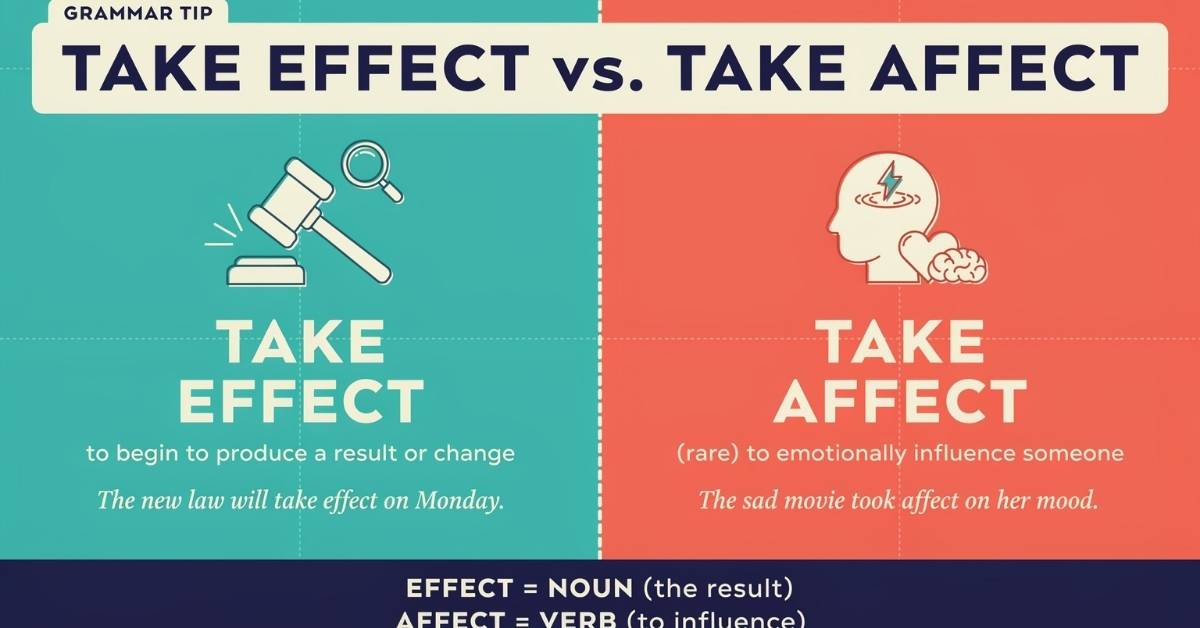
Take effect or take affect? The correct phrase is “take effect.” The expression “take affect” is almost always grammatically incorrect in standard English because effect is the noun that naturally follows the verb take in this fixed English collocation. Whether you’re writing a business email, academic paper, legal contract, government notice, or simply trying to improve your English grammar, using the correct phrase helps your writing sound clear, professional, and credible.
If you’ve ever paused while typing, wondering whether a new law takes effect, a medicine takes effect, or a policy takes affect, you’re not alone. The confusion between affect vs. effect is one of the most common grammar mistakes in English because the words look and sound similar but serve different grammatical roles.
In this guide, you’ll learn what “take effect” means, why “take affect” is usually wrong, how to remember the difference with a simple trick, and how to use the phrase confidently in legal writing, business communication, academic English, and everyday conversations. You’ll also discover practical examples, common mistakes, professional editing tips, and expert insights that go beyond the explanations found in most grammar articles.
The Quick Answer at a Glance
If you’re in a hurry, here’s the answer you need.
| Question | Answer |
|---|---|
| Correct phrase | ✅ Take effect |
| Incorrect phrase | ❌ Take affect (in almost every situation) |
| Meaning | To become active, start working, or become legally or practically effective |
| Common usage | Laws, policies, medicines, contracts, software updates, regulations, insurance policies, workplace rules, and everyday English |
One-Sentence Grammar Rule
Use take effect because effect is the noun that forms a standard English expression with the verb take.
Easy Memory Trick
Think of it this way:
If something begins working, it takes effect—not affect.
Whenever something becomes active or officially starts, effect is the correct word.
What Does “Take Effect” Mean?
The phrase take effect means to become active, operative, enforceable, or start producing results. It is a well-established English collocation, meaning that native speakers naturally pair these two words together.
Unlike many grammar rules that require memorization, this phrase follows a consistent usage pattern across business writing, legal English, government communication, healthcare, technology, and everyday conversation.
Simple Definition
Take effect means:
- To begin working
- To become effective
- To start producing the intended result
- To become officially enforceable
Whether you’re talking about a law, medicine, policy, or software update, the meaning remains the same: something starts operating as intended.
Meaning in Everyday English
In everyday conversations, take effect describes the moment when a change, action, or process begins to work.
For example:
- The new gym membership rules take effect next Monday.
- The headache medicine should take effect within 20 minutes.
- The software update will take effect after you restart your computer.
- The price changes take effect at midnight.
In every example, something moves from being planned or announced to becoming active.
Formal Meaning
In formal and professional writing, take effect often refers to an official start date or implementation.
You’ll frequently encounter the phrase in:
- Employment contracts
- Insurance policies
- Government regulations
- Tax legislation
- Court orders
- Corporate policies
- Terms and conditions
- University regulations
For example:
The revised employment policy will take effect on January 1, 2027.
Here, the policy becomes officially enforceable on the specified date.
When the Phrase Is Commonly Used
One reason take effect appears so often is its versatility. It applies across many industries and situations.
Laws and Regulations
Governments announce when new legislation takes effect, informing citizens and organizations when compliance begins.
Example:
The environmental regulation takes effect on July 1.
Business and Workplace Policies
Companies regularly communicate when new procedures or employee benefits begin.
Example:
The revised remote work policy will take effect next quarter.
Contracts and Agreements
Legal documents often specify an effective date, indicating when contractual obligations begin.
Example:
This agreement shall take effect upon signing.
Healthcare and Medicine
Doctors and pharmacists use the phrase when discussing treatments.
Example:
Most pain relievers take effect within thirty minutes.
Insurance
Insurance companies explain when coverage becomes active.
Example:
Your health insurance coverage takes effect on the first day of next month.
Technology
Software companies announce when updates or new features become active.
Example:
The security patch will take effect after your device restarts.
Education
Schools and universities often publish policy updates.
Example:
The revised attendance policy takes effect at the beginning of the semester.
Why Is “Take Effect” Correct but “Take Affect” Incorrect?
At first glance, affect and effect seem almost interchangeable. They share similar spelling, nearly identical pronunciation, and are among the most commonly confused words in English. However, understanding the difference becomes much easier once you know how each word functions grammatically.
The phrase take effect is correct because it follows a long-established pattern in English where effect acts as a noun meaning result, outcome, or state of becoming active. Together, take and effect form a natural collocation that native speakers instinctively recognize.
By contrast, take affect almost never works because affect is usually a verb, not the noun required after take in this expression.
Understanding the Difference Between “Affect” and “Effect”
The easiest way to separate these words is by remembering their primary grammatical roles.
| Word | Part of Speech | Meaning | Example |
|---|---|---|---|
| Affect | Usually a verb | To influence or change something | Stress can affect your sleep. |
| Effect | Usually a noun | A result, consequence, or outcome | The new rule had an immediate effect. |
This distinction explains why the phrase is take effect, not take affect.
You can affect a situation, but a policy takes effect.
You can affect someone’s decision, but a regulation takes effect on a certain date.
Why English Uses “Effect” After “Take”
English relies heavily on collocations—word combinations that naturally occur together over time.
Examples include:
- Make a decision
- Pay attention
- Break the news
- Catch a cold
- Take responsibility
- Take effect
Although other combinations might seem possible from a grammatical perspective, they simply aren’t part of standard English usage.
This is why native speakers instinctively say:
- The changes take effect tomorrow.
- The medicine takes effect quickly.
- The agreement takes effect immediately.
Saying take affect sounds unnatural because it breaks an established collocation that has been used consistently in professional and everyday English for generations.
The Role of Collocations in English
A collocation is a pair or group of words that commonly appear together. Learning collocations is one of the fastest ways to sound more fluent because native speakers use them automatically.
Some familiar examples include:
| Correct Collocation | Incorrect Alternative |
|---|---|
| Take effect | ❌ Take affect |
| Make progress | ❌ Do progress |
| Pay attention | ❌ Give attention |
| Catch a cold | ❌ Receive a cold |
| Break the law | ❌ Destroy the law |
Notice that the incorrect versions aren’t always impossible to understand—they simply don’t match natural English usage.
Understanding collocations also helps you avoid common writing mistakes that grammar checkers may not always detect. This is especially important in business communication, academic writing, legal drafting, and professional editing, where precise language improves both clarity and credibility.
Why Native Speakers Never Say “Take Affect”
Native English speakers almost never use take affect because it conflicts with the standard grammatical relationship between the words take and effect.
When someone hears take affect, it immediately sounds unusual because affect is expected to function as a verb, not as the noun required in this fixed expression.
Professional editors, proofreaders, journalists, lawyers, and teachers routinely correct this mistake because take effect is the accepted phrase in plain English, legal English, academic writing, and business communication.
If you’re ever unsure, remember this simple rule:
If something becomes active, operational, enforceable, or starts working, it always “takes effect.” Never “takes affect.”
That single rule will help you avoid one of the most common grammar errors in English while making your writing sound polished, accurate, and professional.
The Grammar Behind the Phrase
Understanding why the phrase is take effect instead of take affect becomes much easier once you know the grammatical role of each word. Fortunately, you don’t need to memorize complicated grammar rules—just remember how these words usually function in everyday English.
“Effect” as a Noun
In most situations, effect is a noun. It refers to a result, consequence, outcome, or the state of becoming active.
Examples:
- The new advertising campaign had a positive effect on sales.
- The medication produced the desired effect.
- The policy had little effect on employee productivity.
When paired with the verb take, the phrase take effect means that something begins to produce its intended result or becomes officially active.
Examples:
- The revised pricing policy will take effect next month.
- The warranty will take effect immediately after purchase.
- The software update takes effect after restarting your computer.
In every sentence, effect functions as a noun, making take effect the grammatically correct expression.
“Affect” as a Verb
Unlike effect, affect is most commonly used as a verb, meaning to influence, change, or impact someone or something.
Examples:
- Weather conditions can affect flight schedules.
- Stress may affect your concentration.
- Economic inflation affects household budgets.
- Poor communication can affect customer satisfaction.
Notice the difference:
- You affect a situation.
- A change takes effect.
These two words perform completely different jobs in a sentence, which is why they cannot usually replace each other.
Rare Exceptions You Should Know
One reason people become confused is that both words have less common meanings. While these exceptions are useful to know, they do not change the rule for the phrase take effect.
Effect as a Verb
In formal English, effect can occasionally be used as a verb meaning to bring about, accomplish, or cause.
Examples:
- The CEO hopes to effect significant organizational change.
- The negotiations effected a peaceful agreement.
This usage is relatively uncommon and appears mostly in legal, government, or highly formal writing.
Affect as a Noun
In psychology and psychiatry, affect can be used as a noun describing a person’s outward emotional expression.
Example:
The patient displayed a flat affect during the examination.
Unless you’re reading or writing psychological or medical literature, you’re unlikely to encounter this usage.
Learn More: Diner or Dinner
Why These Exceptions Don’t Change the Rule
Although these uncommon meanings exist, they are unrelated to the expression take effect.
In standard English:
- Policies take effect.
- Laws take effect.
- Contracts take effect.
- Medicines take effect.
You should never replace “effect” with “affect” in these situations.
The exceptions are interesting from a linguistic perspective, but they don’t affect everyday writing decisions.
Real-Life Examples of “Take Effect”
Learning grammar becomes much easier when you see how native speakers actually use a phrase. Below are practical examples from different contexts where take effect naturally appears.
Laws and Government
Governments frequently announce when new legislation becomes legally enforceable.
Examples:
- The revised tax law will take effect on January 1.
- The environmental regulations take effect next month.
- The new immigration policy takes effect immediately.
- The updated traffic rules will take effect after public notification.
Business and Workplace
Organizations often use take effect when introducing new procedures or benefits.
Examples:
- The salary increase will take effect on July 1.
- The revised employee handbook takes effect next Monday.
- The company’s hybrid work policy takes effect next quarter.
- The new performance review process will take effect after management approval.
Contracts and Legal Documents
Legal professionals commonly refer to the effective date of agreements.
Examples:
- This agreement shall take effect upon execution by both parties.
- The revised lease terms take effect after renewal.
- The confidentiality agreement takes effect immediately upon signing.
Healthcare and Medicine
Doctors, pharmacists, and healthcare professionals regularly use this phrase.
Examples:
- The antibiotic should take effect within 48 hours.
- Most pain relievers take effect in about 30 minutes.
- The vaccine begins to take effect after the body’s immune response develops.
Technology and Software
Technology companies often explain when updates become active.
Examples:
- The software update will take effect after restarting your device.
- Your new security settings take effect instantly.
- The system configuration changes will take effect overnight.
Education
Schools and universities frequently announce policy changes.
Examples:
- The revised grading policy takes effect this semester.
- The new attendance requirements take effect in August.
- The scholarship guidelines will take effect next academic year.
Everyday Conversations
You don’t have to be reading legal documents to use this phrase.
Examples:
- The discount takes effect tomorrow.
- The changes won’t take effect until next week.
- The new routine finally started to take effect.
- Hopefully, the medicine will take effect soon.
Quick Reference Table
| Context | Correct Sentence | Why It Is Correct |
|---|---|---|
| Law | The new law takes effect next month. | The law becomes enforceable. |
| Medicine | The medicine takes effect within 30 minutes. | It begins working. |
| Business | The revised policy takes effect Monday. | The policy becomes active. |
| Technology | The software update takes effect after restart. | The update becomes operational. |
| Insurance | Your coverage takes effect tomorrow. | The policy becomes valid. |
| Education | The new rules take effect this semester. | The regulations become applicable. |
Incorrect Examples and How to Fix Them
Many writers accidentally use take affect because they confuse affect and effect. Looking at incorrect examples helps reinforce the correct pattern.
| Incorrect Sentence | Correct Version | Explanation |
|---|---|---|
| The law will take affect tomorrow. | ✅ The law will take effect tomorrow. | Laws become effective. |
| The medicine takes affect quickly. | ✅ The medicine takes effect quickly. | The medicine starts working. |
| The policy takes affect next week. | ✅ The policy takes effect next week. | Policies become active. |
| The contract will take affect immediately. | ✅ The contract will take effect immediately. | Contracts become legally effective. |
| The changes take affect tonight. | ✅ The changes take effect tonight. | Changes become operative. |
Why the Mistake Happens
This mistake usually occurs because:
- Affect and effect look almost identical.
- They sound similar when spoken.
- Both relate to change or results.
- Many people remember the words but forget their grammatical roles.
- Spell checkers don’t always recognize contextual mistakes.
- AI writing tools can occasionally confuse the terms if the surrounding context is unclear.
Fortunately, once you remember the basic rule, the confusion largely disappears.
Why People Confuse “Affect” and “Effect”
Even experienced writers occasionally pause before choosing between these two words. Understanding the reasons behind the confusion makes it easier to avoid the mistake.
Similar Pronunciation
In casual speech, affect and effect sound very similar. This leads many writers to spell the word they hear rather than the one the sentence requires.
Similar Spelling
The words differ by only one letter, making them easy to mix up while typing quickly.
Different Parts of Speech
The biggest source of confusion is grammatical.
- Affect usually acts as a verb.
- Effect usually acts as a noun.
Many people remember the meanings but forget which grammatical role each word typically plays.
How Autocorrect and AI Writing Tools Can Contribute to Confusion
Modern writing tools are helpful, but they aren’t perfect. Some spell checkers focus on spelling rather than grammar, meaning they may not always identify contextual errors such as take affect.
That’s why professional editors still review important documents manually, especially legal agreements, academic papers, and business communications.
The Psychology Behind Frequent Grammar Mix-Ups
Our brains often rely on familiar sound patterns instead of grammar rules. When two words are pronounced similarly and share related meanings, it’s natural to hesitate.
The good news is that repeated exposure to the correct collocation—take effect—helps build long-term language habits.
How to Remember the Difference Forever
Instead of memorizing long grammar explanations, use these simple techniques.
The One-Minute Memory Trick
Remember this sentence:
If something starts working, it takes effect.
That’s all most writers need.
Easy Mnemonics
A popular memory aid is:
- Affect = Action (verb)
- Effect = End Result (noun)
If you’re describing the result of a change becoming active, choose effect.
Editor’s Proofreading Checklist
Before publishing any document, ask yourself:
- Is something becoming active?
- Is a rule beginning?
- Is a policy starting?
- Is a medicine beginning to work?
- Is a contract becoming enforceable?
If you answered yes, the correct phrase is take effect.
A Quick Self-Test Before You Publish
Try choosing the correct phrase.
- The updated insurance policy will __ next month.
- The medicine should __ within an hour.
- The revised school regulations __ tomorrow.
- The software update will __ after installation.
- The employment contract will __ immediately after signing.
Answers:
- take effect
- take effect
- take effect
- take effect
- take effect
If you answered all five correctly, you’ve mastered one of the most commonly confused grammar expressions in English.
“Take Effect” vs. Similar Expressions
Although take effect is the most common phrase, English offers several related expressions that are used in specific contexts. Understanding these subtle differences will help you choose the most natural wording in business writing, legal English, academic writing, and everyday communication.
Take Effect vs. Come Into Effect
Both expressions mean that something becomes active or enforceable. However, come into effect is slightly more formal and appears more frequently in British English and official government documents.
Examples
- The new policy will take effect on October 1.
- The new policy will come into effect on October 1.
Both are correct, but take effect is more common in general English.
Take Effect vs. Go Into Effect
Go into effect is widely used in American English, particularly in news articles, government announcements, and legal notices.
Examples
- The updated regulations go into effect next month.
- The updated regulations take effect next month.
Both are acceptable. Your choice depends on style and regional preference.
Take Effect vs. Enter Into Force
Enter into force is common in international law, treaties, and diplomatic agreements.
Examples
- The treaty entered into force after all member countries ratified it.
- The agreement will enter into force next year.
For everyday writing, take effect is the more natural choice.
Take Effect vs. Become Effective
Become effective emphasizes the status of something, while take effect emphasizes the moment it starts working.
Examples
- The contract becomes effective upon signing.
- The contract takes effect upon signing.
Both are correct, but take effect is more conversational.
In Effect vs. Into Effect
These expressions are often confused, but they have different meanings.
| Phrase | Meaning | Example |
|---|---|---|
| In effect | Currently operating or essentially | The rule is still in effect. |
| Into effect | Becoming active | The regulation comes into effect next month. |
Knowing these distinctions improves your precision in professional communication.
See More: Torta Woman Meaning
Professional Writing Tips: When Precision Matters Most
Using the correct phrase is especially important in situations where clarity and credibility matter.
Legal Writing
Legal documents depend on precise language.
Example:
This agreement shall take effect immediately upon execution by both parties.
Using the wrong phrase in a contract could create confusion and undermine professionalism.
Academic Writing
In essays, research papers, and dissertations, grammatical accuracy reflects your attention to detail.
Example:
The revised methodology will take effect during the second phase of the study.
Business Emails
Managers and HR professionals frequently communicate policy changes.
Example:
The updated leave policy will take effect on August 1.
Government Communications
Government agencies regularly announce when regulations become enforceable.
Example:
The revised tax regulations take effect from the beginning of the financial year.
Journalism
News organizations commonly report when new laws, policies, or economic measures become active.
Example:
The fuel price adjustment takes effect at midnight.
Marketing and Copywriting
Even marketing content benefits from correct grammar.
Example:
The promotional discount takes effect immediately after checkout.
Expert Insight
Professional editors pay close attention to fixed expressions like take effect because they instantly signal whether a writer understands standard English usage. Correct collocations make writing sound more natural, polished, and trustworthy.
Can “Take Affect” Ever Be Correct?
This is one of the most common follow-up questions.
The short answer is almost never.
In modern standard English, take affect is considered a grammatical error because affect is usually a verb, while the expression requires the noun effect.
Rare Linguistic Exceptions
Although affect can function as a noun in psychology, that specialized meaning refers to a person’s emotional expression.
Example:
The patient displayed a flat affect.
Even in this field, writers would not normally say take affect.
The Bottom Line
If you’re writing emails, reports, articles, legal documents, business communications, academic papers, or social media posts, you should confidently use take effect.
What Language Experts and Dictionaries Say
Leading dictionaries and editorial references consistently recognize take effect as the correct expression.
They define it as:
- To become operative
- To begin producing results
- To become legally enforceable
- To start working as intended
Professional style guides and editors also follow this usage because it reflects established English collocation patterns.
Modern English usage in newspapers, legal documents, academic writing, and business communication overwhelmingly supports take effect.
Common Situations Where You’ll See “Take Effect”
You are likely to encounter this phrase in many real-world contexts.
Employment Contracts
Your promotion will take effect on July 1.
Insurance Policies
Coverage takes effect after the waiting period ends.
Tax Rules
The revised tax rates take effect next financial year.
School Regulations
The updated attendance policy takes effect this semester.
Medical Treatments
The medication usually takes effect within thirty minutes.
Government Announcements
The emergency regulations take effect immediately.
Digital Products and Software Updates
The new security settings take effect after restarting your device.
These examples demonstrate why the phrase appears so frequently in legal writing, business communication, healthcare, education, and technology.
Commonly Confused Grammar Pairs Related to This Topic
If you’re improving your English grammar, you may also want to learn these frequently confused word pairs:
- Affect vs. Effect
- Effective vs. Affective
- In Effect vs. Into Effect
- Principal vs. Principle
- Ensure vs. Insure
- Than vs. Then
- Compliment vs. Complement
- Farther vs. Further
Mastering these common grammar distinctions can significantly improve your writing.
Frequently Asked Questions
Is it “take effect” or “take affect”?
Take effect is the correct phrase. Take affect is almost always incorrect in standard English.
Why is “take affect” wrong?
Because affect is usually a verb, while the expression requires the noun effect.
What does “take effect” mean?
It means to become active, begin working, or become legally or officially effective.
Can “effect” be used as a verb?
Yes. In formal English, effect can mean to bring about or accomplish, but this usage is uncommon.
Can “affect” be a noun?
Yes, but only in specialized fields such as psychology, where it describes a person’s observable emotional state.
Is “take effect” an idiom?
Not exactly. It is better described as a fixed collocation—a natural word combination that English speakers regularly use.
When do laws take effect?
A law takes effect on its legally specified effective date, which is usually defined within the legislation itself.
Can medicine take effect?
Yes. Healthcare professionals commonly use take effect to describe when medication begins working.
Is “take effect” formal English?
Yes. It is appropriate for formal, professional, academic, and everyday writing.
Is there a difference between UK and US English?
No significant difference. Both varieties use take effect, although come into effect is slightly more common in British English.
Why do grammar checkers sometimes miss this mistake?
Some grammar tools focus on spelling rather than context. Since both affect and effect are correctly spelled words, they may not always detect the incorrect phrase.
How can I remember the rule easily?
Remember this sentence:
If something starts working, it takes effect.
That simple reminder will help you avoid the mistake every time.
Conclusion
The confusion between take effect or take affect is understandable because affect and effect look and sound similar. However, once you know their grammatical roles, choosing the correct phrase becomes straightforward.
Whenever a law, policy, contract, medicine, software update, or any other change becomes active, the correct expression is take effect. While affect has its own important role as a verb meaning to influence, it does not belong in this fixed English expression.
By understanding the grammar, recognizing the collocation, and practicing with real-world examples, you’ll avoid one of the most common English writing mistakes. Whether you’re preparing a business report, drafting a legal agreement, submitting an academic assignment, or simply improving your everyday communication, using take effect correctly will make your writing clearer, more professional, and more confident.