Introduction
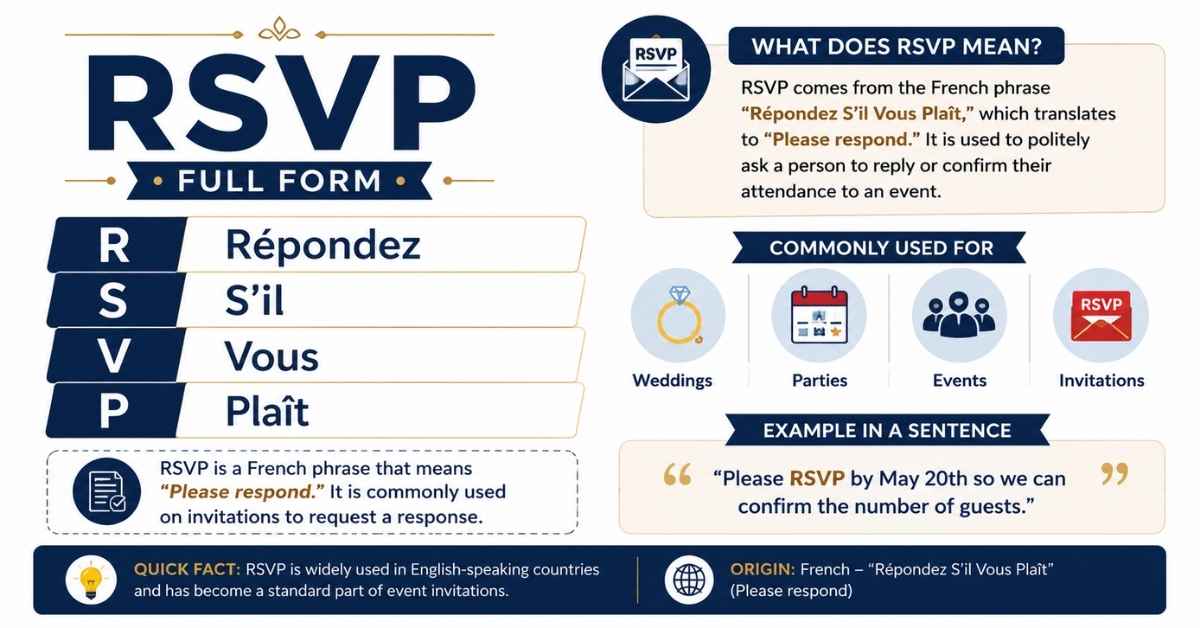
RSVP full form is Répondez s’il vous plaît, a French phrase that means “Please respond.” You will commonly see RSVP printed on wedding invitations, birthday party cards, business event invitations, dinner parties, graduation ceremonies, and online event registrations. It doesn’t mean you have to accept the invitation—it simply asks you to reply and let the host know whether you will attend or not.
Although the term has been used for centuries, many people still wonder what RSVP means on an invitation, why it is written in French, or how to RSVP correctly. Others are unsure whether they should respond by email, phone, text message, WhatsApp, QR code, or an online RSVP form. These small uncertainties can make anyone hesitant, especially when attending a formal event.
In this comprehensive guide, you’ll learn the RSVP full form, its meaning, pronunciation, origin, proper etiquette, response methods, practical examples, and common mistakes to avoid. Whether you’re replying to a wedding invitation, a corporate event, or a birthday celebration, you’ll know exactly how to respond with confidence.
RSVP Full Form at a Glance
Before diving deeper, here’s a quick overview of everything you need to know.
| Feature | Details |
|---|---|
| RSVP Full Form | Répondez s’il vous plaît |
| Language | French |
| English Meaning | Please respond or Please reply |
| Pronunciation | Ray-pon-day see voo play |
| Purpose | To request a guest’s response to an invitation |
| Commonly Used On | Wedding invitations, birthday cards, business events, dinner parties, baby showers, graduation ceremonies |
| Response Methods | Phone, email, text message, WhatsApp, online RSVP form, wedding website, QR code |
Quick Answer: RSVP stands for “Répondez s’il vous plaît,” meaning “Please respond.” It asks invited guests to confirm whether they will attend an event so the host can make proper arrangements.
What Does RSVP Mean?
Many people assume that RSVP means “yes”, but that’s one of the biggest misconceptions.
In reality, RSVP simply means “Please respond.” It doesn’t tell you to accept the invitation—it asks you to inform the host whether you will attend or decline.
For example, if you receive a wedding invitation that says:
RSVP by August 15
It means the couple needs your response by that date. You can reply:
- Yes, I will attend.
- No, I won’t be able to attend.
Both responses satisfy the RSVP request because the host now knows your plans.
Why Hosts Ask for an RSVP
An RSVP helps hosts organize every detail of an event, including:
- Final guest count
- Venue capacity
- Catering orders
- Meal preferences
- Seating arrangements
- Event budget
- Party favors or welcome gifts
- Transportation planning
- Accommodation for guests, if applicable
Without accurate responses, planning becomes difficult, expensive, and stressful.
The Most Important Thing to Remember
RSVP does not mean “Accept.”
It means:
Please let us know whether you are coming or not.
Even if you cannot attend, responding politely is considered good invitation etiquette.
Why Is RSVP in French?
One of the most common questions people ask is:
Why isn’t RSVP written in English?
The answer lies in history.
The phrase Répondez s’il vous plaît originated in France, where French was once regarded as the international language of diplomacy, culture, and formal etiquette. During the 18th and 19th centuries, French expressions became fashionable among European aristocracy and eventually appeared on formal invitation cards.
As invitation customs spread around the world, the abbreviation RSVP remained unchanged because it had already become universally recognized.
Today, although most invitations are written in English, the French abbreviation continues to symbolize politeness, courtesy, and formal invitation etiquette.
Literal Translation vs Everyday Meaning
Many readers are surprised to learn that the literal translation and the intended meaning are slightly different.
| French Phrase | Literal Translation | Natural English Meaning |
|---|---|---|
| Répondez | Respond | Respond |
| s’il | if it | if it |
| vous | you | you |
| plaît | pleases | please |
Together, the phrase is naturally understood as:
Please respond.
That’s why invitations don’t require a long explanation—the abbreviation RSVP has become widely recognized worldwide.
How Do You Pronounce RSVP?
People often know what RSVP means but aren’t sure how to pronounce it.
There are two common ways:
English Pronunciation
People usually say each letter individually:
R-S-V-P
This is the most common pronunciation in English-speaking countries.
French Phrase Pronunciation
The full phrase is approximately pronounced as:
Ray-pon-day see voo play
Don’t worry if your French pronunciation isn’t perfect. In everyday conversations, simply saying R-S-V-P is completely acceptable.
Common Pronunciation Mistakes
Avoid these common errors:
- Saying “Please RSVP” as if RSVP itself means “accept.”
- Mispronouncing Répondez by skipping the final sound.
- Writing the phrase without accents when discussing its original French spelling.
Using the correct spelling and understanding the pronunciation helps build confidence when discussing formal invitations.
Where Will You See RSVP?
Many people associate RSVP only with weddings, but it’s used in many different situations.
Understanding where RSVP appears helps you respond appropriately regardless of the event.
Wedding Invitations
This is where RSVP is most commonly seen.
Couples need accurate guest numbers for:
- Catering
- Seating charts
- Reception planning
- Venue arrangements
- Wedding favors
- Meal selections
Wedding invitations usually include an RSVP deadline several weeks before the ceremony.
Birthday Parties
Whether it’s a child’s birthday or a milestone celebration, RSVP allows the host to prepare enough:
- Food
- Drinks
- Seating
- Party supplies
- Activities
Responding early also helps avoid unnecessary expenses.
Business Events
Corporate invitations often request an RSVP for:
- Conferences
- Networking events
- Product launches
- Award ceremonies
- Business dinners
- Training workshops
Professional RSVP responses are usually sent through email, online registration, or an event website.
Dinner Invitations
Dinner parties require accurate attendance because the host prepares food based on the expected number of guests.
If you cannot attend, informing the host in advance is considered respectful and courteous.
Baby Showers
Baby shower invitations frequently include RSVP information so organizers can prepare:
- Seating
- Games
- Food
- Gift arrangements
Graduation Ceremonies
Graduation celebrations often have limited seating.
An RSVP helps families reserve enough space for invited guests.
Charity Events
Fundraising dinners and charity galas rely heavily on RSVPs because attendance affects:
- Catering
- Donations
- Seating plans
- Event scheduling
Online Invitations and Event Websites
Modern invitations increasingly use digital RSVP systems.
Guests may respond through:
- Wedding websites
- Online RSVP forms
- QR codes
- Email links
- Event registration platforms
- Mobile invitations
Digital RSVPs make it easier for hosts to manage guest lists and update attendance automatically.
Why Is RSVP Important?
Some people wonder why hosts care so much about receiving a reply.
The answer is simple:
Planning an event depends on knowing who will attend.
An RSVP isn’t just a formality—it directly affects the success of the event.
Accurate Guest Count
Hosts need to know exactly how many people are coming.
Even a small difference can change:
- Venue setup
- Table arrangements
- Catering costs
- Staffing requirements
Better Catering Planning
Food is often the largest expense for weddings and formal events.
Late responses or missing RSVPs can result in:
- Food shortages
- Wasted meals
- Increased costs
Prompt replies help hosts order the right amount of food while accommodating dietary restrictions and meal preferences.
Seating Arrangements
Many events assign guests to specific tables.
Without confirmed attendance, creating an effective seating chart becomes difficult.
Budget Management
Every confirmed guest may affect:
- Catering expenses
- Venue pricing
- Decorations
- Printed materials
- Transportation
- Welcome gifts
Responding on time helps hosts stay within budget.
Respect for the Host
Perhaps the most important reason to RSVP is simple courtesy.
When someone invites you to an important occasion, taking a few moments to reply shows appreciation for their effort and respect for the time they’ve invested in organizing the event.
Even if your answer is no, your response is valuable.
How to RSVP Correctly (Step-by-Step Guide)
If you’ve never responded to an invitation before, the process is straightforward.
Following these simple steps ensures your reply is polite, clear, and helpful.
Step 1: Read the Invitation Carefully
Before responding, check:
- The event date
- The RSVP deadline
- The requested response method
- Whether a plus-one is included
- Dress code, if mentioned
- Meal selection instructions
- Venue details
Never assume details that aren’t written on the invitation.
Step 2: Respond Before the RSVP Deadline
Always try to reply as soon as you’ve made your decision.
Waiting until the last minute makes planning more difficult for the host.
If possible, respond well before the deadline rather than on the final day.
Step 3: Use the Requested Response Method
Some invitations ask you to respond by:
- Phone call
- Text message
- Wedding website
- Online RSVP form
- QR code
Use the method requested by the host whenever possible.
Step 4: Clearly Confirm Your Attendance
Avoid vague responses like:
- “I’ll try.”
- “Maybe.”
- “We’ll see.”
Instead, clearly state whether you accept or decline the invitation.
A clear response helps the host finalize plans with confidence.
Step 5: Include Any Requested Information
Some invitations ask for additional details, such as:
- Meal choice
- Dietary restrictions
- Guest names
- Children’s attendance
- Plus-one confirmation
Provide all requested information in your response to avoid follow-up questions.
Step 6: Inform the Host If Your Plans Change
Sometimes emergencies happen after you’ve already replied.
If your attendance changes, notify the host as soon as possible.
Early communication allows them to update seating arrangements, catering, and guest lists with minimal disruption.
Learn More: GTIN Meaning Explained
Different Ways to RSVP
There is no single “correct” way to RSVP. The best method depends on how the host has asked guests to respond. Always follow the instructions provided on the invitation whenever possible.
Here’s how each response method works and when it’s appropriate.
RSVP by Phone
A phone call is one of the most traditional ways to respond, especially for formal dinners, family gatherings, or wedding invitations.
Best Practices
- Call during reasonable hours.
- Introduce yourself clearly.
- Thank the host for the invitation.
- Confirm whether you’ll attend.
- Mention any requested details, such as meal preferences.
Example:
“Hello Sarah, thank you so much for inviting me to your wedding. I’m happy to let you know that I’ll be attending. I look forward to celebrating with you.”
RSVP by Email
Email is commonly used for business events, conferences, seminars, and professional gatherings.
Keep your email:
- Brief
- Polite
- Professional
- Easy to understand
A concise email is often more appreciated than a lengthy explanation.
RSVP by Text Message
Many casual events now accept text messages.
Suitable for:
- Birthday parties
- Family gatherings
- Casual dinners
- Friends’ celebrations
Keep your message friendly but clear.
Instead of:
“Maybe.”
Write:
“Thanks for inviting me! I’d love to come. Count me in.”
RSVP Through WhatsApp
Today, many hosts include a WhatsApp number on invitations.
When replying:
- Keep your message polite.
- Respond before the deadline.
- Avoid sending only emojis.
- Clearly state whether you’re attending.
Good example:
“Hi Emma! Thank you for inviting me. I’d be delighted to attend your birthday celebration. Looking forward to seeing everyone!”
RSVP Using a QR Code
Modern invitations often include a QR code.
Simply:
- Scan the code.
- Open the RSVP page.
- Fill in your details.
- Confirm attendance.
- Submit your response.
This method is increasingly popular for weddings and large events because it automatically updates the guest list.
RSVP Through an Online Form
Some invitations include links to:
- Online RSVP forms
- Event registration pages
- Dedicated event websites
These forms may ask for:
- Your name
- Attendance status
- Meal preference
- Dietary restrictions
- Plus-one details
- Contact information
Complete every required field accurately.
RSVP on a Wedding Website
Many couples create wedding websites where guests can:
- Confirm attendance
- Select meals
- View venue information
- Read accommodation details
- Check schedules
- Find travel information
This simplifies communication for both guests and hosts.
Which RSVP Method Should You Use?
| Response Method | Best For | Etiquette Tip |
|---|---|---|
| Phone | Formal invitations | Call during appropriate hours |
| Business and professional events | Keep it concise and professional | |
| Text Message | Casual gatherings | Clearly confirm attendance |
| Friends and family events | Don’t rely only on emojis | |
| QR Code | Weddings and large events | Complete every required field |
| Wedding Website | Weddings | Review all event details before submitting |
| Online RSVP Form | Conferences and organized events | Double-check your information before sending |
RSVP Message Examples
One of the biggest frustrations people have is knowing what to write.
The good news is that an RSVP doesn’t have to be long. A clear, polite response is usually all that’s needed.
Accepting an Invitation
Wedding Invitation
Thank you so much for inviting me to your wedding. I’m delighted to accept your invitation and look forward to celebrating your special day with you.
Birthday Party
Thanks for the invitation! I’ll be there and can’t wait to celebrate with everyone.
Business Event
Thank you for your invitation. I am pleased to confirm my attendance and look forward to participating in the event.
Dinner Invitation
Thank you for inviting me to dinner. I’d be happy to attend and look forward to spending the evening with you.
Casual Gathering
Count me in! Thanks for inviting me. Looking forward to seeing everyone.
Politely Declining an Invitation
Declining an invitation isn’t rude.
Ignoring it is.
A thoughtful response helps the host plan accurately.
Formal Decline
Thank you very much for your invitation. Unfortunately, I won’t be able to attend. I sincerely appreciate your kindness and wish you a wonderful event.
Friendly Decline
Thanks so much for inviting me. I’m sorry I won’t be able to make it, but I hope you all have an amazing time.
Professional Decline
Thank you for your invitation. Unfortunately, I have a prior commitment and won’t be able to attend. I appreciate the opportunity and hope the event is a great success.
Family Event
I’m so grateful for your invitation. Unfortunately, I won’t be able to attend this time, but I’ll be thinking of everyone and hope you have a wonderful celebration.
Responding After the RSVP Deadline
Life doesn’t always go as planned.
If you’ve missed the RSVP deadline:
- Respond immediately.
- Apologize briefly.
- Ask whether it’s still possible to attend.
Example:
I’m very sorry for my late reply. If it’s still possible, I’d love to attend. If arrangements have already been finalized, I completely understand.
Being honest and respectful is much better than not responding at all.
Changing Your RSVP
Sometimes unexpected situations arise.
If you’ve already accepted but later can’t attend:
- Notify the host immediately.
- Offer a sincere apology.
- Avoid waiting until the last minute unless it’s an emergency.
Example:
I’m very sorry, but due to unexpected circumstances, I won’t be able to attend after all. I sincerely apologize for the inconvenience and wish you a wonderful event.
RSVP Etiquette Everyone Should Know
Knowing the RSVP full form is only part of the process.
Understanding proper RSVP etiquette ensures you’re respectful to the host and helps the event run smoothly.
Always Reply—Even If You Can’t Attend
Many people mistakenly believe that only guests attending the event need to respond.
That’s incorrect.
If an invitation requests an RSVP, the host expects a response whether your answer is yes or no.
A quick reply saves the host from having to follow up later.
Respect the RSVP Deadline
An RSVP deadline isn’t just a suggestion.
Hosts often need final numbers for:
- Catering
- Seating charts
- Venue setup
- Guest lists
- Event schedules
Replying before the deadline shows consideration and good manners.
Don’t Bring Extra Guests
If the invitation doesn’t mention a plus-one, don’t assume you can bring someone.
Only bring additional guests when the invitation clearly allows it.
If you’re unsure, politely ask the host instead of making assumptions.
Read the Invitation Carefully
Some invitations include important instructions such as:
- Adults only
- Meal selections
- Dress code
- Arrival time
- Parking information
- Transportation details
Reading everything carefully prevents misunderstandings.
Inform the Host If Your Plans Change
Emergencies happen.
If you need to change your RSVP:
- Contact the host immediately.
- Explain briefly.
- Apologize sincerely.
Hosts appreciate timely communication much more than silence.
Keep Your Response Simple
You don’t need to write a long message.
Most hosts simply want a clear answer.
A short, polite response is perfectly acceptable.
Common RSVP Mistakes (And How to Avoid Them)
Even experienced guests sometimes make etiquette mistakes.
Avoid these common errors.
Assuming RSVP Means “Yes”
This is the most common misunderstanding.
Remember:
RSVP means “Please respond.”
It does not automatically mean you’re accepting the invitation.
Ignoring the Invitation
Not responding creates uncertainty.
The host may:
- Reserve a seat unnecessarily.
- Order extra meals.
- Continue contacting you for confirmation.
Even if you cannot attend, always reply.
Waiting Until the Last Minute
Delaying your response affects:
- Catering orders
- Seating arrangements
- Guest lists
- Event budgets
Reply as soon as you’ve made your decision.
Bringing an Uninvited Guest
Never assume a plus-one is included.
Respect the invitation exactly as written.
Giving an Unclear Answer
Avoid replies such as:
- Maybe
- I’ll see
- Hopefully
- I’ll try
Instead, clearly confirm whether you’ll attend.
Forgetting Meal Choices
Some invitations ask guests to select:
- Vegetarian meals
- Vegan options
- Children’s meals
- Allergy information
Leaving these blank creates extra work for the host.
Changing Plans Without Informing the Host
If you previously accepted but later can’t attend, let the host know immediately.
This allows them to adjust seating, catering, and guest numbers.
Learn More: Claddagh Meaning
RSVP vs Similar Invitation Terms
Many people confuse RSVP with other invitation-related terms.
Here’s a simple comparison.
| Term | Meaning | What You Should Do |
|---|---|---|
| RSVP | Please respond | Confirm whether you’ll attend |
| Invitation | Request to attend an event | Decide whether to accept or decline |
| Registration | Sign up for an event | Complete the required registration process |
| Confirmation | Verify attendance or booking | Confirm previously provided details |
| Save the Date | Advance notice of an event | Reserve the date; formal invitation usually comes later |
| Regrets Only | Respond only if you cannot attend | Reply only when declining the invitation |
RSVP vs Invitation
An invitation is the request to attend an event.
An RSVP is the request for your response.
RSVP vs Registration
Registration usually involves submitting information to reserve your place at an event.
RSVP simply tells the host whether you plan to attend.
Some large conferences may require both registration and an RSVP.
RSVP vs Confirmation
A confirmation verifies attendance after you’ve already responded.
An RSVP is your initial response to the invitation.
RSVP vs Save the Date
A Save the Date is an early notification.
It tells guests to keep the date available.
A formal invitation with RSVP details usually follows later.
RSVP vs Regrets Only
A Regrets Only invitation works differently.
Instead of asking everyone to reply, it asks guests to respond only if they cannot attend.
If you plan to attend, no response is usually required unless stated otherwise.
Frequently Asked Questions About RSVP
Here are the most common questions people ask about the RSVP full form, RSVP meaning, and invitation etiquette. These concise answers are designed to address real user concerns and align with common People Also Ask (PAA) queries.
What is the RSVP full form?
RSVP full form is Répondez s’il vous plaît, a French phrase that translates to “Please respond.” It is commonly printed on invitations to request that guests confirm whether they will attend an event.
What does RSVP mean on an invitation?
When you see RSVP on an invitation, it means the host is asking you to reply and confirm your attendance. Your response can be either accepting or declining the invitation.
Does RSVP mean yes or no?
No. RSVP does not mean “yes.” It simply means “Please respond.” You are expected to let the host know whether you will attend or will not attend.
Is RSVP mandatory?
While it isn’t legally required, responding to an RSVP is considered proper etiquette. Your reply helps the host finalize guest numbers, catering, seating arrangements, and event planning.
What happens if I don’t RSVP?
If you don’t respond:
- The host won’t know whether to reserve a seat for you.
- Catering and meal planning may be affected.
- Seating arrangements become more difficult.
- The host may need to contact you for confirmation.
- It may be viewed as impolite, especially for formal events.
Whenever possible, it’s always better to respond—even if your answer is no.
Can I RSVP by WhatsApp or text message?
Yes—if the host has provided a WhatsApp number or requested a text response. Always use the communication method mentioned on the invitation and keep your message polite and clear.
What if I miss the RSVP deadline?
If you’ve missed the deadline:
- Contact the host as soon as possible.
- Apologize briefly for the delay.
- Ask whether it’s still possible to attend.
- Respect the host’s decision if arrangements have already been finalized.
A late response is generally appreciated more than no response at all.
Can I change my RSVP after responding?
Yes, if your circumstances change unexpectedly.
Inform the host immediately so they can adjust:
- Guest list
- Seating arrangements
- Catering
- Event logistics
The sooner you communicate, the easier it is for the host to make changes.
Can someone else RSVP on my behalf?
Yes, if the host accepts it and the response is accurate. This is common when:
- Family members respond together.
- Parents reply for children.
- A group organizer confirms attendance for multiple guests.
However, individual responses are preferred if the invitation requests them.
Why is RSVP written in French?
The abbreviation comes from Répondez s’il vous plaît, a French expression that became widely used in formal social etiquette. Although invitations today are often written in English, RSVP remains an internationally recognized and traditional way of requesting a response.
Is RSVP used only for weddings?
No. While weddings commonly include an RSVP request, it is also used for:
- Birthday parties
- Corporate events
- Dinner parties
- Graduation ceremonies
- Baby showers
- Charity events
- Networking events
- Formal celebrations
- Online events and webinars
What is the difference between RSVP and registration?
An RSVP tells the host whether you plan to attend.
Registration usually requires submitting personal information to reserve a place at an event.
Some conferences, seminars, and business events require both.
What does “Regrets Only” mean?
A Regrets Only invitation asks guests to respond only if they cannot attend. If you plan to attend, no reply is usually necessary unless the invitation states otherwise.
Quick RSVP Etiquette Checklist
Before replying to an invitation, use this checklist to make sure you’ve followed proper RSVP etiquette.
- Read the invitation carefully.
- Check the RSVP deadline.
- Reply as soon as you’ve made your decision.
- Use the response method requested by the host.
- Clearly accept or decline the invitation.
- Mention your meal preference or dietary restrictions if requested.
- Confirm your plus-one only if the invitation allows it.
- Notify the host immediately if your plans change.
- Keep your message polite, concise, and respectful.
- Avoid waiting until the last minute to respond.
Following these simple steps demonstrates courtesy and helps ensure the event runs smoothly.
Conclusion
RSVP full form is Répondez s’il vous plaît, meaning “Please respond.” While the phrase originated in French, its purpose is universal: to help hosts plan successful events by knowing who will attend.
Whether you’re responding to a wedding invitation, a business event, a birthday celebration, or an online invitation, the most important thing is to reply clearly, politely, and on time. A simple response can make a significant difference to the host’s planning and reflects good manners in both personal and professional settings.
Now that you understand the RSVP meaning, pronunciation, origin, response methods, and proper etiquette, you can confidently handle any invitation you receive. By following the guidance and examples in this article, you’ll avoid common mistakes, show consideration for your host, and ensure every RSVP is handled with courtesy and confidence.