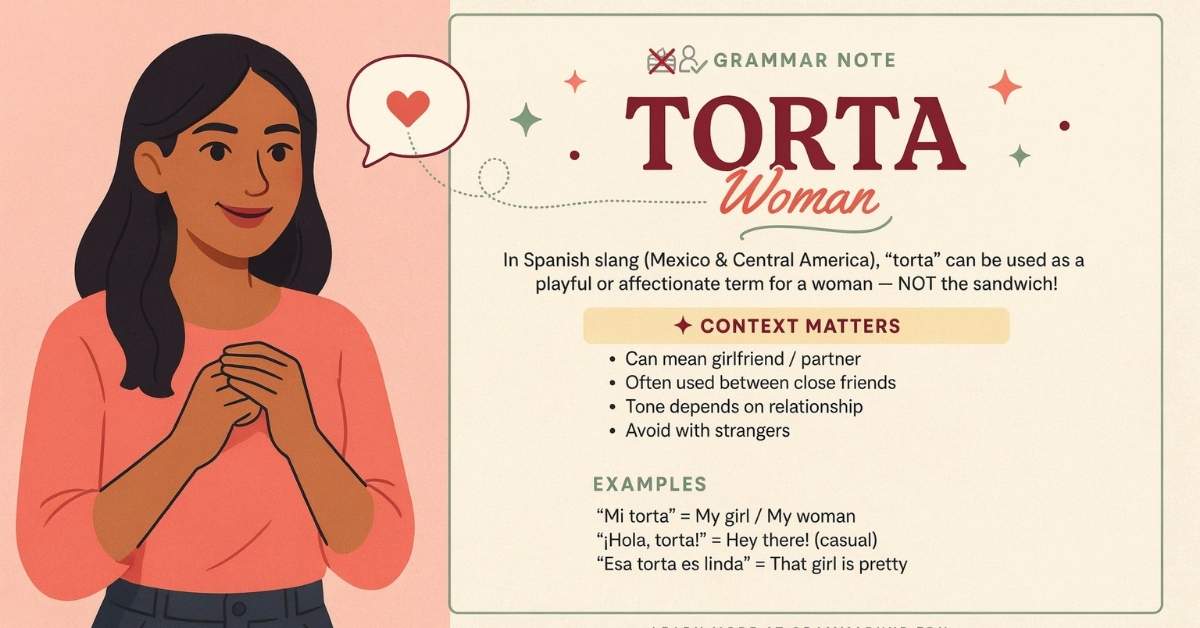
Torta woman is a slang expression most commonly associated with Mexican Spanish and online culture. Depending on the country, community, and context, it can refer to a curvy or overweight woman, often carrying humorous, teasing, or even offensive connotations. However, the term does not have one universal definition. In some situations, it’s used jokingly among friends, while in others it may be considered body-shaming or disrespectful. Understanding the context, tone, and regional usage is essential before interpreting—or using—the phrase.
If you’ve seen “torta woman,” “torta girl,” or “torta” in a TikTok comment, an Instagram caption, or a social media meme, you’re not alone. The phrase has gained popularity online, leaving many people wondering whether it’s a compliment, an insult, or simply another piece of evolving internet slang.
In this guide, you’ll learn what “torta woman” means, how the word evolved from its original Spanish meaning, why it became popular on social media, whether it’s offensive, how it differs across Spanish-speaking countries, and when it’s appropriate—or inappropriate—to use it.
Quick Answer
| Question | Answer |
|---|---|
| What does “torta woman” mean? | It usually refers to a curvy or overweight woman in certain Mexican slang and internet contexts, but the meaning depends on culture and situation. |
| Is it slang? | Yes. It’s primarily used as slang in informal conversations and online communities. |
| Is it offensive? | It can be. Some people use it playfully, while others view it as body-shaming or disrespectful. |
| Where is it commonly used? | Most often in Mexico, among some Latino communities, and across TikTok, Instagram, X (formerly Twitter), and meme culture. |
| Does it always mean the same thing? | No. The meaning changes depending on the country, tone, relationship, and context. |
Key Takeaway: Never assume “torta woman” has a universal meaning. Understanding who says it, where it’s used, and how it’s said is just as important as knowing the dictionary definition.
What Does “Torta Woman” Mean?
The phrase “torta woman” doesn’t have a single official definition. Instead, it’s a cultural slang term whose meaning has evolved over time through everyday conversations, social media, and internet memes.
In many Mexican Spanish communities, “torta” has become a nickname or descriptive slang term used to refer to a woman with a larger, curvier, or heavier body type. Depending on the speaker’s intention, it may be used:
- As playful teasing between close friends.
- As a humorous internet stereotype.
- As an insult meant to criticize someone’s appearance.
- As a self-deprecating joke.
- As a reclaimed label embraced by some online communities.
Because of these different uses, context matters more than the word itself.
For example, two friends joking with each other might use the word very differently than a stranger posting it in a comment section.
The Short Definition
Simply put:
A “torta woman” is generally a slang term used in some Spanish-speaking communities—particularly in Mexican slang—to describe a curvy or overweight woman, although the meaning varies by context and can be playful, descriptive, or offensive.
Unlike formal dictionary words, slang changes quickly. That’s why torta meaning, torta slang, and torta woman meaning often differ depending on who is speaking and where the conversation takes place.
Why the Meaning Changes Depending on Context
One reason torta woman confuses so many people is that language evolves through culture, not just dictionaries.
The same word can carry completely different meanings depending on:
- The country
- The relationship between the people speaking
- The tone of the conversation
- Whether it’s online or offline
- The speaker’s intention
For instance, a close friend may jokingly use the term in a way that’s understood and accepted within their social circle. However, if the same word is used by someone unfamiliar or in a public comment, it may feel insulting or disrespectful.
This is why there isn’t a simple “yes” or “no” answer to questions like:
- Is torta an insult?
- Can torta be a compliment?
- Is torta offensive?
The answer is almost always:
It depends on the context.
Understanding that nuance is essential to interpreting torta meaning in Spanish slang correctly.
Literal Meaning vs. Slang Meaning
Another source of confusion is that “torta” has a perfectly ordinary meaning in Spanish before it becomes slang.
| Literal Meaning | Slang Meaning |
|---|---|
| A type of food (such as a sandwich or cake, depending on the country). | An informal nickname or slang term that may describe a woman’s body type or appear in internet culture. |
This distinction is important because many dictionaries focus only on the food definition, leaving readers confused when they encounter “torta girl” or “torta woman” on social media.
The rise of TikTok slang, memes, and online conversations has pushed the slang meaning into mainstream internet culture, making it increasingly common for people to search for:
- What does torta woman mean?
- What is a torta girl?
- What does torta mean on TikTok?
- What does torta mean in text?
Answering these questions requires more than a dictionary—it requires understanding culture, humor, and online language trends.
Where Did the Term “Torta” Come From?
To understand torta woman meaning, it’s helpful to begin with the original meaning of the word “torta.” Long before it appeared in memes or TikTok slang, it was simply a common Spanish word used to describe different types of food.
Interestingly, what “torta” refers to depends on the country. In Mexico, a torta is a popular sandwich made with a crusty bread roll and filled with ingredients such as meat, beans, avocado, cheese, and vegetables. In other Spanish-speaking countries, however, torta often means a cake, pastry, or another baked dish.
This variation shows how language naturally changes across regions. Just as the culinary meaning differs from one country to another, the slang meaning has also developed in unique ways within different communities.
Over time, certain words that originally described food began to take on new meanings in casual conversations. This isn’t unusual. Many languages use food-related words as nicknames, jokes, or descriptive expressions. As internet culture grew, those informal expressions spread quickly through TikTok, Instagram, X (formerly Twitter), memes, and online communities.
Today, the slang meaning of torta woman is recognized by many internet users, even though traditional dictionaries may still focus primarily on the food definition.
The Original Meaning of “Torta” in Spanish
The word “torta” comes from Spanish and has been part of everyday vocabulary for centuries. Depending on the region, it commonly refers to:
- A sandwich in Mexico.
- A cake or sponge cake in several Latin American countries.
- A flatbread, pastry, or baked dish in some regions.
- Various traditional foods with local recipes and names.
Because these meanings are so common, many people are surprised when they first encounter torta slang online. The shift from a food-related word to an internet expression illustrates how language evolves through culture, humor, and shared experiences rather than remaining fixed over time.
How Did “Torta” Become Internet Slang?
The transformation of “torta” from a food-related word into internet slang didn’t happen overnight. Like many modern expressions, it evolved through everyday conversations before being amplified by social media, memes, and online communities.
In many cultures, food names eventually become nicknames. Sometimes they’re used affectionately, sometimes humorously, and sometimes as stereotypes. The same happened with torta.
As photos, short-form videos, and memes became more popular, certain slang words spread far beyond the communities where they originated. TikTok, Instagram, Facebook, and X (formerly Twitter) accelerated this process, exposing millions of people to phrases they had never heard before.
Today, many people search for:
- What does torta woman mean on TikTok?
- What is a torta girl?
- Why do people call someone a torta?
The answer lies in the way internet culture reshapes language. Words that once belonged to local communities often become global trends, sometimes losing their original nuance along the way.
Language Evolves Through Communities
Unlike dictionary definitions, slang is created by people.
It evolves because communities:
- Create inside jokes.
- Develop cultural references.
- Build shared identities.
- Reuse familiar words in new ways.
- Spread phrases through viral content.
The meaning of torta woman is a perfect example of this process.
What started as an ordinary Spanish word gradually developed additional meanings depending on culture, community, and context.
How Social Media Changed the Meaning
Platforms like TikTok don’t just spread language—they reshape it.
A single viral video can introduce a regional slang word to millions of viewers who have no connection to its original culture.
As creators used phrases like torta girl, torta woman, and related memes, the term became associated with internet humor, dating stereotypes, and discussions about appearance.
However, because people from different backgrounds interpreted the word differently, confusion also increased.
That’s why you’ll often see comments asking:
- “Is torta an insult?”
- “Does torta mean fat?”
- “Can torta be a compliment?”
The answer depends less on the dictionary and more on who is speaking, where they are from, and how the word is being used.
Why Is a Woman Called a “Torta”?
One of the biggest questions people have is why this particular word became associated with women in the first place.
There isn’t one universally accepted explanation, but several cultural and linguistic factors have contributed to its modern usage.
Physical Appearance Associations
In some Mexican slang and internet communities, torta has been used as an informal nickname for a woman with a curvy, plus-size, or heavier body type.
It’s important to note that this isn’t an official definition.
Instead, it’s a slang usage that developed informally over time.
Depending on the speaker, the word may refer to someone who is:
- Curvy
- Thick
- Chubby
- Plus-size
- Heavyset
Different people interpret these descriptions differently.
Some use the word affectionately.
Others use it critically.
Cultural Stereotypes
The internet often simplifies complex cultural ideas into stereotypes.
Unfortunately, torta woman has sometimes become part of that process.
Certain memes portray the “torta girl” as having recognizable fashion styles, interests, or personality traits.
Examples may include references to:
- Long acrylic nails
- Large hoop earrings
- Certain makeup styles
- Fast-food jokes
- Dating memes
- Popular TikTok trends
These stereotypes may be humorous to some audiences, but they do not represent every Latina or every woman.
Treating internet jokes as facts can lead to unfair assumptions.
The Influence of Meme Culture
Modern slang often spreads because it’s funny—not because it’s accurate.
Meme culture rewards:
- exaggeration
- recognizable stereotypes
- quick jokes
- viral trends
As creators began using torta woman in humorous videos, more users repeated the phrase without fully understanding its origins.
Eventually, the slang became recognizable even among people who don’t speak Spanish.
Why Context Matters More Than the Word
One of the biggest mistakes people make is assuming every use of torta has the same meaning.
Imagine these situations:
Example 1
Two lifelong friends joking with each other.
The word may be understood as playful teasing.
Example 2
A stranger leaves “You’re such a torta” under someone’s photo.
The exact same word now feels insulting.
Example 3
Someone discusses Mexican slang in an educational article.
The word becomes descriptive rather than offensive.
The lesson is simple:
Context determines meaning.
Understanding tone, relationship, and culture is far more important than focusing on the word alone.
Is Calling Someone a “Torta” Offensive?
This is one of the most searched questions online—and the honest answer is:
Sometimes.
There is no universal rule because slang depends heavily on culture, intent, and personal perception.
When It May Be Considered Offensive
Calling someone torta may be hurtful when:
- You’re commenting on their body without permission.
- You’re trying to embarrass them.
- You don’t know them personally.
- The comment is meant to mock or shame.
- It’s used in a hostile online discussion.
In these situations, many people would interpret the word as body-shaming rather than playful slang.
Learn More: SAP Full Form
When Friends Might Use It Playfully
Among close friends or family members, some communities use nicknames that outsiders would consider inappropriate.
This doesn’t automatically make the term acceptable everywhere.
Instead, it reflects shared understanding.
Even then, it’s important to remember that not everyone is comfortable with body-related nicknames, regardless of intent.
Intent Isn’t Everything
People often believe:
“I was only joking.”
However, communication involves both intent and impact.
A word may be intended as playful but still hurt someone’s feelings.
This is especially true with descriptions involving appearance.
That’s why it’s usually safer to avoid using torta woman unless you’re familiar with the cultural context and know the other person is comfortable with it.
A Better Rule to Follow
If you’re unsure whether to use the word, ask yourself:
- Do I know this person well?
- Could this be misunderstood?
- Am I commenting on someone’s appearance?
- Would I say it in person?
- Is there a kinder way to express what I mean?
In many cases, choosing respectful language avoids unnecessary misunderstandings.
What Does “Torta Woman” Mean on TikTok and Social Media?
Many people discover the phrase torta woman through TikTok, where slang spreads faster than almost anywhere else online.
Unlike dictionaries, social media users constantly invent, reshape, and popularize new expressions.
As trends evolve, words often gain meanings that extend far beyond their original definitions.
TikTok Usage
On TikTok, torta woman usually appears in:
- Comedy videos
- Dating memes
- Lifestyle content
- Relationship jokes
- Trend videos
- Cultural discussions
Sometimes the term is used jokingly.
Other times, it’s used to describe a stereotype.
Because TikTok relies on short videos, creators rarely explain the cultural background behind the phrase.
As a result, viewers often leave with incomplete or inaccurate interpretations.
Instagram and X (Formerly Twitter)
The phrase also appears in:
- Meme pages
- Reaction posts
- Viral screenshots
- Pop culture discussions
- Comment sections
Unlike educational articles, social media usually prioritizes humor over accuracy.
This is why it’s important not to assume every meme reflects real-life usage.
Why Did the Phrase Go Viral?
Several factors contributed to its popularity:
- Easy-to-remember wording.
- Meme-friendly format.
- Association with viral stereotypes.
- Repetition by influencers.
- High engagement through comments and reactions.
Once a phrase enters internet culture, millions of people begin repeating it—even if they don’t fully understand its meaning.
The Difference Between Real Life and Internet Culture
One important distinction many articles overlook is that internet slang isn’t always representative of everyday speech.
Just because a phrase is common on TikTok doesn’t mean people regularly use it in face-to-face conversations.
Many expressions become popular online precisely because they’re exaggerated, humorous, or controversial.
Understanding that difference helps avoid misunderstandings and prevents readers from assuming that every viral term reflects how an entire culture speaks.
Does “Torta” Mean the Same Thing in Every Spanish-Speaking Country?
Absolutely not.
One of the biggest misconceptions online is that torta has a single meaning across the Spanish-speaking world.
In reality, the meaning changes significantly depending on where you are.
| Country/Region | Common Meaning of “Torta” | Slang Usage | Could It Be Offensive? |
|---|---|---|---|
| Mexico | A sandwich | Yes, in certain informal contexts | Sometimes |
| United States (Latino communities) | Often influenced by Mexican Spanish and internet culture | Yes | Depends on context |
| Argentina | Cake or sponge cake | Rare | Usually no |
| Spain | Cake or pastry | Uncommon | Generally no |
| Colombia | Cake or baked item | Limited | Rarely |
| Other Latin American countries | Varies by region | May be uncommon or absent | Depends on local usage |
This regional variation is one of the main reasons people become confused after searching for torta meaning, torta slang, or torta woman meaning.
A person in one country may think only of food, while someone else immediately associates the word with internet slang.
Understanding these cultural differences is essential before interpreting—or using—the term.
Torta Woman vs. Other Similar Terms
Many people assume that torta, gordita, thick, curvy, and plus-size all mean the same thing. In reality, each term has its own cultural background, emotional tone, and level of sensitivity.
| Term | Typical Meaning | Common Usage | Can It Be Offensive? |
|---|---|---|---|
| Torta | Slang that may describe a curvy or heavier woman in certain contexts | Internet slang, memes, informal conversations | Yes, depending on context |
| Gordita | Literally means “little chubby one”; can be affectionate or descriptive | Family, friends, romantic relationships | Sometimes |
| Curvy | Describes a fuller body shape | General, neutral description | Rarely |
| Thick | Internet slang for someone with a fuller figure, often in a positive way | Social media, pop culture | Usually no, but context matters |
| Plus-size | Inclusive term describing clothing sizes or body types | Fashion, retail, media | Generally no |
The important takeaway is that slang words carry emotional weight. Even if two terms describe a similar body type, they may be interpreted very differently depending on culture, tone, and personal preference.
How to Tell What Someone Means When They Say “Torta”
Because torta has multiple meanings, it’s helpful to evaluate the situation before assuming what the speaker intended.
1. Look at the Conversation
Ask yourself:
- Are people talking about food?
- Is the discussion about dating?
- Is it a meme or joke?
- Is it part of a cultural conversation?
The surrounding conversation usually provides the biggest clue.
2. Consider the Relationship
Words between close friends often carry a different meaning than the same words used by strangers.
A nickname among lifelong friends doesn’t necessarily translate well in public conversations.
3. Think About the Country
Regional differences matter.
Someone in Mexico may understand the slang immediately, while someone in Spain or Argentina may only think of cake or a sandwich.
4. Pay Attention to Tone
Tone can completely change the meaning.
The same word can sound:
- Friendly
- Sarcastic
- Playful
- Hurtful
- Neutral
Without tone, especially in text messages or online comments, misunderstandings are more likely.
5. Consider the Platform
Different platforms encourage different communication styles.
- TikTok: Humor, stereotypes, trends.
- Instagram: Captions, memes, comments.
- X (formerly Twitter): Viral jokes and discussions.
- Private messages: More personal context.
The platform often influences how slang is interpreted.
Real-Life Examples of “Torta Woman” in Context Meaning
Understanding examples is often easier than memorizing definitions.
Example 1: Friendly Banter
“You’ve been eating all the tacos lately—you’ve become such a torta!”
Among close friends who are comfortable joking about each other, the comment may be playful. However, not everyone would appreciate this type of humor.
Example 2: Social Media Comment
“She’s definitely a torta.”
Without context, this could easily be interpreted as insulting or disrespectful because it focuses on someone’s appearance.
Example 3: Educational Discussion
“The term ‘torta’ has different meanings depending on the country and cultural context.”
Here, the word is purely descriptive and carries no insulting intent.
Example 4: Meme Caption
“When the Edgar finally finds his torta.”
This references an internet stereotype rather than a specific individual. While many users recognize the joke, others may find it reinforces unfair assumptions.
Example 5: Cultural Conversation
“Internet slang often changes faster than dictionaries can keep up.”
In this case, torta is discussed as part of language evolution rather than as a label for a person.
Common Myths About “Torta Woman Meaning”
| Myth | Reality |
|---|---|
| It always means an overweight woman. | No. Meanings vary by context, culture, and community. |
| It’s always an insult. | Not necessarily. Some people use it jokingly, while others consider it offensive. |
| Every Spanish speaker uses the word this way. | No. Usage differs significantly across countries. |
| The slang started on TikTok. | TikTok popularized it, but the slang existed before social media. |
| It’s okay to use because it’s a meme. | Viral popularity doesn’t make a term appropriate in every situation. |
See More: Diner or Dinner
Why the Word Torta Woman Meaning Has Become So Popular Online
The popularity of torta woman reflects a broader trend in how internet culture shapes language.
Meme Culture
Memes thrive on recognizable phrases, stereotypes, and humor. Once a term becomes associated with a viral joke, it spreads rapidly.
Short-Form Content
Platforms like TikTok reward short, memorable expressions. Slang terms fit perfectly into quick videos and captions.
Community Identity
Many online communities develop their own vocabulary. Using those words helps members feel connected, even if outsiders don’t fully understand the references.
Algorithm Amplification
Highly engaging content is promoted more frequently, which means catchy slang spreads much faster than traditional language.
Should You Use the Term “Torta Woman As Meaning”?
Before using any slang, it’s worth considering both intent and impact.
It May Be Appropriate When:
- You’re discussing the term in an educational setting.
- You’re explaining internet slang.
- You’re analyzing language or culture.
- Everyone involved understands the context.
You Should Probably Avoid It When:
- Referring to someone you don’t know.
- Commenting on another person’s appearance.
- Speaking in professional settings.
- You’re unsure how the other person will interpret it.
If You’re Not Part of the Culture
Be especially cautious.
Some slang carries cultural meanings that aren’t obvious to outsiders. Using terms without understanding their background can unintentionally cause offense.
Safer Alternatives
If your goal is simply to describe someone’s appearance respectfully, consider neutral expressions such as:
- Curvy
- Plus-size
- Full-figured
- Confident
- Stylish
Choosing respectful language is usually the better option.
Expert Perspective: Why Slang Words Like “Torta” Keep Changing
Language isn’t static—it constantly evolves alongside society.
Words gain new meanings because of:
- Social media trends
- Pop culture
- Generational language shifts
- Regional dialects
- Community identity
- Humor
- Cultural exchange
Today’s slang may become tomorrow’s dictionary entry, while older meanings continue to exist alongside newer ones.
The story of torta woman illustrates how language evolution, internet culture, and cultural identity intersect. Rather than having one fixed definition, the phrase continues to change as different communities adopt, adapt, or reject it.
Understanding this evolution helps us communicate more thoughtfully and avoid making assumptions based on viral trends alone.
Frequently Asked Questions About Torta Woman Meaning
What does torta woman mean?
A torta woman generally refers to a woman described using Mexican slang or internet slang, often implying a curvy or heavier body type. The meaning depends on the speaker, region, and context.
Is torta an insult?
It can be. Some people use it jokingly among friends, while others see it as body-shaming or disrespectful.
What does torta mean in Mexican slang?
In some informal contexts, torta is used as slang to describe a woman with a fuller figure. This usage isn’t universal and varies between communities.
What does torta mean on TikTok?
On TikTok, torta often appears in memes, dating jokes, and viral content. Online usage is usually influenced by humor and internet culture rather than formal language.
Can torta be a compliment?
Sometimes. Among close friends or within certain communities, it may be used playfully. However, because many people consider it sensitive, it’s best not to assume it will be taken positively.
Does torta mean the same thing in every country?
No. In some countries, torta simply means a cake, pastry, or sandwich, while the slang meaning may be unknown or rarely used.
Can I call my friend a torta?
Only if you’re certain they’re comfortable with the term and understand the context. When in doubt, choose more respectful language.
What’s the difference between torta and gordita?
While both may describe body size in certain contexts, gordita and torta have different cultural histories and emotional connotations. Neither should be used casually without understanding the relationship and setting.
Why does context matter so much?
Because slang isn’t defined only by dictionaries. Tone, culture, relationship, and intent all influence how a word is understood.
Conclusion
Torta woman is more than just another internet phrase—it’s an example of how language, culture, and social media constantly shape the way people communicate. While the term is often associated with Mexican slang, TikTok, and internet memes, its meaning is far from universal.
For some, it’s a playful nickname shared among friends. For others, it can feel offensive or reinforce harmful stereotypes. That’s why understanding context, regional differences, and personal boundaries is far more important than memorizing a single definition.
As online slang continues to evolve, approaching unfamiliar terms with curiosity, cultural awareness, and respect is the best way to avoid misunderstandings. Whether you’re researching torta meaning, trying to understand a viral TikTok trend, or simply learning more about Spanish slang, remembering that words carry different meanings in different communities will help you communicate more thoughtfully and accurately.
Ultimately, the meaning of “torta woman” isn’t determined by the word alone—it’s shaped by who says it, where it’s said, and how it’s intended. That’s what makes language both fascinating and constantly evolving.