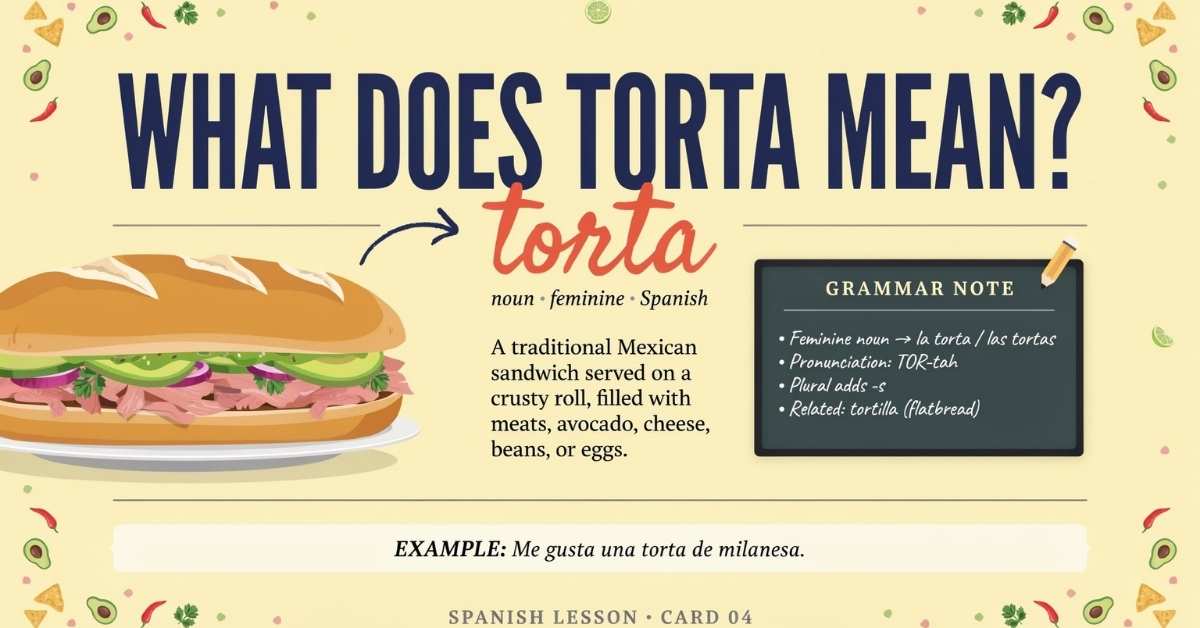
What does torta mean? The answer depends on where you are in the world. In Mexico, a torta is a delicious sandwich made with crusty bread such as a bolillo or telera roll, filled with ingredients like meat, cheese, avocado, beans, and vegetables. However, in Spain and many Latin American countries, the word torta usually refers to a cake, pastry, or another type of baked dessert. In the Philippines, it can even describe an omelet or egg-based dish.
This regional difference often surprises travelers, Spanish learners, and food lovers because there isn’t one universal definition. The meaning of torta changes according to the country’s language, culture, and culinary traditions. That’s why you might order a torta in Mexico expecting a sandwich but receive a cake if you ask for one in Spain or Argentina.
In this comprehensive guide, you’ll discover why the meaning of torta changes by country, its fascinating history and etymology, how native speakers use the word, common regional variations, pronunciation tips, and practical examples to help you understand and use the term confidently wherever you travel.
Quick Answer at a Glance
If you’re looking for the fastest answer, here’s a simple overview.
| Country | Meaning of Torta | Typical Example |
|---|---|---|
| Mexico | Sandwich | Torta de Jamón, Torta Cubana |
| Spain | Cake or Flat Cake | Torta de Santiago |
| Argentina | Cake | Birthday Torta |
| Colombia | Cake or Sweet Pastry | Traditional Celebration Cake |
| Chile | Cake | Chocolate Torta |
| Philippines | Omelet or Egg Dish | Tortang Talong |
The easiest way to remember it is this:
- Mexico = Sandwich
- Most Spanish-speaking countries = Cake
- Philippines = Egg dish
Knowing the country usually tells you exactly which meaning applies.
Why Does “Torta” Mean Different Things?
One of the biggest questions people ask is:
“Why does torta mean a sandwich in one country and a cake in another?”
The answer lies in the fascinating evolution of language and food culture.
Unlike many words that keep the same meaning everywhere, It developed differently as the Spanish language spread across different regions. Over hundreds of years, local traditions, ingredients, and culinary preferences influenced how people used the word.
In Spain, the word traditionally referred to a round cake, flatbread, or baked dessert. As Spanish explorers and settlers traveled throughout Latin America, local communities adapted familiar words to describe new foods that became popular in their regions.
Mexico took a completely different path.
Instead of using This for desserts, Mexicans began using it to describe a hearty sandwich served on crusty bread. Over time, this meaning became so common that today, if someone in Mexico says “torta,” almost everyone immediately thinks of a sandwich rather than a cake.
Meanwhile, countries such as Argentina, Colombia, Chile, Peru, and Venezuela continued using torta primarily to describe cakes and celebration desserts.
This is a perfect example of regional Spanish vocabulary, where one word develops multiple meanings depending on local culture.
The Historical Journey of the Word
The history of It goes back centuries.
The word comes from the Latin root torta, meaning twisted, round, or flat-shaped. Over time, Spanish speakers began using it for various baked goods that shared these characteristics.
As Spanish spread across Europe and the Americas, the meaning evolved.
In Spain
The word continued to describe baked foods such as:
- Cakes
- Flat cakes
- Sweet pastries
- Traditional regional desserts
In Mexico
The term gradually became associated with large filled sandwiches made using:
- Bolillo bread
- Telera bread
Instead of referring to the bread itself, It eventually described the complete sandwich.
In Other Countries
Different Spanish-speaking regions kept their own culinary traditions.
Today, depending on where you are, This may refer to:
- Cake
- Sandwich
- Pie
- Pastry
- Flatbread
This linguistic evolution is one reason translation tools sometimes confuse learners.
Why Dictionaries Often Cause Confusion
Many people search “what does torta mean in Spanish” and receive conflicting answers.
One dictionary says:
Cake
Another says:
Sandwich
Neither answer is completely wrong.
The problem is that dictionaries often present one definition without enough regional context.
Language isn’t static. Words change meaning based on geography, history, and culture.
That’s why understanding where the word is being used is just as important as knowing what it means.
For example:
- A Mexican restaurant menu listing torta cubana is talking about a large sandwich.
- A Spanish bakery advertising torta de Santiago is selling a traditional almond cake.
Without regional context, both translations seem contradictory—even though both are correct.
What Does It Mean in Mexico?
If you’ve ever visited Mexico or explored Mexican cuisine, you’ve probably encountered the word torta on restaurant menus, street food stalls, or food blogs.
In Mexico, a torta is not a cake.
It is one of the country’s most beloved sandwiches.
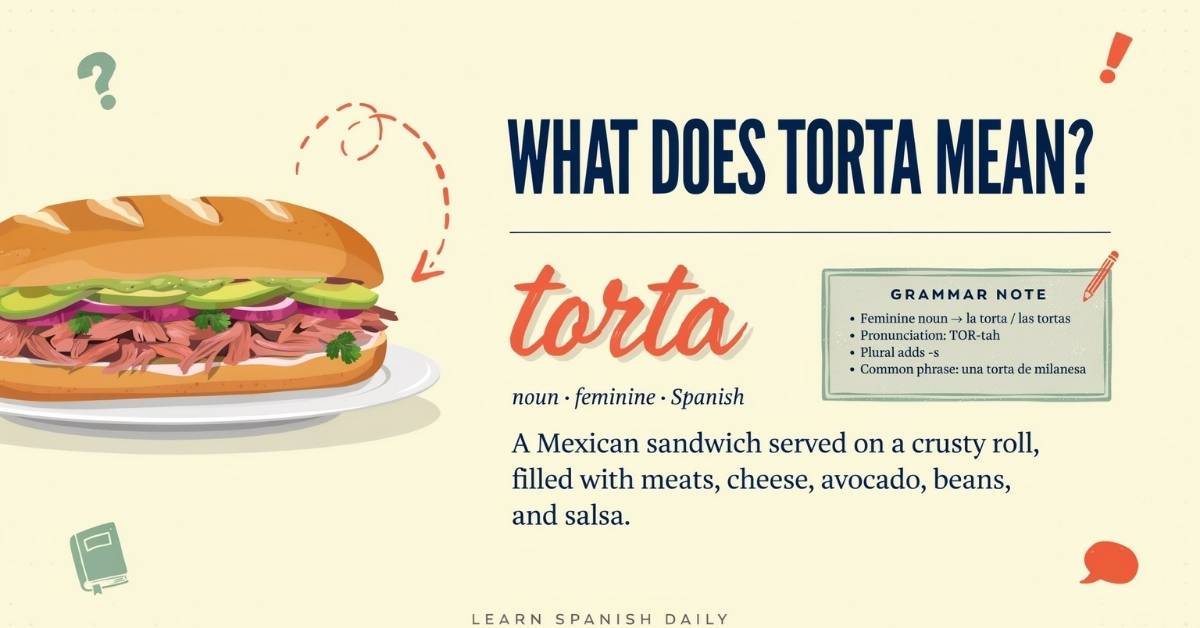
Unlike a simple sliced-bread sandwich, a Mexican It is typically served on a crusty bolillo or soft telera roll. It’s generously filled with flavorful ingredients, making it a satisfying meal enjoyed for breakfast, lunch, dinner, or even a late-night snack.
What Is a Mexican?
A Mexican torta is a hearty sandwich prepared using traditional Mexican bread and layered with a variety of fresh ingredients.
Common fillings include:
- Grilled chicken
- Carne asada
- Milanesa (breaded beef or chicken)
- Carnitas
- Ham
- Chorizo
- Beans
- Avocado
- Queso Oaxaca
- Lettuce
- Tomatoes
- Onions
- Jalapeños
- Chipotle sauce
- Mayonnaise
The combination creates a sandwich that’s rich in texture, flavor, and tradition.
Unlike many fast-food sandwiches, a traditional Mexican torta is known for its generous portions and fresh ingredients.
Why Is It Called a Torta?
Many visitors naturally ask:
“Why isn’t it just called a sandwich?”
In Mexico, this word became associated with this particular style of sandwich because it differs significantly from a standard sandwich.
Its typically features:
- Crusty artisan bread
- Warm fillings
- Multiple layers
- Traditional Mexican flavors
- Homemade sauces
- Regional ingredients
It has become an iconic part of Mexican street food culture, much like tacos, tamales, and quesadillas.
Popular Types of Mexican Tortas
Mexico has countless regional variations, each offering unique flavors.
Torta de Jamón
One of the simplest and most popular options.
Usually contains:
- Ham
- Cheese
- Lettuce
- Tomato
- Avocado
- Jalapeños
- Mayonnaise
It’s a favorite for quick lunches and school meals.
Torta Cubana
Despite its name, Torta Cubana is actually a Mexican creation.
It is famous for its impressive size and generous fillings.
It may include:
- Ham
- Breaded steak
- Sausage
- Bacon
- Cheese
- Egg
- Avocado
- Beans
- Multiple sauces
This is often considered one of Mexico’s most indulgent sandwiches.
Torta Ahogada
The Torta Ahogada, meaning “drowned sandwich,” comes from Guadalajara.
What makes it unique?
The sandwich is submerged in a spicy tomato and chili sauce before serving.
Its bold flavor has made it one of Mexico’s most iconic regional dishes.
Torta de Milanesa
A favorite throughout central Mexico.
The main ingredient is a crispy breaded cutlet, usually:
- Beef
- Chicken
- Pork
Combined with fresh vegetables and creamy avocado, it offers a perfect balance of crunch and freshness.
Regional Specialties
Different Mexican states have their own signature tortas featuring local ingredients and family recipes.
Some regions add:
- Seafood
- Slow-cooked pork
- Regional cheeses
- Homemade salsas
- Pickled vegetables
This diversity is one reason Mexican tortas remain such an important part of the country’s culinary identity.
When Will You Hear this Word in Mexico?
If you’re traveling through Mexico, you’ll encounter the word almost everywhere.
Common places include:
- Street food stalls
- Traditional markets
- Restaurants
- Family kitchens
- Food delivery apps
- Lunch cafés
- Sports stadiums
For example, you might hear:
“Una torta de milanesa, por favor.”
Translation:
“A breaded steak torta, please.”
Or:
“¿Qué tipo de torta quieres?”
Translation:
“What kind of sandwich would you like?”
In these situations, nobody is referring to cake.
Understanding this regional usage helps travelers avoid one of the most common food-related misunderstandings when visiting Mexico.
Real-Life Ordering Example
Imagine you’re visiting a local restaurant in Mexico City.
Customer: “¿Qué recomienda hoy?”
Server: “Nuestra torta cubana es una de las más populares.”
If you know the regional meaning, you’ll understand that the server is recommending a large Mexican sandwich, not a dessert.
This simple cultural insight can make your dining experience much smoother and more enjoyable.
What Does It Mean in Spain and Other Spanish-Speaking Countries?
One of the biggest reasons people search “what does torta mean in Spanish” is because they discover that the definition changes once they leave Mexico.
If you travel from Mexico to Spain, Argentina, Colombia, or Chile, you’ll quickly notice that asking for a torta may bring you something completely different.
In most Spanish-speaking countries outside Mexico, torta generally refers to a cake, sweet pastry, or another type of baked dessert rather than a sandwich.
This isn’t a translation mistake—it’s simply how regional Spanish has evolved over time.
What Does It Mean in Spain?
In Spain, the word torta traditionally refers to a cake, flat cake, or round baked dessert. Depending on the region, it can also describe certain types of rustic bread or pastries.
You’ll commonly hear phrases like:
- Torta de Santiago
- Torta de Chocolate
Unlike the Mexican torta, these foods are baked rather than assembled as sandwiches.
Torta de Santiago
One of Spain’s most famous desserts is Torta de Santiago, a rich almond cake from Galicia.
It is traditionally made with:
- Ground almonds
- Eggs
- Sugar
- Lemon zest
- Cinnamon
The cake is often decorated with the famous Cross of Saint James using powdered sugar, making it instantly recognizable.
If someone in Spain invites you for torta, they’re almost certainly offering dessert—not lunch.
What Does It Mean in Argentina?
In Argentina, It almost always means cake.
It’s the word used for:
- Birthday cakes
- Wedding cakes
- Chocolate cakes
- Fruit cakes
- Homemade celebration desserts
For example:
“Compramos una torta para el cumpleaños.”
Translation:
“We bought a cake for the birthday.”
Unlike Mexico, where a torta is associated with savory ingredients, Argentinians immediately picture a sweet baked dessert.
Learn More: Propper or Proper
What Does It Mean in Colombia?
In Colombia, the meaning is similar.
It generally refers to:
- Cake
- Sweet pastry
- Layered dessert
Popular examples include:
- Chocolate torta
- Tres Leches torta
- Celebration cakes
You’ll frequently see It in bakeries and cafés, especially during birthdays and family celebrations.
What Does It Mean in Chile?
In Chile, It also refers to a cake.
Common varieties include:
- Chocolate torta
- Fruit torta
- Caramel-filled cakes
Celebrations almost always include a beautifully decorated torta.
Other Latin American Countries
Many Spanish-speaking countries share this same meaning.
For example:
Peru
Usually means:
- Cake
- Dessert
- Pastry
Venezuela
Often refers to:
- Cake
- Celebration dessert
Ecuador
Typically means:
- Cake
- Sweet baked dish
Bolivia
Generally used for cakes and pastries.
Although recipes vary from country to country, the overall meaning remains remarkably consistent.
Country-by-Country Comparison
| Country | Meaning of Torta | Common Example |
|---|---|---|
| Mexico | Sandwich | Torta Cubana |
| Spain | Cake | Torta de Santiago |
| Argentina | Birthday Cake | Chocolate Torta |
| Colombia | Cake | Celebration Cake |
| Chile | Cake | Mille-feuille Torta |
| Peru | Cake | Homemade Torta |
| Venezuela | Cake | Birthday Dessert |
| Ecuador | Cake | Bakery Cake |
| Philippines | Egg Dish | Tortang Talong |
The easiest rule to remember is:
- Mexico → Sandwich
- Most of Latin America → Cake
- Philippines → Omelet
What Does It Mean in the Philippines?
Many people are surprised to learn that It has yet another meaning in the Philippines.
Instead of a sandwich or cake, it often refers to an omelet or egg-based dish.
This meaning developed because of centuries of Spanish influence combined with local Filipino cuisine.
Today, many Filipino families prepare different types of torta for breakfast or lunch.
Tortang Talong
One of the country’s best-known dishes is Tortang Talong.
It consists of:
- Grilled eggplant
- Beaten eggs
- Seasonings
The eggplant is coated in eggs before being fried until golden brown.
It’s simple, nutritious, and widely loved throughout the Philippines.
Other Filipino Dishes
Depending on the region, you may also find:
- Ground beef torta
- Crab torta
- Fish torta
- Vegetable torta
- Sweet Cebu torta (a small sponge cake)
This shows how one word can evolve into completely different foods while still preserving its cultural identity.
Is It is a Sandwich, a Cake, or Something Else?
The short answer is:
All of the above.
The correct meaning depends entirely on where the word is being used.
Instead of thinking there’s one “correct” definition, it’s more accurate to think of torta as a regional culinary term.
Here’s a quick comparison:
| Meaning | Region | Food Category |
|---|---|---|
| Sandwich | Mexico | Savory Meal |
| Cake | Spain | Dessert |
| Cake | Argentina | Dessert |
| Cake | Colombia | Dessert |
| Cake | Chile | Dessert |
| Omelet | Philippines | Breakfast/Main Dish |
Language evolves naturally, and torta is one of the best examples of how the same Spanish word can develop unique meanings across different cultures.
How Native Speakers Instantly Know Which Meaning Is Intended
One question many Spanish learners ask is:
“How do native speakers know which torta someone is talking about?”
The answer is surprisingly simple.
Native speakers rely on context.
For example:
At a Restaurant in Mexico
Someone says:
“Quiero una torta.”
Everyone understands they’re ordering a sandwich.
At a Bakery in Spain
Someone says:
“Voy a comprar una torta.”
People immediately think of a cake.
At a Birthday Party in Argentina
Someone asks:
“¿Dónde está la torta?”
Everyone expects the birthday cake.
During Breakfast in the Philippines
Someone says:
“Hoy cociné torta.”
Family members know they’re referring to an egg dish.
Context makes the intended meaning obvious.
How to Use the Word “Torta” Correctly
If you’re learning Spanish or traveling abroad, understanding regional vocabulary can save you from awkward misunderstandings.
Here are a few practical tips.
If You’re Visiting Mexico
When ordering food:
Torta = Sandwich
You can confidently order:
- Torta de Jamón
- Torta Ahogada
- Torta Cubana
If You’re Traveling in Spain
If you want a sandwich, don’t ask for a torta.
Instead, ask for:
- Bocadillo
- Sándwich
If you ask for , you’ll probably receive dessert.
If You’re Visiting Argentina
At bakeries:
Torta = Cake
If you want birthday cake, simply ask for a It.
If You’re Learning Spanish
Always remember:
Spanish vocabulary changes by country.
Words like:
- guagua
- coger
- zumo
- jugo
all have different meanings depending on the region.
Learning these differences helps you sound more natural and avoid confusion.
Common Mistakes Travelers Make
Many visitors make the same mistakes.
Mistake #1
Ordering a torta in Spain expecting a sandwich.
Mistake #2
Seeing torta cubana on a Mexican menu and assuming it’s dessert.
Mistake #3
Using online translators without checking regional context.
Mistake #4
Assuming every Spanish-speaking country uses identical vocabulary.
In reality, regional Spanish is incredibly diverse.
Easy Trick to Remember the Meaning
A simple memory tip can help.
✅ Think of Mexico first.
If you’re in Mexico:
Torta = Sandwich
Anywhere else in the Spanish-speaking world:
Think:
Torta = Cake
While there are exceptions, this rule works in most everyday situations.
See More: Is Good Morning One Word
How Do You Pronounce?
Correct pronunciation is much easier than many people expect.
Pronunciation:
TOR-tah
IPA:
/ˈtoɾ.ta/
The first syllable receives the stress.
Unlike English, the r is lightly tapped rather than strongly rolled.
Common Pronunciation Mistakes
Many English speakers accidentally say:
- Tor-taa
- Tor-ter
- Towr-ta
Native pronunciation is much smoother.
Think:
TOR-tah
with a soft, quick r sound.
Why Google Shows Different Answers
People often become confused because Google sometimes displays:
- Sandwich
- Cake
- Flatbread
- Omelet
The search engine isn’t wrong.
It simply pulls information from different sources representing different countries.
A dictionary may prioritize one definition, while an encyclopedia or cultural guide emphasizes another.
Understanding the regional context resolves this apparent contradiction.
Is This is a Slang or an Offensive Word?
One of the most common follow-up searches is “Is torta slang?” or “Is torta offensive?” The short answer is usually no, but the full explanation depends on the country and context.
In everyday conversations, torta is most commonly a food-related word. In Mexico, it almost always refers to a sandwich, while in Spain and many Latin American countries it usually means a cake or pastry.
However, like many words in regional Spanish, torta can occasionally have slang meanings in certain countries or communities. These meanings are not universal and may vary by location, age group, or social context. Because of this, it’s always best to pay attention to the conversation and local usage rather than assuming a slang meaning.
Good news for travelers and Spanish learners: if you’re ordering food in a restaurant, bakery, or café, people will almost always interpret torta as food—not slang.
Vs. Other Similar Foods
Many people also search for comparisons because they aren’t sure how a torta differs from other popular dishes.
| Food | What It Is | Main Difference |
|---|---|---|
| Torta (Mexico) | Sandwich | Served on a bolillo or telera roll with generous fillings |
| Taco | Folded tortilla | Uses a tortilla instead of bread |
| Burrito | Wrapped flour tortilla | Completely enclosed with fillings |
| Panini | Italian grilled sandwich | Pressed and grilled, different bread style |
| Cake (Torta in Spain/Argentina) | Dessert | Sweet baked dish rather than a savory meal |
The easiest way to distinguish them is to remember that a Mexican torta is built around bread, while tacos and burritos are built around tortillas.
Real-Life Examples in Everyday Conversations
Understanding how native speakers use the word makes it much easier to remember its meaning.
Example 1: Restaurant in Mexico
Customer: “Quisiera una torta de milanesa, por favor.”
Translation: “I’d like a breaded steak torta, please.”
Here, torta clearly means sandwich.
Example 2: Bakery in Spain
Customer: “¿Tiene torta de Santiago?”
Translation: “Do you have Torta de Santiago?”
In this case, torta refers to a famous almond cake.
Example 3: Birthday Party in Argentina
Host: “La torta ya está lista.”
Translation: “The birthday cake is ready.”
Again, the meaning is cake, not sandwich.
Example 4: Filipino Home
Parent: “Hoy cociné torta para el desayuno.”
Translation: “I cooked torta for breakfast today.”
Here, It refers to an egg-based dish.
These examples show why context is far more important than a literal translation.
Interesting Facts
The word torta has a surprisingly rich cultural history. Here are a few interesting facts that many people don’t know.
1. The Same Word Can Describe Completely Different Foods
It’s rare for one culinary term to represent a sandwich, cake, pastry, and omelet depending on the country.
2. Mexican Tortas Are Street Food Icons
From bustling markets to neighborhood food stalls, tortas are one of the most popular forms of Mexican street food.
3. Spain Has Some of the World’s Oldest Recipes
Traditional recipes like Torta de Santiago have been enjoyed for centuries and remain an important part of Spanish culinary heritage.
4. Language Evolves with Culture
The changing meaning of torta demonstrates how language naturally adapts as people migrate, create new recipes, and develop regional traditions.
5. Translation Apps Don’t Always Tell the Whole Story
A translation tool may simply display “cake” or “sandwich,” but only cultural context explains why the meanings differ.
Expert Tips for Remembering the Correct Meaning
If you’re worried about mixing up the definitions, these simple tricks can help.
Think About the Country First
Before interpreting the word, ask yourself:
Where is this conversation taking place?
The answer usually reveals the correct meaning.
Remember the Golden Rule
- Mexico = Sandwich
- Spain = Cake
- Argentina = Cake
- Colombia = Cake
- Chile = Cake
- Philippines = Omelet
This simple rule covers most everyday situations.
Look at the Surrounding Words
Context clues make interpretation easy.
If you see words like:
- ham
- avocado
- bread
- beans
- cheese
It’s almost certainly a Mexican sandwich.
If you see:
- birthday
- bakery
- chocolate
- dessert
- candles
It’s almost certainly a cake.
Common Myths
Myth: It always means a sandwich.
Reality: That’s only true in Mexico and some nearby regions.
Myth: Dictionaries disagree because one is wrong.
Reality: They’re describing different regional meanings.
Myth: Every Spanish-speaking country uses the same vocabulary.
Reality: Regional Spanish varies widely, and torta is one of the best-known examples.
Myth: It is only a Mexican food.
Reality: The word is used across many countries, although the food it describes differs significantly.
Frequently Asked Questions
What does this literally mean?
The literal meaning depends on regional usage. In Mexico, it usually means a sandwich, while in Spain and much of Latin America, it refers to a cake or pastry.
Why does It mean different things?
Because language evolves differently across regions. Historical influences, local cuisine, and cultural traditions all shaped the meaning of the word over time.
Is a torta the same as a sandwich?
Only in Mexico. In many other countries, a torta is a baked dessert rather than a sandwich.
What bread is used for a Mexican torta?
Traditional Mexican tortas are commonly made with bolillo or telera bread.
What is Torta Ahogada?
Torta Ahogada, or “drowned sandwich,” is a famous specialty from Guadalajara. It features a crusty sandwich soaked in a flavorful tomato and chili sauce.
What is Torta Cubana?
Despite its name, Torta Cubana is a Mexican sandwich known for its generous combination of meats, cheese, avocado, beans, and vegetables.
Is It always food?
In most situations, yes. Although there may be occasional regional slang meanings, the word is primarily associated with food.
How do you pronounce It?
It’s pronounced:
TOR-tah
with the emphasis on the first syllable.
Can I order It in Spain?
Yes—but expect to receive a cake or another baked dessert rather than a sandwich.
Why do translation websites give different definitions?
Because they’re reflecting different regional uses of Spanish. Both “sandwich” and “cake” are correct depending on the country.
Conclusion
What does torta mean? It isn’t a word with one fixed definition—it reflects the history, traditions, and culinary identity of the region where it’s used. In Mexico, it’s an iconic sandwich enjoyed as a satisfying meal. Across much of Spain and Latin America, it’s a beloved cake served during celebrations and family gatherings. In the Philippines, it’s even an egg-based dish.
Rather than asking which definition is “correct,” it’s more accurate to ask where the word is being used. Once you understand the regional context, the meaning becomes clear.
The next time you see torta on a restaurant menu, bakery sign, travel guide, or in a Spanish conversation, you’ll know exactly how to interpret it—and you’ll have a deeper appreciation for the fascinating ways language and food evolve across cultures.