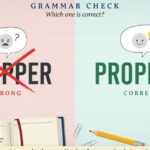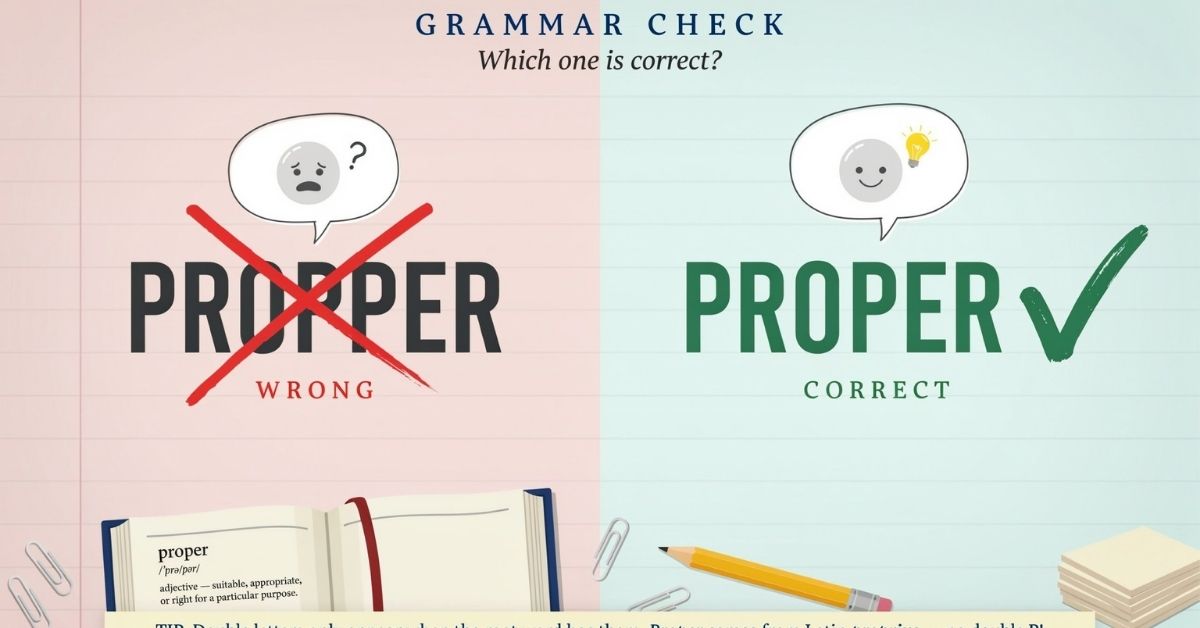
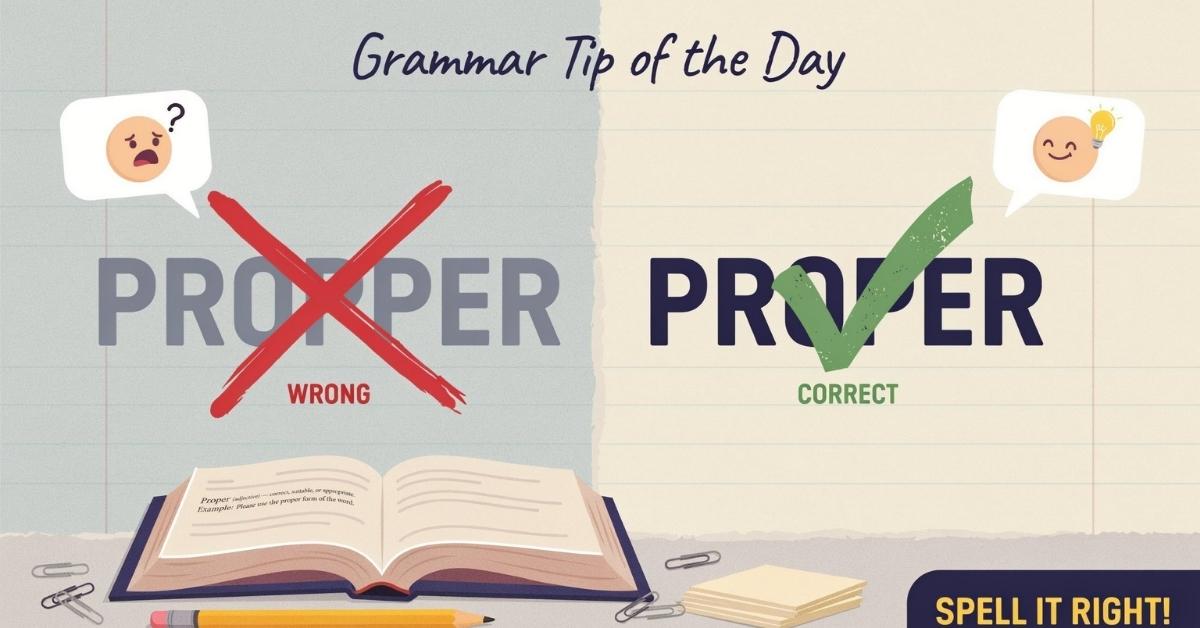
Propper or proper — if you’re wondering which spelling is correct, the answer is simple: “proper” is the correct spelling in standard English, while “propper” is a misspelling in almost every situation. The only time you may see “Propper” with two P’s is when it refers to a surname, a brand name, or another proper noun. If you’re writing an essay, email, resume, business document, or social media post, you should always use proper.
English spelling can be confusing because many words don’t follow predictable patterns. That’s why common spelling mistakes like propper vs. proper happen so often. Whether you’re a student, professional, English learner, or content writer, knowing the correct spelling, meaning, pronunciation, and usage of proper helps you communicate clearly and confidently. In this guide, you’ll learn why propper is incorrect, how to use proper correctly, practical examples, memory tricks, and the most common mistakes to avoid.
Quick Answer: Propper vs. Proper
If you only need a quick answer, here’s everything you should know.
| Propper | Proper |
|---|---|
| ❌ Incorrect spelling in standard English | ✅ Correct English spelling |
| Not recognized as the adjective “proper” | Accepted in all major dictionaries |
| Usually a typing or spelling mistake | Used in academic, professional, and everyday writing |
| May appear as a surname or brand name | Means correct, suitable, appropriate, or well-behaved |
Which One Should You Use?
Always choose proper when you mean:
- Correct
- Appropriate
- Suitable
- Polite
- Accurate
- Well-mannered
For example:
- Please wear proper safety equipment.
- She used proper grammar in her assignment.
- We followed the proper procedure.
Using propper in these sentences would be incorrect.
Can “Propper” Ever Be Correct?
This is where many people become confused.
Although propper is not a standard English word, you may occasionally see Propper because it is used as:
- A family surname
- A company or brand name
- A proper noun
For example:
- Propper (surname)
- Propper (brand)
These are names rather than the English adjective proper.
So if you’re asking:
Is propper a real word?
The answer is:
- ❌ No, not as the English adjective.
- ✅ Yes, only when referring to specific names such as a surname or brand.
Why “Propper” Is a Common Misspelling
Many people accidentally type propper instead of proper, and there’s a good reason for it. This mistake isn’t usually caused by poor grammar—it often results from the way our brains process language.
1. Double-Letter Confusion
English contains many words with double consonants, including:
- happy
- running
- beginning
- stopping
- address
Because of these familiar spelling patterns, some writers mistakenly assume proper should also contain a double P.
2. Pronunciation Doesn’t Reveal the Difference
When spoken aloud, proper doesn’t strongly emphasize the number of P’s.
People often write words based on how they sound rather than how they are spelled. Since pronunciation provides little clue, it’s easy to add an extra letter by mistake.
3. Fast Typing
Typing quickly on a keyboard or smartphone increases the chance of repeating letters accidentally.
Examples include:
- propper
- occured
- seperate
- adress
These are among the most common typing errors in English writing.
4. Learning English as a Second Language
Many English learners rely on pronunciation to spell unfamiliar words. Since English spelling is not completely phonetic, words like proper can easily be misspelled.
5. Lack of Proofreading
Even experienced writers occasionally make spelling mistakes.
A quick proofread or spell check usually catches errors like propper, making it easy to correct before submitting important work.
What Does “Proper” Mean?
The word proper is a versatile adjective used in many different situations. Although the meaning changes slightly depending on the context, it always suggests something that is correct, appropriate, or suitable.
Let’s look at its most common meanings.
Proper Means “Correct”
This is the most common usage.
Examples:
- Please use the proper spelling.
- She gave the proper answer.
- Always follow the proper instructions.
Here, proper simply means correct.
Proper Means “Appropriate”
Sometimes proper describes behavior or actions that are suitable for a particular situation.
Examples:
- Wear proper clothing during the interview.
- Use the proper tool for the job.
- Students should maintain proper discipline.
In these cases, proper means appropriate or suitable.
Proper Means “Polite”
The word can also describe good manners or acceptable social behavior.
Examples:
- Children should learn proper manners.
- He behaved in a proper way.
- Always show proper respect to others.
Proper Means “Accurate”
In technical or professional contexts, proper often refers to something done correctly.
Examples:
- Use the proper measurement.
- Follow the proper medical procedure.
- Install the software using the proper method.
Proper in Formal English
Formal writing often uses proper to emphasize correctness and professionalism.
You’ll commonly see phrases like:
- proper documentation
- proper training
- proper authorization
- proper identification
- proper legal procedure
- proper maintenance
- proper grammar
- proper pronunciation
These expressions appear frequently in business, academic, legal, and government documents.
Pronunciation of “Proper”
Correct pronunciation helps reinforce the correct spelling.
IPA (British English): /ˈprɒpə/
IPA (American English): /ˈprɑːpər/
Simple pronunciation:
PROP-er
Notice that the word contains only one P in the middle when written.
How to Use “Proper” Correctly in Sentences
One of the easiest ways to remember the correct spelling is to see the word used naturally in different situations.
Everyday Conversations
Examples:
- Please wear proper shoes for hiking.
- That’s the proper way to cook rice.
- We finally found the proper solution.
- Use the proper key to unlock the door.
Academic Writing
Correct spelling is especially important in schools and universities.
Examples:
- Always use proper grammar in your essays.
- Students should follow the proper citation format.
- Use proper punctuation throughout your assignment.
- The teacher explained the proper method for solving the problem.
Using propper in academic work may result in spelling errors and lower grades.
Business Communication
Professional writing reflects your credibility.
Examples:
- Please complete the proper documentation.
- Follow the proper approval process.
- Ensure all employees receive proper training.
- We followed the proper company policy.
Correct spelling helps create a positive impression in emails, reports, proposals, and presentations.
Professional Documents
Examples:
- Use the proper legal terminology.
- Submit the proper identification.
- Complete the application using the proper format.
- The contract contains the proper clauses.
Whether you’re preparing a resume, drafting a legal document, or writing an official letter, accurate spelling demonstrates professionalism and attention to detail.
Social Media and Online Writing
Although social media is generally more informal, correct spelling still matters.
Examples:
- Thanks for the proper explanation!
- Here’s the proper way to fix this issue.
- Always wear proper safety gear while riding.
Clear and accurate writing helps your posts appear more trustworthy and easier to understand.
Propper vs. Proper: Complete Side-by-Side Comparison
Although the answer is straightforward—proper is the correct spelling and propper is usually a misspelling—seeing the differences side by side makes it much easier to remember.
| Feature | Proper | Propper |
|---|---|---|
| Correct English spelling | ✅ Yes | ❌ No (for the adjective) |
| Recognized by dictionaries | ✅ Yes | ❌ No |
| Part of speech | Adjective | Not an English adjective |
| Meaning | Correct, suitable, appropriate, polite | No standard dictionary meaning |
| Used in formal writing | ✅ Yes | ❌ No |
| Accepted in exams | ✅ Yes | ❌ Incorrect |
| Professional communication | ✅ Yes | ❌ Avoid |
| Business emails | ✅ Yes | ❌ Spelling error |
| Academic writing | ✅ Yes | ❌ Incorrect |
| Legal documents | ✅ Yes | ❌ Incorrect |
| May appear as a surname or brand | ❌ Not as a surname | ✅ Yes |
The Final Verdict
If you’re writing in standard English, always use proper.
Choose Propper only when it forms part of a person’s name, company name, or another proper noun.
Learn More: Is Good Morning One Word
Is “Propper” a Real Word?
One of the most common questions people ask is:
Is “propper” a real word?
The answer depends on the context.
As an English Adjective
No.
Major English dictionaries recognize proper, not propper, as the adjective meaning correct, appropriate, suitable, or well-behaved.
For example:
- ✅ proper attire
- ✅ proper grammar
- ✅ proper procedure
Writing propper attire or propper grammar is incorrect.
As a Proper Noun
You may come across Propper in situations unrelated to spelling.
Examples include:
- A person’s surname.
- A business or clothing brand.
- A company or organization name.
In these cases, Propper is a name, not the English adjective.
This distinction is important because search engines may show results for both the adjective proper and the proper noun Propper.
British English vs. American English
Another common misconception is that one spelling belongs to British English while the other belongs to American English.
That is not true.
Both varieties of English use the same spelling:
✅ Proper
There is no regional spelling difference.
British English
Examples:
- proper behaviour
- proper organisation
- proper pronunciation
American English
Examples:
- proper behavior
- proper organization
- proper pronunciation
Notice that while words like behaviour/behavior and organisation/organization change depending on the variety of English, the spelling of proper remains exactly the same.
The only noticeable difference is pronunciation, not spelling.
Common Situations Where People Make This Mistake
Understanding where the mistake occurs helps you avoid repeating it.
1. School Assignments
Students often type quickly while completing essays or homework.
Incorrect:
She used propper grammar.
Correct:
She used proper grammar.
Small spelling errors can affect grades, especially in English language assignments.
2. Resume and CV Writing
Recruiters pay attention to detail.
Incorrect spelling on a resume may create a poor first impression.
Correct examples:
- proper communication skills
- proper documentation
- proper training
Professional writing reflects professionalism.
3. Business Emails
Mistakes in workplace communication can reduce credibility.
Incorrect:
Please follow the propper procedure.
Correct:
Please follow the proper procedure.
Using the correct spelling demonstrates attention to detail.
4. Legal and Official Documents
Legal writing depends on precision.
Examples:
- proper authorization
- proper identification
- proper notice
- proper legal procedure
- proper evidence
A spelling mistake may not invalidate a document, but it can affect professionalism.
5. Online Content and Blogging
Whether you’re writing a blog, product description, or website page, spelling influences trust.
Readers are more likely to trust content that is free from obvious errors.
This is especially important for:
- SEO articles
- Educational websites
- Business websites
- News publications
- Marketing copy
6. Social Media Posts
Although social media is informal, correct spelling still improves readability.
Example:
Always wear proper safety gear while riding your motorcycle.
Simple corrections make your content look more polished.
Similar Spelling Mistakes You Should Avoid
People who search for propper or proper often make similar spelling mistakes.
Learning these common errors improves your overall writing.
| Incorrect | Correct |
|---|---|
| seperate | separate |
| occured | occurred |
| definately | definitely |
| neccessary | necessary |
| wierd | weird |
| adress | address |
| untill | until |
| recieve | receive |
These mistakes usually happen because English spelling doesn’t always match pronunciation.
Developing the habit of proofreading can eliminate most of them.
Easy Tricks to Remember the Correct Spelling
Memorizing spelling rules isn’t always effective. Instead, use simple memory techniques.
Trick 1: Think of the Meaning
Whenever you mean:
- correct
- suitable
- appropriate
- polite
the spelling is always proper.
Trick 2: Remember “One P in the Middle”
Many people mistakenly double the middle P.
Visualize the word:
P R O P E R
Only one P appears after PRO.
Trick 3: Use a Mnemonic
Remember this sentence:
Proper people practice proper punctuation.
Repeating it a few times helps reinforce the correct spelling.
Trick 4: Read More
Reading books, newspapers, and quality online articles naturally strengthens your memory for correct spelling.
The more often you see proper, the less likely you are to write propper.
Trick 5: Proofread Before Sending
Whether you’re writing:
- emails
- essays
- blog posts
- reports
- applications
take a few seconds to proofread.
Modern spell-check tools can catch many mistakes, but developing your own proofreading habit is even more valuable.
Why Correct Spelling Matters More Than You Think
Some people assume spelling isn’t important as long as readers understand the message.
In reality, correct spelling influences how others perceive your writing.
Professional Communication
Clients, employers, and colleagues often judge written communication by its accuracy.
Using proper instead of propper shows that you pay attention to detail.
Academic Success
Teachers and examiners notice spelling mistakes.
Using correct English spelling can improve the clarity and quality of assignments, essays, and examinations.
Job Applications
Your resume and cover letter create your first impression.
A document with accurate spelling appears more polished and professional.
Online Credibility
If you run a website or blog, spelling mistakes can reduce reader confidence.
Visitors are more likely to trust content that demonstrates careful proofreading and accurate language.
SEO and Digital Content
Correct spelling also benefits online publishing.
Search engines understand spelling variations, but users generally search for and trust the correct spelling.
Publishing accurate, well-written content contributes to:
- better user experience
- higher engagement
- improved readability
- stronger credibility
- increased trust
For writers, bloggers, and businesses, these factors support long-term content quality and audience satisfaction.
Frequently Asked Questions
Is propper or proper the correct spelling?
Proper is the correct spelling in standard English. Propper is generally a misspelling unless it is being used as a surname, brand name, or another proper noun.
Is propper a real word?
Not as a standard English adjective.
You may occasionally see Propper as:
- A family surname
- A company or brand name
- A proper noun
However, if you mean correct, appropriate, or suitable, the correct spelling is always proper.
What does proper mean?
The word proper has several related meanings depending on the context. It can mean:
- Correct
- Appropriate
- Suitable
- Polite
- Accurate
- Well-behaved
For example:
- Wear proper safety equipment.
- Please use the proper spelling.
- Follow the proper procedure.
How do you pronounce proper?
British English (IPA)
/ˈprɒpə/
American English (IPA)
/ˈprɑːpər/
A simple way to pronounce it is:
PROP-er
Although the pronunciation may sound like there could be two P’s, remember that the correct spelling contains only one.
Why do people spell proper as propper?
There are several reasons why this common misspelling occurs:
- Confusion caused by words with double consonants.
- Typing too quickly.
- Relying on pronunciation instead of spelling.
- Learning English as a second language.
- Skipping proofreading.
Fortunately, once you know the correct spelling, it’s an easy mistake to avoid.
Is proper used in both British and American English?
Yes.
The spelling proper remains the same in both British English and American English.
Only some neighboring words differ, such as:
| British English | American English |
|---|---|
| behaviour | behavior |
| organisation | organization |
| colour | color |
The spelling of proper never changes.
Can I use propper in academic writing?
No.
Schools, colleges, universities, and professional organizations expect the standard spelling:
✅ proper
Using propper in essays, reports, research papers, or exams will usually be marked as a spelling error unless you are referring to a specific name.
Does spell check recognize propper?
Most modern spell-check and grammar-check tools identify propper as an error when you intend to write the adjective proper.
However, because Propper can also be a surname or brand name, some writing tools may not always flag it depending on the context.
It’s still a good habit to proofread your work before submitting or publishing it.
What are some common phrases that use proper?
You’ll encounter proper in many everyday expressions, including:
- proper grammar
- proper spelling
- proper pronunciation
- proper behavior
- proper attire
- proper training
- proper documentation
- proper procedure
- proper maintenance
- proper legal process
- proper identification
- proper etiquette
These collocations are commonly used in academic, professional, legal, and everyday English.
What part of speech is proper?
In most situations, proper is an adjective because it describes a noun.
Examples:
- Proper planning prevents problems.
- She wore proper clothing.
- We followed the proper instructions.
The word also appears in grammatical terms such as proper noun, where it forms part of a descriptive phrase.
How can I remember the correct spelling?
Here are three simple memory tricks:
- Think of the meaning: If the word means correct, appropriate, or suitable, write proper.
- Remember one P: The correct spelling has only one P after PRO.
- Read it aloud: Repeating and seeing the word in books, articles, and professional writing helps reinforce the correct spelling.
With regular reading and writing, the correct form soon becomes second nature.
Quick Recap: Propper vs. Proper
If you only remember one thing from this article, let it be this:
| Question | Answer |
|---|---|
| Which spelling is correct? | ✅ Proper |
| Is propper correct? | ❌ No (except as a surname or brand name) |
| Which spelling should I use in writing? | ✅ Proper |
| Is proper accepted in British and American English? | ✅ Yes |
| Will using propper be considered a spelling mistake? | ✅ In almost all standard writing, yes |
Final Thoughts
When comparing propper or proper, the correct choice is clear: proper is the standard English spelling recognized by dictionaries, educators, employers, and professional writers. While Propper may occasionally appear as a surname or brand name, it should not be used when you mean correct, appropriate, or suitable.
Mastering small spelling differences like this can make a big impact on the quality of your writing. Whether you’re preparing a school assignment, sending a business email, writing a legal document, publishing a blog post, or simply communicating online, using proper demonstrates attention to detail and confidence in your language skills.
Whenever you’re uncertain, remember this simple rule:
If you’re referring to something that is correct, appropriate, or suitable, always use “proper.”
By applying this rule consistently and making proofreading part of your writing process, you’ll avoid one of the most common English spelling mistakes and communicate more clearly in every situation.