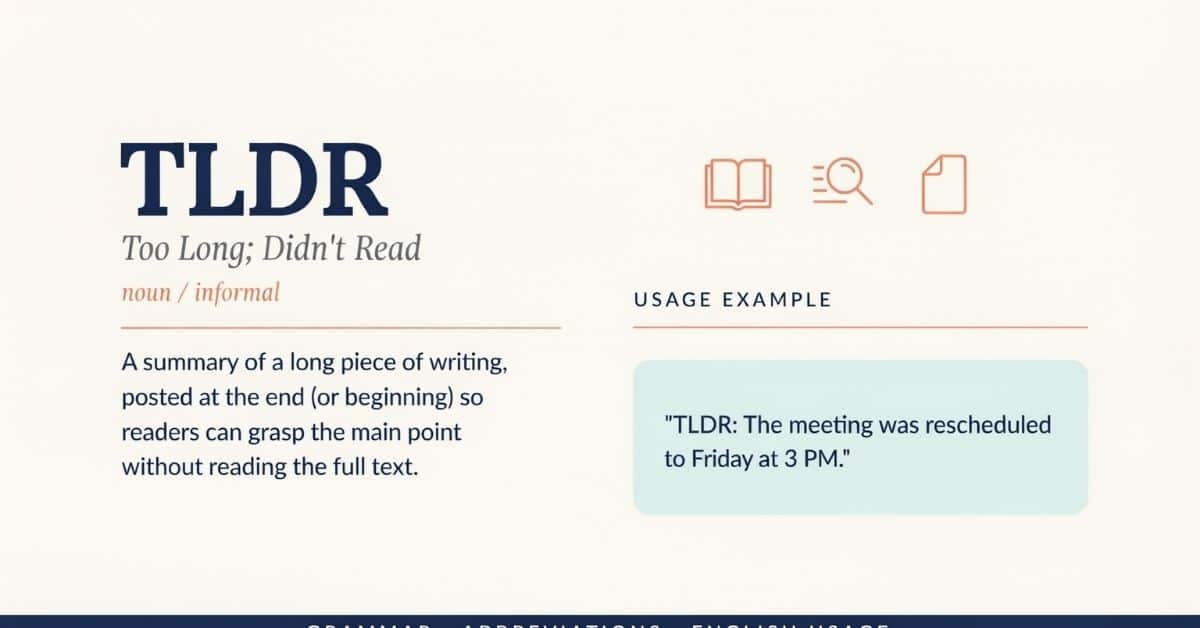
TLDR meaning is “Too Long; Didn’t Read.” It’s a popular internet slang acronym used in text messages, social media, online forums, emails, and blogs. People use TLDR in two main ways: either to tell someone that a message or article is too long, or to provide a short summary of lengthy content. Whether TLDR sounds helpful or rude depends entirely on how and where it’s used.
In today’s fast-paced digital world, where people scroll through endless content on platforms like Reddit, TikTok, Discord, Instagram, X (formerly Twitter), Slack, and messaging apps, TLDR has become a practical way to communicate quickly. However, many people still wonder whether it’s appropriate in professional settings, if it’s offensive, or how to use it correctly. This guide answers all those questions with real-world examples, expert insights, and practical tips so you can understand and use TLDR confidently.
What Does TLDR Mean?
At its simplest, TLDR is an acronym that stands for “Too Long; Didn’t Read.” It became popular on the internet because people often wanted a quick way to respond to long posts or provide readers with a concise version of lengthy information.
Today, TLDR has evolved beyond its original meaning. Instead of only expressing that something was too long to read, it has become a helpful way to introduce a summary that highlights the most important points.
Think of TLDR as the internet’s version of an executive summary. Just as professionals often read a summary before diving into a detailed report, online readers appreciate a quick overview before deciding whether to read an entire post.
The Full Form of TLDR
The full form of TLDR is:
Too Long; Didn’t Read
You’ll also see it written as:
- TL;DR
- TLDR
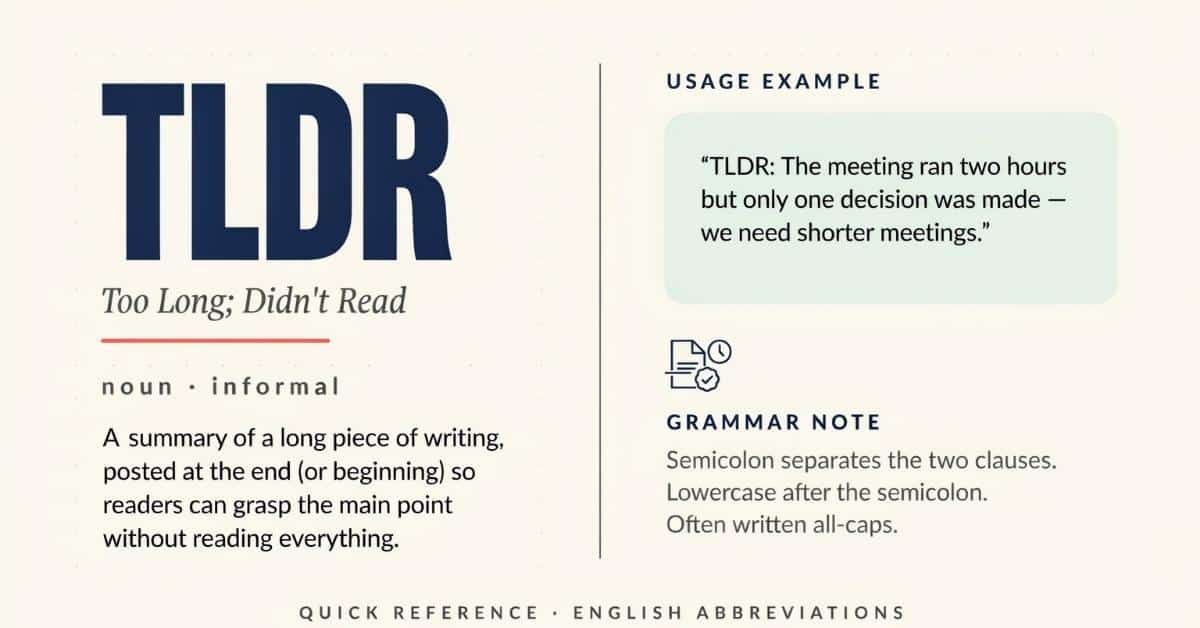
Both versions mean exactly the same thing. The semicolon in TL;DR simply separates the phrases “Too Long” and “Didn’t Read.” Over time, many users dropped the punctuation because it’s quicker to type, especially on smartphones and messaging apps.
Today, both spellings are widely accepted across Reddit, blogs, Discord servers, online communities, and social media platforms.
The Two Most Common Meanings of TLDR
One reason people become confused about TLDR meaning is that it serves two completely different purposes depending on the context.
1. TLDR as a Summary
This is the most common and positive use today.
Writers often place TLDR at the beginning or end of a long article, email, or discussion to provide readers with a quick overview.
Example:
TLDR: The meeting has been moved to Friday at 10 a.m., and everyone should review the updated agenda beforehand.
Here, TLDR saves readers time without replacing the full content.
2. TLDR as a Response
Sometimes someone replies with only:
TLDR
In this situation, they usually mean:
“Your message is too long, and I didn’t read it.”
Depending on the tone and relationship, this can feel:
- Playful
- Honest
- Sarcastic
- Dismissive
- Rude
For example:
Person A:
“I wrote a five-paragraph explanation about what happened yesterday…”
Person B:
“TLDR.”
This reply suggests the message was considered too lengthy. While some internet communities treat this humorously, others may see it as impolite because it dismisses the effort someone put into writing.
How the Meaning Changes Depending on Context
One of the biggest mistakes people make is assuming TLDR always means the same thing.
In reality, the context completely changes its interpretation.
| Where TLDR Appears | What It Usually Means | Tone |
|---|---|---|
| Beginning of a blog post | Here’s a quick summary | Helpful |
| End of an article | Short recap | Helpful |
| Executive summary | Professional (when used appropriately) | |
| Reddit post | Brief overview before details | Helpful |
| Discord message | Summary of a long discussion | Casual |
| Social media caption | Quick takeaway | Friendly |
| Comment saying only “TLDR” | Your post was too long | Can sound rude |
| Group chat | Summarized update | Convenient |
Understanding this difference helps you avoid awkward misunderstandings.
Why Do People Use TLDR?
The internet moves quickly. Every day, people receive dozens of emails, hundreds of messages, and an endless stream of social media posts. Because of this information overload, readers often prefer short summaries before committing to longer content.
That’s where TLDR becomes useful.
Instead of forcing readers to sift through every detail, a TLDR summary highlights the key message in just one or two sentences.
To Save Time
Time has become one of the most valuable resources online.
Whether someone is checking Slack, reading Reddit, browsing TikTok comments, or catching up on emails during a busy workday, they often appreciate getting the main point immediately.
A well-written TLDR allows readers to decide whether they want to continue reading or move on.
To Improve Readability
Long blocks of text can discourage readers.
Adding a TLDR helps improve the overall user experience by making content feel more approachable.
Content creators, bloggers, and technical writers often include summaries because they know not every reader has the time to read thousands of words.
This approach aligns with modern digital communication habits, where clarity and brevity are highly valued.
To Help Busy Readers
Consider these situations:
- Someone checks emails during a meeting.
- A student reviews notes before an exam.
- A manager scans reports before making decisions.
- A customer reads product documentation.
- A gamer catches up on a lengthy Discord discussion.
In each case, a concise TLDR helps readers understand the essential message without getting lost in details.
To Express Frustration
Not every use of TLDR is positive.
Sometimes people use it to express that a message is unnecessarily long.
Imagine receiving this response after sending a lengthy explanation:
TLDR
Without additional context, it can feel dismissive.
However, internet culture varies. Among friends, this might simply be playful teasing. In professional or unfamiliar settings, the same response could come across as disrespectful.
The relationship between the people involved matters just as much as the word itself.
Why TLDR Has Become More Popular
The rise of platforms like Reddit, TikTok, Discord, Instagram, X, YouTube, and messaging apps has changed how people consume information.
Modern users often:
- Read on smartphones.
- Multitask throughout the day.
- Prefer concise content.
- Skim before reading in detail.
- Expect quick answers.
As a result, TLDR has become part of everyday online communication.
Rather than replacing detailed writing, it complements it by making long content easier to navigate.
This shift reflects a broader trend toward reader-first communication, where respecting someone’s time is considered good digital etiquette.
Is TLDR Rude or Helpful?
One of the most searched questions after “What does TLDR mean?” is:
Is TLDR rude?
The answer is:
It depends on the context, tone, and audience.
Just like many forms of internet slang, TLDR isn’t automatically polite or impolite. The way it’s perceived depends on how you use it.
When TLDR Is Helpful
Most of the time, TLDR is intended to help readers.
For example, after writing a detailed blog post or lengthy email, adding a short summary allows busy readers to understand the main idea immediately.
Example:
TLDR: The software update improves performance, fixes security bugs, and introduces dark mode.
This type of summary respects readers’ time while encouraging them to explore the full content if they need more details.
Many professionals now use brief summaries at the beginning of reports or internal documents because they improve readability and decision-making.
When TLDR Can Sound Rude
Problems usually arise when TLDR is used as a standalone reply.
Imagine spending twenty minutes writing a thoughtful explanation and receiving only:
TLDR
Even if the other person meant it as a joke, it can feel dismissive because it implies your effort wasn’t worth reading.
It’s especially risky in:
- Workplace conversations.
- Customer support.
- Academic discussions.
- Serious personal conversations.
- Professional emails.
In these situations, a more constructive response is almost always better.
How to Use TLDR Politely
If you want to use TLDR without sounding rude, keep these simple principles in mind:
- Use it to help, not criticize.
- Add a clear and useful summary instead of just writing “TLDR.”
- Consider your audience and the platform.
- Avoid using it as the only reply to someone’s thoughtful message.
- In professional settings, consider alternatives such as “Summary,” “Key Takeaway,” or “Bottom Line Up Front (BLUF).”
A well-written TLDR improves communication by making information easier to understand. Used carelessly, it can have the opposite effect.
How to Use TLDR Correctly
Understanding the TLDR meaning is only the first step. Knowing how to use TLDR naturally in different situations is what helps you communicate more effectively. The same acronym can sound friendly, helpful, or even unprofessional depending on where and how you use it.
Let’s look at how TLDR works across different platforms and communication styles.
TLDR in Text Messages
In personal conversations, TLDR usually acts as a quick summary after a long explanation.
Example:
Long Message:
“I’ve been busy all week because I had multiple client meetings, finished two projects, attended a training session, and helped my brother move into his new apartment. That’s why I haven’t replied sooner.”
TLDR:
“I’ve had an incredibly busy week, which is why I disappeared.”
This makes it easier for the other person to understand the main point without reading every detail first.
Best Practice: Keep your TLDR summary to one or two sentences.
TLDR on Reddit
Reddit helped popularize TLDR, and it’s still one of the most common places you’ll see it.
Long Reddit posts often end with a short summary.
Example:
TLDR: I tried three budgeting methods for six months, and the zero-based budget worked best for me.
Readers appreciate this because Reddit discussions can become very detailed.
However, replying with only “TLDR” to someone else’s post may be interpreted as:
- “Your post is too long.”
- “I didn’t read it.”
- “Can someone summarize this?”
The tone depends on the subreddit and the relationship between users.
TLDR on TikTok
Although TikTok focuses on short videos, lengthy captions and comment threads still appear.
Creators sometimes write:
TLDR: Here’s what happened in 30 seconds.
This encourages viewers to understand the key takeaway before watching the full explanation.
It’s especially useful for:
- Storytime videos
- Tutorials
- Product reviews
- News updates
- Educational content
TLDR on X (Formerly Twitter)
Because posts on X are designed to be concise, TLDR usually appears in longer threads.
Example:
TLDR: The software update improves speed, battery life, and security.
Readers immediately know the thread’s conclusion before reading every post.
TLDR on Instagram
Long captions often include a summary.
Example:
TLDR: We traveled across Japan for two weeks, and Kyoto was our favorite city.
This improves readability for followers who quickly skim content.
TLDR on Discord
Gaming communities and professional servers frequently use TLDR after lengthy discussions.
Example:
TLDR:
- Update launches Friday.
- Server maintenance starts at 8 PM.
- New features include voice improvements.
This helps members catch up without reading hundreds of previous messages.
TLDR in Emails
Many professionals now include a short summary at the beginning of longer emails.
Example:
TLDR:
- Meeting moved to Thursday.
- Budget approved.
- Client presentation starts at 2 PM.
The detailed explanation follows afterward.
This format respects everyone’s time while ensuring important information isn’t missed.
TLDR in Workplace Communication
Workplace communication values clarity.
Managers, project leads, and executives often appreciate concise summaries.
Instead of writing five paragraphs before explaining your point, start with:
TLDR:
“Project Alpha is on schedule, but vendor delays may push the final launch back by one week.”
The detailed report can follow below.
Many companies use a similar concept called Executive Summary or BLUF (Bottom Line Up Front).
TLDR in Blog Articles
Blogs benefit greatly from summaries because readers have different attention spans.
A TLDR section near the beginning can include:
- Main takeaway
- Key recommendation
- Important warning
- Expected outcome
Readers who want more information can continue reading.
This improves user experience, especially on mobile devices.
TLDR in School or College Assignments
Students sometimes confuse TLDR with an academic summary.
While TLDR works well in informal discussions, schools usually expect:
- Abstract
- Executive summary
- Conclusion
- Synopsis
Unless your teacher specifically allows internet slang, avoid using TLDR in formal assignments.
Real-Life Examples of TLDR in Conversations
One reason many people search for “TLDR meaning in text” or “TLDR examples” is because dictionary definitions don’t show how people actually use the acronym.
Here are realistic scenarios.
Friend-to-Friend Conversation
Alex:
“I spent the whole weekend cleaning the house, fixing my bike, grocery shopping, helping my cousin move, and preparing for Monday.”
Jordan:
“TLDR?”
Alex:
“I had an extremely busy weekend.”
This feels natural because the friends already know each other’s communication style.
Online Forum Discussion
Original Post:
A detailed explanation of troubleshooting a computer issue.
Ending:
TLDR: Updating the graphics driver fixed the problem.
Readers immediately know the solution.
Team Slack Conversation
Project Manager:
“After reviewing client feedback, testing results, marketing plans, and the production schedule…”
TLDR:
“Launch remains on schedule, but we’ll delay Feature X until the next release.”
This helps busy teammates prioritize information.
Customer Support Response
Instead of overwhelming customers with technical details:
TLDR:
“Clear your browser cache and restart the app to solve the login issue.”
The full troubleshooting steps follow afterward.
Social Media Caption
A travel creator writes:
TLDR: Three days in Iceland weren’t enough—we’re already planning another trip.
Followers immediately understand the main message before reading the full story.
Learn More: Chud Meaning
TLDR vs. Similar Internet Abbreviations
Many people confuse TLDR with other common internet abbreviations. While they all help simplify communication, they serve different purposes.
| Abbreviation | Meaning | Primary Use | Typical Tone |
|---|---|---|---|
| TLDR | Too Long; Didn’t Read | Summarize long content | Neutral to helpful |
| BLUF | Bottom Line Up Front | Business communication | Professional |
| ELI5 | Explain Like I’m Five | Request a simple explanation | Friendly |
| FYI | For Your Information | Share useful information | Neutral |
| TMI | Too Much Information | Point out unnecessary detail | Humorous or critical |
TLDR vs. Summary
A summary can be several paragraphs long.
A TLDR is intentionally brief.
Think of a TLDR as a summary of the summary.
TLDR vs. BLUF
BLUF (Bottom Line Up Front) is widely used in military, executive, and corporate communication.
Example:
BLUF:
“Sales increased by 18% this quarter despite higher operating costs.”
Unlike TLDR, BLUF is considered highly professional.
TLDR vs. ELI5
ELI5 means:
Explain Like I’m Five.
Instead of summarizing information, it asks someone to simplify a complex topic.
Example:
ELI5: How does blockchain work?
TLDR vs. FYI
FYI introduces information the reader should know.
TLDR summarizes information already presented.
TLDR vs. TMI
TMI (Too Much Information) suggests someone shared unnecessary or overly personal details.
Although TMI and TLDR both refer to excessive information, they communicate different ideas.
Where Did TLDR Come From?
Like many pieces of internet slang, TLDR has an interesting history.
Understanding where it came from helps explain why it’s still widely recognized today.
Early Internet Forums and Message Boards
Before social media existed, people gathered on:
- Online forums
- Message boards
- Usenet groups
- Discussion communities
Posts often became extremely long.
Readers started responding with:
Too Long; Didn’t Read
Eventually, users shortened it to:
TL;DR
This saved time and quickly became part of online culture.
Reddit and Online Communities
As Reddit grew, TLDR became even more common.
Long personal stories, technical guides, and debates frequently ended with:
TLDR: One or two sentences explaining the main point.
Many users began expecting summaries because discussions often stretched into thousands of words.
Expansion Across Social Media
Today, you’ll find TLDR almost everywhere.
Common platforms include:
- TikTok
- X (formerly Twitter)
- Discord
- Slack
- Online blogs
- YouTube descriptions
- Messaging apps
Its meaning has stayed remarkably consistent despite changes in online communication.
Why TLDR Is Still Popular in 2026
Some internet abbreviations disappear over time.
TLDR hasn’t.
That’s because it solves a universal problem:
People want information quickly.
Modern readers often:
- Browse on smartphones.
- Read while multitasking.
- Skim before committing to longer content.
- Appreciate concise communication.
Rather than replacing detailed writing, TLDR complements it by giving readers the choice between a quick overview and a deeper explanation.
This balance makes it valuable across personal conversations, social media, blogs, newsletters, and workplace communication.
Should You Use TLDR at Work?
A common question is:
Can I use TLDR in professional communication?
The answer depends on your workplace culture, audience, and the type of document you’re writing.
When TLDR Works Well
In informal workplace settings, TLDR can make lengthy updates easier to digest.
Examples include:
- Internal team chats
- Slack discussions
- Project updates
- Technical documentation
- Developer notes
- Company newsletters
A concise summary at the beginning helps busy colleagues identify the key message immediately.
When to Avoid TLDR
Avoid using TLDR in highly formal situations, such as:
- Job applications
- Cover letters
- Legal documents
- Academic papers
- Executive reports for external stakeholders
- Formal client proposals
In these cases, traditional headings such as Executive Summary, Overview, or Key Takeaways create a more professional impression.
Better Alternatives for Formal Communication
If you’re writing for executives, clients, or academic audiences, consider these alternatives:
- Executive Summary
- Key Takeaways
- Overview
- Summary
- Bottom Line Up Front (BLUF)
These labels communicate the same purpose while matching professional expectations.
How Successful Leaders Summarize Information
Experienced managers and executives rarely expect people to read every detail first. Instead, they appreciate communication that begins with the most important point.
A simple structure works well:
- Key message first.
- Supporting details second.
- Background information last.
Common Mistakes People Make With TLDR
Even though TLDR is one of the most recognized internet acronyms, it’s also one of the most misused. Understanding these common mistakes will help you communicate more effectively while avoiding misunderstandings.
Using TLDR Without a Summary
One of the biggest mistakes is writing:
TLDR:
…and then forgetting to include an actual summary.
A TLDR should immediately communicate the main takeaway in one or two sentences. If readers still have to search through the entire message to understand your point, the summary hasn’t achieved its purpose.
Poor Example
TLDR: Read everything below.
Better Example
TLDR: The project will launch next Monday, but the mobile app update has been postponed by one week.
Making the TLDR Too Long
Ironically, some TLDR summaries become almost as long as the original content.
Remember, the goal is clarity, not repetition.
A useful rule is:
- One sentence is ideal.
- Two sentences are acceptable.
- More than three sentences usually becomes another paragraph instead of a summary.
Using TLDR in Formal Documents
Although TLDR works well in blogs, online discussions, and team chats, it isn’t always suitable for formal writing.
Instead of using TLDR in:
- Research papers
- Legal documents
- Academic assignments
- Official reports
Choose headings such as:
- Executive Summary
- Overview
- Key Takeaways
- Abstract
These alternatives maintain professionalism while serving the same purpose.
Misunderstanding the Tone
Many people assume TLDR is always helpful.
In reality, context determines whether it sounds:
- Friendly
- Helpful
- Neutral
- Humorous
- Dismissive
- Rude
For example:
Replying to someone’s emotional message with:
TLDR
can appear insensitive.
Instead, acknowledge their effort before asking for a shorter explanation.
Assuming Everyone Knows the Acronym
While TLDR is common across Reddit, Discord, TikTok, Instagram, Slack, X (Twitter), and online communities, not everyone recognizes internet abbreviations.
If you’re communicating with clients, older audiences, or international readers, consider writing:
Summary
instead of TLDR.
Always match your language to your audience.
How to Write an Effective TLDR Summary
A great TLDR doesn’t simply shorten text—it highlights the most valuable information.
Here’s a simple framework used by experienced writers and communication professionals.
Step 1: Identify the Main Message
Ask yourself:
If someone reads only one sentence, what should they remember?
Everything else is supporting information.
Step 2: Remove Extra Details
Your TLDR shouldn’t include:
- Background stories
- Minor explanations
- Repeated information
- Side discussions
Focus only on the conclusion.
Step 3: Keep It Short
Aim for:
20–40 words
This length works well for:
- Blogs
- Emails
- Reports
- Reddit posts
- Documentation
- Project updates
Step 4: Match the Reader
Different audiences expect different styles.
| Audience | Best Summary Style |
|---|---|
| Friends | Casual |
| Reddit users | Conversational |
| Workplace | Professional |
| Clients | Executive Summary |
| Students | Simple and clear |
| Blog readers | Helpful and engaging |
TLDR Writing Checklist
Before publishing your content, ask yourself:
- Does the summary explain the main idea?
- Can someone understand the topic without reading everything?
- Is it under two sentences?
- Does it avoid unnecessary details?
- Does it encourage readers to continue reading if they want more information?
If you answered “yes” to all five questions, you’ve created an effective TLDR summary.
See More: SMH Meaning
Why TLDR Matters in Modern Digital Communication
The popularity of TLDR reflects a much larger change in how people consume information online.
Today’s readers aren’t necessarily impatient—they’re overwhelmed.
Every day they receive:
- Emails
- Text messages
- Notifications
- Slack updates
- Social media posts
- News articles
- Blog posts
- Documentation
- Online discussions
With so much information competing for attention, people naturally scan before they commit to reading in depth.
That’s why concise communication has become an essential skill.
Shorter Attention Spans Don’t Mean Less Interest
People often say modern audiences have shorter attention spans.
The reality is more nuanced.
Readers are willing to spend time on valuable content—but only after they’re confident it will answer their question.
A TLDR helps build that confidence by showing the value of the content upfront.
Mobile Reading Has Changed Everything
Most online content is now consumed on smartphones.
Large blocks of text can feel overwhelming on small screens.
Adding a TLDR improves:
- Readability
- Accessibility
- User experience
- Engagement
It’s a simple way to respect your audience’s time.
Information Overload Makes Summaries Essential
Whether someone is reading:
- A software guide
- A project update
- A travel blog
- A Reddit discussion
- A product review
They’re often looking for one thing:
The key takeaway.
A clear TLDR provides exactly that.
Better Communication Builds Trust
Providing a concise summary doesn’t replace detailed writing—it enhances it.
Readers appreciate writers who:
- Respect their time.
- Organize information clearly.
- Highlight the most important points.
- Make complex topics easier to understand.
This approach creates a better reading experience and encourages people to engage with the full content.
Frequently Asked Questions About TLDR
What does TLDR stand for?
TLDR stands for “Too Long; Didn’t Read.” It is an internet acronym used to summarize lengthy content or indicate that something was too long to read.
Is TLDR an acronym or an abbreviation?
Technically, TLDR is an initialism, a type of abbreviation made from the first letters of each word. However, many people casually refer to it as an acronym.
Is TLDR rude?
Not necessarily.
When used to introduce a summary, TLDR is generally helpful.
When used as the only reply to someone’s message, it may sound dismissive or rude depending on the situation and tone.
Can TLDR be used in emails?
Yes, especially for internal team communication or informal emails.
For formal business communication, labels like Executive Summary, Overview, or Key Takeaways are often better choices.
Why do some people write TL;DR instead of TLDR?
The semicolon separates the phrases “Too Long” and “Didn’t Read.”
Today, both TL;DR and TLDR are widely accepted.
How do you pronounce TLDR?
Most people simply say each letter individually:
T-L-D-R
Others read the full phrase:
Too Long; Didn’t Read
Both pronunciations are understood in everyday conversation.
Is TLDR still popular in 2026?
Yes.
Despite the rapid evolution of internet slang, TLDR remains widely used across Reddit, TikTok, Discord, Slack, blogs, social media, online communities, and workplace communication because it solves a universal need: delivering important information quickly.
Where should I place a TLDR?
The best location depends on your goal.
- At the top if you want readers to understand the main point before reading.
- At the bottom if you want to summarize everything after readers finish.
Both approaches are common.
What’s the difference between TLDR and a summary?
A summary can be detailed and several paragraphs long.
A TLDR is intentionally brief—usually one or two sentences highlighting only the most important takeaway.
Should I use TLDR in professional communication?
It depends on your audience.
For casual workplace chats, TLDR is perfectly acceptable.
For executives, clients, or formal reports, use alternatives such as Executive Summary, Overview, or Bottom Line Up Front (BLUF).
TLDR Quick Reference Cheat Sheet
| Situation | Use TLDR? | Better Alternative |
|---|---|---|
| Text messages | ✅ Yes | — |
| Reddit posts | ✅ Yes | — |
| Discord chats | ✅ Yes | — |
| Blog articles | ✅ Yes | Key Takeaways |
| Internal team emails | ✅ Yes | Summary |
| Slack updates | ✅ Yes | Quick Update |
| Client emails | ⚠️ Sometimes | Executive Summary |
| Business reports | ❌ No | Executive Summary |
| Academic papers | ❌ No | Abstract |
| Legal documents | ❌ No | Overview |
Key Takeaways
If you only remember a few things about TLDR meaning, make them these:
- TLDR stands for “Too Long; Didn’t Read.”
- It has two common meanings: introducing a summary or commenting that content is too long.
- Whether TLDR sounds helpful or rude depends on context and tone.
- It’s widely used across text messages, Reddit, TikTok, Discord, Instagram, X (Twitter), Slack, blogs, emails, and online communities.
- In professional settings, alternatives such as Executive Summary, Overview, or BLUF are often more appropriate.
- A good TLDR summary is concise, clear, and focused on the main takeaway.
Conclusion
TLDR meaning is much more than a simple internet abbreviation. It represents a modern communication habit built around clarity, efficiency, and respect for the reader’s time. Whether you’re writing a blog post, sending an email, participating in a Reddit discussion, chatting on Discord, or posting on social media, a well-crafted TLDR helps people grasp the essential message without sacrificing important details.
The key is to use it thoughtfully. A concise summary can improve user experience, increase engagement, and make your content more accessible. At the same time, remember that context matters. Using TLDR to guide readers is helpful; using it dismissively may leave the wrong impression.
As digital communication continues to evolve, the ability to summarize information effectively will remain a valuable skill. By understanding what TLDR means, when to use it, and how to adapt it to different audiences, you can communicate with greater confidence, professionalism, and impact.